
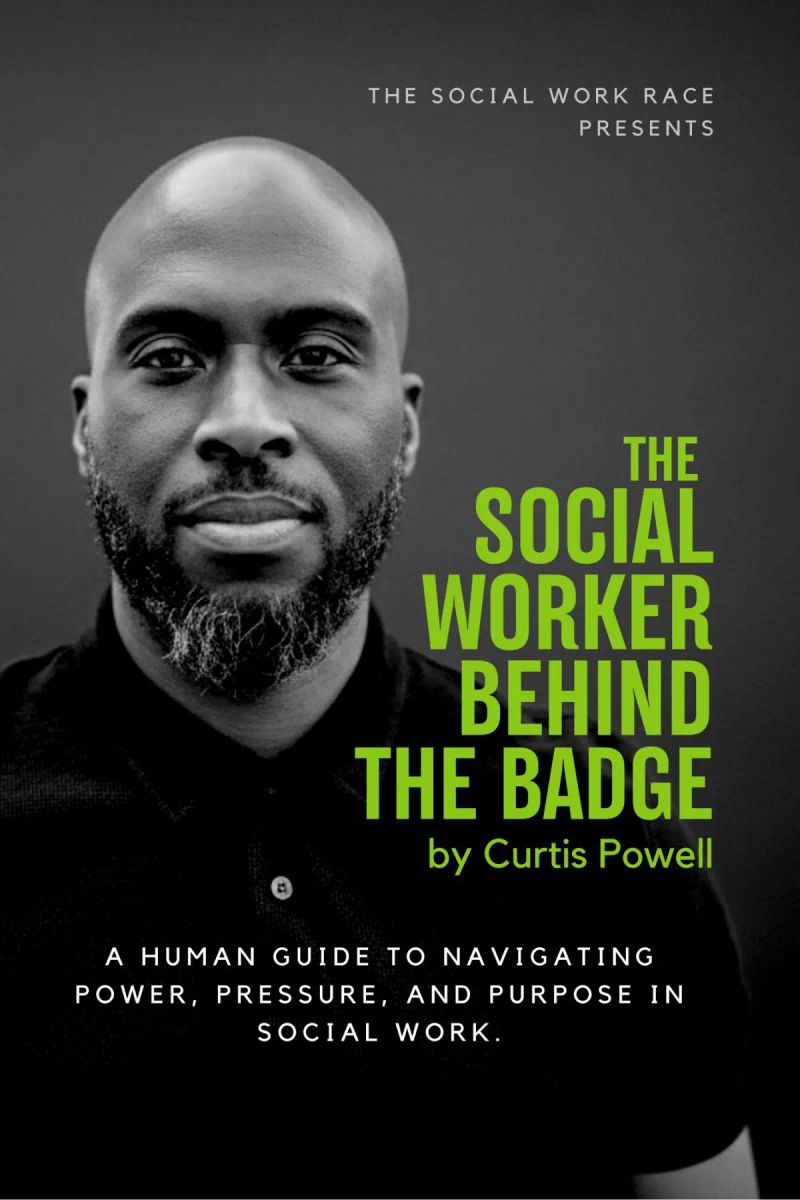
The Social Worker Behind The Badge
A human guide to navigating power, pressure, and purpose in social work.By Curtis Powell


Length3h 39m
About this audiobook
"The Social Worker Behind the Mask" is a practical guide for social workers navigating the emotional, ethical, and systemic challenges of modern practice. Written by Curtis Powell, a frontline UK social worker, it bridges academic training and real-world experience.
The book covers burnout and resilience, avoiding the saviour complex, managing disguised compliance, preventing unnecessary escalation, confronting structural racism, using AI responsibly, and maintaining professional identity. Powell introduces the G.U.I.D.E model for authentic family engagement and emphasizes relationship-centered practice.
Including raw family testimony, real case examples, and reflective questions, this survival guide offers tools and honesty to help social workers stay grounded, effective, and compassionate—revealing the human behind the mask.
Audiobook details
GenreEducation and Learning, Politics and Government
Length3 hrs 39 mins
Narrated byListen with 1,000+ voices
FormateBook with Audio
Publish dateFeb 8, 2026
LanguageEnglish
Table of contents
1Introduction
2Chapter 1: Charting Your Path: Visualising Your Social Work Journey
3Chapter 2: Burnout and Resilience
4Chapter 3: "Know Your Lane: What Social Workers Are (And Aren't)"
5Chapter 4: The True Power and Necessity of Reflective Practice
Show all chaptersShow less
6Chapter 5: A lesson to Stay Curious and Rigorous
7Chapter 6: The Language Barrier
8Chapter 7: The GUIDE Model
9Chapter 8: The Chocolate on the Face: Breaking Through Disguised Compliance
10Chapter 9: The Unnecessary Escalation of Cases
11Chapter 10: The Role of AI in Social Work Practice
12Chapter 11: From Slavery to Social Work: Understanding Structural Racism in Practice
13Chapter 12: Comments from Families on my Social Media
14Chapter 13: Sneak Peek into my DM’s. The following poem and direct message were sent to me during a time when the comments section was particularly intense, and they left a lasting impression. One of the reasons I’ve chosen to engage with the public on social media is to create space for social work to be better understood—especially by parents and families. Of course, not everyone will be open to that. At times, the responses can be deeply critical, even abusive. Over time, I’ve developed a thicker skin to withstand the backlash, and while it’s helped build resilience, it’s certainly not the easiest or gentlest way to grow. It can feel like an emotional rollercoaster—navigating between harsh judgment and heartfelt connection. But every now and then, someone reaches out with words that cut through the noise and offer something grounding. This poem was one of those moments, a reminder of why I continue to show up. “I wanted to thank you for your TikTok on communication I watched today. I was in care for quite a few years as a child & up to 18, I'm now 50. It was not until my later years that, with research in to my past that I became aware that not a lot of communication was done within my family and with social services to the extent that I now have severe CPTSD, not just because of the system but the choices I made in and out of care. I do believe with more communication and work with helping families understand what is actually going on with meetings, visits etc., the whole process wouldn't have been so hostile, and although it was the right thing for me not to be at home, I feel there was no encouragement for reconciliation with family or friends. Growing up with a feeling of no foundation and a feeling of not being wanted or needed with the added factors of abuse in care made me strong but in a way of never putting myself first and although I swore there would never be a reason for social services to be involved in my life, and they never have, I always wondered how things would have been if more communication was done in my family with social services. Maybe nothing but the communication could have been passed to me from my family and I could of had a greater understanding of how and why things went so wrong. So yes in your video it is so important for the communication to parents of what's going on, process and meetings and a lot of talking it also affects the children in the long term. There used to be a sense of hate towards social services and still is from some because you are different and your videos have helped me understand some things from my past. I was vigilant when my kids were growing up about no sleepovers ect and my strict but fair attitude of parenting was my way and I have 3 grown fantastic caring people raised by myself. So anyway thank you for explaining why and how you work and communicate in your TikToks.” I want to share a poem with you now. The words themselves are not mine to change. What I have done is gently adjust the grammar and structure so it can be heard clearly and flow naturally when spoken aloud, while keeping every word exactly as it was written. “A Poem About Being a Social Worker They don't see the nights I lie awake, worrying about choices that I need to make. They don't hear the cries, those desperate pleas, the pain that lingers, the silent grief. They don't see the battles fought every day, to keep a child safe, to find a way to heal the wounds they cannot see, to break the chains of history. I walk into homes filled with despair, where love exists, but so does fear, where parents try, but life is cruel, with poverty and trauma set the rules. I am not the villain they make me out to be; I do not wield my power carelessly. I see the broken, I see the lost, I see the weight of every cost. And though the world may turn away, I'll keep fighting anyway. For every child who needs a voice, for every family who has no choice. So judge me if you think you must, but I will not betray this trust. I do this job because I care, because someone, somewhere, must be there.”
15Chapter 14: The Management Mirror
16Chapter 15: Closing Remarks
17Acknowledgments

A Brief History of IntelligenceMax S. Bennett12h 18m4.6 (6.6K)$29 · $0.00

HomeschooledStefan Merrill Block7h 10m3.6 (18.5K)$28 · $0.00

How We ThinkJohn Dewey7h 6m4.0 (1.1K)Free

EducationEllen G. White9h 41m4.6 (1.5K)$2 · $0.00

Parents and Children (Annotated)Charlotte Mason9h 23m4.6 (988)$2 · $0.00

Children Under FireJohn Woodrow Cox10h 17m4.5 (1.6K)$29 · $0.00

The State Must ProvideAdam Harris7h 15m4.5 (775)$24 · $0.00

The Call of the Wild and FreeAinsley Arment9h 7m4.4 (21.2K)$29 · $0.00

The Freelance WayRobert Vlach19h 48m4.5 (528)$40 · $0.00

Race to the BottomLuke Rosiak9h 20m4.5 (600)$29 · $0.00

They Came for the SchoolsMike Hixenbaugh9h 5m4.5 (2.6K)$8 · $0.00

Find Me UnafraidKennedy Odede, Jessica Posner11h 11m4.5 (2.7K)$29 · $0.00

Asking for ItKate Harding8h 55m4.4 (5.3K)$20 · $0.00
Defining Moments in Black HistoryDick Gregory7h 37m4.4 (6K)$26 · $0.00

The Emerald Tablets of Thoth the AtlanteanMaurice Doreal3h 4m4.4 (8.8K)$6 · $0.00

Learning AmericaLuma Mufleh6h 37m4.4 (564)$24 · $0.00

Math-ishJo Boaler7h 21m4.4 (588)$24 · $0.00
It Worked For MeColin Powell7h 42m4.3 (9.8K)$26 · $0.00

Little SoldiersLenora Chu11h 30m4.3 (3.1K)$29 · $0.00

Financial FeministTori Dunlap8h 3m4.2 (22.2K)$8 · $0.00

Unbroken Bonds of BattleJohnny Joey Jones8h 31m4.6 (2.6K)$8 · $0.00

On Democracies and Death CultsDouglas Murray10h 38m4.6 (6.5K)$29 · $0.00

Balcony Over Jerusalem: A Middle East Memoir - Israel, Palestine and BeyondJohn Lyons12h 37m4.6 (1.4K)$33 · $0.00

RiggedMollie Hemingway12h 48m4.6 (4.2K)$23 · $0.00

SledgehammerDavid Friedman8h 21m4.7 (589)$26 · $0.00

Citizenship in a Republic (Annotated)Theodore Roosevelt2h 44m4.6 (1.4K)$2 · $0.00

No EscapeNury Turkel9h 30m4.6 (809)$28 · $0.00

Always FaithfulThomas Schueman, Zainullah Zaki12h 12m4.6 (977)$29 · $0.00

UnthinkableJamie Raskin15h 8m4.5 (9.3K)$8 · $0.00

My Fourth Time, We DrownedSally Hayden13h 59m4.6 (2.9K)$23 · $0.00

A Revolution of Common SenseScott Jennings9h 29m4.6 (528)$29 · $0.00

Statement From the Dock at the Rivonia TrialNelson Mandela2h 18m4.6 (1.3K)$1 · $0.00

Lessons from the EdgeMarie Yovanovitch17h 11m4.5 (5.9K)$40 · $0.00

To Rescue the American SpiritBret Baier10h 12m4.5 (2.7K)$8 · $0.00

StonewalledSharyl Attkisson15h 19m4.5 (4.3K)$33 · $0.00
The World According to Orwell: 1984 & Animal FarmGeorge Orwell15h 42m4.6 (1.1K)$1 · $0.00

Basic EconomicsThomas Sowell18h 32m4.5 (29.3K)$28 · $0.00

To Rescue the RepublicBret Baier, Catherine Whitney11h 42m4.5 (8.6K)$29 · $0.00

Modern WarriorsPete Hegseth7h 10m4.5 (4.7K)$24 · $0.00

Philosophy and Opinions of Marcus Garvey (Annotated)Marcus Mosiah Garvey4h 42m4.5 (1.7K)$1.99 · $0.00
You may also like

CoventryRachel Cusk7h 30m3.8 (4.5K)$17

Inverse CowgirlAlicia Roth Weigel6h 31m4.1 (1.7K)$24 · $0.00

Sure of YouArmistead Maupin3h4.2 (12.9K)$18 · $0.00
GratefulDiana Butler Bass7h 51m4.1 (1.8K)$26 · $0.00

John Lennon: The LifePhilip Norman12h 51m4.3 (13.3K)$33 · $0.00

Walking in My JoyJenifer Lewis7h 27m4.4 (2.7K)$24 · $0.00

Broad StrokesBridget Quinn5h 29m4.3 (2.7K)$20

Cult TripAnke Richter9h 34m4.3 (1.1K)$29 · $0.00

Frida KahloGerry Souter3h 25m4.1 (1.3K)$13 · $0.00

The Silver SpoonJohn Galsworthy9h 41m4.1 (3.3K)$20

A God in RuinsLeon Uris6h 6m3.7 (4K)$24 · $0.00

The Dance of ConnectionHarriet Lerner7h 5m4.2 (5.9K)$24 · $0.00

The Dance of ConnectionHarriet Lerner4h 39m4.3 (5.5K)$20 · $0.00

Frida Kahlo and artworksGerry Souter1h 27m4.1 (515)$15 · $0.00

MeridianAlice Walker7h 52m3.9 (8.1K)$26 · $0.00

Mr. Cutten's RevoltPeter B. Kyne1h 40m$1 · $0.00
The DeceptionsJill Bialosky7h 58m3.5 (607)$20 · $0.00

Man in ArmourSiobhan McKenna11h 10m3.7 (182)$29 · $0.00
Fake LoveNova Gibson8h 59m4.4 (231)$29 · $0.00

Energy VampiresDan Desmarques2h 21m4.2 (5) Only with Ultra