
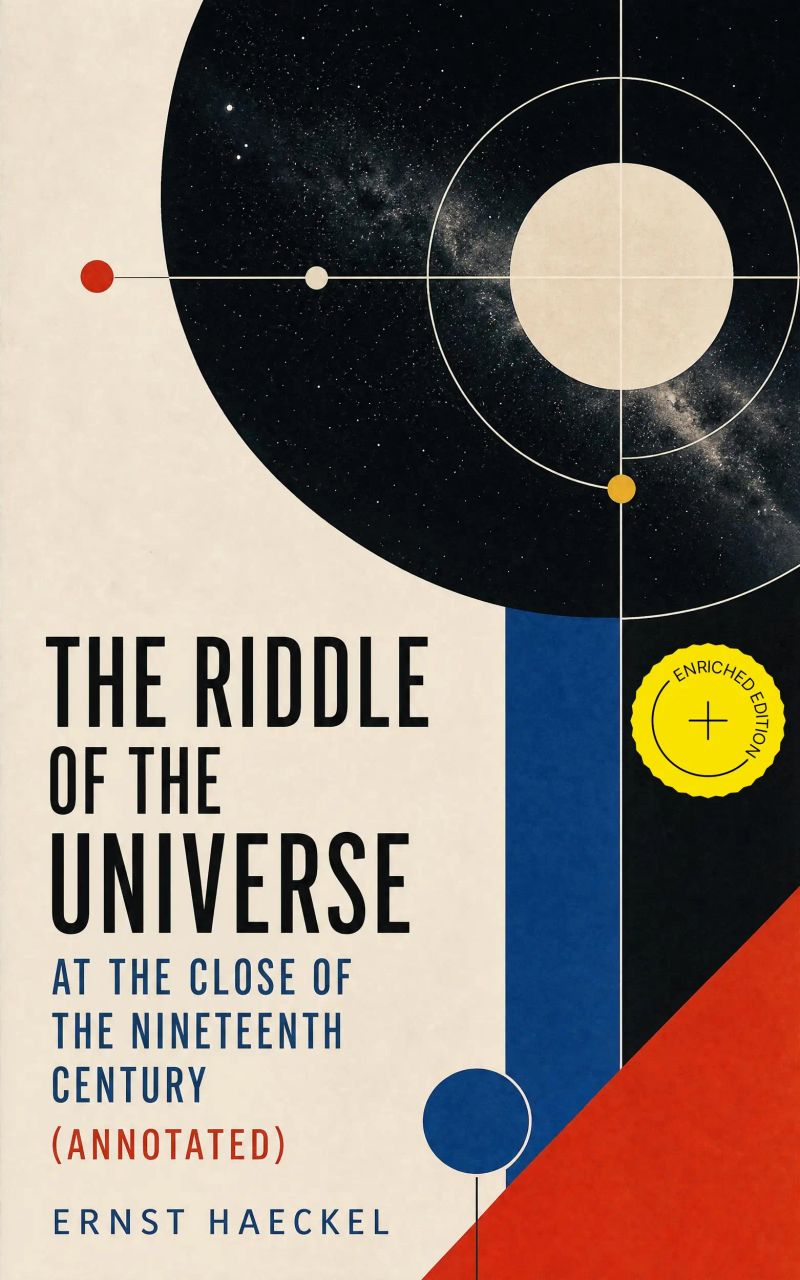
The Riddle of the Universe at the close of the nineteenth century (Annotated)
Enriched Edition. Monist Philosophy, Evolutionary Science, and the Secular Challenge to ReligionBy Ernst Haeckel

Length12h 43m
About this audiobook
In The Riddle of the Universe at the Close of the Nineteenth Century, Ernst Haeckel offers a sweeping monistic interpretation of nature, mind, ethics, and religion in light of evolutionary science. Written in a lucid, polemical, and encyclopedic style, the book seeks to dissolve traditional metaphysical dualisms by grounding life and consciousness in matter and natural law. It belongs to the fin-de-siècle tradition of grand scientific syntheses, where Darwinism, positivism, and secular humanism challenged inherited theological worldviews. Haeckel, a German zoologist, comparative anatomist, and influential popularizer of Darwin, brought to this work the authority of a scientist deeply engaged with embryology, morphology, and evolutionary theory. His doctrine of monism reflected both his biological research and his philosophical ambition to unify all knowledge under a single naturalistic framework. The book also bears the imprint of late nineteenth-century debates over materialism, church authority, and the cultural meaning of science. This volume is recommended to readers interested in the history of evolutionary thought, the philosophy of science, and modern secularism. Though some scientific claims are dated, its intellectual boldness remains indispensable for understanding how science became a worldview.
This enriched edition has been carefully crafted to add value to your reading experience.
- A succinct Introduction situates the work's timeless appeal and themes.
- The Synopsis outlines the central plot, highlighting key developments without spoiling critical twists.
- A detailed Historical Context immerses you in the era's events and influences that shaped the writing.
- A thorough Analysis dissects symbols, motifs, and character arcs to unearth underlying meanings.
- Reflection questions prompt you to engage personally with the work's messages, connecting them to modern life.
- Hand‐picked Memorable Quotes shine a spotlight on moments of literary brilliance.
- Interactive footnotes clarify unusual references, historical allusions, and archaic phrases for an effortless, more informed read.
Audiobook details
GenrePhilosophy
Length12 hrs 43 mins
Narrated byListen with 1,000+ voices
FormateBook with Audio
Publish dateNov 23, 2023
LanguageEnglish
Table of contents
1The Riddle of the Universe at the close of the nineteenth century (Annotated)
2Introduction
3Synopsis
4Historical Context
5PREFACE
Show all chaptersShow less
6CHAPTER I THE NATURE OF THE PROBLEM
7CHAPTER II OUR BODILY FRAME
8CHAPTER III OUR LIFE
9CHAPTER IV OUR EMBRYONIC DEVELOPMENT
10CHAPTER V THE HISTORY OF OUR SPECIES
11CHAPTER VI THE NATURE OF THE SOUL
12CHAPTER VII PSYCHIC GRADATIONS
13CHAPTER VIII THE EMBRYOLOGY OF THE SOUL
14CHAPTER IX THE PHYLOGENY OF THE SOUL
15CHAPTER X CONSCIOUSNESS
16CHAPTER XI THE IMMORTALITY OF THE SOUL
17CHAPTER XII THE LAW OF SUBSTANCE
18CHAPTER XIII THE EVOLUTION OF THE WORLD
19I.—MONISTIC COSMOGONY
20II.—MONISTIC GEOGENY
21III.—MONISTIC BIOGENY
22IV.—MONISTIC ANTHROPOGENY
23CHAPTER XIV THE UNITY OF NATURE
24CHAPTER XV GOD AND THE WORLD
25I.—THEISM
26II.—PANTHEISM
27CHAPTER XVI KNOWLEDGE AND BELIEF
28CHAPTER XVII SCIENCE AND CHRISTIANITY
29I.—PRIMITIVE CHRISTIANITY
30II.—PAPAL CHRISTIANITY
31III.—THE REFORMATION
32IV.—THE PSEUDO-CHRISTIANITY OF THE NINETEENTH CENTURY
33CHAPTER XVIII OUR MONISTIC RELIGION
34CHAPTER XIX OUR MONISTIC ETHICS
35CHAPTER XX SOLUTION OF THE WORLD-PROBLEMS
36I.—PROGRESS OF ASTRONOMY
37II.—PROGRESS OF GEOLOGY
38III.—PROGRESS OF PHYSICS AND CHEMISTRY
39IV.—PROGRESS OF BIOLOGY
40V.—PROGRESS OF ANTHROPOLOGY
41CONCLUSION
42Analysis
43Reflection
44Memorable Quotes
More from Ernst Haeckel

Natur & MenschErnst Haeckel6h 31m$1 · $0.00
Last Words on Evolution: A Popular Retrospect and SummaryErnst Haeckel3h 9m$2 · $0.00

Les énigmes de l'UniversErnst Haeckel17h 30m3.6 (179)$1 · $0.00

The Last Link: Our Present Knowledge of the Descent of ManErnst Haeckel3h 40m$2 · $0.00
The History of CreationErnst Haeckel26h 8m4.0 (173)$1.99 · $0.00

Natur und Mensch (Illustriert) (Kommentiert)Ernst Haeckel6h 27m$1 · $0.00
Freedom in Science and Teaching. from the German of Ernst HaeckelErnst Haeckel3h 21m$2 · $0.00

Die WelträtselErnst Haeckel11h 40m3.8 (320)$2 · $0.00

The History of Creation (Vol.1&2) (Annotated)Ernst Haeckel26h 4m4.6 (14)$0.99 · $0.00

IlluminationsWalter Benjamin10h 12m4.4 (16.2K)$20 · $0.00

That Bird Has My WingsJarvis Jay Masters9h 49m4.4 (13.7K)$29 · $0.00

Tâo Teh KingLaozi2h 34m4.4 (230.9K)$2 · $0.00
SymposiumPlato3h 26m4.4 (97.9K)$1.20 · $0.00

Buddhist Boot CampTimber Hawkeye2h 39m4.4 (8.4K)$18 · $0.00
Enchiridion & The Discourses of Epictetus (Annotated)Arrian Epictetus18h 9m4.4 (3.5K)$2 · $0.00

The Meditations of the Emperor Marcus Aurelius AntoninusEmperor of Rome Marcus Aurelius5h 41m4.4 (1.8M)$1 · $0.00

Crime and PunishmentFyodor Dostoevsky23h 11m4.4 (1.3M)$12 · $0.00

MeditationsMarcus Aurelius5h 52m4.4 (433.7K)$1 · $0.00

Everyday DharmaSuneel Gupta5h 2m4.5 (761)$20 · $0.00
The Joyful Wisdom ("La Gaya Scienza")Friedrich Wilhelm Nietzsche11h 37m4.4 (26.6K)$1 · $0.00
The Art of LivingEpictetus, Sharon Lebell3h 16m4.4 (50.1K)$18 · $0.00
MeditationsEmperor Of Rome Marcus Aurelius7h 23m4.3 (477.5K)$1.20 · $0.00

The Imitation of ChristThomas à Kempis6h 27m4.3 (84.6K)$21 · $0.00

Sadhana: the realisation of lifeRabindranath Tagore3h 49m4.4 (8.6K)$6 · $0.00
SapiensYuval Noah Harari15h 18m4.3 (1.4M) · 1280$33 · $0.00

You BelongSebene Selassie8h 35m4.4 (2.7K)$26 · $0.00

The Song Celestial; Or, Bhagavad-Gîtâ (from the Mahâbhârata)Anonymous2h 18m4.4 (3.2K)$2 · $0.00

The KybalionThe Three Initiates3h 47m4.3 (58.7K)$20 · $0.00

Chuang Tzu: Mystic, Moralist, and Social ReformerZhuangzi14h 42m4.4 (1.2K)$1 · $0.00
You may also like

Beyond Good and EvilFriedrich Nietzsche7h 5m4.2 (155.1K)$1.20 · $0.00
Leonardo da Vinci: Thoughts on Art & LifeLeonardo da Vinci6h 48m4.1 (1.5K)$1.99 · $0.00
The Evolution of EverythingMatt Ridley13h 10m4.0 (4.9K)$33 · $0.00

WaldenHenry David Thoreau10h 26m3.9 (241.4K)$17 · $0.00
The Mystique of EnlightenmentU. G. Krishnamurti7h 50m4.3 (435)$1.99 · $0.00

WaldenHenry David Thoreau13h 32m3.9 (237.8K)$5 · $0.00

Walden and On the Duty of Civil DisobedienceHenry David Thoreau13h 51m4.1 (58.2K)$25

The Essential Henry David Thoreau (Illustrated Collection of the Thoreau's Greatest Works) (Annotated)Henry David Thoreau89h 20m4.2 (1.1K)$2 · $0.00

Walden, Walking & Civil Disobedience (Including The Life of Henry David Thoreau)Henry David Thoreau15h 8m4.2 (2.9K)$1.99 · $0.00

Civil Disobedience & Other Essays - Premium Collection (Annotated)Henry David Thoreau18h 53m4.2 (379)$2 · $0.00
A Discourse Upon the Origin and the Foundation of the Inequality Among MankindJean-Jacques Rousseau2h 53m4.0 (24.1K)$2.30

DiscourseDescartes2h 24m4.0 (71.5K)$2.30

WomanNatalie Angier18h 41m4.1 (5.4K)$30 · $0.00

O'KeeffeJanet Souter1h 33m4.3 (1.4K)$13.50 · $0.00
On the Relations of Man to the Lower AnimalsThomas Henry Huxley2h 4m$2 · $0.00
The evolution of PhilosophyRudolf Steiner8h 55m4.3 (144)$5.10 · $0.00

Claude Monet: Vol 1Nathalia Brodskaïa, Nina Kalitina3h 55m$18 · $0.00

Claude Monet: Vol 1Nathalia Brodskaïa, Nina Kalitina4h$18 · $0.00
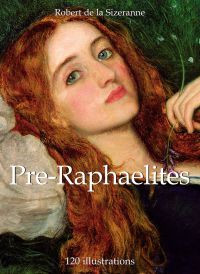
Pre-Raphaelites 120 illustrationsRobert de la Sizeranne1h 42m3.6 (75)$15 · $0.00

Rousseau and RomanticismIrving Babbitt12h 36m4.4 (45)$1 · $0.00