
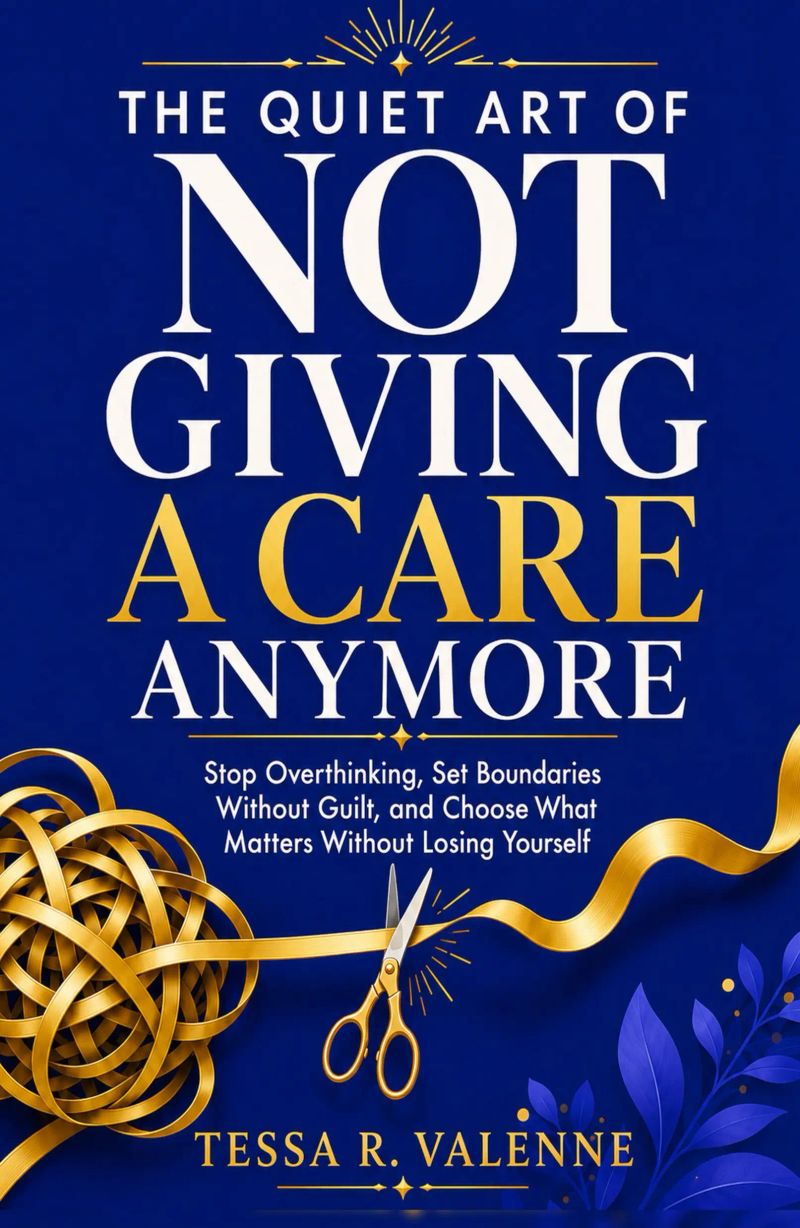
The Quiet Art of Not Giving a Care Anymore
Stop Overthinking, Set Boundaries Without Guilt, and Choose What Matters Without Losing YourselfBy Tessa R. Valenne

Length5h 46m
About this audiobook
YOU SAID YES AGAIN. SOMETHING IN YOU WENT QUIET.
It is 9:42 p.m., and your phone is still in your hand.
You are rewriting a message so nobody thinks you are rude, selfish, difficult, or ungrateful. You have already agreed to something you do not have the time, energy, or desire to carry. Now resentment is rising, guilt is talking, and your own needs have disappeared from the room.
The Quiet Art of Not Giving a Care Anymore is for burned-out women and sensitive adults who care deeply, overthink every reaction, and feel guilty each time they try to say no.
Your problem is not kindness. Your problem is the belief that love must be proved through constant availability, emotional labor, apology, and self-erasure.
Instead of telling you to become colder, tougher, or more detached, Tessa R. Valenne offers a calmer path:
Boundaries for people who feel bad having boundaries.
Through the practical Quiet Care Method, you will learn to:
• Notice the false care that makes other people’s moods feel like your responsibility
• Name the real cost in lost time, sleep, peace, confidence, and identity
• Choose the true care that reflects your values, health, relationships, and priorities
• Speak the quiet boundary without panic, long explanations, or unnecessary apologies
You will find clear scripts for family, work, friendship, and romantic relationships. You will learn how to stop replaying difficult conversations, respond to guilt trips and silent treatment, handle negotiation and pushback, and recover from the emotional discomfort that often follows an honest no.
This book gives you what much boundary advice leaves out: what to say, what to do next, and how to survive the guilt afterward.
You can care about people without carrying every feeling they bring to you.
You can disappoint someone without becoming a bad person.
You can protect your time without defending your goodness.
You can rest before your body forces you to stop.
Your life does not need a louder version of you. It needs a version of you who no longer disappears.
Stop handing your life to the loudest reaction in the room. Get your copy today and start choosing what deserves your care before another automatic yes costs you another piece of yourself.
Audiobook details
GenreSelf-Help
Length5 hrs 46 mins
Narrated byListen with 1,000+ voices
FormateBook with Audio
LanguageEnglish
Table of contents
1Introduction
2Dedication
3A Note Before You Begin
4Introduction: The Weight You Call Love
5How to Use This Book
Show all chaptersShow less
6Without Turning It Into Another Assignment
7What Progress May Look Like
8Part One: The Cost of Caring About Everything
9Chapter One: The Good One's Exhaustion
10The Job Nobody Hired You For
11The Real Name for This Work
12Why Their Mood Becomes Yours
13The Bill Comes Due Somewhere
14The Three-Part Cost You Can Already Feel
15Kind Is Not the Same as Available
16The Day That Looks Fine From the Outside
17The First Signs That the Role Is Running You
18The Good-One Day, Hour by Hour
19A Two-Minute Exhaustion Check
20Chapter Two: Where the Guilt Learned Your Name
21Nobody Is Born Apologizing
22The Conformity Built Into You
23The Attachment Blueprint
24The Good Girl Ledger
25Guilt Is Not the Same as Responsibility
26Guilt's Older, Heavier Cousin
27Compassion Without Excuses
28When Old Guilt Borrows Moral Language
29When Guilt Gets Used as a Lever
30A Cleaner Way to Test Guilt
31The Five-Minute Guilt Reset
32Chapter Three: Your Mind on Replay
33The Waiter Who Remembered the Wrong Order
34Why “What If They Think I'm Rude” Never Ends
35Why “Just Stop Thinking About It” Backfires
36The Gendered Weight of Rumination
37The Worry About the Worry
38Interrupting the Loop
39The Replay Reset
40The Four Replay Triggers
41Why Midnight Makes It Worse
42The After-Text Practice
43When the Loop Is Asking for One Real Action
44Reflection Has an Exit
45The Body Door Out of the Mind
46A Replay Decision Tree
47When Closure Never Comes
48Part Two: The Quiet Care Method
49Chapter Four: Notice the False Care
50The Half-Second Before You Answer
Learning to PrayJames Martin13h 24m4.5 (3.4K)$33 · $0.00
Forever BoyKate Swenson9h 27m4.7 (5K)$29 · $0.00

You Are Worth ItKyle Carpenter, Don Yaeger8h 53m4.7 (4.8K)$29 · $0.00

The Happiest Man on EarthEddie Jaku3h 48m4.6 (178K)$7 · $0.00

Finding MeViola Davis9h 15m4.6 (256.4K)$29 · $0.00

Spiritual AnatomyDaaji Kamlesh D. Patel9h 47m4.7 (319)$29 · $0.00

The Dangerous Truth about Today’s MarijuanaLaura Stack CSP, MBA9h 57m4.7 (385)$20 · $0.00

The Gospel according to Spiritualism (Translated)Allan Kardec14h 39m4.6 (3.9K)$5.70 · $0.00

Birdie & HarlowTaylor Wolfe7h 50m4.6 (6.5K)$26 · $0.00

CrossroadsKaleb Dahlgren7h 56m4.6 (4.9K)$26 · $0.00

Life on the BridgeKaelynn Partlow5h 40m4.6 (1.1K)$24 · $0.00

Keep Your Love OnDanny Silk9h 4m4.6 (8.1K)$10 · $0.00
The Tao of Joy Every DayDerek Lin10h 24m4.6 (762)$20 · $0.00
UndividedVicky Beeching9h 2m4.6 (1.3K)$29 · $0.00

HE CAN WHO THINKS HE CAN & OTHER BOOKS ON SUCCESSOrison Swett Marden5h 54m4.6 (1.2K)$1.99 · $0.00
Level UpRob Dial7h 42m4.6 (3.3K)$26 · $0.00
Burn the HaystackJennie Young, PhD9h 30m4.6 (543)$29 · $0.00

ACRES OF DIAMONDS: Our Every-day Opportunities (Wisdom & Empowerment Series) (Annotated)Russell Conwell2h 26m4.6 (1K)$2 · $0.00

Good InsideBecky Kennedy9h 55m4.5 (59.3K)$29 · $0.00

The Lost VoiceGreta Morgan8h 30m4.7 (285)$26 · $0.00
You may also like

The Breastfeeding Book, Revised EditionMartha Sears RN, William Sears MD14h 4m4.3 (1.6K)$23 · $0.00

Men Are from Mars, Women Are from VenusJohn Gray1h 32m3.6 (223.1K)$16 · $0.00

The EnchiridionEpictetus0m4.4 (41.3K)$1 · $0.00
The Healthy Empathy WorkbookMindful Growth Press7h 11m$11.50 · $0.00
The Book of BurnoutBev Aisbett2h 9m3.1 (489)$16 · $0.00

Unveiling the Secrets of Baby Newborn Care SuperstarsAurora Brooks1h 20m$3.50 · $0.00
Wait, It Gets WorseLydia Slaby6h 33m$20 · $0.00
Dbt: Interpersonal Effectiveness and Distress Tolerance With Practical dbt Exercises (Practical dbt Skills to Build Emotional Permanence, Overcome Rsd, and Stop Spiraling in Relationships)Garry Corry2h 15m$3.50 · $0.00
Mastering Bipolar DisorderJason L Brown3h 52m$13 · $0.00

Emergency FundLuna Z. Rainstorm2h 31m$4.10 · $0.00

Let Love LeadJackson Michael48m5.0 (50) Only with Ultra

Common Mistakes to Avoid in Baby Newborn CareAurora Brooks1h 3m$3.50 · $0.00
Bipolar Disorder: Step by Step Techniques to Manage Bipolar Disorder (The Truth About Bipolar Disorder and How to Understand and Find the Best Ways to Gain Control)Mason g, Bruce Walters1h 54m$8.10 · $0.00

The Working Mom's Guide to Self-CareAurora Brooks58m$3.50 · $0.00

ADHS bei Frauen im FamilienalltagNora Elin Falken, Isabela Noemí Alvar7h 4m$11.50 · $0.00

It Begins with You Now: The WorkbookJillian Turecki1h 38m$29 · $0.00

Dad’s First 90 DaysDaphne O. Keane1h 54m$2.30 · $0.00

The Ultimate Checklist for Baby Newborn CareAurora Brooks1h 29m$3.50 · $0.00
Why We Should Focus on Emotional Resilience in ParentingAurora Brooks1h 6m$3.50 · $0.00
Unf#ck Your BusinessJoe Biel, Dr. Faith G. Harper2h 50m$15