
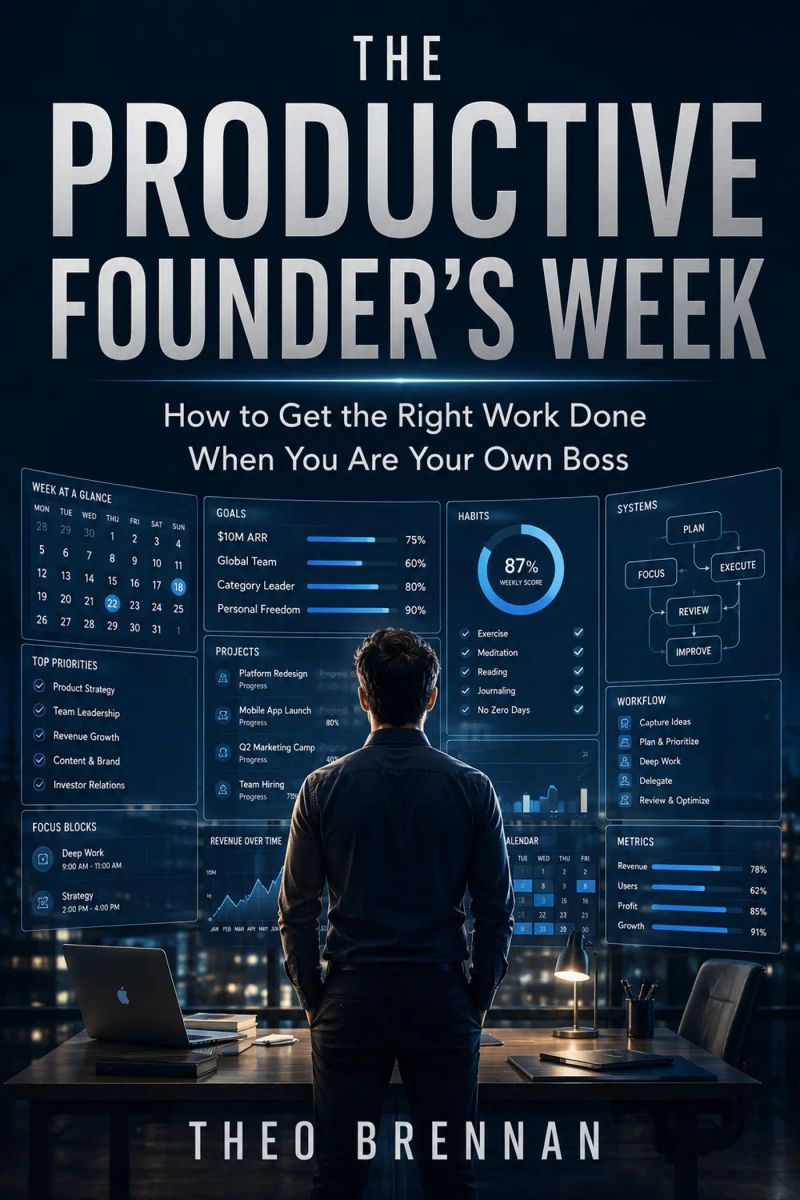
The Productive Founder's Week
How to Get the Right Work Done When You Are Your Own BossBy Theo Brennan


Length8h 12m
About this audiobook
Time management for entrepreneurs and self-employed founders, weekly planning, deep work, and energy management — from a founder who ran an agency for seven years, sold it, and has coached roughly four hundred solo founders through their weeks.
A founder named Priya, who runs a four-person product studio, sent Theo Brennan a message one Friday: "I read three productivity books this month and I'm getting less done than I was in March." The books weren't bad. They were written for someone with a manager, a team standing up at nine, a calendar populated by other people, and a paycheck that arrived whether or not she shipped anything. Priya had none of that. When you are self-employed, Monday is a blank field, and if you don't decide what to do this morning, no one else will decide for you.
This is a time management book for founders that throws out the corporate playbook. Brennan has been self-employed for twelve years and has watched roughly four hundred founders work through their weeks in detail. The difference between the ones thriving and the ones exhausted is rarely talent or luck. It is almost always structure: three to five weekly practices they can name, protect, and run without negotiation. The book is built on hard-earned opinions — the calendar is the source of truth, not the to-do list; a real week has three priorities, not ten; deep work happens in two-hour blocks, not eight-hour heroics; energy management beats time management; and rest is a load-bearing input, not a reward. Every chapter ends with a concrete "Try this" experiment you can run this week.
Inside this founder productivity book:
• Three priorities, not ten — Why ten priorities is no priorities, and how to design a week around three real ones with one two-hour deep work block assigned to each (Chapters 2 and 7)
• The calendar that actually holds — Treating the calendar as a commitment instead of a wish list, so the work that compounds gets a time and the rest stops pretending it will happen (Chapter 3)
• The two-hour deep work block — Run a single protected block Monday morning, defended like a religious observance, then repeat Tuesday until you can see what your whole week could be (Chapter 7)
• Saying no with no boss to hide behind — How to protect three time blocks a week from a world trying to take them when there is no manager to blame (Chapter 6)
• The Friday review that produces better Mondays — A forty-five-minute, four-section review run Friday afternoon so the week's transition is already done before Monday (Chapter 10)
• Energy management beats time management — The six leveraged inputs (sleep, food, movement, sunlight, social connection, recovery) most self-employed founders systematically under-invest in (Chapter 12)
• Rest, burnout recovery, and the hard day — How to save a day that's falling apart, recover from burnout, and treat rest as productive (Chapters 15, 16, and 19)
This is not a book about more tools or a more sophisticated task system. Most founders need fewer tools and a calendar that holds. Over a year, the compounding power of boring, well-structured weeks is what takes a business from where it is now to where you want it in two years — six hours of protected deep work a week, repeated, is enough to grow a business. The week, as Brennan writes, is the unit.
For readers of Cal Newport's Deep Work and Oliver Burkeman's Four Thousand Weeks: Time Management for Mortals.
Audiobook details
GenreBusiness and Economics, Self-Help
Length8 hrs 12 mins
Narrated byListen with 1,000+ voices
FormateBook with Audio
LanguageEnglish
Table of contents
1Appendix I — A Final Note on the Founders Who Don’t Make It 15 6
2Introduction — Why Most Productivity Advice Fails the Self- Employed
3Chapter 1 — The Founder’s Productivity Problem Is Not the Same Problem
4Chapter 2 — Designing a Week Around Three Real Priorities
5Chapter 3 — The Calendar as the Source of Truth (Not the To-Do List)
Show all chaptersShow less
6Chapter 4 — Time Blocks That Actually Hold
7Chapter 5 — The Morning Practice That Costs Twenty Minutes and Saves Hours
8Chapter 6 — Saying No When There’s No Boss to Hide Behind
9Chapter 7 — The Two-Hour Deep Work Block (and What Breaks It)
10Chapter 8 — Email and Slack: The Hidden Tax on Founder Productivity
11Chapter 9 — Meetings That Earn Their Place
12Chapter 10 — The Friday Review That Produces Better Mondays
13Chapter 11 — Quarterly Goals Without the Corporate Theater
14Chapter 12 — Energy Management Beats Time Management
15Chapter 13 — The Tools That Earn Their Place (and the Ones That Don’t)
16Chapter 14 — Delegating When the Team Is You and a Contractor
17Chapter 15 — The Hard Day: How to Save a Day That’s Falling Apart
18Chapter 16 — Rest as a Productive Activity
19Chapter 17 — Managing Procrastination on the Hard Project
20Chapter 18 — The Travel Week: Working Well From Somewhere Else
21Chapter 19 — Burnout Recovery and the Quarter That Saves the Year
22Chapter 20 — How a Year Adds Up: The Compounding Power of Boring Weeks
23Conclusion — The Week Is the Unit
24Appendix A — A Sample Week, Hour by Hour
25Appendix B — The Tools I Actually Use (and the Ones I’ve Tried and Stopped Using)
26Appendix C — Case Study One: Daniel, Solo Developer Reaching the Ceiling
27Appendix D — Case Study Two: Carla, Consultant Heading Toward Burnout
28Appendix E — Case Study Three: Mei, Studio Owner Scaling From One Person to Three
29Appendix F — Case Study Four: Ravi, Coach Building a Productized Offering
30Appendix G — Case Study Five: Hannah, Writer Whose Project Was Eating Her Year
31Appendix H — A Thirteen-Week Plan for Installing the Structure
32Appendix I — A Final Note on the Founders Who Don’t Make It
33Appendix J — Common Questions From Founders, Answered Directly
34Appendix K — A Note for Founders With Young Children at Home
35Appendix L — A Note on the Economic Cycle
36Appendix M — A Note on Health and the Body
37Appendix N — A Note on Money
38Appendix O — Case Study Six: Tomas, Designer Trapped in Revisions
39Appendix P — Case Study Seven: Lena, Newsletter Writer Who Couldn’t Sustain the Cadence
40Appendix Q — Case Study Eight: Rashid, Solo Lawyer Building Toward Partnership
41Appendix R — The Practice in Bad Seasons
42Appendix S — A Letter to the Founder Reading This at 3 a.m.
43Appendix T — Case Study Nine: Yuki, Course Creator Whose
44Appendix U — Case Study Ten: Pavel, Two-Founder Team Whose Roles Had Drifted
45Appendix V — Case Study Eleven: Imani, Therapist Building a Group Practice
46Appendix W — Case Study Twelve: Saul, Agency Owner Selling the Business
47Appendix X — A Note on When to Quit
48Appendix Y — Case Study Thirteen: Marcela, Bookkeeper Going From Per-Hour to Per- Month
49Appendix Z — Case Study Fourteen: Aleksey, Solo Founder Returning From a Long Burnout
50About the Author
More from Theo Brennan
Never Split the DifferenceChris Voss, Tahl Raz8h 7m4.4 (277.7K)$26 · $0.00
The Intelligent Investor Rev Ed.Benjamin Graham17h 48m4.3 (191.5K)$40 · $0.00
The Hard Thing About Hard ThingsBen Horowitz7h 57m4.2 (134.3K)$26 · $0.00
Boundaries for LeadersHenry Cloud7h 36m4.3 (3.6K)$26 · $0.00
BuildTony Fadell11h 5m4.5 (14.3K)$8 · $0.00
The Joys Of CompoundingGautam Baid17h 34m4.5 (2.5K)$18 · $0.00
Basic EconomicsThomas Sowell18h 32m4.5 (29.3K)$28 · $0.00

Poor Charlie’s AlmanackGrover Gardener, Charles T. Munger13h 9m4.5 (24.7K)$18 · $0.00

The Ambuja StoryNarotam Sekhsaria13h 59m4.5 (830)$33 · $0.00

The Secret Door to SuccessFlorence Scovel Shinn2h 25m4.5 (2.1K)$1.20 · $0.00

This Is Going to HurtAdam Kay5h 47m4.4 (444.7K)$24 · $0.00

Big TrustShadé Zahrai, Fayçal Sekkouah8h 36m4.6 (406)$26 · $0.00
The Intelligent Investor Third EditionBenjamin Graham, Jason Zweig20h4.4 (156.6K)$46 · $0.00

Bottle of LiesKatherine Eban14h 25m4.4 (12K)$33 · $0.00

The Antiracist Business BookTrudi Lebrón6h 10m4.6 (275)$17 · $0.00
The FormulaJoshua Robinson, Jonathan Clegg10h 41m4.4 (6.9K)$29 · $0.00

Let Them LeadJohn U. Bacon7h 10m4.5 (1.4K)$24 · $0.00

Secrets of the Millionaire MindT. Harv Eker5h 11m4.4 (301.4K)$24 · $0.00

The Person You Mean to BeDolly Chugh9h 6m4.4 (7.2K)$29 · $0.00
BoundlessNick Kostov, Sean McLain9h 17m4.5 (1.1K)$29 · $0.00
Learning to PrayJames Martin13h 24m4.5 (3.4K)$33 · $0.00

Forever BoyKate Swenson9h 27m4.7 (5K)$29 · $0.00

You Are Worth ItKyle Carpenter, Don Yaeger8h 53m4.7 (4.8K)$29 · $0.00

The Happiest Man on EarthEddie Jaku3h 48m4.6 (178K)$7 · $0.00

Finding MeViola Davis9h 15m4.6 (256.4K)$29 · $0.00

Spiritual AnatomyDaaji Kamlesh D. Patel9h 47m4.7 (319)$29 · $0.00

The Dangerous Truth about Today’s MarijuanaLaura Stack CSP, MBA9h 57m4.7 (385)$20 · $0.00
The Gospel according to Spiritualism (Translated)Allan Kardec14h 39m4.6 (3.9K)$5.70 · $0.00

Birdie & HarlowTaylor Wolfe7h 50m4.6 (6.5K)$26 · $0.00

CrossroadsKaleb Dahlgren7h 56m4.6 (4.9K)$26 · $0.00

Life on the BridgeKaelynn Partlow5h 40m4.6 (1.1K)$24 · $0.00

Keep Your Love OnDanny Silk9h 4m4.6 (8.1K)$10 · $0.00
The Tao of Joy Every DayDerek Lin10h 24m4.6 (762)$20 · $0.00
UndividedVicky Beeching9h 2m4.6 (1.3K)$29 · $0.00

HE CAN WHO THINKS HE CAN & OTHER BOOKS ON SUCCESSOrison Swett Marden5h 54m4.6 (1.2K)$1.99 · $0.00
Level UpRob Dial7h 42m4.6 (3.3K)$26 · $0.00

Burn the HaystackJennie Young, PhD9h 30m4.6 (543)$29 · $0.00

ACRES OF DIAMONDS: Our Every-day Opportunities (Wisdom & Empowerment Series) (Annotated)Russell Conwell2h 26m4.6 (1K)$2 · $0.00

Good InsideBecky Kennedy9h 55m4.5 (59.3K)$29 · $0.00

The Lost VoiceGreta Morgan8h 30m4.7 (285)$26 · $0.00
You may also like

Evolution Gone WrongAlex Bezzerides9h 13m4.1 (1.6K)$29 · $0.00

The road to Wigan PierGeorge Orwell7h 24m4.1 (30K)$4 · $0.00

The Book of WilliamPaul Collins6h 43m4.1 (682)$17
A Season on the WindKenn Kaufman8h 40m4.2 (963)$20

The Prairie TravelerRandolph B. Marcy7h 2m4.1 (527)$1 · $0.00

The Prairie Traveller, a Hand-book for Overland ExpeditionsRandolph Barnes Marcy, Richard Francis Burton6h 16m4.1 (446)$1 · $0.00
How to Make Money Flipping Used Restaurant Equipment - How to Assess Equipment, Transport and Repair Costs, and Resell to Local BusinessesJACK FLIPWELL1h 57m$7.80 · $0.00

Florida Motorcycle Permit & License Test Prep 2026/2027Tobias Vantreese10h 58m$15
The Cost of Doing NothingInvestor Ventures3h 29m5.0 (3)$19.99

Business Plan Handbook for Start-upsArthur Lämmle39m4.8 (12)$11 · $0.00

WISCONSIN MOTORCYCLE PERMIT EXAM PREP 2026–2027Tyler Knox8h 46m$10
How to Make Money Flipping Power Tools - How to Find Undervalued Tools, Test Batteries and Motors, and Increase Margins with Complete KitsJACK FLIPWELL8h 47m$7.90 · $0.00

Langenscheidt Audio-Sprachführer EnglischLangenscheidt-Redaktion58m$10 · $0.00

Human-Centric Mechanical DesignDana Whitcombe11h 42m$66

Managing Commercial Construction ProjectsAdaeze Nwachukwu14h 51m$55

ARIZONA MOTORCYCLE PERMIT EXAM PREP 2026–2027Tyler Knox7h 32m$10

Wisconsin Motorcycle Permit & License Test Prep 2026/2027Tobias Vantreese11h 8m$15

Don’t Retire BrokeRick Rodgers7h 20m3.9 (254)$20
Financially SpeakingMade for Success3h 31m4.4 (23)$14

North Carolina CDL Permit and Endorsement Test Prep 2026/2027Wendell Tollgard15h 13m$20