
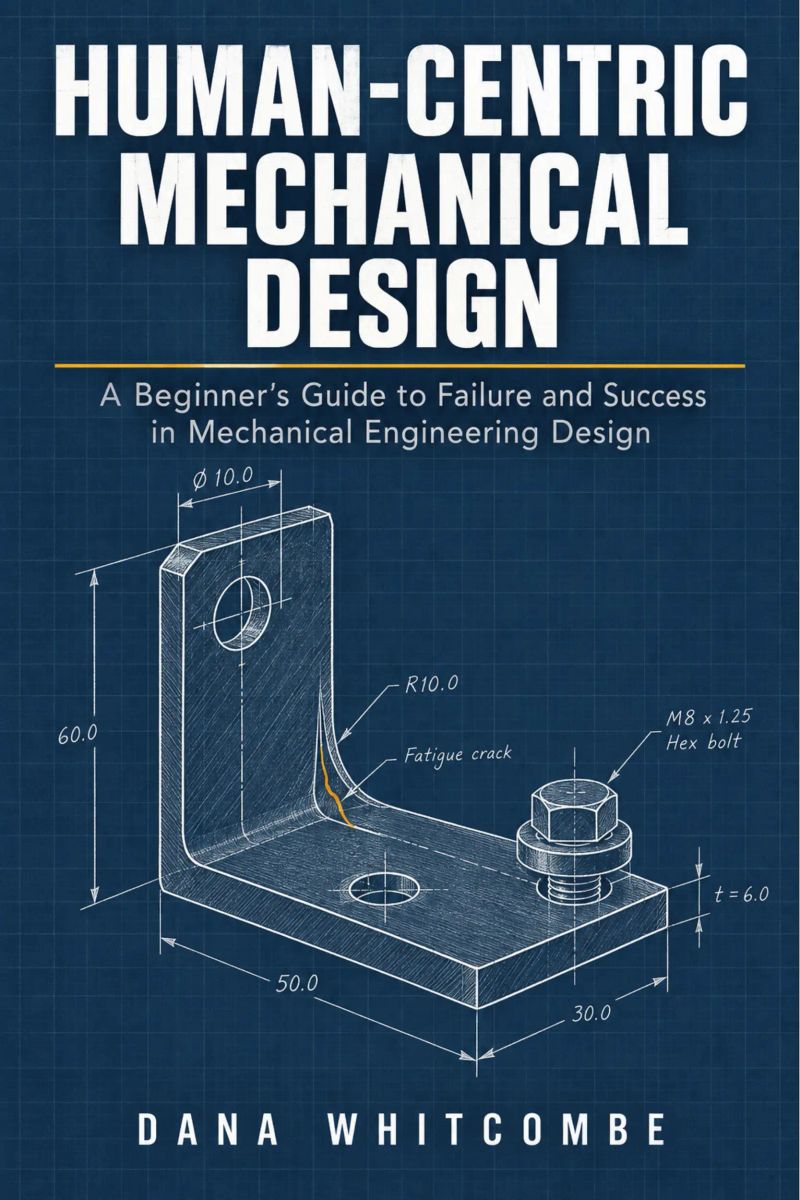
Human-Centric Mechanical Design
A Beginner's Guide to Failure and Success in Mechanical Engineering DesignBy Dana Whitcombe


Length11h 41m
About this audiobook
You can size a part correctly and still watch it break. This book shows you why.
Most mechanical engineering design texts teach you to calculate a stress and compare it to a strength. That approach works right up until it doesn't: a shaft that passes every static check cracks at a keyway after ten thousand cycles, a bracket that looked conservative buckles in service, a bolted joint that was torqued to spec loosens and leaks. Human-Centric Mechanical Design starts from the design loop that working engineers actually follow, then builds your judgement around the failure modes that cause real breakages: yielding, buckling, fatigue cracking at a notch, corrosion at a joint, and creep in a hot section.
Each technical idea is demonstrated on a component you could hold in your hand. You will work through factor-of-safety selection, S-N life estimates, crack-size limits, material property charts, tolerance stack-up, and bolt preload, seeing how each decision changes the hardware. Four famous failures are analysed in enough technical detail to identify the specific decision that caused them, not just the outcome. The final chapters turn that knowledge into practice: how to run a design review, what to document, and which tests actually verify a design rather than merely exercising it.
What you will learn:
• How the real design loop differs from the textbook version, and why iteration is the point
• How to recognise yielding, buckling, fatigue, corrosion, and creep before they choose your design for you
• How to select a factor of safety with a reason instead of a habit
• How to estimate component life from an S-N curve and set a crack-size limit
• How to read material property charts and choose a material for the failure mode you fear
• How to calculate tolerance stack-up and specify fits that can actually be manufactured
• How to set bolt preload and design joints, fasteners, and welds that stay tight
• How to run an FMEA and a design review that surface problems while they are still cheap to fix
• How to document and verify a design so the next engineer can trust it
Written for engineering students, apprentice designers, and technicians moving into design work, this guide assumes you can handle basic mechanics but does not assume you have ever had to defend a design decision. If you want to move from calculating parts to understanding why they succeed or fail, this book is your starting point.
Audiobook details
GenreTechnology
Length11 hrs 41 mins
Narrated byListen with 1,000+ voices
FormateBook with Audio
Publish dateSep 27, 2026
LanguageEnglish
Table of contents
1Foreword
2Preface
3About This Book
4Important Safety Notice
5Chapter 1: What Design Actually Is
Show all chaptersShow less
61.1 From Request to Requirement
71.2 The Design Loop and Its Iterations
81.3 Constraints, Trade Studies and the Design Space
91.4 Margins, Units and the Cost of Being Wrong
101.5 Documentation from Day One
11Chapter 2: How Parts Fail
122.1 Yielding and Permanent Deformation
132.2 Brittle Fracture and the Cost of Notch Sensitivity
142.3 Buckling and Instability
152.4 Wear, Fretting and Surface Damage
162.5 Corrosion and Environmental Attack
172.6 Creep and Elevated-Temperature Behavior
18Chapter 3: Loads, Stress and the Factor of Safety
193.1 Free-Body Diagrams and Load Paths
203.2 Stress, Strain and the Sections That Carry Them
213.3 Stress Concentration and Combined Loading
223.4 Allowable Stress Design and Choosing a Factor of Safety
233.5 Deflection, Stiffness and Serviceability Limits
24Chapter 4: Fatigue and Component Life
254.1 S-N Behavior and the Endurance Limit
264.2 Notches, Stress Concentration and Notch Sensitivity
274.3 Mean Stress and Fluctuating Loads
284.4 Cumulative Damage and Variable Amplitude Loading
294.5 Surface Finish, Residual Stress and Life Improvement
30Chapter 5: Fracture and Damage Tolerance
315.1 Crack Initiation, Growth and the Three Stages
325.2 Stress Intensity and Critical Crack Size
335.3 Leak-Before-Break and Damage-Tolerant Design
345.4 Inspection Intervals and Probability of Detection
35Chapter 6: Choosing Materials
366.1 Property Charts and Material Indices
376.2 Strength, Ductility and Toughness Trade-offs
386.3 Corrosion Resistance and Environmental Compatibility
396.4 Cost, Availability and Manufacturability
40Chapter 7: Tolerances, Fits and Manufacturability
417.1 Limits, Fits and the Tolerance Stack-Up
427.2 Geometric Dimensioning and Tolerancing in Practice
437.3 Designing for the Process That Makes the Part
447.4 Process Capability and Tolerance Allocation
45Chapter 8: Joints, Fasteners and Welds
468.1 Bolt Preload, Torque and Joint Stiffness
478.2 Gasketed Flanges and Leakage Control
488.3 Weld Types and Throat Sizing
498.4 Joint Fatigue and Preload Loss
508.5 Corrosion and Fretting at Joints

The Honey BusMeredith May9h 31m4.4 (16.6K)$25 · $0.00

Collected Writings of Nikola TeslaThomas Commerford Martin, Nikola Tesla19h 42m4.4 (2.8K)$1.99 · $0.00

Operation PedestalMax Hastings12h 29m4.4 (5.2K)$29 · $0.00

When the Heavens Went on SaleAshlee Vance18h 20m4.4 (3K)$40 · $0.00

Everybody Has a Podcast (Except You)Justin McElroy, Travis McElroy, Griffin McElroy5h 9m4.3 (2.3K)$24 · $0.00

Hands of TimeRebecca Struthers8h 8m4.4 (1.3K)$26 · $0.00

Never Lost AgainBill Kilday10h 1m4.4 (805)$29 · $0.00

How the Internet HappenedBrian McCullough13h 28m4.3 (2.7K)$23 · $0.00

Collected Writings of Nikola TeslaNikola Tesla, Thomas Commerford Martin21h 50m4.3 (1.7K)$1 · $0.00

Just AspireAjai Chowdhry9h 13m4.4 (260)$29 · $0.00

The Little Book of AliensAdam Frank8h 20m4.3 (1.3K)$26 · $0.00

The inventions, researches and writings of Nikola Tesla (Annotated)Thomas Commerford Martin16h 59m4.3 (1.3K)$2 · $0.00

KargilV.P. Malik15h 18m4.3 (2K)$24 · $0.00

Experiments with Alternating CurrentsNikola Tesla9h 16m4.3 (874)$1.99 · $0.00

Fire on the HorizonTom Shroder, John Konrad8h 23m4.3 (858)$26 · $0.00

The Smell of Kerosene (Annotated)National Aeronautics and Space Administration, Donald L. Mallick, Peter W. Merlin11h 32m4.3 (523)$2 · $0.00

The Boy Who Harnessed the WindWilliam Kamkwamba, Bryan Mealer10h 5m4.2 (78.9K)$29 · $0.00

Across the Airless WildsEarl Swift10h 8m4.3 (1.3K)$29 · $0.00

Console WarsBlake J. Harris20h 41m4.2 (13.7K)$46 · $0.00

Improvised Munitions HandbookU.S. Department of Defense4h 49m4.3 (1.6K)$1.99 · $0.00
You may also like

The road to Wigan PierGeorge Orwell7h 24m4.1 (30K)$4 · $0.00

The Book of WilliamPaul Collins6h 43m4.1 (682)$17

The Origin of SpeciesCharles Darwin14h 23m4.2 (163.7K)$9 · $0.00

Evolution Gone WrongAlex Bezzerides9h 13m4.1 (1.6K)$29 · $0.00

Travel words and phrases in FrenchJM Gardner1h 11m$7 · $0.00

The Productive Founder's WeekTheo Brennan8h 12m$11.50 · $0.00

North Carolina CDL Permit and Endorsement Test Prep 2026/2027Wendell Tollgard15h 13m$20

I am learning HindiJM Gardner3h 57m$18 · $0.00
How to Start a Profitable Pressure Washing BusinessJane Brooks5h 8m$5 · $0.00

Real Estate Investing for BeginnersTycho Press4h 15m3.8 (514)$15 · $0.00

The automobile owner's guideFrank B. Scholl8h 33m$2 · $0.00

ILLINOIS MOTORCYCLE PERMIT EXAM PREP 2026–2027Tyler Knox8h 35m$10

Plumbing Fixes for BeginnersImad Muratspahic3h 49m$11 · $0.00

I am learning IndonesianJM Gardner3h 56m$18 · $0.00

The Young CaptivesAnonymous5m$2 · $0.00

I am learning JapaneseJM Gardner3h 57m4.3 (19)$18 · $0.00

The Motorist's Companion: 5 Classic Automobile BooksH. Clifford Brokaw, Charles A. Starr, Charles Andrew Coey, The automotive business magazine Motor, Ford Motor Company, Frank B. Scholl40h 28m$1.99 · $0.00

Food Truck: How to Start and Grow Your Own Food Truck Business (How to Start a Mobile Food Business the Easy Way, From Business Plan and Startup to Profits and Scaling)Randy Jordon3h 15m$3.50 · $0.00

Managing Commercial Construction ProjectsAdaeze Nwachukwu14h 51m$55

Food Truck: Simple Strategic Plan to Build and Maintain a Successful Mobile Business (How to Start a Mobile Food Business the Easy Way, From Business Plan and Startup to Profits and Scaling)Joseph Lowry2h 3m$3.50 · $0.00