
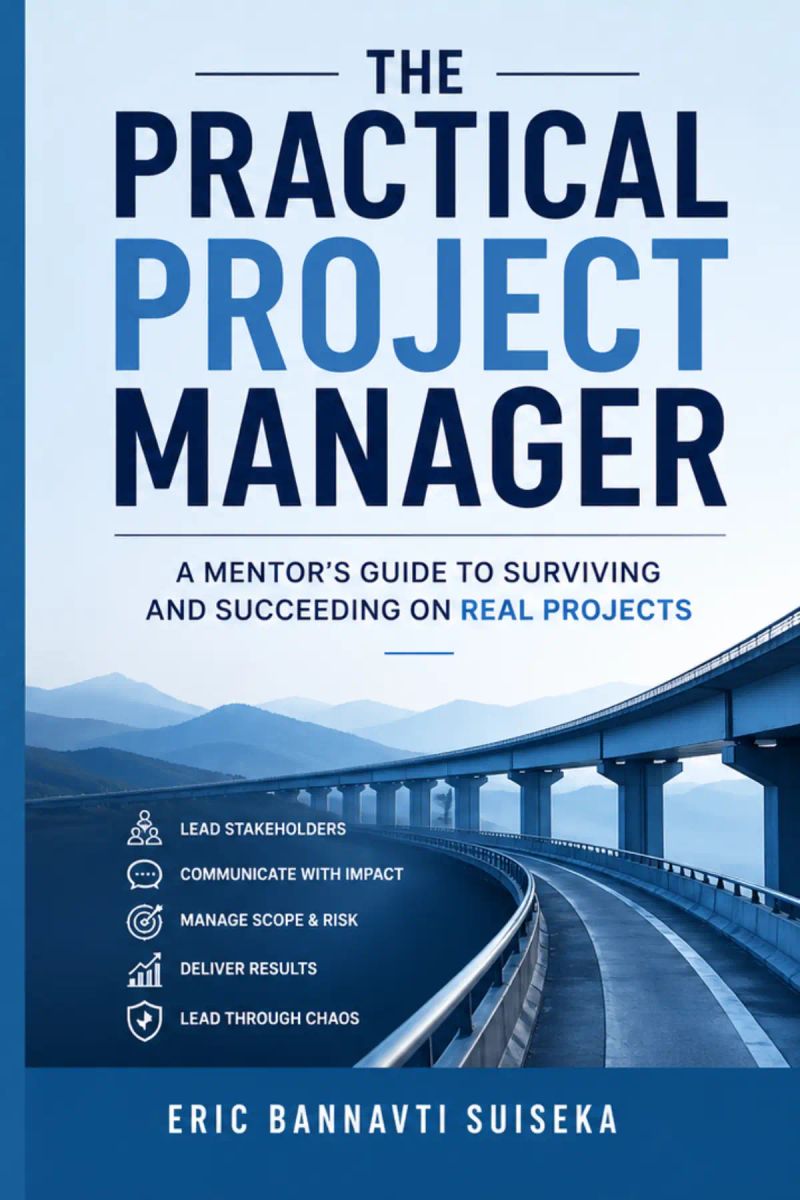
The Practical Project Manager
A Mentor’s Guide to Surviving and Succeeding on Real ProjectsBy Eric Bannavti Suiseka


Length1h 31m
About this audiobook
Project Management Isn’t About the Plan.
It’s About What Happens When the Plan Stops Working.
If you’ve ever managed a project that looked perfect on paper—but quickly fell apart in reality—this book is for you.
The Practical Project Manager is not another theory-heavy guide or certification manual. It’s a real-world, mentor-style playbook for professionals who want to succeed when projects get messy, stakeholders push back, and pressure rises.
Whether you’re already managing projects or preparing to step into the role, this book gives you what most training programs don’t: practical judgment, leadership clarity, and execution confidence.
Audiobook details
GenreTechnology, Education and Learning
Length1 hr 31 mins
Narrated byListen with 1,000+ voices
FormateBook with Audio
Publish dateAug 18, 2013
LanguageEnglish
Table of contents
1Introduction
2Why This Book Exists
3AUTHOR’S NOTE
4Chapter 1: So, You Want to Be a Project Manager
5The Job You Think You’re Signing Up For
Show all chaptersShow less
6What Project Management Really Is
7Why Certifications Don’t Prepare You for This
8The First Mindset Shift You Must Make
9What Experience Teaches You (Sometimes the Hard Way)
10A Word for Aspiring Project Managers
11A Word for Practicing Project Managers
12How to Use This Book
13Mentor’s Takeaway
14Chapter 2: The Gap Between Certification and Reality
15What Certifications Actually Do Well
16The First Reality Check: Projects Are Not Controlled Environments
17The Myth of the Perfect Plan
18Why “Following the Process” Isn’t Enough
19The Unspoken Skill: Judgment
20The Stakeholder Reality Certifications Gloss Over
21The Emotional Labor of the Role
22Closing the Gap Without Rejecting the Framework
23For Aspiring Project Managers: What to Do Now
24For Practicing Project Managers: Reframing the Role
25Mentor’s Takeaway
26Chapter 3: Why Projects Really Fail
27The Comfortable Lie About Tools
28The Most Common Root Causes of Project Failure
291. Lack of True Alignment
302. Unclear or Weak Sponsorship
313. Fear of Difficult Conversations
324. Overcommitment and Unrealistic Expectations
335. Decision Paralysis
34Why Blaming the Tool Feels Safe
35The Project Manager’s Real Levers
36A Practical Example
37What This Means for Aspiring Project Managers
38What This Means for Practicing Project Managers
39Mentor’s Takeaway
40Chapter 4: Thinking Like an Owner
41There is a moment in every Project Manager’s career when something becomes painfully clear:You can do everything you were asked to do—and still be seen as ineffective.
42The Coordinator Trap
43What It Means to Think Like an Owner
44Ownership Is About Accountability, Not Control
45How Owners See Risk Differently
46Ownership Changes How You Communicate
47The Courage to Challenge (Respectfully)
48The Difference Between Escalation and Ownership
49What Ownership Looks Like Day to Day
50A Reality Check for Aspiring Project Managers
More from Eric Bannavti Suiseka



Hands of TimeRebecca Struthers8h 8m4.4 (1.3K)$26 · $0.00
Never Lost AgainBill Kilday10h 1m4.4 (805)$29 · $0.00

How the Internet HappenedBrian McCullough13h 28m4.3 (2.7K)$23 · $0.00

Collected Writings of Nikola TeslaNikola Tesla, Thomas Commerford Martin21h 50m4.3 (1.7K)$1 · $0.00

Just AspireAjai Chowdhry9h 13m4.4 (260)$29 · $0.00

The Little Book of AliensAdam Frank8h 20m4.3 (1.3K)$26 · $0.00
The inventions, researches and writings of Nikola Tesla (Annotated)Thomas Commerford Martin16h 59m4.3 (1.3K)$2 · $0.00

KargilV.P. Malik15h 18m4.3 (2K)$24 · $0.00

Experiments with Alternating CurrentsNikola Tesla9h 16m4.3 (874)$1.99 · $0.00

Fire on the HorizonTom Shroder, John Konrad8h 23m4.3 (858)$26 · $0.00

The Smell of Kerosene (Annotated)National Aeronautics and Space Administration, Donald L. Mallick, Peter W. Merlin11h 32m4.3 (523)$2 · $0.00

The Boy Who Harnessed the WindWilliam Kamkwamba, Bryan Mealer10h 5m4.2 (78.9K)$29 · $0.00

Across the Airless WildsEarl Swift10h 8m4.3 (1.3K)$29 · $0.00

Console WarsBlake J. Harris20h 41m4.2 (13.7K)$46 · $0.00
Improvised Munitions HandbookU.S. Department of Defense4h 49m4.3 (1.6K)$0.99 · $0.00

Escaping GravityLori Garver10h 54m4.2 (2.2K)$20 · $0.00

Wireless WarsJonathan Pelson8h 2m4.3 (418)$20 · $0.00

Let There Be WaterSeth M. Siegel8h 36m4.2 (2.3K)$20 · $0.00

The PerfectionistsSimon Winchester11h 46m4.2 (9.9K)$29 · $0.00

Rethinking NarcissismDr. Craig Malkin6h 7m4.2 (3.4K)$24 · $0.00

A Brief History of IntelligenceMax S. Bennett12h 18m4.6 (6.6K)$29 · $0.00

HomeschooledStefan Merrill Block7h 10m3.6 (18.5K)$28 · $0.00

The State Must ProvideAdam Harris7h 15m4.5 (775)$24 · $0.00

The Call of the Wild and FreeAinsley Arment9h 7m4.4 (21.2K)$29 · $0.00
The Freelance WayRobert Vlach19h 48m4.5 (528)$40 · $0.00

Race to the BottomLuke Rosiak9h 20m4.5 (600)$29 · $0.00

They Came for the SchoolsMike Hixenbaugh9h 5m4.5 (2.6K)$8 · $0.00

Find Me UnafraidKennedy Odede, Jessica Posner11h 11m4.5 (2.7K)$29 · $0.00

Asking for ItKate Harding8h 55m4.4 (5.3K)$20 · $0.00
Defining Moments in Black HistoryDick Gregory7h 37m4.4 (6K)$26 · $0.00

The Emerald Tablets of Thoth the AtlanteanMaurice Doreal3h 4m4.4 (8.8K)$6 · $0.00

Learning AmericaLuma Mufleh6h 37m4.4 (564)$24 · $0.00

Math-ishJo Boaler7h 21m4.4 (588)$24 · $0.00

Daddy-Long-LegsJean Webster12h 18m4.2 (91K)$1.99 · $0.00
It Worked For MeColin Powell7h 42m4.3 (9.8K)$26 · $0.00

Little SoldiersLenora Chu11h 30m4.3 (3.1K)$29 · $0.00

Grammar-land; Or, Grammar in Fun for the Children of Schoolroom-shireM. L. Nesbitt2h 36m4.4 (488)$1 · $0.00

Financial FeministTori Dunlap8h 3m4.2 (22.2K)$8 · $0.00

DarkwaterWilliam Edward Burghardt Du Bois6h 40m4.3 (1.4K)$11 · $0.00

The Highway Code UKDepartment for Transport3h 33m4.2 (36.6K)$11 · $0.00
You may also like

An Enquiry Concerning Human UnderstandingDavid Hume5h 59m4.1 (29.2K)$2.30

The World as Will and Idea (Vol. 1 of 3)Arthur Schopenhauer20h 17m4.4 (519)$2.30

The Art of Money GettingP. T. Barnum1h 27m4.1 (7.5K)$4.70 · $0.00

Aesthetic IntelligencePauline Brown6h 57m4.0 (1.2K)$24 · $0.00
How to Master the Art of Selling Anything ProgramTom Hopkins10h 28m4.3 (179)$25
The Academy of Master ClosingTom Hopkins7h 45m4.6 (31)$40
The Art of Logical Thinking, or, The Laws of ReasoningWilliam Walker Atkinson3h 50m4.0 (287)$2.30

Insight OutTina Seelig5h 13m3.9 (570)$24 · $0.00

Blackboard DrawingFrederick Whitney25m4.2 (51)$2 · $0.00

The New Science of Healthy AgingScientific American6h 14m3.9 (265)$17

A Book of PrefacesH. L. Mencken7h 33m3.8 (67)$2 · $0.00

Public Speaking SuperstarMade for Success7h 25m3.6 (72)$30

CEO Communication SkillsMade for Success8h 59m3.8 (28)$20

How to Invest in Stocks for BeginnersJoylar B. James8h 32m$10

Business-Englisch lernen Audio - Can you deal with change?Ian McMaster1h 14m$23

The Best of Radical Candor, Vol. 1: Get Stuff DoneKim Scott6h 4m$23

Personality ChallengesMade for Success1h 35m2.8 (18)$14

Proof It!Made for Success37m$5

Modern FictionCharles Dudley Warner45m$2 · $0.00

Nationality and Race from an Anthropologist's Point of ViewArthur Sir Keith1h 14m$1 · $0.00