
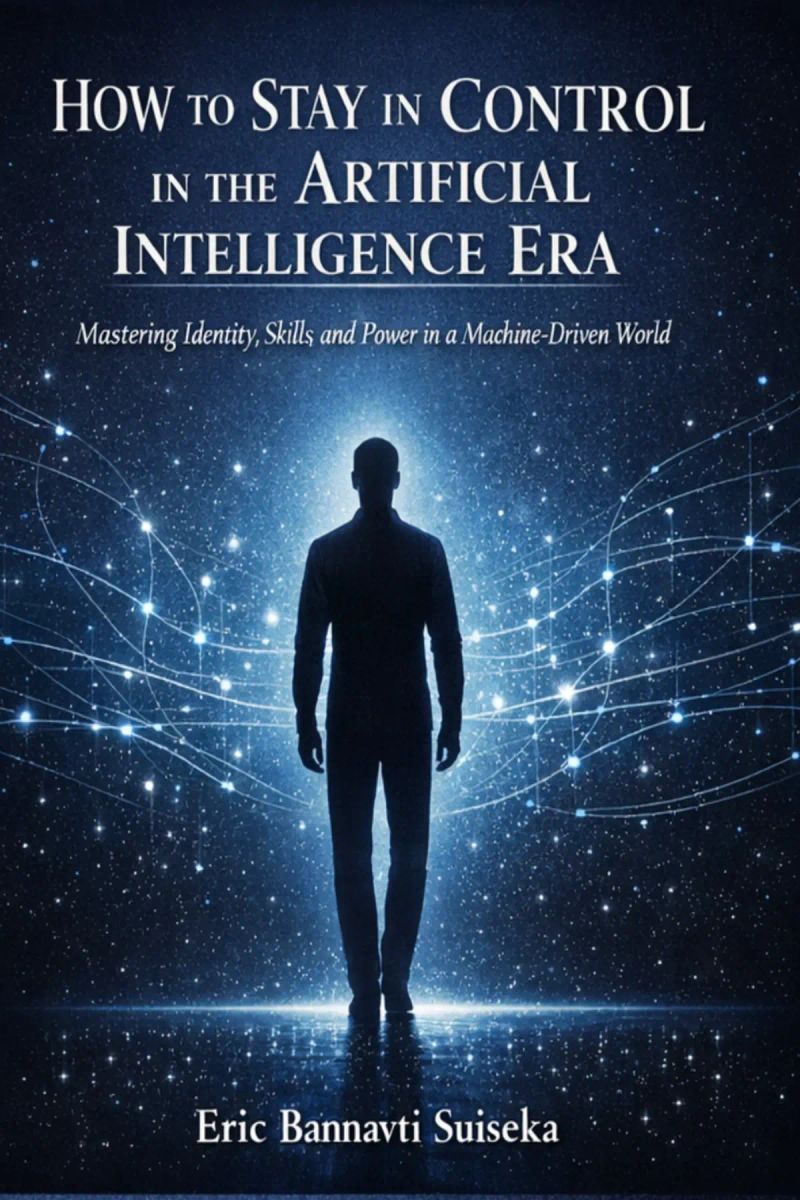
How to Stay in Control...
Mastering Identity, Skills, and Power in a Machine-Driven WorldBy Eric Bannavti Suiseka


Length1h 18m
About this audiobook
Control isn’t disappearing in the AI era. It’s shifting.
Artificial Intelligence is accelerating faster than most people are prepared for—not just technologically, but psychologically.
How to Stay in Control in the Artificial Intelligence Era is a human-centered guide for professionals and leaders who want to remain grounded, relevant, and autonomous in a machine-driven world.
This book explores:
• Mental stability in a hyper-speed environment
• Identity beyond job titles and tools
• Human skills that will never be automated
• Ethical judgment in AI-driven systems
• How to work with AI without surrendering control
This is not a book about tools or predictions.
It is a guide to human agency.
AI will shape the future.
You still decide who you become in it.
Audiobook details
GenreTechnology, Self-Help
Length1 hr 18 mins
Narrated byListen with 1,000+ voices
FormateBook with Audio
Publish dateJul 11, 2026
LanguageEnglish
Table of contents
1Introduction
2Dedication
3Preface
4Acknowledgments
5Chapter 1 – The Rise of AI and the Illusion of Control
Show all chaptersShow less
61.1 A World Rebuilt Overnight
71.2 The Psychological Dislocation
81.3 The Illusion of Control
91.4 What AI Is, and What It Is Not
101.5 Why People Feel Powerless
111.6 The Real Threat Is Not Artificial Intelligence—It Is Passive Intelligence
121.7 The New Empowerment Curve
131.8 The Path Forward
14Chapter 2 – The Power Shift: What AI Actually Changes
152.1 The End of Effort as a Measure of Value
162.2 From Scarcity of Knowledge to Scarcity of Judgment
172.3 Work Is No Longer a Place — It Is a Function
182.4 Creativity Is No Longer About Creation — It Is About Selection
192.5 The Acceleration of Inequality
202.6 Attention Becomes the Most Valuable Currency
212.7 Identity Becomes Fluid — and Fragile
222.8 The Shift from Linear Growth to Exponential Adaptation
232.9 What AI Does Not Change
242.10 The New Definition of Control
25Chapter 3 – Mental Stability in a Hyper-Speed World
263.1 The Velocity Mismatch: Human Biology vs. Machine Speed
273.2 Overstimulation and the Erosion of Focus
283.3 Anxiety in the Age of Acceleration
293.4 Information Hygiene: Feeding the Mind with Intention
303.5 The Loss of Stillness
313.6 Reclaiming Cognitive Authority
323.7 Emotional Regulation in a Machine-Driven World
333.8 Designing a Stable Mental Environment
343.9 The Role of Purpose in Mental Stability
353.10 Mental Stability as the First Line of Control
36Chapter 4 – Identity Anchoring: Who Are You Without Your Tools?
374.1 The Fragility of Tool-Based Identity
384.2 Identity vs. Capability
394.3 The Psychological Cost of Constant Reinvention
404.4 Values as the Core Anchor
414.5 Self-Worth Beyond Output
424.6 Identity in the Age of Comparison
434.7 The Role of Narrative in Identity Stability
444.8 Tools as Extensions, Not Substitutes
454.9 Rebuilding Identity After Disruption
464.10 Identity Anchoring as Long-Term Control
47Chapter 5 – Emotional Intelligence as the Ultimate Human Advantage
485.1 Why Emotional Intelligence Matters More Now
495.2 The Limits of Artificial Empathy
505.3 Emotional Regulation as a Strategic Skill
More from Eric Bannavti Suiseka



Hands of TimeRebecca Struthers8h 8m4.4 (1.3K)$26 · $0.00
Never Lost AgainBill Kilday10h 1m4.4 (805)$29 · $0.00

How the Internet HappenedBrian McCullough13h 28m4.3 (2.7K)$23 · $0.00

Collected Writings of Nikola TeslaNikola Tesla, Thomas Commerford Martin21h 50m4.3 (1.7K)$1 · $0.00

Just AspireAjai Chowdhry9h 13m4.4 (260)$29 · $0.00

The Little Book of AliensAdam Frank8h 20m4.3 (1.3K)$26 · $0.00

The inventions, researches and writings of Nikola Tesla (Annotated)Thomas Commerford Martin16h 59m4.3 (1.3K)$2 · $0.00

KargilV.P. Malik15h 18m4.3 (2K)$24 · $0.00

Experiments with Alternating CurrentsNikola Tesla9h 16m4.3 (874)$1.99 · $0.00

Fire on the HorizonTom Shroder, John Konrad8h 23m4.3 (858)$26 · $0.00

The Smell of Kerosene (Annotated)National Aeronautics and Space Administration, Donald L. Mallick, Peter W. Merlin11h 32m4.3 (523)$2 · $0.00

The Boy Who Harnessed the WindWilliam Kamkwamba, Bryan Mealer10h 5m4.2 (78.9K)$29 · $0.00

Across the Airless WildsEarl Swift10h 8m4.3 (1.3K)$29 · $0.00

Console WarsBlake J. Harris20h 41m4.2 (13.7K)$46 · $0.00

Improvised Munitions HandbookU.S. Department of Defense4h 49m4.3 (1.6K)$0.99 · $0.00
Escaping GravityLori Garver10h 54m4.2 (2.2K)$20 · $0.00

Wireless WarsJonathan Pelson8h 2m4.3 (418)$20 · $0.00

Let There Be WaterSeth M. Siegel8h 36m4.2 (2.3K)$20 · $0.00

The PerfectionistsSimon Winchester11h 46m4.2 (9.9K)$29 · $0.00

Rethinking NarcissismDr. Craig Malkin6h 7m4.2 (3.4K)$24 · $0.00

Learning to PrayJames Martin13h 24m4.5 (3.4K)$33 · $0.00

The Happiest Man on EarthEddie Jaku3h 48m4.6 (178K)$7 · $0.00

Finding MeViola Davis9h 15m4.6 (256.4K)$29 · $0.00

Spiritual AnatomyDaaji Kamlesh D. Patel9h 47m4.7 (319)$29 · $0.00

The Dangerous Truth about Today’s MarijuanaLaura Stack CSP, MBA9h 57m4.7 (385)$20 · $0.00

The Gospel according to Spiritualism (Translated)Allan Kardec14h 39m4.6 (3.9K)$5.70 · $0.00

Birdie & HarlowTaylor Wolfe7h 50m4.6 (6.5K)$26 · $0.00

CrossroadsKaleb Dahlgren7h 56m4.6 (4.9K)$26 · $0.00

Life on the BridgeKaelynn Partlow5h 40m4.6 (1.1K)$24 · $0.00

Keep Your Love OnDanny Silk9h 4m4.6 (8.1K)$10 · $0.00

The Tao of Joy Every DayDerek Lin10h 24m4.6 (762)$20 · $0.00

UndividedVicky Beeching9h 2m4.6 (1.3K)$29 · $0.00

HE CAN WHO THINKS HE CAN & OTHER BOOKS ON SUCCESSOrison Swett Marden5h 54m4.6 (1.2K)$1.99 · $0.00
Level UpRob Dial7h 42m4.6 (3.3K)$26 · $0.00

Burn the HaystackJennie Young, PhD9h 30m4.6 (543)$29 · $0.00

ACRES OF DIAMONDS: Our Every-day Opportunities (Wisdom & Empowerment Series) (Annotated)Russell Conwell2h 26m4.6 (1K)$2 · $0.00

Good InsideBecky Kennedy9h 55m4.5 (59.3K)$29 · $0.00

The Lost VoiceGreta Morgan8h 30m4.7 (285)$26 · $0.00

Stripped DownBunnie Xo8h 25m4.5 (32.9K)$26 · $0.00

UnthinkableJamie Raskin15h 8m4.5 (9.3K)$8 · $0.00
You may also like

Notes on a Nervous PlanetMatt Haig5h 11m4.1 (64.5K)$24 · $0.00
Everything is F*ckedMark Manson7h 2m3.8 (131.8K) · 1252$24 · $0.00

More Than WordsJohn Warner7h 46m4.0 (513)$23

Future ShockAlvin Toffler16h 50m3.9 (10.7K)$30 · $0.00

Sex Robots and Vegan MeatJenny Kleeman10h 9m4.0 (2K)$20
Attention SpanGloria Mark10h 52m3.7 (2.3K)$29 · $0.00

The Last Skill You'll Ever NeedDr. Josh Harari2h 5m$5.70 · $0.00

Miracle by Price and two more storiesIrving E. Cox2h 45m$2.30

Masters or Slaves?Jeremy Peckham6h 44m4.2 (23)$23

ReplacedDisrupt.co.nz4h 4m$1.20 · $0.00
Pay AttentionDavid Pakman9h 27m$29 · $0.00

We Radiant ThingsFranny Choi6h 8m$24 · $0.00

IntelligenceSteve Pavlina2h 51m$8 · $0.00

Queers Destroy Science Fiction!Seanan McGuire, Sigrid Ellis, Steve Berman, Gabrielle de Cuir11h4.0 (303)$20
No More WorkJames Livingston3h 16m3.7 (449)$15

Amazing Tales Volume 89Rog Phillips et al.2h 31m$2.30

The Puppet MastersMorgan B. Blake4h 45m$4.10 · $0.00

The Human EdgeDorian Frinch1h 9m$14 · $0.00

I Asked AI. It Sounded Right. - A Satirical Guide to Life That Makes Sense NowMax Paradox2h 20m4.3 (156)$7.70 · $0.00

Super ChangeBerny Dohrmann9h 20m$20