
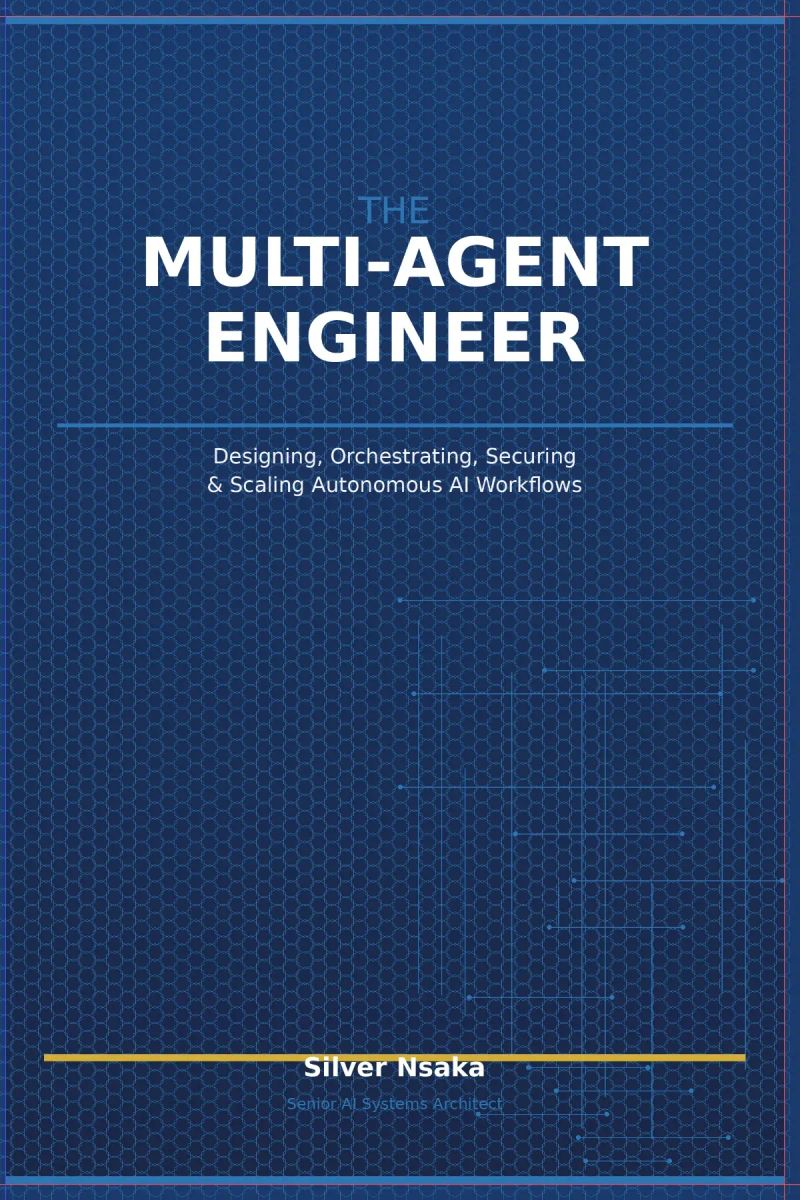
THE MULTI-AGENT ENGINEER
Building Production-Ready AI SystemsBy Silver Nsaka


Length4h 3m
About this audiobook
The Multi-Agent Engineer is the definitive engineering handbook for building production-ready multi-agent AI systems. Written for AI engineers, ML engineers, and enterprise architects who already understand LLM basics, this book teaches the distributed systems discipline required to take agentic AI from demo to production
Following a complete Media Rights & Content Licensing Engine case study built chapter by chapter, you will learn to:
• Design multi-agent architectures with the Supervisor, Planner-Executor, and Critic-Actor patterns
• Build typed agent communication using Pydantic schemas
• Implement Human-in-the-Loop approval workflows with durable state persistence
• Engineer fault tolerance with retry logic, circuit breakers, and the Dead-Agent Queue
• Evaluate agents with LLM-as-Judge pipelines calibrated against expert judgment
• Secure agents with IAM, prompt injection defense, and sandboxed tool
• Deploy on Kubernetes with event-driven autoscaling
Audiobook details
GenreTechnology
Length4 hrs 3 mins
Narrated byListen with 1,000+ voices
FormateBook with Audio
Publish dateJul 15, 2023
LanguageEnglish
Table of contents
1Introduction
2Preface
3From Prompts to Processes: Why Single LLM Calls Are Not Enough
41.1 The Anatomy of a Broken AI System
51.2 The Limits of Context Windows
Show all chaptersShow less
61.3 Compound AI Systems: A New Paradigm
71.4 The State Problem
81.5 The Case Study: Media Rights and Content Licensing Engine
91.6 Chapter Summary
10The Multi-Agent Paradigm: Principles of Production AI
112.1 The Seven Properties of Production Multi-Agent Systems
12Property 1: Composability
13Property 2: Observability
14Property 3: Reliability
15Property 4: Security
16Property 5: Evaluability
17Property 6: Cost Accountability
18Property 7: Governance
192.2 Agent Roles and Responsibilities
202.3 The Evolution from Chatbots to Autonomous Workflows
212.4 The Orchestrator Pattern
222.5 Agent Communication Protocols
232.6 Designing for Failure
242.7 Chapter Summary
25Layers of Intelligence: Anatomy of the Agentic Stack
263.1 The LLM Layer
273.2 The Memory Layer
283.3 The Tool Layer
293.4 The Orchestration Layer
303.5 The Evaluation Layer
313.6 The Observability Layer
323.7 The Security Layer
333.8 Chapter Summary
34Framework Wars: LangGraph, CrewAI, AutoGen, and Semantic Kernel
354.1 LangGraph: Graph-Based Workflow Orchestration
364.2 CrewAI: Role-Based Collaborative Agents
374.3 AutoGen: Conversational Multi-Agent Coordination
384.4 Semantic Kernel: Enterprise Integration Focus
394.5 The Case for Framework Independence
404.6 Chapter Summary
41Stack Selection and Integration Strategy
425.1 The Reference Stack
435.2 The Pydantic Contract
445.3 Integrating the Reference Stack
455.4 Chapter Summary
46Designing Agents: Roles, Capabilities, and Reasoning Strategies
476.1 The Single Responsibility Principle for Agents
486.2 Reasoning Strategies
49Direct Completion
50Chain-of-Thought (CoT)
More from Silver Nsaka

When the Heavens Went on SaleAshlee Vance18h 20m4.4 (3K)$40 · $0.00

Everybody Has a Podcast (Except You)Justin McElroy, Travis McElroy, Griffin McElroy5h 9m4.3 (2.3K)$24 · $0.00

Hands of TimeRebecca Struthers8h 8m4.4 (1.3K)$26 · $0.00
Never Lost AgainBill Kilday10h 1m4.4 (805)$29 · $0.00
How the Internet HappenedBrian McCullough13h 28m4.3 (2.7K)$23 · $0.00

Collected Writings of Nikola TeslaNikola Tesla, Thomas Commerford Martin21h 50m4.3 (1.7K)$1 · $0.00

Just AspireAjai Chowdhry9h 13m4.4 (260)$29 · $0.00

The Little Book of AliensAdam Frank8h 20m4.3 (1.3K)$26 · $0.00
The inventions, researches and writings of Nikola Tesla (Annotated)Thomas Commerford Martin16h 59m4.3 (1.3K)$2 · $0.00

KargilV.P. Malik15h 18m4.3 (2K)$24 · $0.00
Experiments with Alternating CurrentsNikola Tesla9h 16m4.3 (874)$1.99 · $0.00

Fire on the HorizonTom Shroder, John Konrad8h 23m4.3 (858)$26 · $0.00

The Smell of Kerosene (Annotated)National Aeronautics and Space Administration, Donald L. Mallick, Peter W. Merlin11h 32m4.3 (523)$2 · $0.00

The Boy Who Harnessed the WindWilliam Kamkwamba, Bryan Mealer10h 5m4.2 (78.9K)$29 · $0.00

Across the Airless WildsEarl Swift10h 8m4.3 (1.3K)$29 · $0.00

Console WarsBlake J. Harris20h 41m4.2 (13.7K)$46 · $0.00

Improvised Munitions HandbookU.S. Department of Defense4h 49m4.3 (1.6K)$1.99 · $0.00
Escaping GravityLori Garver10h 54m4.2 (2.2K)$20 · $0.00

Wireless WarsJonathan Pelson8h 2m4.3 (418)$20 · $0.00

Let There Be WaterSeth M. Siegel8h 36m4.2 (2.3K)$20 · $0.00
You may also like
ITIL Foundation Essentials ITIL 4 Edition - The ultimate revision guide, second editionClaire Agutter1h 12m4.2 (462)$27 · $0.00
Google ItAnna Crowley Redding4h 18m4.0 (711)$15
Everyone’s Talking About AI, and I Don’t Know Where to Start - How to Use AI for Everyday Tasks, Check Its Answers, and Keep Thinking for YourselfMax Paradox4h 12m4.9 (18)$7.70 · $0.00

12 Smart-Device AI ProjectsDesmond Whitlock7h 52m$5

Polyglotpython:Jimmy L. De Mello1h 41m$30 · $0.00

Social Media Marketing BoostFernando Moreira0m1.0 (1)$7 · $0.00

Artificial Intelligence for Business StrategyTheo Riven3h 11m$5

Email Marketing: The Ultimate Guide to Building an Email List Asset (How to Compel Your Subscribers to Open Your Emails and Take Action Now)Howard Steward1h$3.50 · $0.00
ChatGPT for ArchitectsAdrian Lucas2h 43m$4 · $0.00
LEICA Q3 43 MASTERY GUIDEMichael J. Frame20h 28m$11.50 · $0.00

The Systems EngineBradley J Sugars1h 54m3.9 (115)Free

AI Money MachineSara Melo1h 31m$1.80 · $0.00

On-Device AI: The Complete TinyML Guide for DevelopersCaroline Lennox3h 22m$4 · $0.00
Millionaire ChatGPTSara Melo1h 53m$1.80 · $0.00
T-SQL Worth KnowingIngrid Pereira7h 53m$5 · $0.00

Chatgpt Complete GuideJoaquin Gener1h 23m$6 · $0.00

Artificial Intelligence for Web DevelopmentJaxen Holt, Nadia Valentine4h 5m$6

AI for Financial AnalysisRenata Holloway8h 5m$5 · $0.00

The Start-up Founder's Guide to Digital MarketingPramod Maloo8h 17m4.6 (27)$20 · $0.00

Affiliate Marketing: The Ultimate Guide to Starting Your Online Business (Affiliate Marketing Explained Affiliate Marketing Course Affiliate Marketing Strategies)William Ramsey3h 25m$3.50 · $0.00