
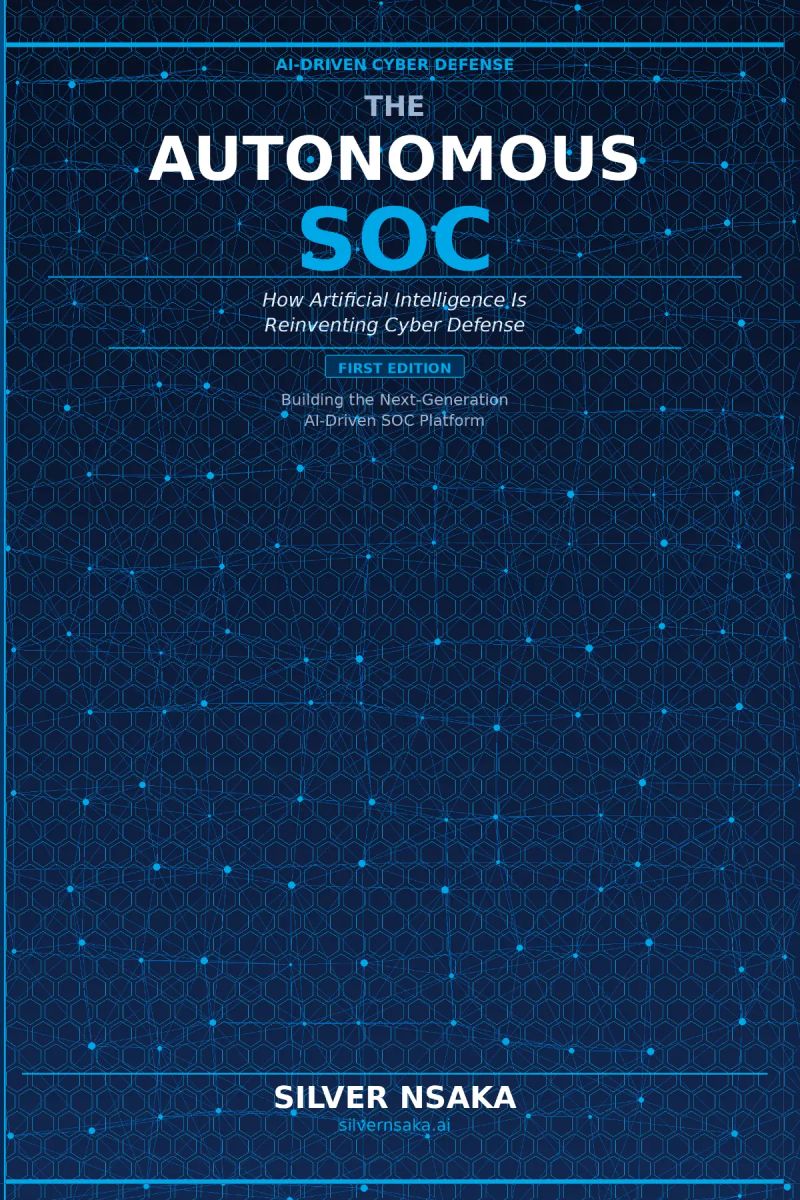
THE AUTONOMOUS SOC
How Artificial Intelligence Is Reinventing Cyber DefenseBy Silver Nsaka


Length3h 51m
About this audiobook
In an era where cyberattacks launch in milliseconds and breach organizations in seconds, the traditional Security Operations Center is reaching the end of its operational viability. THE AUTONOMOUS SOC is the definitive guide to the AI-driven transformation that every security organization must undertake to survive the next decade of cyber warfare. Written by Silver Nsaka — cybersecurity strategist, AI architect, and founder of Kingdom AI Solutions — this book delivers a complete blueprint from the failing SOC of today to the autonomous, AI-driven cyber defense platform of tomorrow. WHAT YOU WILL LEARN: How machine learning, behavioral analytics, and graph-based detection replace static rules with systems that think and adapt. How LLMs and agentic AI systems transform analysts into strategic orchestrators of autonomous defense. How to architect a complete AI-SOC platform on AWS, Azure, and Google Cloud.
Audiobook details
GenreTechnology
Length3 hrs 51 mins
Narrated byListen with 1,000+ voices
FormateBook with Audio
Publish dateMar 27, 2026
LanguageEnglish
Table of contents
1Introduction
2Foreword
3Preface
4Table of Contents
5Chapter 1: The Broken SOC — Why Traditional Security Operations Are Failing
Show all chaptersShow less
6The Alert Tsunami
7Mean Time to Detect and Mean Time to Respond: The Metrics of Failure
8The Tool Proliferation Problem
9The Talent Crisis
10Architecture Diagrams: The Traditional SOC vs. The AI-SOC
11The Case for Radical Transformation
12Traditional SOC vs. AI-SOC: Key Metrics
13Chapter 2: The Threat Landscape Has Evolved — Your Defenses Have Not
14The New Anatomy of Attack
15AI-Enhanced Attack Techniques
16The Speed Problem: Why Rules Cannot Keep Up
17Supply Chain and Third-Party Risk: The Expanding Attack Surface
18Cloud-Native Attack Surfaces
19Chapter 3: The Human Bottleneck — Alert Fatigue, Analyst Burnout, and the Talent Crisis
20The Neuroscience of Alert Fatigue
21The Staffing Model Impossibility
22Designing for Human-AI Collaboration
23Chapter 4: The Economics of Cyber Failure — The ROI of Legacy Security Is Collapsing
24The True Cost of a Security Breach
25The ROI Framework for AI-SOC Investment
26Chapter 5: The Case for Transformation — What a Modern AI-SOC Must Deliver
27Defining the AI-SOC: Capabilities and Characteristics
28The AI-SOC Maturity Model
29AI-SOC Maturity Model
30Chapter 6: Machine Learning for Threat Detection — From Rules to Intelligence
31A Taxonomy of Machine Learning in Security
32Feature Engineering for Security ML
33Behavioral Analytics: Building Baselines That Matter
34ML Model Deployment and MLOps for Security
35Chapter 7: Behavioral Analytics and UEBA — The New Perimeter
36User and Entity Behavior Analytics: Architecture and Implementation
37Insider Threat Detection: The Most Difficult Problem
38Chapter 8: Graph-Based Threat Detection and Attack Path Analysis
39Why Graphs Are Natural Security Models
40Attack Graph Analysis and MITRE ATT&CK Mapping
41Chapter 9: Large Language Models in the SOC — The AI Security Analyst
42LLMs Transform SOC Operations
43Building a Security-Specific LLM: Fine-Tuning and RAG
44LLM Security Copilots: Architecture and Implementation
45Chapter 10: AI Threat Hunting — Autonomous Discovery of Hidden Threats: The Evolution of Threat Hunting
46Chapter 11: AI Anomaly Detection — Finding What Rules Cannot See
47Taxonomy of Anomaly Detection Techniques
48ML Techniques for Security: Selection Guide
49Chapter 12: The AI-SOC Reference Architecture
50The Complete AI-SOC Architecture
More from Silver Nsaka

When the Heavens Went on SaleAshlee Vance18h 20m4.4 (3K)$40 · $0.00

Everybody Has a Podcast (Except You)Justin McElroy, Travis McElroy, Griffin McElroy5h 9m4.3 (2.3K)$24 · $0.00

Hands of TimeRebecca Struthers8h 8m4.4 (1.3K)$26 · $0.00
Never Lost AgainBill Kilday10h 1m4.4 (805)$29 · $0.00
How the Internet HappenedBrian McCullough13h 28m4.3 (2.7K)$23 · $0.00
Collected Writings of Nikola TeslaNikola Tesla, Thomas Commerford Martin21h 50m4.3 (1.7K)$1 · $0.00

Just AspireAjai Chowdhry9h 13m4.4 (260)$29 · $0.00
The Little Book of AliensAdam Frank8h 20m4.3 (1.3K)$26 · $0.00
The inventions, researches and writings of Nikola Tesla (Annotated)Thomas Commerford Martin16h 59m4.3 (1.3K)$2 · $0.00

KargilV.P. Malik15h 18m4.3 (2K)$24 · $0.00
Experiments with Alternating CurrentsNikola Tesla9h 16m4.3 (874)$1.99 · $0.00

Fire on the HorizonTom Shroder, John Konrad8h 23m4.3 (858)$26 · $0.00

The Smell of Kerosene (Annotated)National Aeronautics and Space Administration, Donald L. Mallick, Peter W. Merlin11h 32m4.3 (523)$2 · $0.00

The Boy Who Harnessed the WindWilliam Kamkwamba, Bryan Mealer10h 5m4.2 (78.9K)$29 · $0.00

Across the Airless WildsEarl Swift10h 8m4.3 (1.3K)$29 · $0.00

Console WarsBlake J. Harris20h 41m4.2 (13.7K)$46 · $0.00
Improvised Munitions HandbookU.S. Department of Defense4h 49m4.3 (1.6K)$1.99 · $0.00
Escaping GravityLori Garver10h 54m4.2 (2.2K)$20 · $0.00
Wireless WarsJonathan Pelson8h 2m4.3 (418)$20 · $0.00

Let There Be WaterSeth M. Siegel8h 36m4.2 (2.3K)$20 · $0.00
You may also like
Wired for WarP. W. Singer20h 26m4.1 (3.1K)$32
ITIL Foundation Essentials ITIL 4 Edition - The ultimate revision guide, second editionClaire Agutter1h 12m4.2 (462)$27 · $0.00
AI-Proof Your Career: Navigating the Future with ConfidenceJasper Livingstone7h 11m$6.90
CLAUDE CODE MASTERY 2026Smart Alden6h 5m$8.50 · $0.00
The AI Operations PlaybookJasper Livingstone5h 17m$11.50 · $0.00
No-Code AI AgentsVincent Abara7h 37m$5 · $0.00
Artificial IntelligenceAxel Mammitzsch53m$10 · $0.00
Neural Networks Without PythonPaloma Iqbal7h 29m$5 · $0.00
Eft Investing: A Comprehensive Guide to Researching and Investing (The Intelligent Investor's Guide to Using Free Online Stock Screeners to Find Winning Stocks)Matthew Nagel2h 7m$3.50 · $0.00
Build AI Voice AssistantsVera Grimaldi7h 53m$5
Automatisierte Textklassifizierung Wie man Dokumente, Tickets und Nachrichten mit überwachtem Lernen automatisch kategorisiertSloane Garrett7h 40m$10.20 · $0.00
Me, My Customer, and AIHenrik Werdelin, Nicholas Thorne3h 41m3.3 (16)$20
The In-Car-Nation CodeDr. Engelbert Wimmer20h 15m$21 · $0.00
RepluggedSatnam Bains13h 47m$14 · $0.00
In Our Own ImageGeorge Zarkadakis13h 48m3.8 (341)$23 · $0.00

Edge-AI-Engineering Wie man Künstliche Intelligenz am Netzwerkrand Aufbaut, Bereitstellt und OptimiertSloane Garrett6h 33m$13 · $0.00
The 9 AI Powers: How to Build Digital Wealth in 2025Yasin Ali 1h 41m4.7 (12) Only with Ultra
Artificial Intelligence for Workflow AutomationTheo Riven3h 25m$5
The Machine Learning Engineer's PathPriya Quill7h 34m$5
Leadership In The AI EraJasper Livingstone7h 23m$13 · $0.00