
Audio only


Length1h 27m
About this audiobook
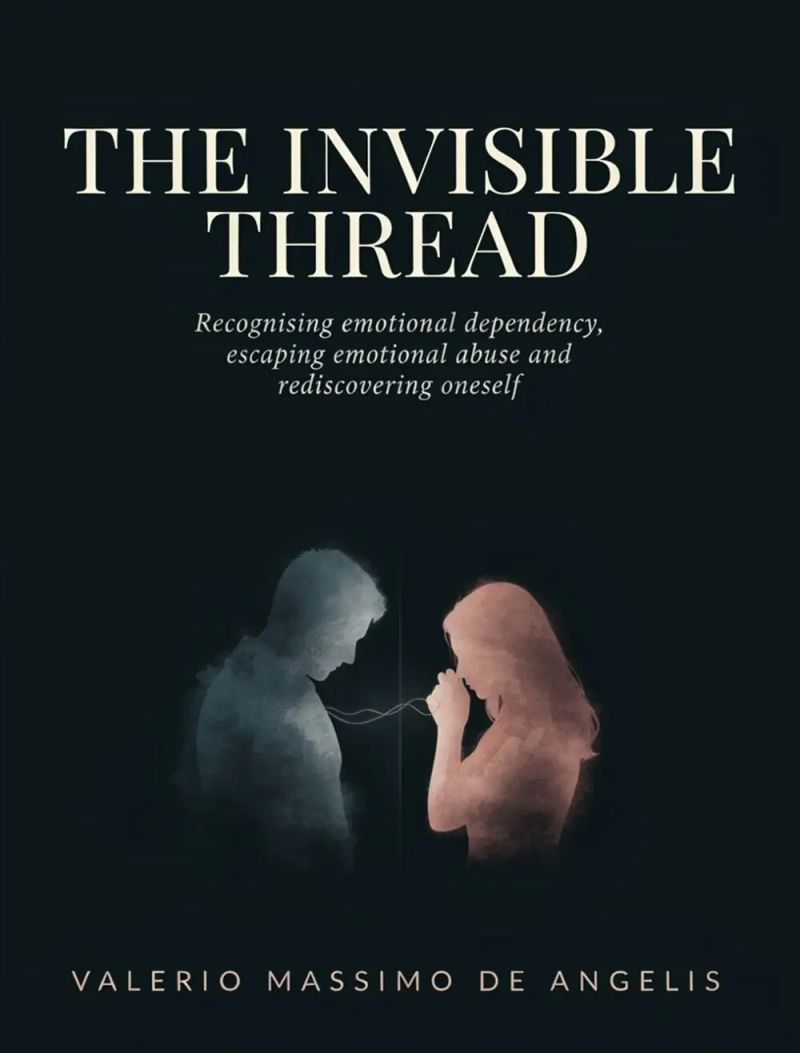
The Invisible Thread - Recognising emotional dependency, escaping emotional abuse and rediscovering oneself by Valerio Massimo De Angelis.
There comes a moment when you ask yourself: ‘Is it normal to feel this way?’. Those in a relationship marked by emotional dependency or abuse often take years to find the words to name that pain — because their perception of what is normal shifts, slowly, until the unacceptable becomes acceptable.
The Invisible Thread is a comprehensive guide for anyone who recognises themselves, even only partially, in this experience: the fear of abandonment, the constant need for reassurance, the struggle to distinguish true love from control disguised as care. Through a journey spanning thirty-nine chapters, the book explores the psychological roots of emotional dependency, the neurobiological mechanisms that make it so difficult to leave a painful relationship, the signs of emotional abuse — from gaslighting to isolation — and practical strategies for breaking free and rebuilding a healthy relationship with oneself.
Written in clear and direct language, with illustrative stories, practical worksheets and a 30-day action plan, this book is not just a text to be read, but a tool to be used: for those seeking the strength to walk away, for those who have already left and are rebuilding their identity, and for those who want to learn to recognise, in future, the difference between love and dependency.
A book about awareness, healing and rebirth — to rediscover not only the relationship, but also oneself.
Audiobook details
GenreLiterary Classics
Length1 hr 27 mins
Narrated byListen with 1,000+ voices
FormateBook with Audio
Publish dateAug 8, 2026
LanguageEnglish
Table of contents
1The Invisible Thread
2A Note to the Reader
3Foreword
4Chapter 1: What is emotional dependency?
5Chapter 2: An example: Elena’s story
Show all chaptersShow less
6Chapter 3: The Roots: Attachment, Childhood and Relational Patterns
7Chapter 4: Recognising emotional abuse: signs and forms
8Chapter 5: An example: Davide’s story
9Chapter 6: The cycle of the dysfunctional relationship
10Chapter 7: Why It Is So Difficult to Walk Away
11Chapter 8: Self-esteem, identity and the void that the other person seems to fill
12Chapter 9: The chemistry of love and the mechanisms of addiction
13Chapter 10: Healthy love versus emotional dependency: the differences
14Chapter 11: Awakening: the first steps towards awareness
15Chapter 12: Practical strategies for leaving the relationship
16Chapter 13: Rebuilding Personal Boundaries
17Chapter 14: Recovery: therapy, support, self-help groups
18Chapter 15: Rebuilding Your Identity and Self-Love
19Chapter 16: Recognising new patterns and preventing relapses
20Chapter 17: Towards healthy relationships: building the future
21Chapter 18: When your partner has narcissistic traits
22Chapter 19: Love bombing: when the beginning is already a warning sign
23Chapter 20: The Family Legacy: Patterns Passed Down
24Chapter 21: Emotional Dependency in the Digital Age
25Chapter 22: When Children Are Involved
26Chapter 23: Overcoming shame and judgement (including that of others)
27Chapter 24: Emotional Dependency in Men: Beyond the Stereotype
28Chapter 25: The role of friends and family in the journey towards recovery
29Chapter 26: Mindfulness and Emotional Regulation
30Chapter 27: Relapses: When You Go Back
31Chapter 28: Forgiveness: Who It Belongs To, and What It Really Means
32Chapter 29: The mourning of the relationship: the stages of coming to terms with it
33Chapter 30: Body, Sexuality and Intimacy after Emotional Abuse
34Chapter 31: Writing your personal manifesto
35Chapter 32: Measuring progress: how to recognise that you are healing
36Chapter 33: Three Stories of Rebirth
37Chapter 34: The value of chosen solitude
38Chapter 35: Practical Worksheets
39Chapter 36: Frequently Asked Questions
40Chapter 37: Cultures, social contexts and emotional dependence
41Chapter 38: A letter to the reader, from the other side of the journey
42Chapter 39: One final tool: the 30-day plan
43Conclusion
44Glossary of Terms
45About the Author
46Acknowledgements
47Useful Resources
More from Valerio Massimo

Il Filo InvisibileValerio Massimo1h 28m$8.20 · $0.00

O Fio InvisívelValerio Massimo1h 29m$8.20 · $0.00

El hilo invisibleValerio Massimo1h 30m$8.20 · $0.00

Der unsichtbare FadenValerio Massimo1h 39m$8.20 · $0.00

ThaumaturgiaValerio Massimo9h 41m3.9 (23)$4.70 · $0.00

Thaumaturgia: As Elucidações do MaravilhosoValerio Massimo9h 25m$4.60 · $0.00

ThaumaturgiaValerio Massimo10h 17m$4.70 · $0.00
ThaumaturgiaValerio Massimo10h 4m$4.70 · $0.00

ThaumaturgiaValerio Massimo9h 40m$4.60 · $0.00

To Kill a MockingbirdHarper Lee12h 18m4.5 (7.4M)$29 · $0.00

These Precious DaysAnn Patchett11h 14m4.5 (45.2K)$29 · $0.00

Braving the TruthRachel Held Evans11h 31m4.7 (359)$29 · $0.00

The Old Man and the Sea (Annotated)Ernest Hemingway4h 27m4.6 (1.4K)$2 · $0.00

Twelfth Night (The Unabridged Play) + The Classic Biography (Annotated)William Shakespeare, Sidney Lee16h 38m4.6 (1.4K)$2 · $0.00

Henry V (The Play, Historical Background and Analysis of the Character in the Play)William Shakespeare, William Hazlitt8h 40m4.6 (1.3K)$1 · $0.00

H. P. LOVECRAFT Ultimate Collection: Novellas, Short Stories, Poetry & Essays (Annotated)H. P. Lovecraft12h 28m4.6 (2.3K)$2 · $0.00
Time RegainedMarcel Proust15h 54m4.5 (10.6K)$2 · $0.00

TORAH - Bilingual Edition: English/Hebrew (Annotated)Max Margolis, JPS28h 26m4.6 (1K)$2 · $0.00

Betty Crocker picture cooky bookBetty Crocker, Inc. General Mills2h 13m4.5 (6.5K)$1 · $0.00

The Complete Tales of Beatrix PotterBeatrix Potter3h 36m4.5 (75K)$3 · $0.00

Crime and Punishment (The Unabridged Garnett Translation) (Annotated)Fyodor Dostoevsky24h 25m4.5 (15.4K)$1.99 · $0.00

The North American IndianEdward S. Curtis, Frederick Webb Hodge6h4.5 (1.2K)$2 · $0.00

The Picture of Dorian Gray: The Uncensored 13 Chapter Version + The Revised 20 Chapter Version (Annotated)Oscar Wilde16h 12m4.5 (2.8K)$1.99 · $0.00

Grimoire Of The Everyday WitchIsadora Lys / Virginia Santos5h 35m4.5 (3.9K)$9 · $0.00

Winnie-the-PoohAlan Alexander Milne2h 52m4.5 (401.1K)$3 · $0.00

Sitting PrettyRebekah Taussig7h 33m4.5 (18.9K)$26 · $0.00

The Poetic Edda & The Prose EddaSnorri Sturluson, Saemund Sigfusson9h 34m4.5 (4K)$1 · $0.00

The Complete Satires & Essays of Mark Twain (Annotated)Mark Twain23h 21m4.5 (1.1K)$2 · $0.00

Rilla of InglesideLucy Maud Montgomery10h 58m4.5 (46.7K)$1 · $0.00
You may also like

Will I Ever Be Free of You?Dr. Karyl McBride PhD6h 45m4.2 (970)$20

Beyond the High Blue AirLu Spinney8h 10m4.4 (411)$20

Losing MusicJohn Cotter7h 5m4.1 (395)$17 · $0.00

Unbreak My HeartToni Braxton7h 43m4.1 (2.5K)$26 · $0.00

Breakup BootcampAmy Chan8h 44m4.2 (1.7K)$26 · $0.00

MadnessMarya Hornbacher9h 43m4.1 (17.9K)$29 · $0.00

Black BeautyAnna Sewell5h 31m4.2 (322.9K)$4 · $0.00

Pitch PerfectBill McGowan7h 52m4.0 (2.6K)$26 · $0.00

Stripped DownBunnie Xo8h 25m4.5 (32.9K)$26 · $0.00

Funny FarmLaurie Zaleski8h 10m4.3 (9.3K)$20 · $0.00

ShatteredHanif Kureishi6h 9m4.3 (1.4K)$24 · $0.00

Seize the DaySaul Bellow3h 47m3.8 (20.3K)$12
Breaking AddictionLance M. Dodes5h 53m4.1 (625)$24 · $0.00

Mothers Who Can't LoveSusan Forward, Donna Frazier Glynn8h 28m4.3 (7.1K)$26 · $0.00

John Lennon 1980Kenneth Womack10h 32m4.4 (925)$20

This Is Not How It EndsJehan Casinader6h 19m4.2 (417)$24 · $0.00

The Dance of ConnectionHarriet Lerner7h 5m4.2 (5.9K)$24 · $0.00

The Courage to DisappointTarun Mankar2h 52m4.5 (21)Free

In Sickness and in HealthLaura Mauldin6h 49m4.3 (125)$24 · $0.00

Good in a CrisisMargaret Overton7h 57m3.6 (733)$22 · $0.00