
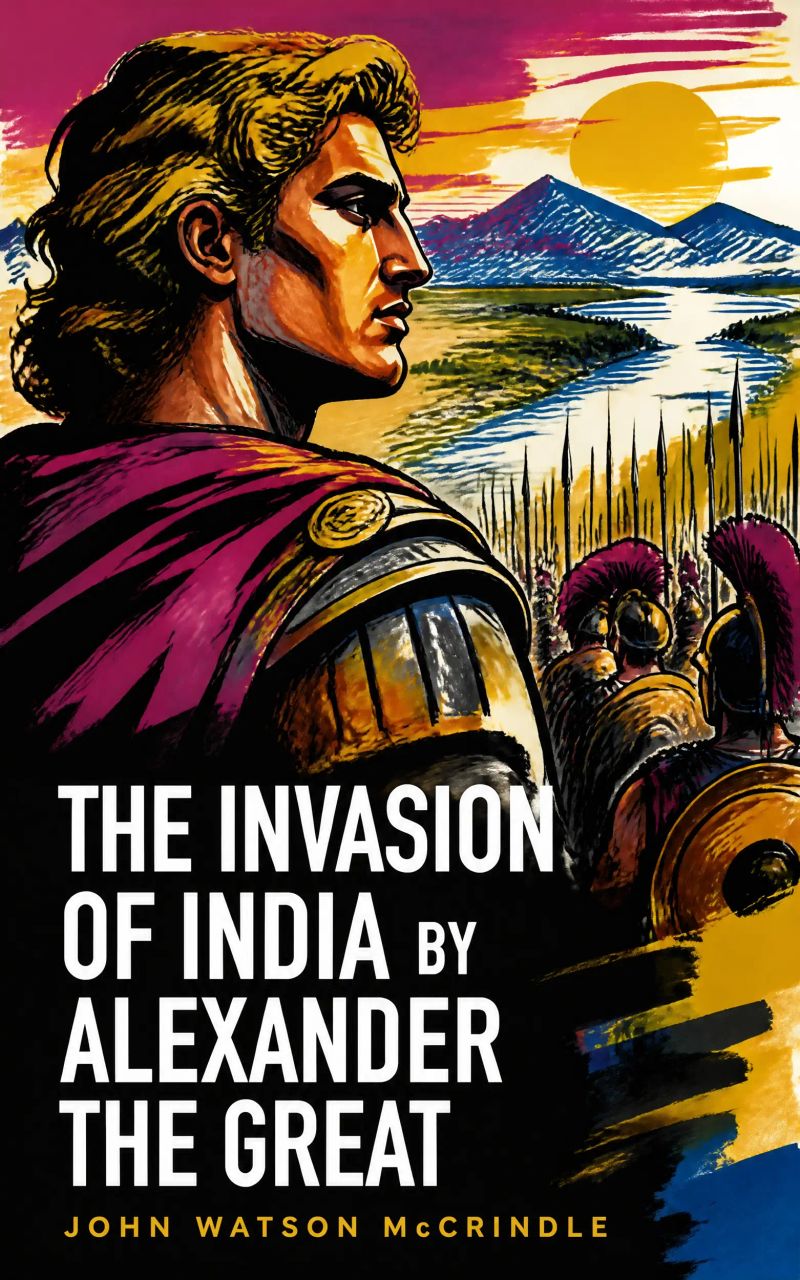
The Invasion of India by Alexander the Great
Classical Sources, Ancient Geography, and the Indo-Greek Encounter in Northwestern IndiaBy John Watson McCrindle


Length17h 15m
About this audiobook
In *The Invasion of India by Alexander the Great*, John Watson McCrindle reconstructs the Macedonian king's eastern campaign through a critical synthesis of Greek, Roman, and Indian evidence. Drawing especially on Arrian, Curtius Rufus, Diodorus, Plutarch, and Strabo, the work follows Alexander from his crossing of the Indus and encounters with Taxila and Porus to the battles, negotiations, and difficult retreat that defined the expedition's limits. McCrindle's method combines translation, historical commentary, geographical identification, and comparison of variant classical accounts. Its prose belongs to the learned nineteenth-century tradition of imperial-era classical scholarship: documentary and explanatory, yet animated by the drama of military travel and intercultural encounter. The book is therefore both a narrative history and an apparatus for reading the ancient sources critically. McCrindle was a Scottish scholar of India whose career as an educator and translator cultivated a sustained interest in the relationship between classical historiography and South Asian history. Writing at a time when European scholars were systematically assembling knowledge of India from Sanskrit, Buddhist, Persian, and Greco-Roman materials, he sought to make ancient testimonies accessible while testing them against geography, ethnography, and indigenous traditions. His work reflects the period's philological rigor, as well as its imperial intellectual framework, and remains valuable precisely because it reveals how Alexander's invasion was interpreted in the nineteenth century. This book will reward readers of ancient history, classical studies, South Asian historiography, and the history of cross-cultural contact. It offers a carefully mediated introduction to the surviving evidence, clarifies the uncertainties surrounding Alexander's campaign, and invites reflection on how military conquest becomes historical memory. Readers should approach its colonial assumptions critically, but will find in it a substantial, informative, and still stimulating guide to one of antiquity's most consequential encounters.
Audiobook details
Rating★★★★ 3.7 (34)
Includes Amazon, Goodreads, LibraryThing
GenreHistory
Length17 hrs 15 mins
Narrated byListen with 1,000+ voices
FormateBook with Audio
Publish dateMar 25, 2022
LanguageEnglish
Table of contents
1The History of the Jewish People & The Jewish-Roman Wars (Annotated)
2INTRODUCTION
3Arrian
4Q. Curtius Rufus
5Plutarch
Show all chaptersShow less
6Diodoros the Sicilian
7Justinus Frontinus
8The Life of Alexander the Great
9ARRIAN
10ARRIAN’S ANABASIS
11Fourth Book
12Chapter XXII.—Alexander crosses the Indian Kaukasos to invade India and advances to the river Kôphên
13Chapter XXIII.—Alexander wars against the Aspasians
14Chapter XXIV.—Operations against the Aspasians
15Chapter XXV.—Defeat of the Aspasians—The Assakenians and Gouraians attacked
16Chapter XXVI.—Siege of Massaga
17Chapter XXVII.—Massaga taken by storm—Ora and Bazira besieged
18Chapter XXVIII.—Bazira captured—Alexander marches to the rock Aornos
19Chapter XXIX.—Siege of Aornos
20Chapter XXX.—Capture of Aornos—Advance to the Indus
21Fifth Book
22Chapter I.—Alexander at Nysa
23Chapter II.—Alexander permits the Nysaians to retain their Autonomy—Visits Mount Mêros
24Chapter III—How Eratosthenes views the legends concerning Heraklês and Dionysos—Alexander crosses the Indus
25Chapter IV.—General description of the Indus and of the people of India
26Chapter V.—The rivers and mountains of Asia
27Chapter VI.—Position and boundaries of India and how its plains may have been formed
28Chapter VII.—The bridging of rivers
29Chapter VIII.—Alexander arrives at Taxila—Receives an embassy from Abisares and advances to the Hydaspês
30Chapter IX.—Alexander on reaching the Hydaspês finds Pôros prepared to dispute its passage
31Chapter X.—Alexander’s devices to deceive Pôros and steal the passage of the river
32Chapter XI.—Arrangements made by Alexander for crossing the Hydaspês unobserved
33Chapter XII.—Alexander crosses the Hydaspês
34Chapter XIII.—Incidents of the passage of the river
35Chapter XIV.—Skirmish with the son of Pôros at the landing-place
36Chapter XV.—The arrangements made by Pôros for the conflict
37Chapter XVI.—The plan of attack adopted by Alexander
38Chapter XVII.—Description of the battle of the Hydaspês—Defeat of Pôros
39Chapter XVIII.—Sequel of the battle and surrender of Pôros
40Chapter XIX.—Alexander makes Pôros his firm friend and ally—Founds two cities—Death of his famous horse Boukephalas
41Chapter XX.—Alexander conquers the Glausai, receives embassies from Abisarês and other chiefs, and crosses the Akesinês
42Chapter XXI.—Pursuit after Pôros, nephew of the great Pôros—Conquest of the country between the Akesinês and the Hydraôtês—Passage of the latter river
43Chapter XXII.—Alexander marches against the Kathaians—Takes Pimprama, and lays siege to Sangala
44Chapter XXIII.—Alexander drives the Kathaians into Sangala, which he invests on every side
45Chapter XXIV.—Alexander captures Sangala, razes it to the ground, and advances to the river Hyphasis
46Chapter XXV.—Alexander finding the army unwilling to advance beyond the Hyphasis, convokes his officers and addresses them on the subject
47Chapter XXVI.—Continuation of Alexander’s Speech
48Chapter XXVII—Koinos, replying to Alexander, states the grievances of the army
49Chapter XXVIII.—Alexander mortified by the refusal of his army to advance, secludes himself in his tent, but in the end resolves to return
50Chapter XXIX.—Alexander erects altars on the banks of the Hyphasis to mark the limits of his advance, recrosses the Hydraôtês and Akesinês and regains the Hydaspês
More from John Watson McCrindle

A Brief History of IntelligenceMax S. Bennett12h 18m4.6 (6.6K)$29 · $0.00

The Gulag Archipelago Volume 3Aleksandr I. Solzhenitsyn21h 56m4.7 (8.9K)$46 · $0.00

Pearl of Great PriceJoseph Smith3h 8m4.7 (7.2K)$1.20 · $0.00

The Happiest Man on EarthEddie Jaku3h 48m4.6 (178K)$7 · $0.00

MotherlandJulia Ioffe17h 52m4.7 (2.5K)$40 · $0.00

Where Cowards Go to DieBenjamin Sledge8h 42m4.7 (351)$20 · $0.00

RevolutionariesSanjeev Sanyal11h 23m4.6 (2.6K)$29 · $0.00

We Crossed a Bridge and It TrembledWendy Pearlman6h4.6 (5.2K)$24 · $0.00

Unbroken Bonds of BattleJohnny Joey Jones8h 31m4.6 (2.6K)$8 · $0.00

The Daughter of AuschwitzTova Friedman, Malcolm Brabant7h 54m4.6 (16.7K)$26 · $0.00

Lily's PromiseLily Ebert, Dov Forman8h 54m4.6 (16.1K)$29 · $0.00

On Democracies and Death CultsDouglas Murray10h 38m4.6 (6.5K)$29 · $0.00

Across the RiverKent Babb11h 40m4.6 (927)$29 · $0.00

Balcony Over Jerusalem: A Middle East Memoir - Israel, Palestine and BeyondJohn Lyons12h 37m4.6 (1.4K)$33 · $0.00

BeyondStephen Walker15h 39m4.6 (3.2K)$33 · $0.00

Kings and PawnsHoward Bryant10h 9m4.6 (678)$29 · $0.00

No EscapeNury Turkel9h 30m4.6 (809)$28 · $0.00

Jubal Stone: U.S. Marshal: Blood Trail To Hell: A Western Adventure NovelCasey Nash3h 42m4.6 (3.2K)$18 · $0.00

Fall and RiseMitchell Zuckoff17h 23m4.6 (9.8K)$40 · $0.00

The SurvivorJosef Lewkowicz, Michael Calvin9h 22m4.6 (2.5K)$29 · $0.00
You may also like

The Winning of the West (Complete Edition)Theodore Roosevelt47h 7m4.1 (975)$2 · $0.00
The Story of MankindHendrik Van Loon13h 39m3.6 (4.5K)Free

On the Border with Crook General George Crook, the American Indian Wars and Life on the American FrontierJohn Gregory Bourke21h 45m4.3 (1K)$2.30

The Story of Mankind - Illustrated History of the Human Civilization Retold for ChildrenHendrik Willem van Loon14h 42m3.6 (5.3K)$1.99 · $0.00

The Gallic War (Annotated)Julius Caesar11h 6m4.2 (28.1K)$2 · $0.00

Life of George Washington (Illustrated Edition)Washington Irving34h 43m4.2 (361)$2 · $0.00

The History of Protestantism (Complete 24 Books in One Volume)James Aitken Wylie131h 42m4.6 (390)$1.99 · $0.00

Old Times in the Colonies & The Story of LibertyCharles Carleton Coffin23h 14m4.3 (280)$1.99 · $0.00

The History of Greece from Its Earliest Beginnings to the Hellenistic AgeJohn Bagnell Bury41h 57m4.2 (922)$1.99 · $0.00

The Most Momentous Stories from the History of Unated StatesHenrietta Elizabeth Marshall20h 22m4.2 (2.7K)$1.99 · $0.00

The Memoirs of the Conquistador Bernal Diaz del Castillo (Vol. 1&2)Bernal Díaz del Castillo41h 18m4.3 (375)$1 · $0.00
The Great Civilizations of the Ancient East (Annotated)George Rawlinson145h 31m$2 · $0.00

Hero TalesTheodore Roosevelt, Henry Cabot Lodge5h 41m3.9 (766)$17

Our Soldiers: Gallant Deeds of the British Army during Victoria's ReignWilliam Henry Giles Kingston11h 42m$2 · $0.00

The Last American Frontier (Complete Edition)Frederic L. Paxson11h 30m3.7 (46)$1.99 · $0.00

The Story of Malta (Annotated)Maturin M. Ballou6h 59m3.6 (87)$2 · $0.00

Great Epochs in American History (Vol. 1&2) (Annotated)Various Authors12h 59m$2 · $0.00
The Invasion of India by Alexander the GreatJohn Watson McCrindle18h 44m$1 · $0.00

The Incredible Tales of Ohio (Illustrated Edition)William Dean Howells9h 10m$1.99 · $0.00

The Winning of the West: The Founding of the Trans-Alleghany Commonwealths, 1784-1790Theodore Roosevelt7h 43m4.0 (47)$1 · $0.00