
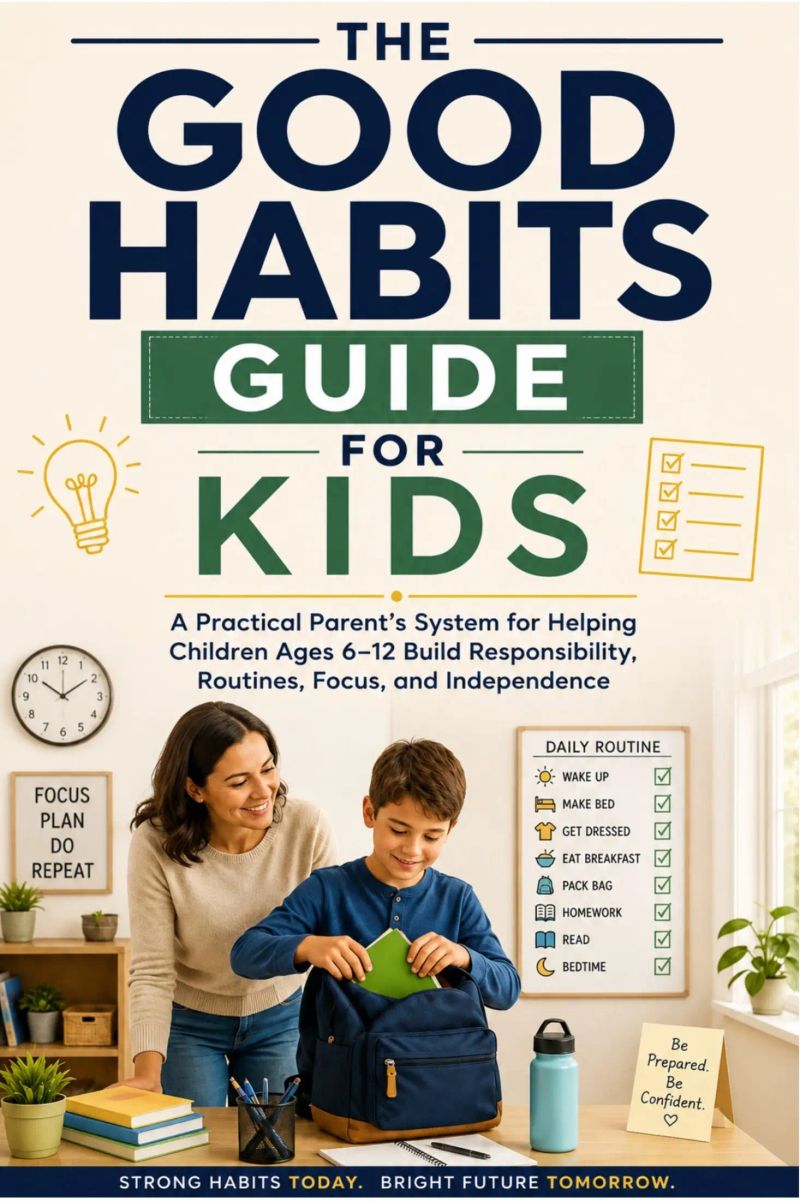
THE GOOD HABITS GUIDE FOR KIDS
A Practical Parent’s System for Helping Children Ages 6–12 Build Responsibility, Routines, Focus, and IndependenceBy Andrew Boliver


Length4h 32m
About this audiobook
THE GOOD HABITS GUIDE FOR KIDS:A Practical Parent’s System for Helping Children Ages 6–12 Build Responsibility, Routines, Focus, and Independence
What if your child could become more responsible without you having to remind them about everything?
“Brush your teeth.”
“Pack your bag.”
“Do your homework.”
“Put your clothes away.”
“Finish your chore.”
“Turn off the tablet.”
If you find yourself repeating the same instructions every day, you're not alone. Many parents want their children to become more responsible and independent, but don't know how to move from constant reminders to genuine ownership.
The Good Habits guide for Kids gives you a practical system for helping children ages 6–12 develop the everyday habits and skills they need to manage more of their own lives.
This isn't about creating a perfectly organized child.
It's about teaching children what to do, helping them practice it, and gradually stepping back as they become capable of doing more for themselves.
Inside, you'll discover practical strategies for:
• Building morning and evening routines that children can actually follow
• Helping kids get ready for school with fewer reminders
• Creating homework, reading, and study habits without unnecessary pressure
• Teaching responsibility through realistic, age-appropriate chores
• Helping children organize their belongings, school supplies, and daily responsibilities
• Developing focus, patience, follow-through, and the ability to finish what they start
• Creating healthier boundaries around screens and technology
• Using encouragement, rewards, and consequences without turning every situation into a power struggle
• Moving from constant commands to questions that encourage children to think for themselves
• Gradually transferring responsibilities from parent to child
• Recovering when routines fall apart during holidays, busy periods, illness, or major changes
• Using a practical 30-Day Good Habits Plan to put the system into action
Most importantly, you'll learn how to stop trying to manage every little thing for your child and start building systems that help your child manage more independently.
Because responsibility isn't created by one big lecture.
It's built through small actions repeated consistently:
Put it away.
Check the list.
Prepare for tomorrow.
Finish what you started.
Notice the mistake.
Fix it.
Try again.
Whether you're dealing with chaotic mornings, forgotten homework, unfinished chores, messy routines, screen-time battles, or a child who seems to need constant reminders, this book gives you a practical starting point.
Start with one habit. Build it properly. Then give your child the responsibility to own it.
Help your child become not just more obedient, but more capable, responsible, confident, and independent—one everyday habit at a time.
Audiobook details
GenreSelf-Help
Length4 hrs 32 mins
Narrated byListen with 1,000+ voices
FormateBook with Audio
LanguageEnglish
Table of contents
1Introduction
2Introduction
3Acknowledgments
4Chapter 1
5Why Good Habits Matter
Show all chaptersShow less
6Habits Are What Children Do When Nobody Is Reminding Them
7From Rules and Reminders to Real Responsibility
8Start Small: Building Habits Without Turning Home Into a Battlefield
9Chapter 2
10Understanding How Children Build Habits
11The Habit Loop: What Happens Before, During, and After a Behavior
12Make the Right Behavior the Easy Behavior
13Why Children Resist and How to Build Habits They Can Actually Own
14Chapter 3
15Creating a Morning and Evening Routine
16Build the Morning Around a Simple Sequence
17Win Tomorrow Tonight
18Step Back Without Dropping the Routine
19Chapter 4
20Homework, Reading, and Study Habits
21Create a Homework Rhythm, Not a Homework War
22Teach Focus and Reading Without Turning Learning Into Punishment
23Move From “I Need Help” to “I Can Handle This”
24Chapter 5
25Teaching Responsibility Through Chores
26Give Children Real Responsibilities, Not Random Jobs
27Teach Completion Before You Expect Independence
28When Chores Become a Battle
29Chapter 6
30Organization and Time Management
31Give Everything a Home—and Teach the Child to Use It
32Teach Children to Prepare Before They Need Something
33Move the Responsibility for Remembering From You to Them
34Chapter 7
35Building Focus, Patience, and Follow-Through
36Teach Children to Stay When the Work Gets Hard
37Teach Children to Handle Boredom, Waiting, and “Not Yet”
38Teach Children What to Do When Things Go Wrong
39Chapter 8
40Screen Time and Healthy Daily Balance
41Create Screen Rules That Don't Depend on Daily Arguments
42Teach Children How to Stop, Not Just When to Stop
43Build a Child Who Can Eventually Manage Their Own Technology
44Chapter 9
45Encouragement, Rewards, and Discipline
46Reinforce the Behavior You Want to See
47Make Expectations Clear Before You Correct Behavior
48Stay Firm Without Turning Every Conflict Into a Battle
49Chapter 10
50From Constant Reminders to Independence
More from Andrew Boliver
LE GUIDE DES BONNES HABITUDES POUR LES ENFANTSAndrew Boliver5h 8m$10

DER GUTE-GEWÖHNHEITEN-RATGEBER FÜR KINDERAndrew Boliver5h 16m4.6 (13)$10

La guida completa per perdere peso e mangiare sanoAndrew Boliver1h 49m4.1 (12)$10

La guía completa para perder peso y comer sanoAndrew Boliver2h$10

Le guide complet de la perte de poids et d'une alimentation saineAndrew Boliver1h 49m$11.50 · $0.00

Der vollständige Leitfaden für Gewichtsverlust und gesunde ErnährungAndrew Boliver1h 43m$10
Learning to PrayJames Martin13h 24m4.5 (3.4K)$33 · $0.00

Swayam Ki AwaazPrem Rawat8h 34m4.7 (1.1K)$26 · $0.00
Forever BoyKate Swenson9h 27m4.7 (5K)$29 · $0.00

You Are Worth ItKyle Carpenter, Don Yaeger8h 53m4.7 (4.8K)$29 · $0.00

The Happiest Man on EarthEddie Jaku3h 48m4.6 (178K)$7 · $0.00

Finding MeViola Davis9h 15m4.6 (256.4K)$29 · $0.00

Spiritual AnatomyDaaji Kamlesh D. Patel9h 47m4.7 (319)$29 · $0.00

The Dangerous Truth about Today’s MarijuanaLaura Stack CSP, MBA9h 57m4.7 (385)$20 · $0.00
The Gospel according to Spiritualism (Translated)Allan Kardec14h 39m4.6 (3.9K)$5.70 · $0.00

Birdie & HarlowTaylor Wolfe7h 50m4.6 (6.5K)$26 · $0.00

CrossroadsKaleb Dahlgren7h 56m4.6 (4.9K)$26 · $0.00

Life on the BridgeKaelynn Partlow5h 40m4.6 (1.1K)$24 · $0.00

Keep Your Love OnDanny Silk9h 4m4.6 (8.1K)$10 · $0.00
The Tao of Joy Every DayDerek Lin10h 24m4.6 (762)$20 · $0.00
UndividedVicky Beeching9h 2m4.6 (1.3K)$29 · $0.00

HE CAN WHO THINKS HE CAN & OTHER BOOKS ON SUCCESSOrison Swett Marden5h 54m4.6 (1.2K)$1.99 · $0.00
Level UpRob Dial7h 42m4.6 (3.3K)$26 · $0.00
Burn the HaystackJennie Young, PhD9h 30m4.6 (543)$29 · $0.00

ACRES OF DIAMONDS: Our Every-day Opportunities (Wisdom & Empowerment Series) (Annotated)Russell Conwell2h 26m4.6 (1K)$2 · $0.00
Good InsideBecky Kennedy9h 55m4.5 (59.3K)$29 · $0.00
You may also like

Parents and Children (Annotated)Charlotte Mason9h 23m4.6 (988)$2 · $0.00

Ramona Quimby, Age 8Beverly Cleary2h 7m4.3 (92.9K)$16 · $0.00

The Colored Girl BeautifulE. Azalia Hackley1h 25m4.2 (268)$1 · $0.00
Teach Your Children WellMadeline Levine10h 57m4.0 (1.8K)$29 · $0.00
The Gift of FailureJessica Lahey7h 47m4.2 (11.6K)$26 · $0.00

Kiss of Broken GlassMadeleine Kuderick2h3.7 (2.1K)$16 · $0.00
The Available ParentDr. John Duffy5h 48m4.2 (748)$20 · $0.00
How Children SucceedPaul Tough8h 36m4.0 (29.1K)$26 · $0.00
The Mother DanceHarriet Lerner9h 39m4.0 (3.2K)$29 · $0.00

The Blessing of a B MinusWendy Mogel PhD8h 18m4.3 (1.7K)$17 · $0.00
The Discipline BookWilliam Sears MD, Martha Sears RN17h 21m4.0 (1.4K)$25

Baby Milestones Are They Really a Measure of SuccessAurora Brooks1h 1m$3.50 · $0.00
Responsive FeedingMelanie Potock MA, CCC-SLP6h 51m4.6 (190)$17 · $0.00
Raising Confident Kids as a Working MomAurora Brooks1h 14m$3.50 · $0.00

Tips for Raising a Confident DaughterAurora Brooks1h 13m$3.50 · $0.00
Raising Conscious ChildrenDr. Sarah Mitchell3h 51m$14 · $0.00
The Top Parenting Mistakes to AvoidAurora Brooks1h 9m$3.50 · $0.00

WHISPERS OF THE SOULJESSICA TAYLOR46m4.3 (22) Only with Ultra

Self-Esteem for TeenagersMade for Success34m$5

New Skills for Frazzled Parents, Revised EditionDaniel G. Amen MD3h 49m4.1 (115)$17