
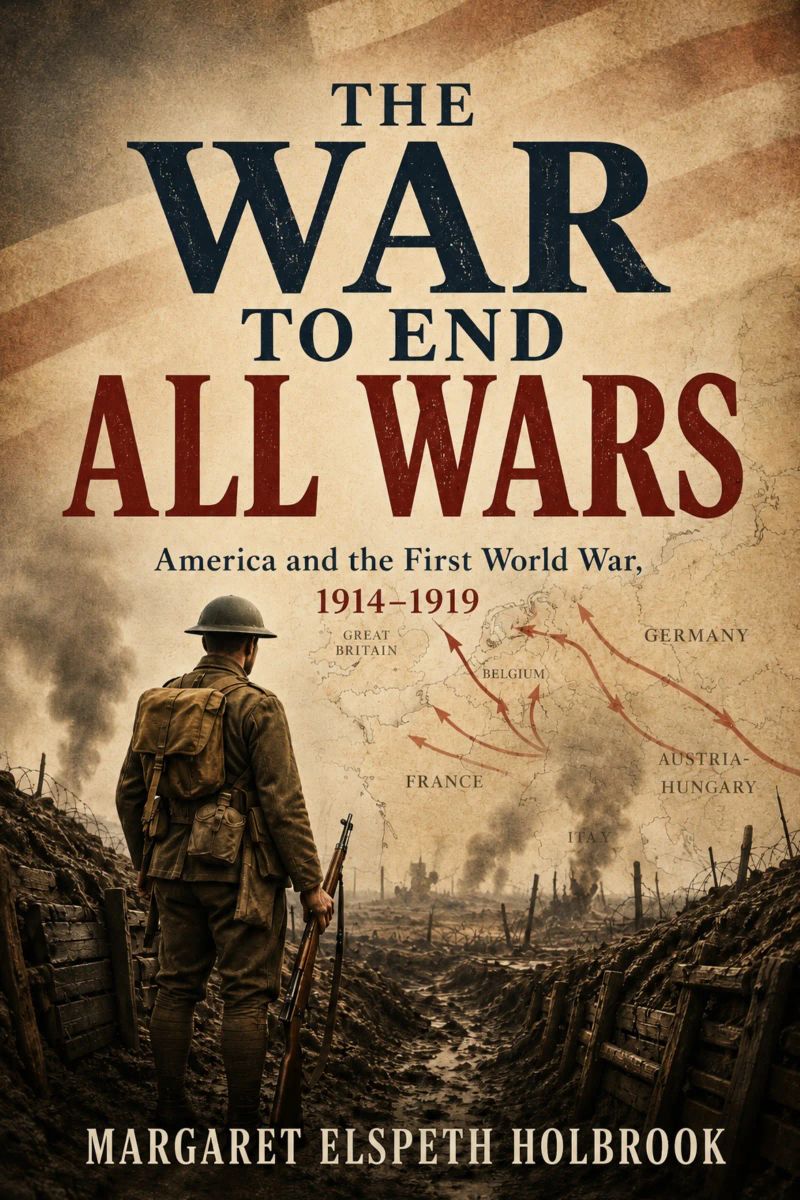
THE WAR TO END ALL WARS
America and the First World War, 1914–1919By Margaret Elspeth Holbrook


Length7h 8m
About this audiobook
World War I history — America and the First World War 1914-1919: Wilson's neutrality, the Lusitania, the Zimmermann Telegram, the Western Front, the influenza pandemic, and the Treaty of Versailles that planted the seeds of the next catastrophe.
On June 28, 1914, Gavrilo Princip stepped forward from the crowd outside a Sarajevo delicatessen and fired twice. Both the Archduke and his wife were dead within the hour. Within thirty-seven days, the alliance machinery of Europe had transformed a Balkan assassination into a continental war. The United States watched from three thousand miles away — and was dragged in anyway, not by any single act of will but by finance, submarines, propaganda, and the structural impossibility of neutrality when $2.3 billion in American bank loans had already tied the country's economy to an Allied victory.
This World War I history follows America's full arc from August 1914 through the Senate's rejection of the League of Nations in 1920. Woodrow Wilson, Henry Cabot Lodge, John Pershing, W.E.B. Du Bois, Eugene Debs, Colonel Edward House, Secretary William Jennings Bryan, and the two million doughboys of the American Expeditionary Forces — along with the 675,000 Americans killed by the influenza pandemic, more than all twentieth-century combat deaths combined — move across twenty-four chapters of the most transformative five years in modern American history.
Inside this World War I history:
The Lusitania's 18 minutes — U-20's single torpedo, 1,198 dead including 128 Americans, and how Germany's legally defensible military argument was politically catastrophic (Chapter 3)
The Western Front's industrial killing — 57,470 British casualties on July 1, 1916 alone; men walking upright into intact machine guns because commanders believed the artillery had cleared them (Chapter 9)
Wilson's impossible neutrality — exports to the Allies rising from $824 million in 1914 to $3.2 billion by 1916; Bryan resigning rather than sign the second Lusitania note; the Sussex Pledge's fragility from the moment Wilson accepted it (Chapter 2)
Influenza at the peace conference — Wilson's April 1919 illness, the cognitive changes his advisers noticed, and the concessions on reparations and the war guilt clause made in his final weeks at Paris (Chapter 16)
Black Americans in the war — the 369th Infantry's 191 days in the French front line, more than any other American unit, and the race riots greeting their return in 1919 (Chapter 14)
The Senate's fatal arithmetic — 23 Wilson-loyal Democrats voting against the treaty with reservations; a shift of 7 votes would have passed it; what the League's absence from American membership cost (Chapter 19)
Holbrook's World War I history delivers the complete American story: why a neutral nation became a belligerent, what it paid, what Wilson promised at Paris, and why the gap between the Fourteen Points and the Treaty of Versailles was the wound through which the next war entered.
Audiobook details
GenreHistory
Length7 hrs 8 mins
Narrated byListen with 1,000+ voices
FormateBook with Audio
Publish dateJun 1, 2026
LanguageEnglish
Table of contents
1Introduction
2Prologue: The World Before the War
3PART ONE: THE ROAD TO WAR (1914–1917)
4Chapter 1: The Guns of August — Europe Goes to War
5Chapter 2: American Neutrality — Wilson's Impossible Balance
Show all chaptersShow less
6Chapter 3: The Submarine War — Germany's Gamble and America's Response
7Chapter 4: The Zimmermann Telegram — The Final Provocation
8PART TWO: AMERICA MOBILIZES (1917)
9Chapter 5: Over Here — The Draft, Propaganda, and Wartime America
10Chapter 6: The Doughboys — Building the American Expeditionary Forces
11Chapter 7: The Home Front — Industry, Labor, and Sacrifice
12Chapter 8: The War on Dissent — Espionage Act and Civil Liberties
13PART THREE: THE WESTERN FRONT (1917–1918)
14Chapter 9: The Trenches — Life and Death on the Western Front
15Chapter 10: America Arrives — Pershing and the AEF in France
16Chapter 11: The German Spring Offensive of 1918 — The Last Gamble
17Chapter 12: The Hundred Days — The Allied Victory
18PART FOUR: THE WAR'S HUMAN COST
19Chapter 13: The Lost Generation — American Casualties and Their Stories
20Chapter 14: Black Americans in the War — Serving a Country That Excluded Them
21Chapter 15: Women in the War — Nurses, Workers, and the Suffrage Connection
22Chapter 16: The Influenza Pandemic — The War's Deadliest Weapon
23PART FIVE: THE PEACE (1918–1919)
24Chapter 17: The Fourteen Points — Wilson's Vision for the World
25Chapter 18: The Paris Peace Conference — Versailles and Its Compromises
26Chapter 19: The Senate Fight — The Treaty's American Defeat
27Chapter 20: The Red Scare — Fear, Repression, and the Postwar Crisis
28PART SIX: LEGACIES
29Chapter 21: What the War Did to America — The Transformation
30Chapter 22: The Failure of the League — Wilsonianism Without Wilson
31Chapter 23: The War's Long Shadow — How WWI Led to WWII
32Chapter 24: Memory and Memorials — How America Remembers the Great War
33Epilogue: The Peace That Failed
34Acknowledgments
35Selected Bibliography
36About the Author
More from Margaret Elspeth Holbrook


A Brief History of IntelligenceMax S. Bennett12h 18m4.6 (6.6K)$29 · $0.00

The Gulag Archipelago Volume 3Aleksandr I. Solzhenitsyn21h 56m4.7 (8.9K)$46 · $0.00

Pearl of Great PriceJoseph Smith3h 8m4.7 (7.2K)$1.20 · $0.00

The Happiest Man on EarthEddie Jaku3h 48m4.6 (178K)$7 · $0.00

MotherlandJulia Ioffe17h 52m4.7 (2.5K)$40 · $0.00

Where Cowards Go to DieBenjamin Sledge8h 42m4.7 (351)$20 · $0.00

RevolutionariesSanjeev Sanyal11h 23m4.6 (2.6K)$29 · $0.00

We Crossed a Bridge and It TrembledWendy Pearlman6h4.6 (5.2K)$24 · $0.00

Unbroken Bonds of BattleJohnny Joey Jones8h 31m4.6 (2.6K)$8 · $0.00

The Daughter of AuschwitzTova Friedman, Malcolm Brabant7h 54m4.6 (16.7K)$26 · $0.00

Lily's PromiseLily Ebert, Dov Forman8h 54m4.6 (16.1K)$29 · $0.00

On Democracies and Death CultsDouglas Murray10h 38m4.6 (6.5K)$29 · $0.00

Across the RiverKent Babb11h 40m4.6 (927)$29 · $0.00

Balcony Over Jerusalem: A Middle East Memoir - Israel, Palestine and BeyondJohn Lyons12h 37m4.6 (1.4K)$33 · $0.00

BeyondStephen Walker15h 39m4.6 (3.2K)$33 · $0.00
Kings and PawnsHoward Bryant10h 9m4.6 (678)$29 · $0.00

No EscapeNury Turkel9h 30m4.6 (809)$28 · $0.00

Jubal Stone: U.S. Marshal: Blood Trail To Hell: A Western Adventure NovelCasey Nash3h 42m4.6 (3.2K)$18 · $0.00

Fall and RiseMitchell Zuckoff17h 23m4.6 (9.8K)$40 · $0.00
The SurvivorJosef Lewkowicz, Michael Calvin9h 22m4.6 (2.5K)$29 · $0.00
You may also like
The Korean WarSir Max Hastings17h 35m4.3 (14.5K)$28

The Second World WarMartin Gilbert42h 59m4.3 (5.3K)$30

The Politically Incorrect Guide to the Vietnam WarPhillip Jennings6h 30m4.0 (575)$14
D-Days in the PacificDonald L. Miller17h 52m4.4 (475)$25

140 Days to HiroshimaDavid Dean Barrett13h 8m4.5 (548)$23
Dereliction of DutyH. R. McMaster15h 58m4.1 (7K)$33 · $0.00
History of the Great War (All 6 Volumes)Arthur Conan Doyle57h 13m3.9 (47)$2 · $0.00
Keith Murdoch’s Gallipoli LetterSir Keith Murdoch49m3.9 (32)$8

The Great WarRobert Livesey2h 3m$8 · $0.00

Germany's High Seas Fleet in the World WarReinhard Scheer16h 3m4.0 (208)$1 · $0.00
The Story of the Great War (Vol. 1-8) (Annotated)Various Authors155h 1m$2 · $0.00
THE FORGOTTEN WARThomas Andrew Buckley5h 39m$8

The Russo-Japanese War (Annotated)Sydney Tyler14h 34m$1.99 · $0.00

My Year of the Great WarFrederick Palmer14h 14m3.9 (95)$2 · $0.00
THE BATTLE OF THE SOMMEJohn Buchan4h 44m3.5 (44)$1 · $0.00
Gallipoli Diary (Annotated)Ian Hamilton21h 28m4.0 (173)$1.99 · $0.00
The Battle for the RhineRobin Neillands12h 9m4.0 (454)$23

Europe at WarSantiago Machain7h 4m$25 · $0.00

Lessons of the War: Being Comments from Week to Week to the Relief of LadysmithSpenser Wilkinson3h 55m$1 · $0.00
Our Greatest Battle (The Meuse-Argonne) (Annotated)Frederick Palmer13h 31m$2 · $0.00