
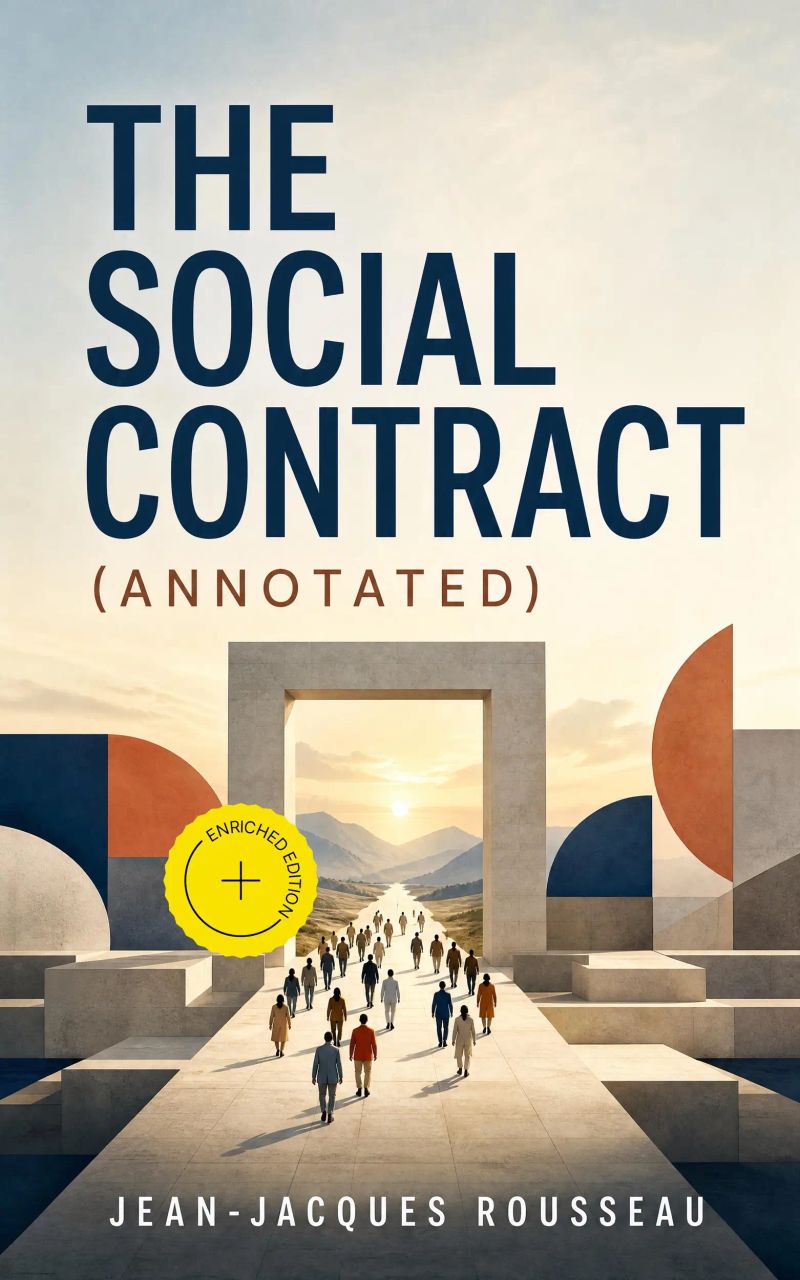
The Social Contract (Annotated)
Enriched Edition. Enlightenment Political Philosophy on Popular Sovereignty, the General Will, Democracy, and Modern FreedomBy Jean-Jacques Rousseau


Length8h 19m
About this audiobook
In The Social Contract (1762), Jean-Jacques Rousseau offers one of the defining works of modern political philosophy, asking how legitimate authority can arise among free and equal persons. Written in a compressed, aphoristic, and rigorously argumentative style, the treatise develops the famous doctrine of the "general will," distinguishing true sovereignty from mere domination. Situated within the Enlightenment yet sharply critical of its complacencies, it challenges hereditary monarchy, private faction, and political inequality. Rousseau, born in Geneva in 1712, was shaped by republican civic traditions, social marginality, and a lifelong suspicion of institutions that corrupt natural freedom. His experiences in France, his conflicts with philosophes, and his earlier writings on inequality and education all inform this work. The Social Contract reflects both his democratic aspirations and his anxiety that liberty requires moral discipline, civic participation, and a shared commitment to the common good. This book is essential for readers seeking to understand revolution, democracy, citizenship, and the tensions between individual liberty and collective authority. Demanding but lucid, it rewards careful reading and remains indispensable to political theory, constitutional thought, and the history of modern freedom.
This enriched edition has been carefully crafted to add value to your reading experience.
- A succinct Introduction situates the work's timeless appeal and themes.
- The Synopsis outlines the central plot, highlighting key developments without spoiling critical twists.
- A detailed Historical Context immerses you in the era's events and influences that shaped the writing.
- An Author Biography reveals milestones in the author's life, illuminating the personal insights behind the text.
- A thorough Analysis dissects symbols, motifs, and character arcs to unearth underlying meanings.
- Reflection questions prompt you to engage personally with the work's messages, connecting them to modern life.
- Hand‐picked Memorable Quotes shine a spotlight on moments of literary brilliance.
- Interactive footnotes clarify unusual references, historical allusions, and archaic phrases for an effortless, more informed read.
Audiobook details
Rating★★★★ 3.6 (169)
Includes Goodreads
GenrePolitics and Government
Length8 hrs 19 mins
Narrated byListen with 1,000+ voices
FormateBook with Audio
Publish dateMay 1, 2018
LanguageEnglish
Table of contents
1Introduction
2Introduction
3Synopsis
4Historical Context
5Author Biography
Show all chaptersShow less
6Introduction
7Foreword
8Book I
9Chapter I. Subject of the First Book
10Chapter II. The First Societies
11Chapter III. The Right of the Strongest
12Chapter IV. Slavery
13Chapter V. That We Must Always Go Back to a First Convention
14Chapter VI. The Social Compact
15Chapter VII. The Sovereign
16Chapter VIII. The Civil State
17Chapter IX. Real Property
18Book II
19Chapter I. That Sovereignty is Inalienable
20Chapter II. That Sovereignty is Indivisible
21Chapter III. Whether the General Will is Fallible
22Chapter IV. The Limits of the Sovereign Power
23Chapter V. The Right of Life and Death
24Chapter VI. Law
25Chapter VII. The Legislator
26Chapter VIII. The People
27Chapter IX. The People (continued)
28Chapter X. The People (continued)
29Chapter XI. The Various Systems of Legislation
30Chapter XII. The Division of the Laws
31Book III
32Chapter I. Government in General
33Chapter II. The Constituent Principle in the Various Forms of Government
34Chapter III. The Division of Governments
35Chapter IV. Democracy
36Chapter V. Aristocracy
37Chapter VI. Monarchy
38Chapter VII. Mixed Governments
39Chapter VIII. That All Forms of Government Do Not Suit All Countries
40Chapter IX. The Marks of a Good Government
41Chapter X. The Abuse of Government and Its Tendency to Degenerate
42Chapter XI. The Death of the Body Politic
43Chapter XII. How the Sovereign Authority Maintains Itself
44Chapter XIII. The Same (continued)
45Chapter XIV. The Same (continued)
46Chapter XV. Deputies or Representatives
47Chapter XVI. That the Institution of Government is Not a Contract
48Chapter XVII. The Institution of Government
49Chapter XVIII. How to Check the Usurpations of Government
50Book IV

El contrato socialJean-Jacques Rousseau4h 50m4.0 (72.9K)$1.99 · $0.00

Dirección Financiera: Inversión Y Financiación Vol I Decisiones De InversiónJean-Jacques Rousseau18h 12m$23 · $0.00

The Complete Works (Annotated)Jean-Jacques Rousseau70h 7m$2 · $0.00

Confessions & The Social Contract (Annotated)Jean-Jacques Rousseau36h 49m4.6 (12)$2 · $0.00

Confessions (Annotated)Jean-Jacques Rousseau30h 27m4.0 (28.9K)$2 · $0.00

Discourse on the Origin of Inequality (Annotated)Jean-Jacques Rousseau4h 36m4.2 (40.4K)$2 · $0.00

Emile oder über die Erziehung (Kommentiert)Jean-Jacques Rousseau38h 10m4.5 (12)$2 · $0.00

The Social Contract & EmileJean-Jacques Rousseau33h 43m3.8 (59.7K)$2 · $0.00

Emile, or On EducationJean-Jacques Rousseau26h 3m3.8 (7.2K)$1 · $0.00
Émile eli KasvatuksestaJean-Jacques Rousseau28h 13m4.0 (14.1K)$2 · $0.00

A Discourse Upon the Origin and the Foundation of the Inequality Among MankindJean-Jacques Rousseau2h 50m4.0 (24.3K)$2 · $0.00

The Essential Writings of Jean-Jacques RousseauJean-Jacques Rousseau82h 44m4.3 (1.8K)$1.99 · $0.00

Emile & Confessions (Annotated)Jean-Jacques Rousseau56h 15m4.3 (39)$2 · $0.00
Emile, Confessions & The Social Contract (3 Books in One Edition)Jean-Jacques Rousseau62h 46m$1.99 · $0.00

Emile oder über die ErziehungJean-Jacques Rousseau31h 57m4.0 (20.5K)$2 · $0.00
Yhteiskuntasopimuksesta, eli, Valtio-oikeuden johtavat aatteetJean-Jacques Rousseau4h 36m3.8 (59.4K)$1 · $0.00

The French Revolution and NapoleonJean-Jacques Rousseau, Alexis de Tocqueville, Montesquieu, Charles Downer Hazen62h 54m4.1 (574)$2 · $0.00

The Essential Writings of Jean-Jacques RousseauJean-Jacques Rousseau82h 31m4.1 (26)$2 · $0.00

El contrato socialJean-Jacques Rousseau5h 58m4.1 (123.4K)$2 · $0.00

RiggedMollie Hemingway12h 48m4.6 (4.2K)$23 · $0.00

SledgehammerDavid Friedman8h 21m4.7 (589)$26 · $0.00

Citizenship in a Republic (Annotated)Theodore Roosevelt2h 44m4.6 (1.4K)$2 · $0.00

No EscapeNury Turkel9h 30m4.6 (809)$28 · $0.00

Always FaithfulThomas Schueman, Zainullah Zaki12h 12m4.6 (977)$29 · $0.00

UnthinkableJamie Raskin15h 8m4.5 (9.3K)$8 · $0.00

My Fourth Time, We DrownedSally Hayden13h 59m4.6 (2.9K)$23 · $0.00

A Revolution of Common SenseScott Jennings9h 29m4.6 (528)$29 · $0.00

Statement From the Dock at the Rivonia TrialNelson Mandela2h 18m4.6 (1.3K)$1 · $0.00

Lessons from the EdgeMarie Yovanovitch17h 11m4.5 (5.9K)$40 · $0.00

To Rescue the American SpiritBret Baier10h 12m4.5 (2.7K)$8 · $0.00

StonewalledSharyl Attkisson15h 19m4.5 (4.3K)$33 · $0.00
The World According to Orwell: 1984 & Animal FarmGeorge Orwell15h 42m4.6 (1.1K)$1 · $0.00
Basic EconomicsThomas Sowell18h 32m4.5 (29.3K)$28 · $0.00

To Rescue the RepublicBret Baier, Catherine Whitney11h 42m4.5 (8.6K)$29 · $0.00

Modern WarriorsPete Hegseth7h 10m4.5 (4.7K)$24 · $0.00

Philosophy and Opinions of Marcus Garvey (Annotated)Marcus Mosiah Garvey4h 42m4.5 (1.7K)$1.99 · $0.00

A Plague Upon Our HouseScott W. Atlas MD10h 37m4.5 (3.4K)$20 · $0.00

One Bright MoonAndrew Kwong12h 21m4.5 (813)$29 · $0.00

CredibleDeborah Tuerkheimer8h 5m4.6 (551)$26 · $0.00
You may also like

Free Market RevolutionYaron Brook, Don Watkins8h 13m4.4 (1K)$20 · $0.00

The MAGA DoctrineCharlie Kirk6h 34m4.1 (4.1K)$24 · $0.00

America's Cultural RevolutionChristopher F. Rufo11h 24m4.5 (3.9K)$29 · $0.00
Wages, Price and ProfitKarl Marx2h 16m4.3 (3.8K)$4 · $0.00
The Communist ManifestoKarl Marx, Friedrich Engels2h 13m3.9 (252.7K)$2 · $0.00

An Enemy of the PeopleHenrik Ibsen3h 44m4.0 (20.4K)$21 · $0.00

It’s Even Worse Than It LooksThomas E. Mann, Norman J. Ornstein6h 43m4.0 (4.6K)$18 · $0.00

Now & AfterAlexander Berkman11h 28m3.9 (1.7K)$2 · $0.00

10 Books Every Conservative Must ReadBenjamin Wiker PhD10h 34m4.2 (827)$20 · $0.00

The Passing of EmpireH. Fielding6h 11m4.4 (10)$2 · $0.00

LawlessIlya Shapiro10h 31m3.5 (92)$29 · $0.00

Alsace-Lorraine under German RuleCharles Downer Hazen6h 10m3.8 (10)$1 · $0.00

The Organization of the Congregation in the Early Lutheran Churches in AmericaB. M. Schmucker1h 36m$2 · $0.00

Red State UprisingErick Erickson, Lewis K. Uhler6h 37m3.6 (23)$14 · $0.00

Federalist Versus Anti-Federalist in AmericaAlexander Hamilton, James Madison, John Jay, Patrick Henry, Samuel Bryan20h 47m4.6 (12)$1.99 · $0.00

The Complete Works of Lysander SpoonerLysander Spooner88h 40m$1 · $0.00

Why Do We Still Have the Electoral College?Alexander Keyssar17h 26m4.2 (130)$25 · $0.00

The Swedish-Norwegian Union CrisisKarl Nordlund4h 32m$2 · $0.00

Who fears to speak of '98Anonymous54m$1 · $0.00

Rabbi with a Cause: Israel and Identity - A Conversation with David J. GoldbergHoward Burton1h 9m$3 · $0.00