
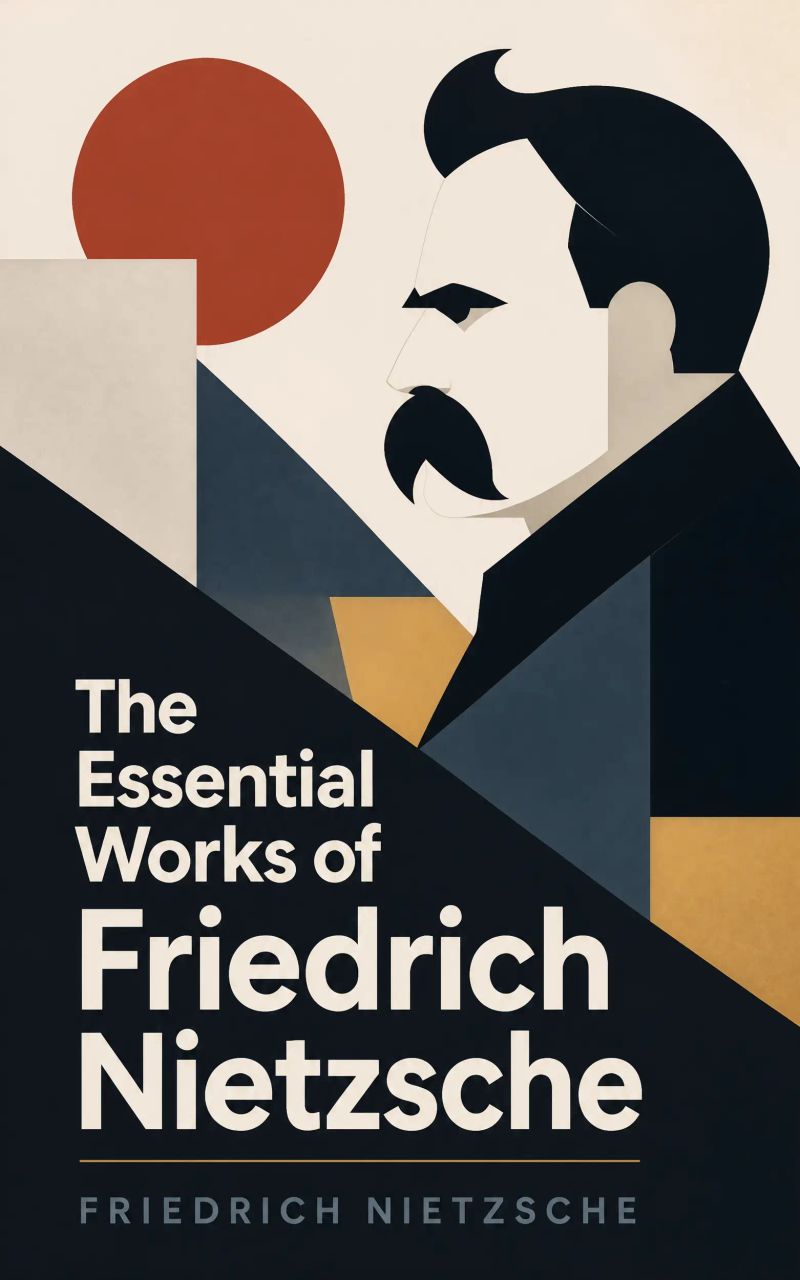
The Essential Works of Friedrich Nietzsche
Aphorisms on Morality, Nihilism, Self-Overcoming, and the Will to PowerBy Friedrich Nietzsche


Length91h 53m
About this audiobook
The Essential Works of Friedrich Nietzsche gathers representative writings from the philosopher's most influential periods, presenting his sustained examinations of morality, religion, art, culture, knowledge, and the formation of the self. Across aphorisms, polemical essays, and more lyrical, prophetic passages, Nietzsche dismantles inherited certainties while advancing such provocative concepts as the will to power, the Übermensch, eternal recurrence, and the transvaluation of values. His compressed rhetoric, irony, genealogical method, and deliberately unsettling voice place these texts at the crossroads of nineteenth-century German philosophy, Romantic cultural criticism, and the emerging modernist critique of reason and progress. Born in 1844 and initially trained as a classical philologist, Nietzsche brought an exceptional sensitivity to language, Greek tragedy, and historical interpretation to his philosophical work. His early admiration for Wagner, later rejection of the composer, fraught relationship with Christianity, and growing dissatisfaction with academic and European culture all helped shape his project of cultural diagnosis. Writing during a period of scientific, political, and religious upheaval, he sought not merely to refute doctrines but to expose the psychological and historical needs from which values arise. This volume is an excellent introduction to Nietzsche's challenging and influential thought, while also rewarding readers already familiar with his major works. It invites sustained reflection rather than passive agreement, making it valuable for students of philosophy, literature, intellectual history, and anyone interested in the possibilities and dangers of radical critique.
Audiobook details
Rating★★★★★ 4.5 (389)
Includes Amazon, Goodreads
GenrePhilosophy
Length91 hrs 53 mins
Narrated byListen with 1,000+ voices
FormateBook with Audio
Publish dateDec 18, 2023
LanguageEnglish
Table of contents
1Four Phases of Morals: Socrates, Aristotle, Christianity, Utilitarianism (Annotated)
2Preface
3Chapter I. Prejudices of Philosophers
4Chapter II. The Free Spirit
5Chapter III. The Religious Mood
Show all chaptersShow less
6Chapter IV. Apophthegms and Interludes
7Chapter V. The Natural History of Morals
8Chapter VI. We Scholars
9Chapter VII. Our Virtues
10Chapter VIII. Peoples and Countries
11Chapter IX. What is Noble?
12From the Heights
13Supplement to Chapter VIII. Peoples and Countries
14The Genealogy of Morals
15Preface
16First Essay. "Good and Evil," "Good and Bad."
17Second Essay. "Guilt," "Bad Conscience," and the Like.
18Third Essay. What is the Meaning of Ascetic Ideals? (pt. 1)
19Third Essay. What is the Meaning of Ascetic Ideals? (pt. 2)
20The Birth of Tragedy or, Hellenism and Pessimism
21Introduction
22An Attempt at Self-Criticism
23Foreword to Richard Wagner
24The Birth of Tragedy (pt. 1)
25The Birth of Tragedy (pt. 2)
26Appendix
27The Antichrist
28Introduction
29Preface
30The Antichrist (pt. 1)
31The Antichrist (pt. 2)
32Thus Spoke Zarathustra: A Book for All and None
33Introduction by Mrs Forster-Nietzsche
34First Part. Zarathustra’s Discourses
35Zarathustra’s Prologue
36I. The Three Metamorphoses
37II. The Academic Chairs of Virtue
38III. Backworldsmen
39IV. The Despisers of the Body
40V. Joys And Passions
41VI. The Pale Criminal
42VII. Reading and Writing
43VIII. The Tree on the Hill
44IX. The Preachers of Death
45X. War and Warriors
46XI. The New Idol
47XII. The Flies in the Market-Place
48XIII. Chastity
49XIV. The Friend
50XV. The Thousand and One Goals

Jenseits von Gut und BöseFriedrich Nietzsche7h 35m4.2 (184.4K)$10 · $0.00

Also sprach ZarathustraFriedrich Nietzsche10h 20m4.2 (214.8K)$24 · $0.00

Zur Genealogie der MoralFriedrich Nietzsche6h 10m4.3 (84.8K)$10 · $0.00

The Gay ScienceFriedrich Nietzsche11h 16m4.3 (25.7K)$1.99 · $0.00

EL ANTICRISTOFriedrich Nietzsche3h 17m4.1 (40.2K)$1.99 · $0.00

The Essential Works of Friedrich NietzscheFriedrich Nietzsche93h 31m4.4 (2K)$1.99 · $0.00

MorgenrötheFriedrich Nietzsche12h 8m4.3 (8.4K)$1 · $0.00

THUS SPOKE ZARATHUSTRA (Unabridged)Friedrich Nietzsche11h 38m4.1 (204.6K)$1.99 · $0.00
NIETZSCHE: Beyond Good and Evil, Thus Spoke Zarathustra and Hellenism & PessimismFriedrich Nietzsche27h 37m4.5 (18)$1.99 · $0.00

BEYOND GOOD AND EVIL (Unabridged)Friedrich Nietzsche8h 43m4.2 (139.5K)$1.99 · $0.00

El AnticristoFriedrich Nietzsche3h 15m4.1 (41.1K)$2.99 · $0.00

Le Gai SavoirFriedrich Nietzsche11h 4m4.3 (26.5K)$1.99 · $0.00

Sehnsucht nach Italien: Die 60 schönsten Italien-GedichteFriedrich Nietzsche, Georg Trakl, J.W. Goethe, Rainer Maria Rilke, Stefan Zweig, Adolf Friedrich von Schack, Alfred de Musset, Alfred Henschke, Anastasius Grün, Franz Grillparzer, Francesco Petrarca2h 2m$1 · $0.00

Ejercicios Resueltos De Sistemas DigitalesFriedrich Nietzsche5h 10m$15 · $0.00

Die Geburt der Tragödie (Kommentiert)Friedrich Nietzsche7h 20m4.4 (133)$1 · $0.00

Le Gai Savoir (Annoté)Friedrich Nietzsche12h 20m$1.99 · $0.00

Thus Spoke Zarathustra, Beyond Good and Evil, Hellenism & Pessimism (Annotated)Friedrich Nietzsche27h 36m$2 · $0.00

BEYOND GOOD AND EVIL - Prelude to a Philosophy of the Future (Annotated)Friedrich Nietzsche8h 46m4.2 (197.2K)$2 · $0.00

Ecce homo (Kommentiert)Friedrich Nietzsche5h 34m4.3 (44.5K)$1 · $0.00

Jenseits von Gut und Böse (Kommentiert)Friedrich Nietzsche9h 28m4.2 (134.6K)$1 · $0.00

WitnessAriel Burger8h 1m4.6 (1.3K)$20 · $0.00
The Magic PresenceGodfré Ray King10h 21m4.6 (307)$1.20 · $0.00

The Art of LivingThich Nhat Hanh5h 1m4.5 (14.2K)$24 · $0.00

Moral Letters to LuciliusLucius Annaeus Seneca24h 26m4.5 (71.7K)$1.99 · $0.00

Lessons in TruthH. Emilie Cady3h 50m4.5 (2.4K)$20 · $0.00
The Discourses of EpictetusP. E. MATHESOM12h 47m4.4 (17.7K)$1.20 · $0.00

IlluminationsWalter Benjamin10h 12m4.4 (16.2K)$20 · $0.00

That Bird Has My WingsJarvis Jay Masters9h 49m4.4 (13.7K)$29 · $0.00

Tâo Teh KingLaozi2h 34m4.4 (230.9K)$2 · $0.00
SymposiumPlato3h 26m4.4 (97.9K)$1.20 · $0.00

Buddhist Boot CampTimber Hawkeye2h 39m4.4 (8.4K)$18 · $0.00
Enchiridion & The Discourses of Epictetus (Annotated)Arrian Epictetus18h 9m4.4 (3.5K)$2 · $0.00

The Meditations of the Emperor Marcus Aurelius AntoninusEmperor of Rome Marcus Aurelius5h 41m4.4 (1.8M)$1 · $0.00
Crime and PunishmentFyodor Dostoevsky23h 11m4.4 (1.3M)$12 · $0.00

MeditationsMarcus Aurelius5h 52m4.4 (433.7K)$1 · $0.00

Everyday DharmaSuneel Gupta5h 2m4.5 (761)$20 · $0.00

The Joyful Wisdom ("La Gaya Scienza")Friedrich Wilhelm Nietzsche11h 37m4.4 (26.6K)$1 · $0.00
The Art of LivingEpictetus, Sharon Lebell3h 16m4.4 (50.1K)$18 · $0.00
MeditationsEmperor Of Rome Marcus Aurelius7h 23m4.3 (477.5K)$1.20 · $0.00

The Imitation of ChristThomas à Kempis6h 27m4.3 (84.6K)$21 · $0.00
You may also like

The World as Will and IdeaArthur Schopenhauer56h 15m4.4 (14.5K)$2 · $0.00

The Halo EffectPhil Rosenzweig6h 58m4.0 (6.5K)$20 · $0.00

About The Holy Bible: A LectureRobert Green Ingersoll2h 13m4.3 (388)$2 · $0.00
Hume in 90 MinutesPaul Strathern1h 18m3.6 (1.2K)$7

The Religion of the SamuraiKaiten Nukariya7h 36m4.1 (733)$1.20 · $0.00

Beyond Good and EvilFriedrich Nietzsche7h 5m4.2 (137.8K)$2 · $0.00

Three Dialogues between Hylas and PhilonousGeorge Berkeley4h 7m3.9 (3K)$1.20 · $0.00

The Invention of ScienceDavid Wootton22h 3m4.0 (1.9K)$30

On the Genealogy of MoralsFriedrich Nietzsche6h 11m4.3 (76.5K)$1.20 · $0.00

The Wealth of NationsAdam Smith45h 12m4.1 (138K)$40 · $0.00

The Mob MentalityGustave Le Bon16h 48m3.9 (34.1K)$1 · $0.00

Article Marketing Secrets ExposedAnthony Ekanem58m$5 · $0.00

Capital (Das Kapital) (Annotated)Karl Marx103h 48m$1.99 · $0.00
NudesJp. A. Calosse1h 53m3.1 (10)$13.50 · $0.00

1000 Erotic Works of GeniusHans-Jürgen Döpp, Joe A. Thomas, Victoria Charles9h 54m4.0 (151)$18 · $0.00

Drawings in Pen & Pencil from Dürer's Days to Ours, with Notes and AppreciationsGeoffrey Holmes1h 40m$2.30

How to Teach a Foreign LanguageOtto Jespersen5h 34m$2 · $0.00

Sex in the Cities Vol 1 (Amsterdam)Hans Jürgen Döpp2h 51m$12 · $0.00

Arithmetic of infinityYaroslav D. Sergeyev2h 50m4.5 (12)$19 · $0.00

Sex in the Cities Vol 2 (Berlin)Hans Jürgen Döpp2h 57m$15 · $0.00