
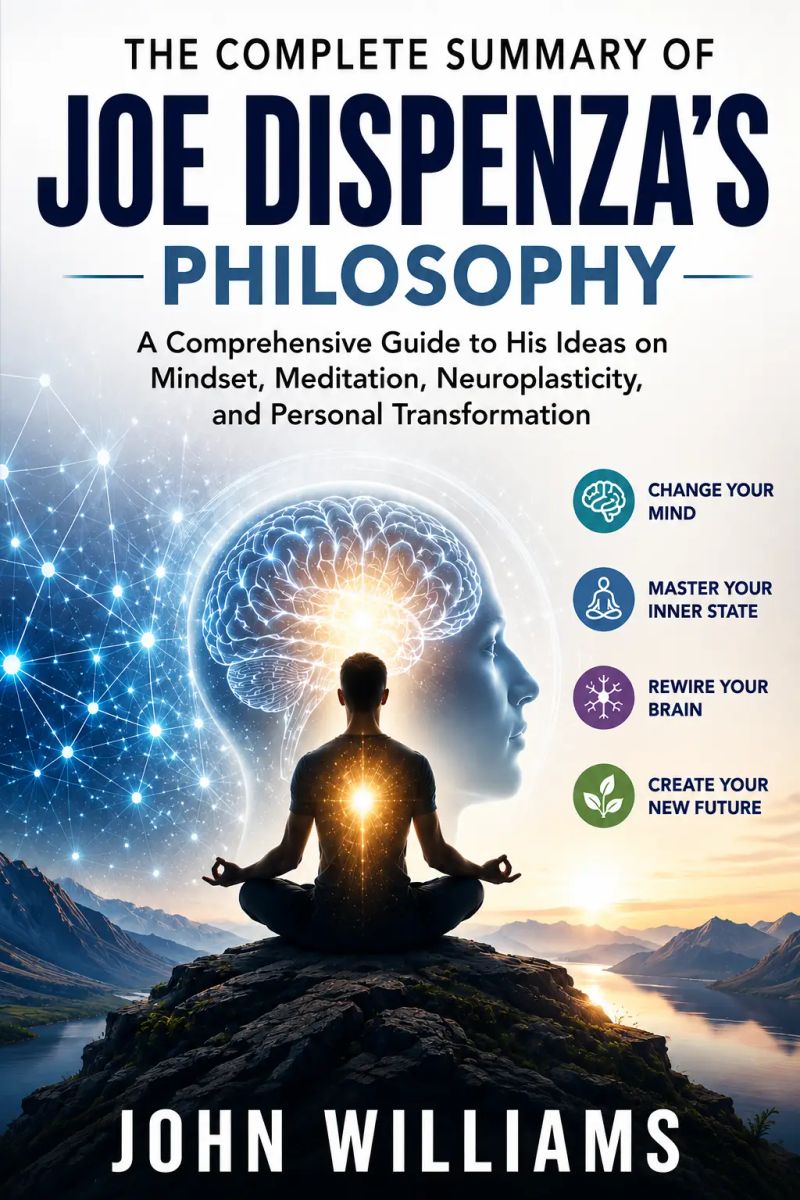
The Complete Summary of Joe Dispenza's Philosophy
A Comprehensive Guide to His Ideas on Mindset, Meditation, Neuroplasticity, and Personal TransformationBy John Williams


Length1h 23m
About this audiobook
Joe Dispenza has convinced millions that they can rewire their brains, break the habit of being themselves, and remake their lives from the inside out. But how much of his philosophy is science, and how much is spectacle? This independent guide reconstructs his entire system — the self as habit, the body's addiction to emotion, meditation as rehearsal, and the contested "quantum field" — in clear, original language, then weighs each claim against the evidence on neuroplasticity, stress, placebo, and visualization. Admiring where he earns it and unsparing where he overreaches, it separates what genuinely works from what merely sells.
Audiobook details
Rating★★★★★ 5.0 (1)
GenreSelf-Help, Health and Wellness
Length1 hr 23 mins
Narrated byListen with 1,000+ voices
FormateBook with Audio
Publish dateAug 4, 2026
LanguageEnglish
Table of contents
1Introduction
2Publisher's Note and Disclaimer
3Chapter 1: The Man, the Message, and Why It Traveled So Far….
4What kind of thinker is he?
5The four pillars
Show all chaptersShow less
6Why a summary is worth writing
7Chapter 2: You Are Not Your Past — The Core Premise
8The three levers
9Why the past feels like the future
10Where I part company
11Chapter 3: The Neuroscience — Neuroplasticity, Wiring, and the Limits of the Metaphor
12What is actually established
13Where the metaphor gets stretched
14An honest reformulation
15Chapter 4: The Body Remembers — Emotion, Chemistry, and the Addicted Self
16The argument in plain terms
17Is the addiction language fair?
18Stress as the master case
19The narrowing effect
20Chapter 5: Breaking the Habit of Being Yourself — The Model of Change
21Step one: metacognition
22Step two: interruption
23Step three: the withdrawal problem
24Step four: rehearsal
25An assessment of the architecture
26Chapter 6: Meditation as a Technology, Not a Tranquilliser
27Not relaxation, not emptiness
28The logic of the sequence
29The brainwave argument
30What is genuinely valuable
31Chapter 7: Elevated Emotion, Gratitude, and the Coherent Heart
32Why gratitude occupies the central place
33The heart material
34The practical residue
35Chapter 8: The Quantum Question — Where the Trouble Lives
36What he claims
37What quantum mechanics actually says
38The rhetorical function of the physics
39The cost of the fourth pillar
40Chapter 9: Placebo, Epigenetics, and the Claims About Healing
41The placebo argument
42Where the inference breaks
43Epigenetics
44How I would advise a reader
45Chapter 10: Environment, Body, and Time — The Three Anchors
46The environment
47The body
48Time
49An original observation
50Chapter 11: Mental Rehearsal and the Manufactured Future
Learning to PrayJames Martin13h 24m4.5 (3.4K)$33 · $0.00

Swayam Ki AwaazPrem Rawat8h 34m4.7 (1.1K)$26 · $0.00

Forever BoyKate Swenson9h 27m4.7 (5K)$29 · $0.00

You Are Worth ItKyle Carpenter, Don Yaeger8h 53m4.7 (4.8K)$29 · $0.00

The Happiest Man on EarthEddie Jaku3h 48m4.6 (178K)$7 · $0.00

Finding MeViola Davis9h 15m4.6 (256.4K)$29 · $0.00

Spiritual AnatomyDaaji Kamlesh D. Patel9h 47m4.7 (319)$29 · $0.00

The Dangerous Truth about Today’s MarijuanaLaura Stack CSP, MBA9h 57m4.7 (385)$20 · $0.00
The Gospel according to Spiritualism (Translated)Allan Kardec14h 39m4.6 (3.9K)$5.70 · $0.00

Birdie & HarlowTaylor Wolfe7h 50m4.6 (6.5K)$26 · $0.00

CrossroadsKaleb Dahlgren7h 56m4.6 (4.9K)$26 · $0.00

Life on the BridgeKaelynn Partlow5h 40m4.6 (1.1K)$24 · $0.00

Keep Your Love OnDanny Silk9h 4m4.6 (8.1K)$10 · $0.00
The Tao of Joy Every DayDerek Lin10h 24m4.6 (762)$20 · $0.00
UndividedVicky Beeching9h 2m4.6 (1.3K)$29 · $0.00

HE CAN WHO THINKS HE CAN & OTHER BOOKS ON SUCCESSOrison Swett Marden5h 54m4.6 (1.2K)$1.99 · $0.00
Level UpRob Dial7h 42m4.6 (3.3K)$26 · $0.00

Burn the HaystackJennie Young, PhD9h 30m4.6 (543)$29 · $0.00

ACRES OF DIAMONDS: Our Every-day Opportunities (Wisdom & Empowerment Series) (Annotated)Russell Conwell2h 26m4.6 (1K)$2 · $0.00

Good InsideBecky Kennedy9h 55m4.5 (59.3K)$29 · $0.00

A Plague Upon Our HouseScott W. Atlas MD10h 37m4.5 (3.4K)$20 · $0.00

The Cancer CodeDr. Jason Fung10h 48m4.5 (5.3K)$29 · $0.00

The Gift of TherapyIrvin Yalom7h 39m4.5 (38.8K)$26 · $0.00

EarlySarah DiGregorio9h 47m4.5 (1.3K)$29 · $0.00

Bottle of LiesKatherine Eban14h 25m4.4 (12K)$33 · $0.00

The 36-Hour DayNancy L. Mace, Peter V. Rabins17h 13m4.4 (9.2K)$28 · $0.00

FlooredSara Reardon10h 36m4.5 (1K)$29 · $0.00

Radical RemissionKelly A. Turner9h 26m4.4 (8.1K)$29 · $0.00
The Sinatra SolutionStephen T. Sinatra MD9h4.5 (899)$20 · $0.00

The Songaminute ManSimon McDermott6h 12m4.5 (280)$24 · $0.00
Sometimes BrilliantLarry Brilliant12h 27m4.5 (954)$29 · $0.00

Live Your LifeAmanda Kloots, Anna Kloots10h 54m4.4 (13.7K)$29 · $0.00

All in Her HeadElizabeth Comen13h 25m4.4 (18.2K)$33 · $0.00
The Wisdom of Your BodyHillary McBride9h 14m4.4 (6.7K)$29 · $0.00

The Alzheimer's SolutionDean Sherzai, Ayesha Sherzai9h 47m4.4 (1.9K)$29 · $0.00
Rewire Your MindsetBrian Keane6h 49m4.5 (896)$23 · $0.00

Tuning The Human Biofield: Healing With Vibrational MedicineCENTER FOR SOUND THERAPY13h 28m4.4 (2.5K)$35 · $0.00

VaccinatedPaul A. Offit8h 30m4.4 (3.7K)$26 · $0.00

Hot and UnbotheredYana Tallon-Hicks10h 44m4.5 (600)$29 · $0.00
MetabolicalRobert H. Lustig12h 4m4.4 (12.8K)$29 · $0.00
You may also like

The 12 Powers of Man (Annotated)Charles Fillmore5h 31m4.4 (368)$1.99 · $0.00
Brain Training for RidersAndrea Monsarrat Waldo5h 56m4.7 (550)$19 · $0.00

Let That Sh*t GoNina Purewal, Kate Petriw8h 4m4.0 (4.2K)$26 · $0.00

Thought PowerSri Swami Sivananda3h 52m4.4 (456)$3.50 · $0.00

The Honest EnneagramSarajane Case6h 35m4.2 (3K)$17

The power of your subconscious mindJoseph Murphy7h 19m4.2 (546.5K)$4.70 · $0.00
THE POWER OF CONCENTRATIONWilliam Walker Atkinson4h 21m4.0 (4.8K)$1.99 · $0.00

Sei come pensi di essere (Tradotto)James Allen58m4.4 (1.1K)$2.30 · $0.00
Four SecondsPeter Bregman6h 41m4.0 (1.2K)$24 · $0.00
A Practical Guide to Self-HypnosisMelvin Powers4h 32m3.9 (2.8K)$1 · $0.00

Feeling GoodDavid D. Burns13h 21m4.2 (77.3K)$8 · $0.00

A Road to Prosperity - Ultimate CollectionWallace D. Wattles, William Walker Atkinson, P. T. Barnum, Benjamin Franklin, Orison Swett Marden, James Allen, Russell Conwell, Henry Harrison Brown, Thorstein Veblen, Émile Coué, Kahlil Gibran, Marcus Aurelius, Niccolò Machiavelli, Lao Tzu, B. F. Austin, Charles F. Haanel, Robert Collier, Elbert Hubbard, William Crosbie Hunter, Harry A. Lewis, Florence Scovel Shinn145h 5m$2 · $0.00

The Science of CalmSara Melo4h 2m$1.80 · $0.00

Emotional Intelligence for Better LoveDanniel Silva3h 39m$1.80 · $0.00

The Dove's Nest and Other StoriesKatherine Mansfield5h 38m3.9 (117)$20

Manipulation: A Complete Guide to Navigating Toxic Relationships (The Machinery of Manipulation and the Quiet Destruction of the Mind)Mike Wheeler3h 8m$3.50 · $0.00
The Programmable MindDanniel Silva3h 7m$1.80 · $0.00
People Pleasing: How to Overcome Negative Thinking Live in the Present Moment (Finally Put Yourself First Set Boundaries With Confidence and Release the Negativity in Saying No)Tommy Wilson3h 46m$3.50 · $0.00

Soul purification... feeling better with hypnosisMichael Bauer43m$35 · $0.00

The Seven Laws of ManifestationSara Lenz1h 55m$8.10 · $0.00