
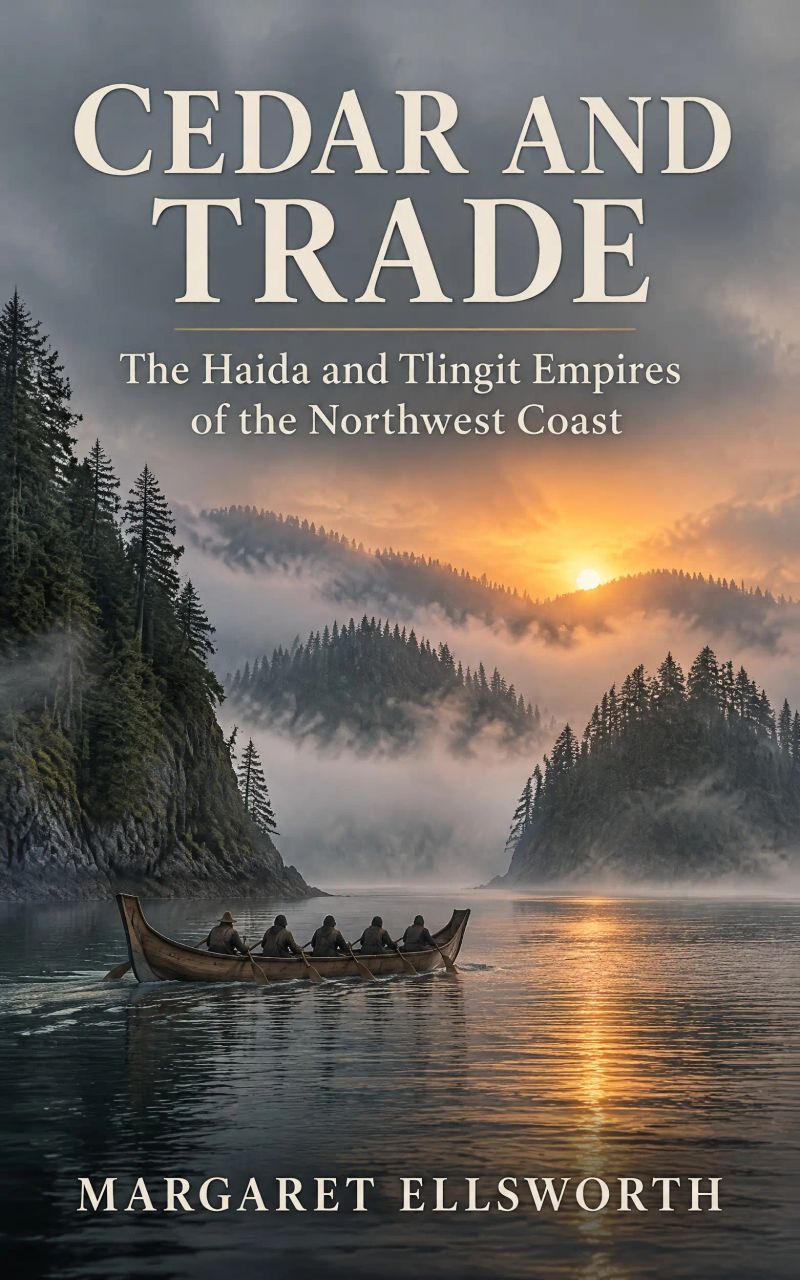
Cedar and Trade: The Haida and Tlingit Empires of the Northwest Coast
By Margaret Ellsworth


Length4h 33m
About this audiobook
On a fog-bound slope in Haida Gwaii, a canoe builder lays his palm on a red cedar that has stood for four hundred years, strikes it with a stone adze and listens. A clean, hollow note means sound heartwood and a canoe inside, waiting to be let out. Before the tree comes down, burned through at a notch packed with wet clay and scraped with shell, he will speak to it, explain what is wanted and thank it for what it is about to give.
The patience came from abundance. Salmon runs darkened the rivers, eulachon grease passed as food and currency, and on that wealth the Haida and the Tlingit built societies of sharp rank, divided into Raven and Eagle and traced through the mother's line. Their big cedar canoes carried trade, war parties and captives the length of the coast.
In 1774 Haida paddlers came out to trade with a Spanish ship, and what followed tested every part of that world: the sea otter rush and the smallpox years, the Russian and then the American claim to Tlingit country, and the Canadian law of 1884 that banned the potlatch. Later came new constitutions and long land claims, and the book ends with potlatches held in the open again and the question of who will decide the future of the cedar.
Audiobook details
GenreHistory
Length4 hrs 33 mins
Narrated byListen with 1,000+ voices
FormateBook with Audio
Publish dateSep 19, 2026
LanguageEnglish
Table of contents
1Chapter 1: The Cedar Forest and the Sea
2Chapter 2: The Warrior Traders
3Chapter 3: The First Ships
4Chapter 4: The Sea Otter Rush
5Chapter 5: The Smallpox Years
Show all chaptersShow less
6Chapter 6: The Fur Trade Empires
7Chapter 7: The Arrival of the Americans
8Chapter 8: The Potlatch Wars
9Chapter 9: Canoes and Constitutions
10Chapter 10: The Land Claims
11Chapter 11: The Modern Potlatch
12Chapter 12: The Cedar and the Future
13About the Author
More from Margaret Ellsworth


A Brief History of IntelligenceMax S. Bennett12h 18m4.6 (6.6K)$29 · $0.00

The Happiest Man on EarthEddie Jaku3h 48m4.6 (178K)$7 · $0.00

MotherlandJulia Ioffe17h 52m4.7 (2.5K)$40 · $0.00

Where Cowards Go to DieBenjamin Sledge8h 42m4.7 (351)$20 · $0.00

RevolutionariesSanjeev Sanyal11h 23m4.6 (2.6K)$29 · $0.00

We Crossed a Bridge and It TrembledWendy Pearlman6h4.6 (5.2K)$24 · $0.00

Unbroken Bonds of BattleJohnny Joey Jones8h 31m4.6 (2.6K)$8 · $0.00

The Daughter of AuschwitzTova Friedman, Malcolm Brabant7h 54m4.6 (16.7K)$26 · $0.00

Lily's PromiseLily Ebert, Dov Forman8h 54m4.6 (16.1K)$29 · $0.00

On Democracies and Death CultsDouglas Murray10h 38m4.6 (6.5K)$29 · $0.00

Across the RiverKent Babb11h 40m4.6 (927)$29 · $0.00

Balcony Over Jerusalem: A Middle East Memoir - Israel, Palestine and BeyondJohn Lyons12h 37m4.6 (1.4K)$33 · $0.00

BeyondStephen Walker15h 39m4.6 (3.2K)$33 · $0.00
Kings and PawnsHoward Bryant10h 9m4.6 (678)$29 · $0.00

No EscapeNury Turkel9h 30m4.6 (809)$28 · $0.00

Jubal Stone: U.S. Marshal: Blood Trail To Hell: A Western Adventure NovelCasey Nash3h 42m4.6 (3.2K)$18 · $0.00

Fall and RiseMitchell Zuckoff17h 23m4.6 (9.8K)$40 · $0.00

The SurvivorJosef Lewkowicz, Michael Calvin9h 22m4.6 (2.5K)$29 · $0.00

Always FaithfulThomas Schueman, Zainullah Zaki12h 12m4.6 (977)$29 · $0.00

The State of Society in France Before the Revolution of 1789 (Annotated)Alexis de Tocqueville17h 25m4.6 (1.2K)$2 · $0.00
You may also like

One Hundred And Four HorsesMandy Retzlaff10h4.3 (1.2K)$29 · $0.00

The Great HungerCecil Woodham-Smith18h 23m4.3 (2.3K)$28
The History of Mary Prince, a West Indian SlaveMary Prince2h 14m4.0 (5.3K)Free

Ishi in Two WorldsTheodora Kroeber10h 48m4.2 (4K)$21
Twenty-Two Years a Slave and Forty Years a FreemanAustin Steward8h 53m4.2 (255)$1 · $0.00

What Is the WhatDave Eggers20h 28m4.3 (90.3K)$30

The Ginseng HunterJeff Talarigo4h 16m3.6 (1.2K)$20 · $0.00

Somewhere We Are HumanReyna Grande, Sonia Guiñansaca8h 16m4.4 (789)$26 · $0.00

The Desert of WheatZane Grey13h 18m3.8 (1.3K)$3

One Bright MoonAndrew Kwong12h 21m4.5 (813)$29 · $0.00
We Crossed a Bridge and It TrembledWendy Pearlman6h4.6 (5.2K)$24 · $0.00

Smallpox on the Missouri: The Mandan, Hidatsa, and ArikaraDaniel R. Whitlock4h 13m$6

The Catawba Nation: River People of the Carolina PiedmontMargaret Ellsworth Boyd4h 40m$6

The Snake War and the Bannock War: Northern Paiute and Bannock ResistanceDuncan H. Ridgeway3h 56m$6

Gold and Ashes: California's Indians and the Rush That Remade the WestDaniel R. Hollister4h 12m$6
Mayflower ChroniclesKathryn Brewster Haueisen11h 26m4.3 (88)$23 · $0.00

The Gentleman from EverywhereJames Henry Foss6h 38m$2 · $0.00

The Trail of Tears: The Forced Removal of the Cherokee NationMargaret Ellsworth Calloway5h 19m$6

The Middlemen of the Columbia: Chinook Power and the River TradeMarcus Hale Whitfield4h 24m$6

UnconventionalDave Werklund9h4.8 (10)$21 · $0.00