
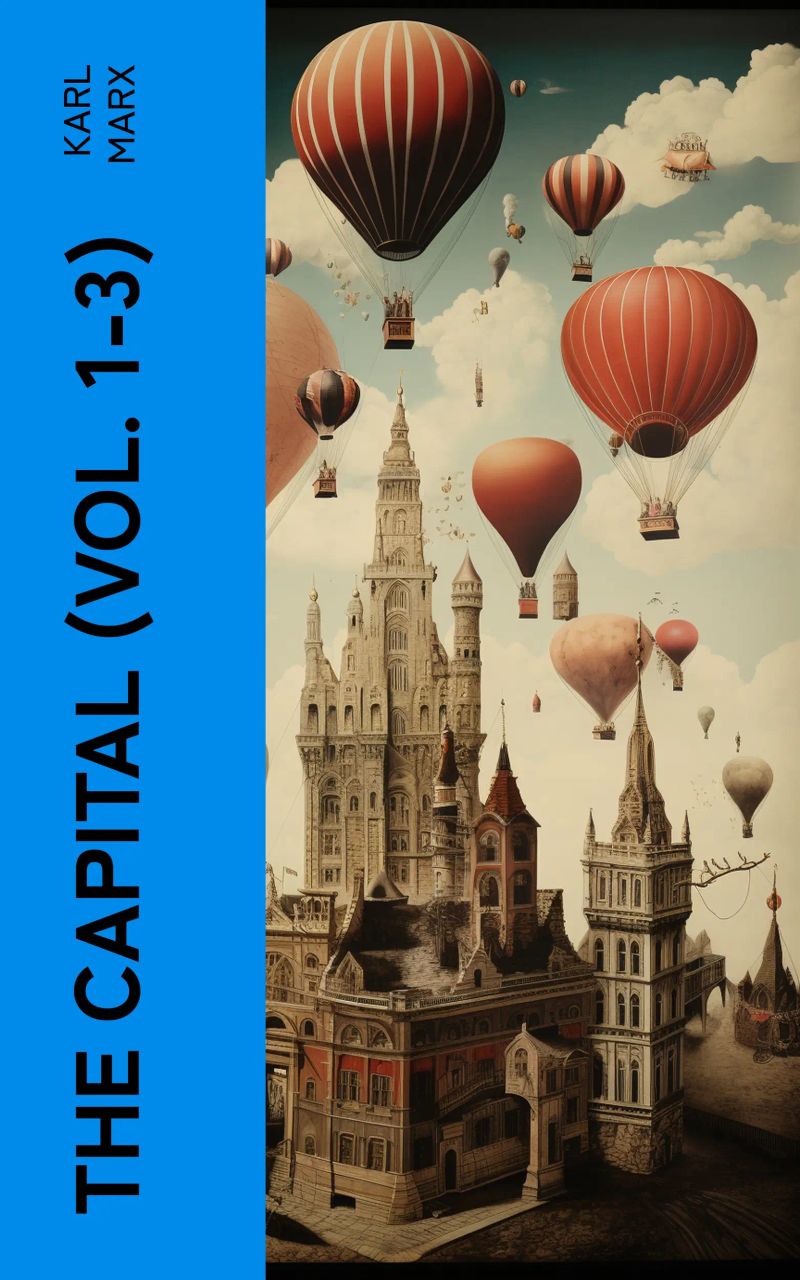
The Capital (Vol. 1-3)
Including The Communist Manifesto, Wage-Labour and Capital, & Wages, Price and ProfitBy Karl Marx


Length103h 42m
About this audiobook
Capital by Karl Marx is a foundational theoretical text in materialist philosophy, economics and politics. Marx aimed to reveal the economic patterns underpinning the capitalist mode of production, in contrast to classical political economists such as Adam Smith, Jean-Baptiste Say, David Ricardo and John Stuart Mill. Marx did not live to publish the planned second and third parts, but they were both completed from his notes and published after his death by his colleague Friedrich Engels. Capital is the most cited book in the social sciences published before 1950. The Communist Manifesto (originally Manifesto of the Communist Party) is an 1848 political pamphlet by German philosophers Karl Marx and Friedrich Engels. Commissioned by the Communist League and originally published in London just as the revolutions of 1848 began to erupt, the Manifesto was later recognised as one of the world's most influential political documents. Wage Labour and Capital is an essay on economics by Karl Marx, written in 1847 and first published in articles in the Neue Rheinische Zeitung in April 1849. This essay has been widely acclaimed as the precursor to Marx's important treatise Das Kapital. Value, Price and Profit was a speech given to the First International Working Men's Association in June in 1865 by Karl Marx. It was written between the end of May and June 27 in 1865, and was published in 1898. Karl Marx (1818–1883) was a famous German philosopher, economist, historian, political theorist, sociologist, journalist and revolutionary socialist.
Audiobook details
GenreBusiness and Economics
Length103 hrs 42 mins
Narrated byListen with 1,000+ voices
FormateBook with Audio
Publish dateDec 15, 2023
LanguageEnglish
Table of contents
1Author’s Preface: First German Edition
124V. The Promotion of the Transactions by the Circulation of Money
2Editor’s Preface: First English Translation
125VI. The Constant Capital of Department I
3I. The Two Factors of a Commodity: Use-Value and Value
126VII. Variable Capital and Surplus-Value in Both Departments
4II. The Two-fold Character of the Labour Embodied in Commodities
127VIII. The Constant Capital in both Departments
5III. The Form of Value or Exchange-Value
128IX. A Retrospect on Adam Smith, Storch, and Ramsay
Show all chaptersShow less
6IV. The Fetishism of Commodities and the Secret Thereof
129X. Variable Capital and Wages
72. Exchange
130XI. Reproduction of the Fixed Capital
8I. The Measure of Values
131XII. The Reproduction of the Money Supply
9II. The Medium of Circulation
132XIII. Destutt De Tracy's Theory of Reproduction
10III. Money
133I. Accumulation in Department I
114. The General Formula for Capital
134II. Accumulation in Department II
125. Contradictions in the General Formula of Capital
135III. Diagrammatic Presentation of Accumulation
136. The Buying and Selling of Labour-Power
1361. Cost Price and Profit
14I. The Labour-Process or the Production of Use-Values
1372. The Rate of Profit
15II. The Production of Surplus-Value
1383. The Relation of the Rate of Profit to the Rate of Surplus-Value
168. Constant Capital and Variable Capital
1394. The Effect of the Turn-Over on the Rate of Profit
17I. The Degree of Exploitation of Labour-Power
140I. General Economies.
18II. The Representation of the Components of the Value of the Product
141II. Economies in the conditions of labor at the expense of the laborers.
19III. Senior’s “Last Hour”
142III. Economies in the Generation of Power, Transmission of Power, and Buildings.
20IV. Surplus-Produce
143IV. Utilisation of the Excrements of Production.
21I. The Limits of the Working day
144V. Economies Due to Inventions.
22II. The Greed for Surplus-Labor, Manufacturer and Boyard
145I. Fluctuations in the Price of Raw Materials, and their Direct Effects on the Rate of Profit.
23III. Branches of English Industry without Legal Limits to Exploitation
146II. Appreciation, Depreciation, Release, and Tie-up of Capital.
24IV. Day and Night Work. The Relay System
147III. General Illustration. The Cotton Crisis of 1861-1865.
25V. Compulsory Laws for the Extension of the Working Day (Mid 14th- End 17th Century)
1487. Additional Remarks
26VI. Compulsory Limitation by Law of the Working-Time
1498. Different Composition of Capitals
27VII. Reaction of the English Factory Acts on Other Countries
1509. Average Rate of Profit and Transformation of the Values of Commodities into Prices Of Production
2811. Rate and Mass of Surplus-Value
15110. Market Prices and Market Values. Surplus-Profit
2912. The Concept of Relative Surplus-Value
15211. Effects of General Fluctuations of Wages on Prices of Production
3013. Co-operation
153I. Causes Implying a Variation of the Price of Production.
31I. Two-Fold Origin of Manufacture
154II. Price of Production of Commodities of Average Composition.
32II. The Detail Labourer and his Implements
155III. Fluctuations for which the Capitalist makes Allowance.
33III. The Two Fundamental Forms of Manufacture
15613. The Theory of the Law
34IV. Division of Labour in Manufacture, and Division of Labour in Society
157I. Raising the Intensity of Exploitation.
35V. The Capitalistic Character of Manufacture
158II. Depression of Wages Below their Value.
36I. The Development of Machinery
159III. Cheapening of the Elements of Constant Capital.
37II. The Value Transferred by Machinery to the Product
160IV. Relative Overpopulation.
38III. The Proximate Effects of Machinery on the Workman
161V. Foreign Trade.
39IV. The Factory
162VI. The Increase of Stock Capital.
40V. The Strife between Workman and Machine
163I. General Remarks.
41VI. The Theory of Compensation as Regards the Workpeople Displaced by Machinery
164II. Conflict between the Expansion of Production and the Creation of Values.
42VII. Repulsion and Attraction of Workpeople by the Factory System
165III. Surplus of Capital and Surplus of Population.
43VIII. Revolution Effected in Manufacture, Handicrafts, and Domestic Industry
166IV. Supplementary Remarks.
44IX. The Factory Acts
16716. Commercial Capital
45X. Modern Industry and Agriculture
16817. Commercial Profit
4616. Absolute and Relative Surplus-Value
16918. The Turn-Over of Merchant's Capital
47I. Length of the Working day and Intensity of Labour Constant
17019. Financial Capital
48II. Working Day Constant
17120. Historical Data Concerning Merchants' Capital
49III. Productiveness and Intensity of Labour Constant
17221. The Interest-Bearing Capital.
50IV. Simultaneous Variations in the Duration, Productiveness, and Intensity of Labour
17322. Division of Profit. Rate of Interest. Natural Rate of Interest
5118. Various Formula for the rate of Surplus-Value
17423. Interest and Profit of Enterprise
5219. The Transformation of the Value and Respective Price of Labour-Power into Wages
17524. Externalisation of the Relations of Capital in the Form of Interest-Bearing Capital
5320. Time-Wages
17625. Credit and Fictitious Capital
5421. Piece Wages
17726. Accumulation of Money-Capital. Its Influence On The Rate Of Interest
5522. National Differences of Wages
17827. The Role of Credit in Capitalist Production
5623. Simple Reproduction
17928. The Medium of Circulation and Capital. Tooke's and Fullarton's Conception.
57I. Capitalist Production on a Progressively Increasing Scale
18029. The Composition of Banking Capital.
58II. Erroneous Conception
18130. Money-Capital and Actual Capital - I
59III. Separation of Surplus-Value into Capital and Revenue
18231. Money-Capital and Actual Capital - II
60IV. Circumstances that Determine the Amount of Accumulation
18332. Money-Capital and Actual Capital - III
61V. The So-Called Labour Fund
18433. The Currency under the Credit System.
62I. The Increased Demand for Labour Power that Accompanies Accumulation
18534. The Currency Principle and the English Bank Laws of 1844.
63II. Relative Diminution of the Variable Part of Capital
186I. The Movements of the Gold Reserve.
64III. Progressive Production of a Relative Surplus Population or Industrial Reserve Army
187II. The Rate of Exchange.
65IV. Different Forms of the Relative Surplus Population
188III. Rate of Exchange with Asia.
66V. Illustrations of the General Law of Capitalist Accumulation (pt. 1)
189IV. England's Balance of Trade.
67V. Illustrations of the General Law of Capitalist Accumulation (pt. 2)
190Interest in the Middle Ages.
6826. The Secret of Primitive Accumulation
191Advantage of the Prohibition of Interest for the Church.
6927. Expropriation of the Agricultural Population from the Land
19237. Preliminaries
7028. Bloody Legislation against the Expropriated
19338. Differential Rent
7129. Genesis of the Capitalist Farmer
19439. The First Form of Differential Rent
7230. Reaction of the Agricultural Revolution on Industry
19540. The Second Form of Differential Rent
7331. The Genesis of the Industrial Capitalist
19641. First Case: Constant Price of Production
7432. Historical Tendency of Capitalist Accumulation
197I. The Productivity of the Additional Investment of Capital Remains the Same.
7533. The Modern Theory of Colonisation (pt. 1)
198II. The Rate of Productivity of the Additional Capitals Decreases.
7633. The Modern Theory of Colonisation (pt. 2)
199III. The Rate of Productivity of the Additional Capitals Increases.
7733. The Modern Theory of Colonisation (pt. 3)
20043. Third Case: Rising Price of Production
7833. The Modern Theory of Colonisation (pt. 4)
20144. Differential Rent Even Upon the Worst Soil under Cultivation
79I. First Stage. M-C
20245. Absolute Ground-Rent
80II. Second Stage. Functions of Productive Capital
20346. Building Lot Rent. Mining Rent. Price of Land
81III. Third Stage. C'-M'
204I. Introductory Remarks.
82IV. The Rotation as a Whole
205II. Labor Rent.
83I. Simple Reproduction
206III. Rent in Kind.
84II. Accumulation and Reproduction on an Enlarged Scale
207IV. Money Rent.
85III. Accumulation of Money
208V. Share Farming (Metairie System) and Small Peasants' Property.
86IV. Reserve Funds
209I.
873. The Circulation of Commodity-Capital
210II.
884. The Three Diagrams of the Process of Circulation
211III.
895. The Time of Circulation
21249. A Contribution to the Analysis of the Process of Production
90I. Genuine Expenses of Circulation.
21350. The Semblance of Competition
91II. Expenses of Storage.
21451. Conditions of Distribution and Production
92III. Expenses of Transportation
21552. The Classes
937. The Period and Number of Turn-Overs
216PREFACE
94I. Distinctions of Form
217MANIFESTO OF THE COMMUNIST PARTY.
95II. Composition, Reproduction, Repair, and Accumulation of Fixed Capital
218I. BOURGEOIS AND PROLETARIANS.3
969. The Total Turn-Over of Advanced Capital
219II. PROLETARIANS AND COMMUNISTS.
9710. Theories of Fixed and Circulating Capital. The Physiocrats and Adam Smith
220III. SOCIALIST AND COMMUNIST LITERATURE.
9811. Theories of Fixed and Circulating Capital. Ricardo
221IV. POSITION OF THE COMMUNISTS IN RELATION TO THE VARIOUS EXISTING OPPOSITION PARTIES.
9912. The Working Period
222Introduction
10013. The Time of Production
223Chapter 1 Preliminary
10114. The Time of Circulation
224Chapter 2 What Are Wages?
102I. The Working Period Equal to the Period of Circulation
225Chapter 3 By What is the Price of a Commodity Determined?
103II. The Working Period Greater Than the Period of Circulation
226Chapter 4 By What Are Wages Determined?
104III. The Working Period Smaller Than the Circulation Period
227Chapter 5 The Nature and Growth of Capital
105IV. Conclusions
228Chapter 6 Relation of Wage-labor to Capital
106V. The Effect of a Change of Prices
229Chapter 7 The General Law That Determines the Rise and Fall of Wages and Profits
107I. The Annual Rate of Surplus-Value
230Chapter 8 The Interests of Capital and Wage-labor Are Diametrically Opposed -- Effect of Growth of Productive Capital on Wages
108II. The Turn-Over of the Individual Variable Capital
231Chapter 9 Effect of Capitalist Competition on the Capitalist Class, The Middle Class, and The Working Class
109III. The Turn-Over of the Variable Capital, Considered from the Point of View of Society
232Preliminary
110I. Simple Reproduction
233I. Production and Wages
111II. Accumulation and Reproduction on an Enlarged Scale
234II. Production, Wages, Profits
112I. The Object of the Analysis
235III. Wages and Currency
113II. The Role of Money-Capital
236IV. Supply and Demand
114I. The Physiocrats
237V. Wages and Prices
115II. Adam Smith
238VI. Value and Labour
116III. Smith Resolves Exchange-Value into V Plus S
239VII. Labouring Power
117IV. The Constant Portion of Capital.
240VIII. Production of Surplus Value
118V. Capital and Revenue in Adam Smith
241IX. Value of Labour
119VI. The Economists after Smith
242X. Profit is Made by Selling a Commodity at its Value
120I. The Formulation of the Question.
243XI. The Different Parts into Which Surplus Value is Decomposed
121II. The Two Departments of Social Production
244XII. General Relation of Profits, Wages and Prices
122III. The Transactions between the Two Departments
245XIII. Main Cases of Attempts at Raising Wages or Resisting Their Fall
123IV. Necessities of Life and Articles of Luxury
246XIV. The Struggle Between Capital and Labour and its Results

The Greatest Works of Karl MarxKarl Marx130h 15m$2 · $0.00

Das KapitalKarl Marx92h 16m$1 · $0.00

Wages, Price and ProfitKarl Marx2h 18m$2 · $0.00

Karl Marx: Zur Kritik der Hegelschen RechtsphilosophieKarl Marx6h 10m$1 · $0.00

Ten Days That Shook the WorldKarl Marx16h 16m$1 · $0.00

El Capital: tomo IKarl Marx42h 1m$1 · $0.00

CAPITAL (All 3 Books)Karl Marx98h 6m$1 · $0.00

Die wichtigsten Werke von Karl Marx (50 Titel in einem Band)Karl Marx254h 30m$2 · $0.00

Manifest der Kommunistischen ParteiKarl Marx3h 57m$2 · $0.00

Karl Marx: Manifest der Kommunistischen ParteiKarl Marx3h 59m$2 · $0.00

The Civil War in FranceKarl Marx4h 51m$2 · $0.00

Die heilige FamilieKarl Marx10h 35m$2 · $0.00

Zur JudenfrageKarl Marx1h 34m$2 · $0.00
Capital: The Process of Capitalist Production as a WholeKarl Marx39h 25m$2 · $0.00

Secret Diplomatic History of The Eighteenth CenturyKarl Marx2h 58m$2 · $0.00

Der Briefwechsel zwischen Friedrich Engels und Karl Marx 1844 bis 1883 (Zusammengefasste Ausgabe)Karl Marx, Friedrich Engels5h 13m$2

Die bekanntesten historiografischen Schriften von Karl MarxKarl Marx1h 28m$1 · $0.00

Manifesto of the Communist PartyKarl Marx, Friedrich Engels3h 10m$1 · $0.00

Die deutsche Ideologie: Thesen über FeuerbachKarl Marx, Friedrich Engels28h$1 · $0.00

Hal Moore on LeadershipHarold G. Moore, Mike Guardia5h 6m$17
Basic Economics, Fifth EditionThomas Sowell28h 6m$40

The Goals ProgramZig Ziglar4h 34m$20

The Stocks & ETF Compass: A Guide to Wealth, High Standard of Living, and Secure Retirement through Intelligent Investment in the Stock Market and Passive Income – Including Starter GuideJens Hattermann4h 9m$20 · $0.00

Eat It!Jordan Syatt, Michael Vacanti4h 40m$20 · $0.00

Not Everything Counts but Everything Matters: The powerful and inspirational new book about leadership and achieving success from the visionary multi-premiership winning Panthers coachIvan Cleary6h 1m$24 · $0.00

Leads MachineFrancis Rodino6h 30m$27 · $0.00
CAPITAL (Complete 3 Volume Edition)Karl Marx111h 13m$2 · $0.00

BuildTony Fadell11h 5m$8 · $0.00

The Entrepreneur Roller CoasterDarren Hardy7h 8m$17

The Law of Success in Sixteen LessonsNapoleon Hill1h 31m$2 · $0.00

The Ambuja StoryNarotam Sekhsaria13h 59m$33 · $0.00

Military Culture ShiftCorie Weathers13h 13m$25 · $0.00

Saving Social CareNeil Eastwood4h 54m$18 · $0.00

Big TrustShadé Zahrai, Fayçal Sekkouah8h 36m$26 · $0.00

SocialismLudwig von Mises24h 8m$30

Being EssentialDain Dunston4h 13m$15 · $0.00

Purposeful PerformanceJonathan Stanley10h 14m$25

Bottle of LiesKatherine Eban14h 25m$33 · $0.00

The Antiracist Business BookTrudi Lebrón6h 10m$17 · $0.00
You may also like

Our Journey to the HebridesElizabeth Robins Pennell, Joseph Pennell4h 11m$2 · $0.00

A Short History of English AgricultureW. H. R. Curtler9h 24m$2 · $0.00

The Voice of ReasonAyn Rand15h 57m$25

The Founding Fathers’ Guide to the ConstitutionBrion McClanahan PhD6h 32m$20

Life in a Railway FactoryAlfred Williams11h 15m$1 · $0.00
Ireland and the Home Rule MovementMichael Sir McDonnell5h 42m$2 · $0.00

The Condition of the Working-Class in England in 1844 with a Preface written in 1892Friedrich Engels14h 38m$2 · $0.00

Hulme's Journal, 1818-19Richard Flower, John Woods, Thomas Hulme9h 34m$1 · $0.00

Twenty-five Years in the WestE. Manford12h 31m$2.40

Sea, Salt And SpiceMeher Mirza11h 6m$20 · $0.00
The Art of Not Being GovernedJames C. Scott17h 34m$30

Old Times in the Colonies (Illustrated Edition)Charles Carleton Coffin12h 35m$2 · $0.00

Our Journey to the HebridesElizabeth Robins Pennell, Joseph Pennell5h 25m$1 · $0.00

The Dollar HenMilo Hastings7h 38m$2 · $0.00

Kingdom of Olives and AshMichael Chabon, Ayelet Waldman16h 5m$33 · $0.00

Pilgrimage from the Alps to the TiberJames Aitken Wylie15h 30m$2 · $0.00

Englisch lernen Audio - Englische GärtenSpotlight Verlag1h 1m$17

Ashes of TwilightKassy Tayler9h 23m$26

The Dressmaker of Khair KhanaGayle Tzemach Lemmon6h 17m$24 · $0.00

The English in the West Indies; Or, The Bow of UlyssesJames Anthony Froude11h 1m$1 · $0.00