
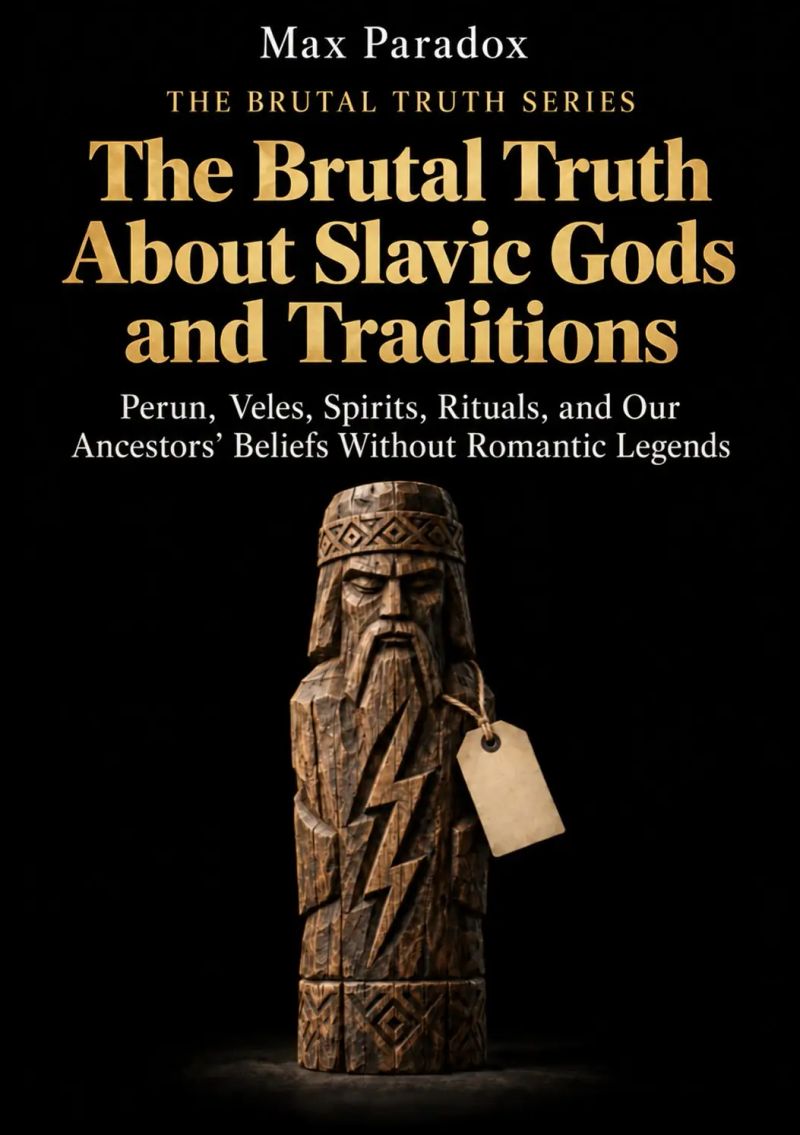
The Brutal Truth About Slavic Gods and Traditions - Perun, Veles, Spirits, Rituals, and Our Ancestors’ Beliefs Without Romantic Legends
By Max Paradox


Length6h 27m
About this audiobook
Perun rules the thunder. Veles belongs to the underworld. Ancient Slavic symbols carried fixed meanings for centuries. Midsummer rites looked exactly like modern reconstructions. And if someone asks for the source? Well, perhaps Christianity destroyed it.
That version is neat, memorable, and emotionally satisfying. It is also much more complete than the surviving evidence allows.
The Brutal Truth About Slavic Gods and Traditions examines what we actually know about pre-Christian Slavic religion and what happens when uncertainty becomes uncomfortable. Max Paradox looks at Perun, Veles, household spirits, seasonal rites, ancestor traditions, sacred symbols, oaths, divination, folklore, Christianization, and modern revival movements without pretending that every fragment fits into one lost theological handbook.
This is not another catalogue of gods with fixed symbols, sacred colors, favorite animals, and perfectly organized responsibilities. It is a satirical social-psychological essay about how historical fragments become cultural certainty. A late folk custom can turn into an unchanged pagan survival. A modern emblem can acquire an ancient biography. A reconstruction can become "what our ancestors did." A hypothesis repeated often enough can begin to feel older than the source that inspired it.
The book also examines why these transformations are so attractive. A complete ancestral system offers roots. It gives symbols emotional weight, rituals legitimacy, communities cohesion, and present-day choices the authority of the past. It can make modern dissatisfaction feel like historical loss and modern identity feel inherited rather than chosen. The benefit is real. So is the cost: pressure to be authentic, arguments over cultural purity, gatekeeping, selective skepticism, and the growing need to defend a preferred past whenever new evidence complicates it.
Without dismissing genuine religious experience or cultural attachment, Max Paradox separates documented evidence from probability, reconstruction, later folklore, and contemporary creation. The point is not that ancient Slavic religion was unreal because the sources are incomplete. Perun and Veles are not internet inventions, ritual and cultic life certainly existed, and later traditions preserve material worth studying. The harder truth is that a culture can have been rich, complex, and meaningful without leaving us enough evidence to rebuild every missing part.
That gap is where romantic legends grow best. It is also where algorithms, commercial symbolism, identity politics, and the simple human dislike of unfinished stories can turn possibility into certainty.
For readers interested in Slavic mythology, folklore, Native Faith, religious history, cultural identity, archaeology, and the psychology of tradition, this book asks a less comfortable question than "What did the Slavs believe?" It asks what we do when the honest answer is sometimes: we know part of it, we can reconstruct part of it, and part of it is gone.
This publication was prepared using tools that support the creative process, including artificial intelligence solutions. The final concept, structure and editing are the responsibility of the author.
Audiobook details
GenreSpirituality and Religion
Length6 hrs 27 mins
Narrated byListen with 1,000+ voices
FormateBook with Audio
Publish dateOct 13, 2026
LanguageEnglish
Table of contents
1INTRO
2Chapter 1 - A God Written in Someone Else's Hand
3Chapter 2 - The Pantheon Nobody Ever Standardized
4Chapter 3 - A Tradition Older Than Its Paper Trail
5Chapter 4 - Conversion Did Not Come With an Off Switch
Show all chaptersShow less
6Chapter 5 - The Symbol That Knows More in the Gift Shop Than in the Excavation Report
7Chapter 6 - The Ancestor Who Somehow Shares All Our Opinions
8Chapter 7 - Someone Has to Live Behind the Stove
9Chapter 8 - The Fire Never Promised a Good Harvest
10Chapter 9 - When a Promise Needs More Than a Witness
11Chapter 10 - The Person Who Explains the Sign Is Never Just Watching
12Chapter 11 - The Dead Still Have a Place at the Table
13Chapter 12 - The Calendar Notices Who Stayed Home
14Chapter 13 - When Your Roots Start to Feel Heavy
15Chapter 14 - The Competition for the Most Authentic Slav
16Chapter 15 - The Paradise Nobody Remembers Losing
17Chapter 16 - The Foreign Trace on Your Own Doorstep
18Chapter 17 - You Can't Prove It Didn't Happen
19Chapter 18 - It's Only Symbolic When Someone Asks for the Source
20Chapter 19 - The God the Algorithm Likes
21Chapter 20 - The Label Says "Function Unknown"

Kupiłem Samochód i Teraz Boję Się Każdej Kontrolki - Jak ogarnąć serwis, ubezpieczenie, koszty i podstawową obsługę auta bez udawania mechanikaMax Paradox5h 41m$7.70 · $0.00

I Think I Just Became the Boss - How to Start Managing People, Delegate, Give Feedback, and Stop Trying to Do Everything YourselfMax Paradox8h$7.70 · $0.00

I Can't Separate Work from Life - How to Stop Mentally Sitting at the Office During Dinner, Vacations, and SleepMax Paradox6h 9m$7.70 · $0.00

I Put Off All My Paperwork Until the Last Day - How to Handle Documents, Phone Calls, and Forms Without Moving to the WoodsMax Paradox6h 31m$7.70 · $0.00

Za dużo biorę na siebie - Jak przestać być jednoosobowym działem ratunkowym dla całego świataMax Paradox5h 11m4.3 (23)$7.70 · $0.00

How to Build Self-Confidence from the Ground UpMax Paradox6h 50m$7.70 · $0.00

I Take on Too Much - How to Stop Being the Entire World's One-Person Rescue SquadMax Paradox7h 8m$7.70 · $0.00

Nie wiem już, czy to zdjęcie jest prawdziwe - Jak przeżyć epokę deepfake’ów, AI i internetu, który potrafi podrobić wszystkoMax Paradox5h 46m$7.70 · $0.00

Mam etat, ale internet twierdzi, że potrzebuję jeszcze trzech biznesów - Jak przestać czuć się przegrywem bez side hustleMax Paradox5h 24m$7.70 · $0.00

The Brutal Truth About Social Media - You scroll. You compare. You perform. Then you say you don’t care.Max Paradox6h 27m$7.70 · $0.00

Mam Kupić Prezent i Nagle Nie Znam Tej Osoby - Jak wybierać prezenty bez paniki, przepłacania i kupowania kolejnego kubka tylko dlatego, że zostały trzy godzinyMax Paradox5h 11m$7.70 · $0.00

Brutalna prawda o Bolesławie Chrobrym - Wojny, żony, namiętności i bezwzględna droga pierwszego króla Polski do koronyMax Paradox5h 15m$7.70 · $0.00

We Can't Talk About Money - How Not to Divorce Over a Receipt, a Loan, and a Mysterious Online OrderMax Paradox7h 7m$7.70 · $0.00

Odkładam wszystkie sprawy urzędowe do ostatniego dnia: Jak ogarnąć dokumenty, telefony i formularze bez przeprowadzki do lasuMax Paradox5h 33m$7.70 · $0.00

Planet TikTok - How a 15-Second App Became a Global SuperpowerMax Paradox4h 33m$7.70 · $0.00

I'm Afraid to Talk to My Boss - How to Ask for What You Need Without Preparing Your WillMax Paradox7h 46m$7.70 · $0.00

How to Manage Stress and Regain ControlMax Paradox6h 57m$7.70 · $0.00
I Feel Stuck - How to Move Forward When Everyone Else Is Apparently SucceedingMax Paradox6h 15m$7.70 · $0.00

I Keep Going Back to My Ex - How to Stop Checking Whether an Old Mistake Has Somehow Become a Great IdeaMax Paradox7h 17m$7.70 · $0.00

A Little God Time for Women Morning & Evening DevotionalBroadStreet Publishing Group LLC15h 15m4.9 (1.2K)$10 · $0.00
The Chosen Presents: A Blended Harmony of the GospelsSteve Laube, Amanda Jenkins, Dallas Jenkins7h 8m4.9 (823)$10 · $0.00

Prayers from the Throne RoomBrian Simmons8h 55m4.9 (256)$10 · $0.00
31 Decrees of Blessing for Your LifePatricia King2h 38m4.8 (1.4K)$10 · $0.00

Loved BabySarah Philpott4h 51m4.8 (1.4K)$10 · $0.00

The QuranAllah23h 7m4.7 (136.1K)$1 · $0.00

The Secret of the RosaryLouis de Montfort6h 1m4.7 (16K)$2 · $0.00

The Holy Qur-an: Text, Translation and CommentaryAbdullah Yusuf Ali22h 16m4.7 (133K)$1 · $0.00
All of Grace (Annotated)Charles Spurgeon5h 1m4.7 (1.3K)$1.99 · $0.00

Steps to ChristEllen G. White3h 12m4.7 (13.8K)$2 · $0.00
The Doctrine and Selected CovenantsJoseph Smith13h 53m4.7 (10.4K)$1.99 · $0.00
Sinners in the Hands of an Angry God & Other Sermons (Annotated)Jonathan Edwards7h 51m4.7 (1.5K)$2 · $0.00

Swayam Ki AwaazPrem Rawat8h 34m4.7 (1.1K)$26 · $0.00

Behind the BadgeAdam Davis10h 18m4.7 (2.7K)$10 · $0.00
The New Human Revolution, vol. 1Daisaku Ikeda7h 46m4.7 (669)$12 · $0.00

You Are Worth ItKyle Carpenter, Don Yaeger8h 53m4.7 (4.8K)$29 · $0.00
Praying GraceDavid A. Holland3h 2m4.7 (658)$10 · $0.00

Evidence Not SeenDarlene Deibler Rose11h 11m4.6 (11.9K)$29 · $0.00
The Christ KeyChad Bird, Chad Bird7h 33m4.7 (592)$17.40 · $0.00
He and IGabrielle Bossis10h 12m4.7 (554)$17 · $0.00
You may also like
SOUL OF SEXThomas Moore2h 57m4.1 (1.5K)$18 · $0.00

MemoriesF. Max Müller3h 17m4.0 (1.2K)$1 · $0.00

Personae (Annotated)Ezra Pound2h 3m4.1 (1.7K)$1.99 · $0.00

Woman in the Nineteenth CenturySarah Margaret Fuller Ossoli12h 38m3.8 (1.3K)$1 · $0.00

TanakhVarious Authors231h 15m4.6 (11.4K)$1.99 · $0.00

Singer's Siddur - The Standard Prayer BookSimeon Singer14h 7m4.6 (487)$1.99 · $0.00

Herder's conception of "das Volk"Georgiana Rose Simpson3h 24m$1 · $0.00

Pictographs of the North American IndiansGarrick Mallery11h 23m4.3 (25)$2 · $0.00

The Greatest Works of French Literature: 100+ Novels, Short Stories, Poetry Collections & PlaysStendhal, Jules Verne, Gustave Flaubert, Anatole France, Émile Zola, Victor Hugo, Guy de Maupassant, Jean-Jacques Rousseau, Alexandre Dumas, François Rabelais, George Sand, Marcel Proust, Gaston Leroux, Charles Baudelaire, Molière, Pierre Corneille, Jean Racine, Voltaire, Pierre Choderlos de Laclos, Alexandre Dumas fils1422h 47m4.5 (113)$1 · $0.00
Coffee in the GourdJ. Frank Dobie, L.W. Payne Jr., Max Sylvius Handman, W. H. Thomas, Victor J. Smith, J. R. Craddock, W. P. Webb, A. W. Eddins, Dorothy Scarborough, Julia Estill, Florence Johnson Scott, Mary A. Sutherland3h 43m$1.99 · $0.00

The Lenâpé and Their LegendsDaniel G. Brinton8h 10m3.6 (23)$1 · $0.00

Custom and MythAndrew Lang8h 13m3.8 (193)$2 · $0.00
Hellenism in Asia MinorKarl Dieterich3m$1 · $0.00

The Romantic Scottish Ballads: Their Epoch and AuthorshipRobert Chambers2h 44m$1 · $0.00

The Peoples of IndiaJ. D. Anderson3h 1m3.8 (27)$1.20 · $0.00
The Philosophy of Giambattista VicoBenedetto Croce12h 26m4.2 (19)$2 · $0.00

The Lenâpé and Their Legends (Annotated)Daniel G. Brinton4h 58m3.8 (40)$1.99 · $0.00

The Ontario High School ReaderAletta E. Marty7h 53m$2 · $0.00
The Philosophy of Giambattista VicoBenedetto Croce12h 28m4.2 (42)$2 · $0.00

Through the Year with Famous AuthorsMabel Patterson3h 22m$2 · $0.00