
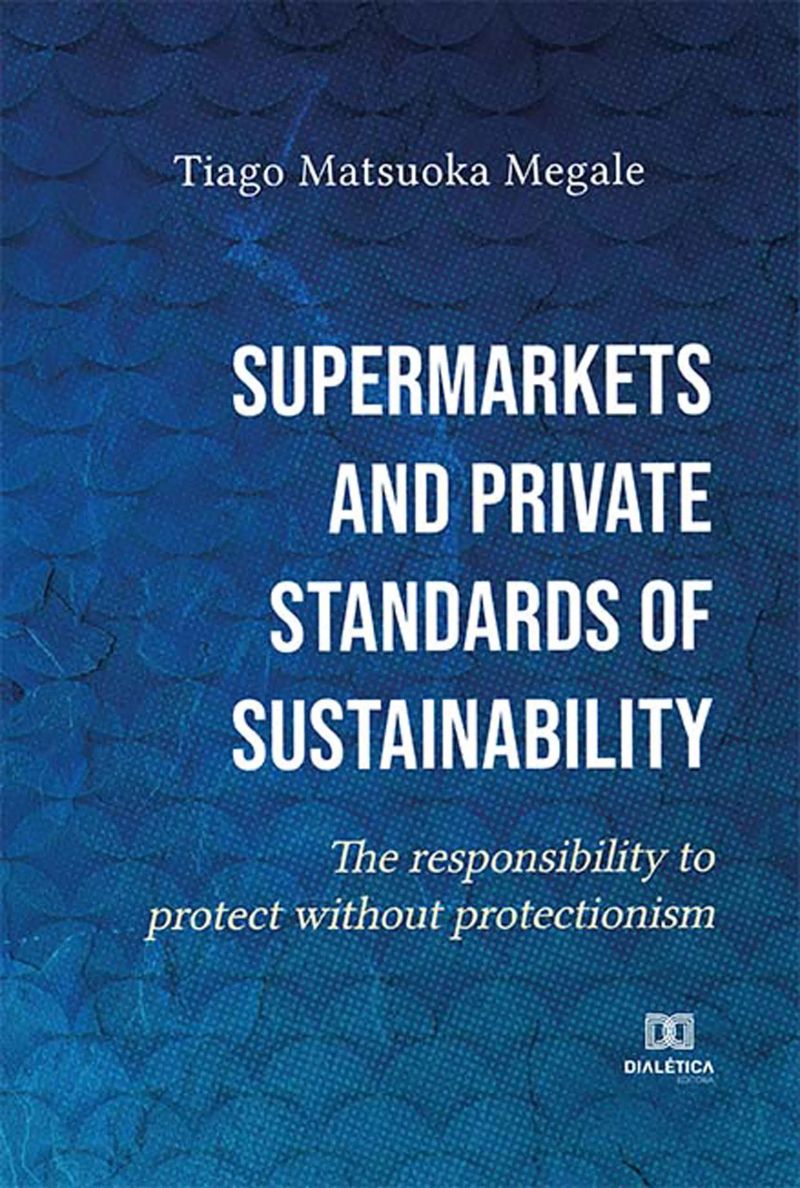
Supermarkets and private standards of sustainability
the responsibility to protect without protectionismBy Tiago Matsuoka Megale


Length3h 19m
About this audiobook
The current international economic scenario is characterized by the presence of an increasing number of multinational enterprises, the formation of global value chains and the creation of transnational regulatory networks. The aim of this book is to analyze to which extent private standards of sustainability imposed by supermarkets protect common values as the human life or health instead of constituting disguised restrictions to trade. The analysis and the case studies disclosed that the essence of the aforementioned standards can be determined through the limited scope of WTO treaties that regulate non-tariff barriers to trade and the search of coherence between supermarkets? sustainability policies and OECD rules.
Audiobook details
GenreBusiness and Economics
Length3 hrs 19 mins
Narrated byListen with 1,000+ voices
FormateBook with Audio
Publish dateOct 26, 2021
LanguageEnglish
Table of contents
1Acronyms
2Apresentação
31. Introduction
42. Theoretical basis
52.1. The firm in the market
Show all chaptersShow less
62.2. The firm in the supply chain
72.3. Private standards and the fragmentation of international trade
82.3.1. WTO regulation of technical and phytosanitary standards
92.3.2. Privatization of the governance of international trade
102.3.3. Sustainable development and the search of unity in international trade
113. Methodology
123.1. Hypothesis development
133.2. The internationalization process: the multinational as a new global player
143.2.1. Justification of the international retailers chosen
153.2.2. Tesco’s internationalization
163.2.3. Casino’s internationalization
173.2.4. Walmart’s internationalization
183.3. Sample: private standards of sustainability in the retail sector
193.4. Empirical research: species of private standards and their scope
204. The world of private standards
214.1. Terminological precision: private label and private standard
224.2. Plurality of private labels and private standards on the retail
234.2.1. Walmart sustainability policy and private standards
244.2.2. Tesco sustainability policy and private standards
254.2.3. Casino sustainability policy and private standards
264.3. Corporate social responsibility in the retail sector
274.3.1. A business case for CSR
284.3.2. Global expansion of corporate social responsibility
294.3.3. The OECD regulation of corporate social responsibility
304.4. Determining the essence of private labels
314.5. The search of coherence between supermarkets’ sustainability policies and the OECD framework
325. Conclusion
Never Split the DifferenceChris Voss, Tahl Raz8h 7m4.4 (277.7K)$26 · $0.00
The Intelligent Investor Rev Ed.Benjamin Graham17h 48m4.3 (191.5K)$40 · $0.00
The Hard Thing About Hard ThingsBen Horowitz7h 57m4.2 (134.3K)$26 · $0.00
Boundaries for LeadersHenry Cloud7h 36m4.3 (3.6K)$26 · $0.00
Big TrustShadé Zahrai, Fayçal Sekkouah8h 36m4.6 (406)$26 · $0.00
The Intelligent Investor Third EditionBenjamin Graham, Jason Zweig20h4.4 (156.6K)$46 · $0.00
Bottle of LiesKatherine Eban14h 25m4.4 (12K)$33 · $0.00

The Antiracist Business BookTrudi Lebrón6h 10m4.6 (275)$17 · $0.00
The FormulaJoshua Robinson, Jonathan Clegg10h 41m4.4 (6.9K)$29 · $0.00
Let Them LeadJohn U. Bacon7h 10m4.5 (1.4K)$24 · $0.00
Secrets of the Millionaire MindT. Harv Eker5h 11m4.4 (301.4K)$24 · $0.00
The Person You Mean to BeDolly Chugh9h 6m4.4 (7.2K)$29 · $0.00
BoundlessNick Kostov, Sean McLain9h 17m4.5 (1.1K)$29 · $0.00
Everyday DharmaSuneel Gupta5h 2m4.5 (761)$20 · $0.00
Let's Talk Mutual FundsMonika Halan7h 5m4.4 (2.4K)$16 · $0.00
The Law of Success in Sixteen LessonsNapoleon Hill2h 39m4.4 (17.2K)$2 · $0.00
Barbarians at the GateBryan Burrough, John Helyar3h 3m4.4 (52.7K)$18 · $0.00
JumpSteve Harvey4h 24m4.4 (4.5K)$20 · $0.00
AngelJason Calacanis8h 20m4.4 (4.4K)$26 · $0.00
Creative CallingChase Jarvis8h 33m4.4 (2.8K)$26 · $0.00
You may also like
The Low-Carb FraudT. Colin Campbell PhD2h 9m3.9 (1.5K)$15
We the CorporationsAdam Winkler14h 30m4.4 (1.7K)$23

The History of the Standard Oil Company (Complete Illustrated Edition) (Annotated)Ida Minerva Tarbell33h 47m4.2 (3.6K)$1.99 · $0.00
Food SanityDr. David Friedman12h 31m4.3 (489)$20 · $0.00
Cat TaleCraig Pittman9h 45m4.3 (1.6K)$29 · $0.00

Better Than We Found ItFrederick Joseph, Porsche Joseph13h 52m4.4 (357)$23
WholeT. Colin Campbell PhD11h 8m4.2 (10.2K)$20 · $0.00

Escaping the Rabbit HoleMick West11h 16m4.0 (1.2K)$20
The Future of NutritionT. Colin Campbell PhD11h 6m4.2 (1.2K)$20
No Is Not EnoughNaomi Klein7h 56m4.2 (14.1K)$17
Healthy Eating, Healthy WorldJ. Morris Hicks, Ken Kurson7h 39m4.1 (672)$17
Sacred CowDiana Rodgers RD, Robb Wolf8h 28m4.4 (4.3K)$20
MetabolicalRobert H. Lustig12h 4m4.4 (12.8K)$29 · $0.00

Silent Spring RevolutionDouglas Brinkley29h 25m4.4 (752)$53 · $0.00

BittenKris Newby5h 1m4.3 (3.7K)$24 · $0.00

Common GroundCal Thomas, Bob Beckel8h 19m3.6 (116)$26 · $0.00

The Art of Letting GoDan Desmarques2h 9m4.7 (9) Only with Ultra

Food ForensicsMike Adams9h 22m4.3 (208)$20 · $0.00

Baptized in PCBsEllen Griffith Spears14h 21m4.1 (34)$25

SHADOWS ABOVE THE WATERSHEDJudson Powers56m4.6 (9) Only with Ultra