
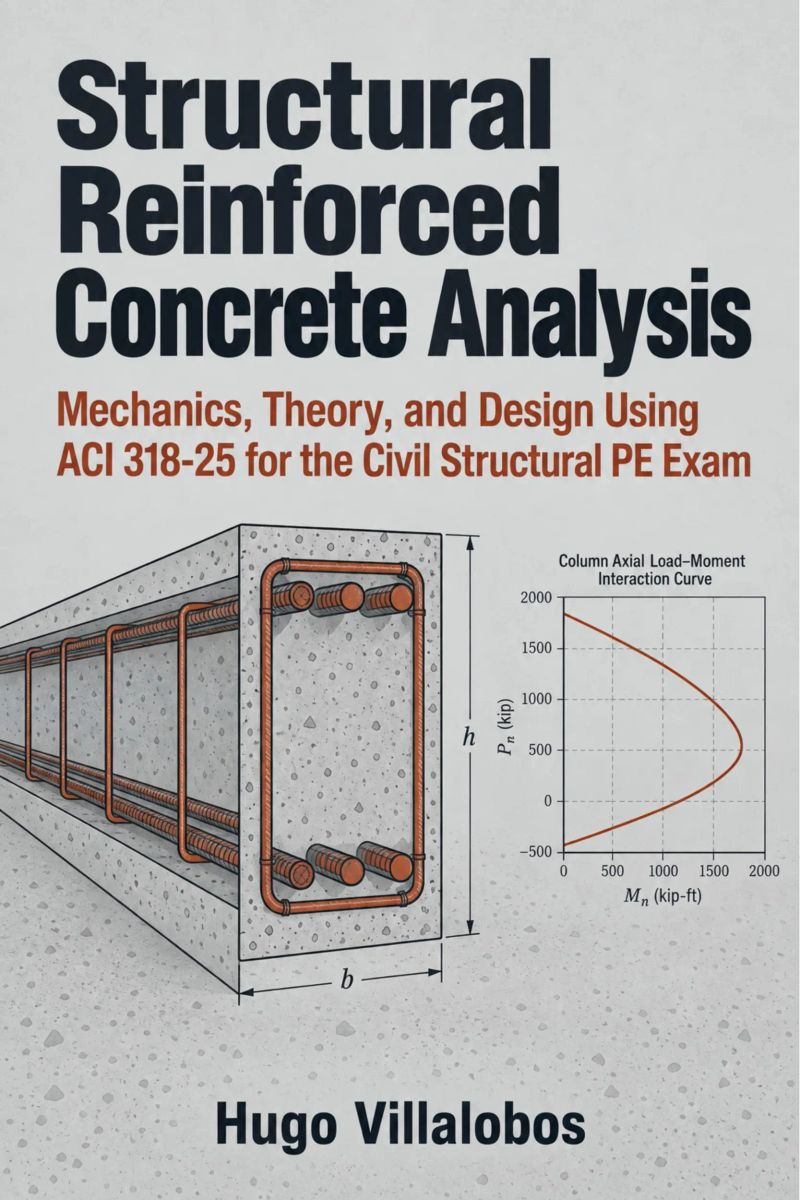
Structural Reinforced Concrete Analysis
Mechanics, Theory, and Design Using ACI 318-25 for the Civil Structural PE ExamBy Hugo Villalobos


Length16h 1m
About this audiobook
Reinforced concrete design goes wrong in the details, not the formulas.
This book builds the mechanics first, deriving the stress block from strain compatibility so you know exactly why a section is tension-controlled, then carries each limit state through to a finished bar schedule. You will design beams in flexure, size stirrups for shear and torsion, calculate development lengths and place cutoffs correctly, control cracking and long-term deflection, construct column interaction diagrams, handle slenderness and moment magnification, and design one-way and two-way slabs including punching shear. Footings and retaining walls follow, with a closing set of licensing-exam problems worked in full under current code provisions.
Every chapter connects theory to practice: start with material behavior and design philosophy, move through flexural analysis and design of rectangular and flanged beams, then tackle shear, torsion, bond, development, and splices. Serviceability, short and slender columns, continuous beams, one-way and two-way slabs, footings, and retaining walls are covered with step-by-step procedures and code-referenced checks. The final chapter integrates systems and provides exam-style practice problems solved in full, so you can verify your understanding and build speed for the structural depth exam.
What you will learn:
• Derive the equivalent stress block from strain compatibility and identify tension-controlled, transition, and compression-controlled sections.
• Analyze and design rectangular and flanged beams for flexure, including reinforcement selection and detailing.
• Size stirrups and design for shear and torsion using ACI 318-25 provisions.
• Calculate development lengths, lap splices, and bar cutoffs, and apply proper detailing rules.
• Control cracking and long-term deflection through serviceability checks.
• Construct column interaction diagrams and handle slenderness and moment magnification.
• Design one-way and two-way slab systems, including punching shear reinforcement.
• Proportion footings and retaining walls for stability and strength.
• Work licensing-exam problems in full, from load takedown to final design.
For structural engineering students, design office engineers, and candidates preparing for the structural depth exam, this book provides a rigorous yet practical path to mastering reinforced concrete analysis and design under current code provisions.
Audiobook details
GenreTechnology, Education and Learning
Length16 hrs 1 min
Narrated byListen with 1,000+ voices
FormateBook with Audio
Publish dateSep 27, 2026
LanguageEnglish
Table of contents
1Foreword
2Preface
3About This Book
4Important Safety Notice
5Chapter 1: Concrete and Reinforcing Steel
Show all chaptersShow less
61.1 Concrete as a Composite Material
71.2 Compressive Stress-Strain Behavior and Modulus
81.3 Creep, Shrinkage, and Temperature Effects
91.4 Reinforcing Steel Grades and Stress-Strain Behavior
101.5 Bar Sizes, Spacing, and Detailing Conventions
111.6 Durability, Cover, and Material Specification
12Chapter 2: Design Philosophy and Loads
132.1 Strength Design Basis and Limit States
142.2 Load Types and Load Combinations
152.3 Strength Reduction Factors and Their Basis
162.4 Serviceability and Deflection Limits
172.5 Reliability, Variability, and the Safety Margin
18Chapter 3: Flexural Analysis of Beams
193.1 Flexural Behavior and the Three Stages
203.2 Strain Compatibility and Equilibrium
213.3 The Equivalent Rectangular Stress Block
223.4 Balanced, Tension-Controlled, and Compression-Controlled Sections
233.5 Doubly Reinforced and Flanged Sections in Analysis
24Chapter 4: Flexural Design of Rectangular and Flanged Beams
254.1 Design Procedure for Singly Reinforced Rectangular Beams
264.2 Minimum Reinforcement and Reinforcement Ratio Limits
274.3 Doubly Reinforced Beam Design
284.4 Flanged Beam Design
294.5 Bar Layout, Spacing, and Detailing for Flexure
304.6 Design Examples with Complete Bar Schedules
31Chapter 5: Shear and Diagonal Tension
325.1 Diagonal Tension and the Shear Mechanism
335.2 Concrete Shear Contribution
345.3 Stirrup Design and Spacing Limits
355.4 Shear Design Procedure and Complete Example
365.5 Shear Friction and Interface Shear
375.6 Deep Beams, Brackets, and Corbels
38Chapter 6: Torsion
396.1 Torsion in Structural Members and Equilibrium versus Compatibility Torsion
406.2 Torsional Strength and the Thin-Walled Tube Analogy
416.3 Torsion Reinforcement Detailing
426.4 Combined Shear and Torsion Design
43Chapter 7: Bond, Development, and Splices
447.1 Bond Mechanics and Development Length
457.2 Standard Hooks and Mechanical Anchorage
467.3 Lap Splices
477.4 Bar Cutoffs and the Moment Diagram
487.5 Anchorage and Detailing at Supports and Connections
49Chapter 8: Serviceability
508.1 Crack Control and Crack Width

When the Heavens Went on SaleAshlee Vance18h 20m4.4 (3K)$40 · $0.00

Everybody Has a Podcast (Except You)Justin McElroy, Travis McElroy, Griffin McElroy5h 9m4.3 (2.3K)$24 · $0.00

Hands of TimeRebecca Struthers8h 8m4.4 (1.3K)$26 · $0.00
Never Lost AgainBill Kilday10h 1m4.4 (805)$29 · $0.00

How the Internet HappenedBrian McCullough13h 28m4.3 (2.7K)$23 · $0.00

Collected Writings of Nikola TeslaNikola Tesla, Thomas Commerford Martin21h 50m4.3 (1.7K)$1 · $0.00

Just AspireAjai Chowdhry9h 13m4.4 (260)$29 · $0.00

The Little Book of AliensAdam Frank8h 20m4.3 (1.3K)$26 · $0.00

The inventions, researches and writings of Nikola Tesla (Annotated)Thomas Commerford Martin16h 59m4.3 (1.3K)$2 · $0.00

KargilV.P. Malik15h 18m4.3 (2K)$24 · $0.00

Experiments with Alternating CurrentsNikola Tesla9h 16m4.3 (874)$1.99 · $0.00

Fire on the HorizonTom Shroder, John Konrad8h 23m4.3 (858)$26 · $0.00

The Smell of Kerosene (Annotated)National Aeronautics and Space Administration, Donald L. Mallick, Peter W. Merlin11h 32m4.3 (523)$2 · $0.00

The Boy Who Harnessed the WindWilliam Kamkwamba, Bryan Mealer10h 5m4.2 (78.9K)$29 · $0.00

Across the Airless WildsEarl Swift10h 8m4.3 (1.3K)$29 · $0.00

Console WarsBlake J. Harris20h 41m4.2 (13.7K)$46 · $0.00

Improvised Munitions HandbookU.S. Department of Defense4h 49m4.3 (1.6K)$0.99 · $0.00

Escaping GravityLori Garver10h 54m4.2 (2.2K)$20 · $0.00

Wireless WarsJonathan Pelson8h 2m4.3 (418)$20 · $0.00

Let There Be WaterSeth M. Siegel8h 36m4.2 (2.3K)$20 · $0.00

A Brief History of IntelligenceMax S. Bennett12h 18m4.6 (6.6K)$29 · $0.00

HomeschooledStefan Merrill Block7h 10m3.6 (18.5K)$28 · $0.00

Parents and Children (Annotated)Charlotte Mason9h 23m4.6 (988)$2 · $0.00

Children Under FireJohn Woodrow Cox10h 17m4.5 (1.6K)$29 · $0.00

The State Must ProvideAdam Harris7h 15m4.5 (775)$24 · $0.00

The Call of the Wild and FreeAinsley Arment9h 7m4.4 (21.2K)$29 · $0.00
The Freelance WayRobert Vlach19h 48m4.5 (528)$40 · $0.00

Race to the BottomLuke Rosiak9h 20m4.5 (600)$29 · $0.00

They Came for the SchoolsMike Hixenbaugh9h 5m4.5 (2.6K)$8 · $0.00

Find Me UnafraidKennedy Odede, Jessica Posner11h 11m4.5 (2.7K)$29 · $0.00

Asking for ItKate Harding8h 55m4.4 (5.3K)$20 · $0.00
Defining Moments in Black HistoryDick Gregory7h 37m4.4 (6K)$26 · $0.00

The Emerald Tablets of Thoth the AtlanteanMaurice Doreal3h 4m4.4 (8.8K)$6 · $0.00

Learning AmericaLuma Mufleh6h 37m4.4 (564)$24 · $0.00

Math-ishJo Boaler7h 21m4.4 (588)$24 · $0.00

Daddy-Long-LegsJean Webster12h 18m4.2 (91K)$1.99 · $0.00
It Worked For MeColin Powell7h 42m4.3 (9.8K)$26 · $0.00

Little SoldiersLenora Chu11h 30m4.3 (3.1K)$29 · $0.00

Grammar-land; Or, Grammar in Fun for the Children of Schoolroom-shireM. L. Nesbitt2h 36m4.4 (488)$1 · $0.00

Financial FeministTori Dunlap8h 3m4.2 (22.2K)$8 · $0.00
You may also like
The Ten-Day MBASteven Silbiger11h 6m3.9 (6.2K)Free

On the SublimeLonginus2h 7m4.1 (1.8K)$21 · $0.00

The Wealth of NationsAdam Smith35h 14m4.1 (124.1K)$40
The Intelligent Investor Rev Ed.Benjamin Graham17h 48m4.3 (191.5K)$40 · $0.00

ProofAdam Rogers8h 44m4.1 (7.1K)$20

The EconomistXenophon3h 53m3.9 (1.4K)Free

Fundamental Principles of the Metaphysic of MoralsImmanuel Kant3h 21m4.0 (24.5K)$0.60 · $0.00

A History of Video Games in 64 ObjectsWorld Video Game Hall of Fame7h 41m4.1 (477)$26 · $0.00

Scattered PoemsJack Kerouac51m3.9 (3.2K)$8
The Speed of SoundScott Eyman13h 39m4.2 (368)$23
The inventions, researches and writings of Nikola Tesla (Annotated)Thomas Commerford Martin16h 59m4.3 (1.3K)$2 · $0.00

Just Visiting This Planet, Revised and Updated for the Twenty-First CenturyNeil deGrasse Tyson5h 35m4.0 (1.4K)$17

The Problem of PainC. S. Lewis3h 58m4.3 (135.8K)$12

Competitive Dynamics Of Air Transport In Brazil: 2008-2014Luiz Fernando Abel4h 55m$18 · $0.00

The Money Pit, Vol. 13Tom Kraeutler, Leslie Segrete9h 41m$20

What Even Is an APIFlorence Larkin7h$5 · $0.00
Guitar by Ear: Solos Box Set 3Bill Brown14h 1m$23

Guitar by Ear: Pop and Standards Box Set 2Bill Brown17h 11m$25

Bass by Ear: Box Set 2Bill Brown8h 59m$23

Piano by Ear: New and Traditional Classical Box Set 1Bill Brown13h 24m$23