
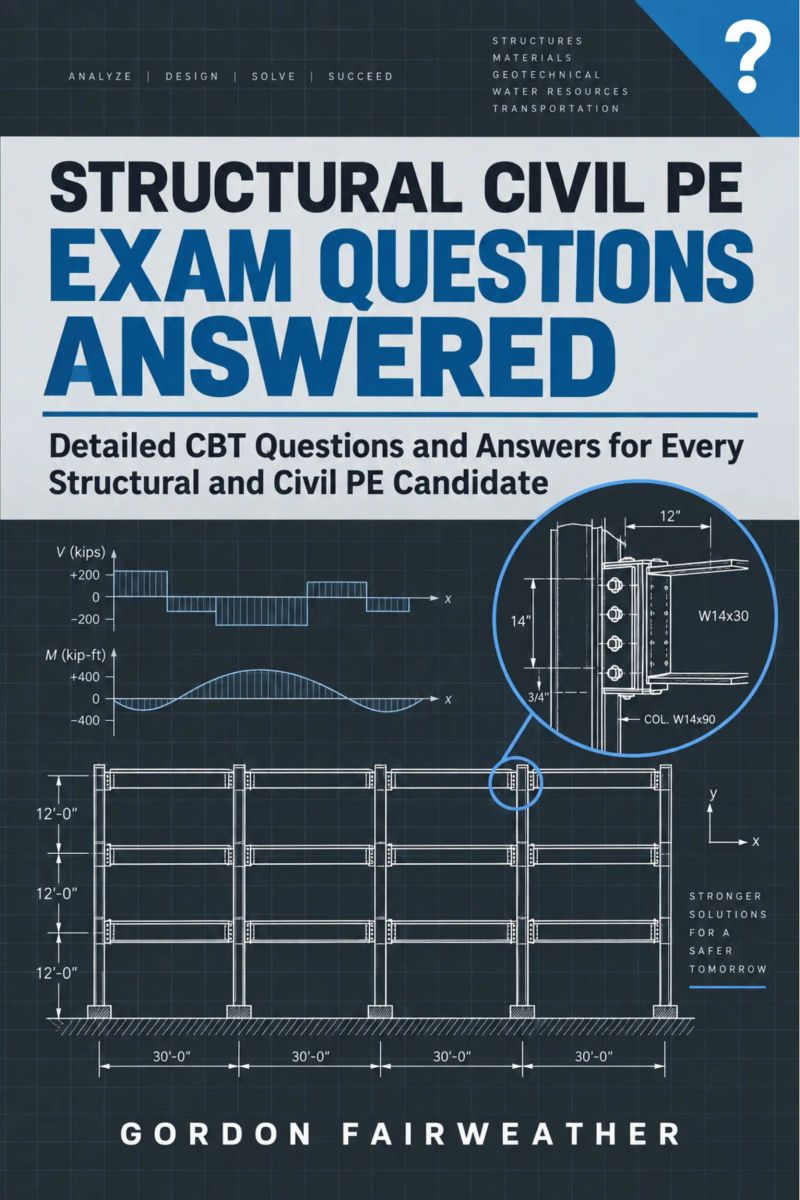
Structural Civil PE Exam Questions Answered
Detailed CBT Questions and Answers for Every Structural and Civil PE CandidateBy Gordon Fairweather


Length14h 8m
About this audiobook
Answer the question first, then find out what you actually knew.
That is how this book works. Each chapter puts exam-realistic structural problems in front of you, then explains the solution in full engineering detail: how the load combination was chosen, why the section is compact or slender, where the development length came from, what changed when the wall became slender. You cover gravity and lateral loads, analysis, reinforced and prestressed concrete, steel members and connections, wood, masonry, foundations, retaining structures and temporary works, then close with mixed timed sets that mimic exam pacing. Every rationale names the reference you should have opened on screen.
For civil engineers taking the structural depth exam and for structural engineers returning to licensure after a gap, this book builds the habit of answering before reading the explanation, so you learn what you truly know and where to focus next.
What you will learn:
• Navigate the structural depth exam format and question types with confidence.
• Apply gravity load combinations and load factors correctly for buildings and bridges.
• Determine lateral loads from wind and seismic provisions and distribute them through structural systems.
• Perform structural analysis for determinate and indeterminate structures, including approximate methods.
• Design reinforced concrete members for flexure, shear, and development, and handle slender walls.
• Analyze prestressed concrete members for service and strength limit states.
• Select and check structural steel members and connections, including bolted and welded details.
• Design wood and masonry elements according to code requirements.
• Evaluate foundations, earth retention systems, and temporary structures for constructability.
This book is for civil engineers preparing for the structural depth portion of the PE exam and for structural engineers returning to licensure after time away. If you want to test your knowledge under realistic conditions and learn from detailed, reference-backed explanations, this book is for you.
Audiobook details
Rating★★★★★ 4.8 (10)
Includes Amazon
GenreTechnology, Education and Learning
Length14 hrs 8 mins
Narrated byListen with 1,000+ voices
FormateBook with Audio
Publish dateSep 27, 2026
LanguageEnglish
Table of contents
1Foreword
2Preface
3About This Book
4Important Safety Notice
5Chapter 1: Inside the Structural Depth Exam
Show all chaptersShow less
61.1 Exam Format, Timing and Question Mix
71.2 The Testing Interface and On-Screen Tools
81.3 Navigating the Searchable Reference Set
91.4 A Repeatable Method for Working a Question
101.5 Where Candidates Lose Marks
111.6 Building a Study Plan Around the Question Bank
12Chapter 2: Gravity Loads and Load Combinations
132.1 Dead Loads and Superimposed Dead Loads
142.2 Live Loads, Occupancy Values and Live Load Reduction
152.3 Roof Live, Snow and Rain Loads
162.4 Rain Loads and Ponding Instability
172.5 Tributary Areas and Load Paths
182.6 Strength and Allowable Stress Load Combinations
19Chapter 3: Lateral Loads
203.1 Wind Pressure Determination
213.2 Seismic Base Shear
223.3 Vertical Distribution of Seismic Forces and Story Shears
233.4 Diaphragm and Vertical System Behavior
243.5 Story Drift, P-Delta and Deflection Limits
253.6 Structural Irregularities and Their Consequences
26Chapter 4: Structural Analysis
274.1 Determinacy, Stability and Support Idealization
284.2 Shear and Moment Diagrams
294.3 Deflection by Integration, Moment-Area and Superposition
304.4 Influence Lines for Moving Loads
314.5 Force Method and Stiffness Method Foundations
324.6 Approximate Analysis of Frames and Continuous Beams
33Chapter 5: Reinforced Concrete Design
345.1 Flexural Design of Rectangular Sections
355.2 Shear Design and Stirrup Proportioning
365.3 Development Length, Anchorage and Splices
375.4 Short Columns Under Axial Load and Bending
385.5 Slender Columns and Moment Magnification
39Chapter 6: Prestressed Concrete
406.1 Prestressing Systems, Materials and Geometry
416.2 Immediate and Long-Term Loss Estimation
426.3 Service Stress Checks and Flexural Strength
436.4 Transfer Length, Development and Detailing
44Chapter 7: Structural Steel Design
457.1 Tension Members: Yielding, Rupture and Block Shear
467.2 Compression Members and Flexural Buckling
477.3 Flexural Members and Lateral-Torsional Buckling
487.4 Beam-Columns and the Interaction Equations
49Chapter 8: Steel Connections
508.1 Bolted Connections: Shear, Bearing and Tearout

Hands of TimeRebecca Struthers8h 8m4.4 (1.3K)$26 · $0.00
Never Lost AgainBill Kilday10h 1m4.4 (805)$29 · $0.00

How the Internet HappenedBrian McCullough13h 28m4.3 (2.7K)$23 · $0.00

Collected Writings of Nikola TeslaNikola Tesla, Thomas Commerford Martin21h 50m4.3 (1.7K)$1 · $0.00

Just AspireAjai Chowdhry9h 13m4.4 (260)$29 · $0.00

The Little Book of AliensAdam Frank8h 20m4.3 (1.3K)$26 · $0.00
The inventions, researches and writings of Nikola Tesla (Annotated)Thomas Commerford Martin16h 59m4.3 (1.3K)$2 · $0.00

KargilV.P. Malik15h 18m4.3 (2K)$24 · $0.00

Experiments with Alternating CurrentsNikola Tesla9h 6m4.3 (874)$1 · $0.00

Fire on the HorizonTom Shroder, John Konrad8h 23m4.3 (858)$26 · $0.00

The Smell of Kerosene (Annotated)National Aeronautics and Space Administration, Donald L. Mallick, Peter W. Merlin11h 32m4.3 (523)$2 · $0.00

The Boy Who Harnessed the WindWilliam Kamkwamba, Bryan Mealer10h 5m4.2 (78.9K)$29 · $0.00

Across the Airless WildsEarl Swift10h 8m4.3 (1.3K)$29 · $0.00

Console WarsBlake J. Harris20h 41m4.2 (13.7K)$46 · $0.00

Improvised Munitions HandbookU.S. Department of Defense4h 49m4.3 (1.6K)$1.99 · $0.00
Escaping GravityLori Garver10h 54m4.2 (2.2K)$20 · $0.00

Wireless WarsJonathan Pelson8h 2m4.3 (418)$20 · $0.00

Let There Be WaterSeth M. Siegel8h 36m4.2 (2.3K)$20 · $0.00

The PerfectionistsSimon Winchester11h 46m4.2 (9.9K)$29 · $0.00

Rethinking NarcissismDr. Craig Malkin6h 7m4.2 (3.4K)$24 · $0.00

A Brief History of IntelligenceMax S. Bennett12h 18m4.6 (6.6K)$29 · $0.00

HomeschooledStefan Merrill Block7h 10m3.6 (18.5K)$28 · $0.00

WitnessAriel Burger8h 1m4.6 (1.3K)$20 · $0.00

EducationEllen G. White9h 41m4.6 (1.5K)$2 · $0.00

Parents and Children (Annotated)Charlotte Mason9h 23m4.6 (988)$2 · $0.00

Children Under FireJohn Woodrow Cox10h 17m4.5 (1.6K)$29 · $0.00

The State Must ProvideAdam Harris7h 15m4.5 (775)$24 · $0.00

The Call of the Wild and FreeAinsley Arment9h 7m4.4 (21.2K)$29 · $0.00
The Freelance WayRobert Vlach19h 48m4.5 (528)$40 · $0.00

Race to the BottomLuke Rosiak9h 20m4.5 (600)$29 · $0.00

They Came for the SchoolsMike Hixenbaugh9h 5m4.5 (2.6K)$8 · $0.00

Find Me UnafraidKennedy Odede, Jessica Posner11h 11m4.5 (2.7K)$29 · $0.00

Asking for ItKate Harding8h 55m4.4 (5.3K)$20 · $0.00
Defining Moments in Black HistoryDick Gregory7h 37m4.4 (6K)$26 · $0.00

The Emerald Tablets of Thoth the AtlanteanMaurice Doreal3h 4m4.4 (8.8K)$6 · $0.00

Learning AmericaLuma Mufleh6h 37m4.4 (564)$24 · $0.00
Math-ishJo Boaler7h 21m4.4 (588)$24 · $0.00
It Worked For MeColin Powell7h 42m4.3 (9.8K)$26 · $0.00

Little SoldiersLenora Chu11h 30m4.3 (3.1K)$29 · $0.00

Financial FeministTori Dunlap8h 3m4.2 (22.2K)$8 · $0.00
You may also like
TubesAndrew Blum7h 21m3.6 (4.9K)$24 · $0.00

The Chemical History of a Candle (Scientific Lectures)Michael Faraday5h 14m4.1 (1.2K)$1 · $0.00

Journey to the Center of the EarthJules Verne8h 22m4.0 (277K)$21 · $0.00

Finding ZeroAmir D. Aczel5h 56m3.8 (1.5K)$20

The Changing Conceptions of the Universe - From Newton to Einstein -Benjamin Harrow, Albert Einstein, Arthur Stanley Eddington, Joseph Sweetman Ames, Joseph John Thomson, Frank Watson Dyson2h 57m3.6 (16)$1 · $0.00

The Criticism of the New TestamentFrederick Henry Ambrose Scrivener35h 33m4.3 (38)$2 · $0.00

Through the Eyes of the AntsX Kwang3m$9 · $0.00

Black Hole ChasersAnna Crowley Redding2h 55m4.2 (90)$15

Pale Ink (Annotated)Henriette Mertz5h 46m4.0 (232)$2 · $0.00

Conversations About Physics, Volume 1Howard Burton11h 45m$10 · $0.00

FusangCharles G. Leland5h 6m3.8 (35)$21 · $0.00
The discovery and decipherment of the trilingual cuneiform inscriptionsArthur John Booth15h 7m$1 · $0.00

Experiments and Observations Tending to Illustrate the Nature and Properties of ElectricityWilliam Sir Watson1h 1m$1 · $0.00

Power BI for Business IntelligenceLena Farrell7h 24m$5 · $0.00

Value A CoinRichard W. Avery1h 31m3.1 (18)$2.30

The Every-Machine Bread Maker CookbookCerys J. Chamberlain11h 10m$11.50

Unpermitted Work and Retroactive PermitsImad Muratspahic3h 59m$14 · $0.00

Old Glass and How to Collect itJ. Sydney Lewis2h 55m$1.50 · $0.00
Groundwork of the Metaphysics of Morals (Annotated)Immanuel Kant5h 5m$2 · $0.00
Photographic Reproduction ProcessesPeter C. Duchochois3h 56m$2 · $0.00