
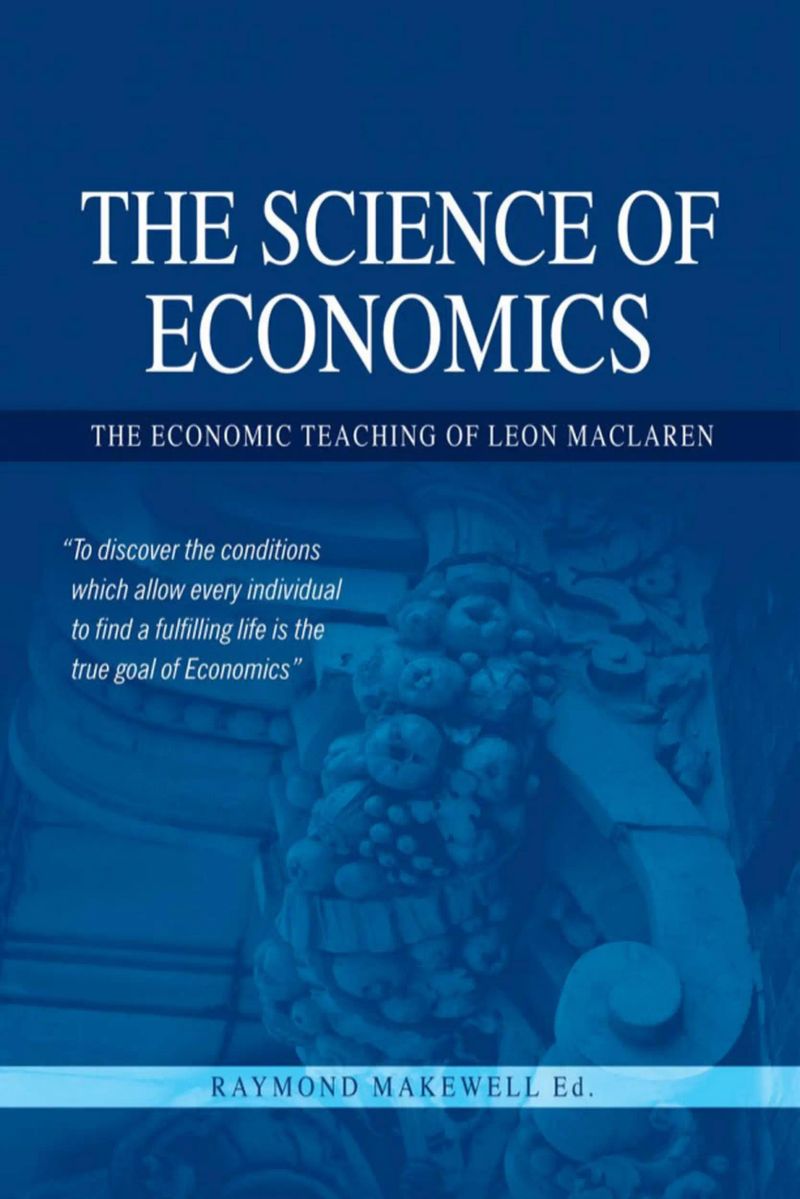


Length11h 40m
About this audiobook
Leon MacLaren (1910-1994) was a barrister, politician, philosopher and the founder of the School of Economic Science. He considered the true goal of Economics to be the discovery of the conditions which allow every individual to find a fulfilling life. In his view, science was a study of laws that exist in nature, whilst economics was a study of the humanities, with the interaction of human nature and the natural universe at its heart.
MacLaren defined economics as 'the study of the natural laws which govern the relationships between people in society'.
This book is based on a three-year course prepared by Leon MacLaren for the School of Economic Science in London in the late 1960s. The editor, Raymond Makewell, presents the original subject matter revised with more recent examples and statistics from Australia, Canada, New Zealand, UK and USA.
Instead of making supply and demand the starting point, it begins with the simple observation that all material wealth is ultimately derived from land, and, where goods are exchanged the first requirement is trust, or a system of credit. From this starting point the major characteristics of the modern economy such as banking, companies or corporations, international trade, taxation and trade cycles are examined in terms of the conditions that govern how and why they evolved and how they operate today.
The framework in which the economy operates is examined in terms of how the system of land tenure and the concepts of property evolved in the English-speaking world, the role of government in economic affairs, and the degree of economic freedom. This reveals how the current economic situation denies people access to all that they need to work and produce wealth for themselves.
Injustice is the inevitable result and poverty its inseparable companion.
Audiobook details
GenreBusiness and Economics
Length11 hrs 40 mins
Narrated byListen with 1,000+ voices
FormateBook with Audio
Publish dateAug 8, 2012
LanguageEnglish
Table of contents
1Acknowledgements
263.2 Natural Law
2Foreword
27Chapter 4 Further Divisions of Wealth
3Introduction
284.1 The Rise of Capitalism
4Who Was Leon Maclaren?
294.2 Secondary Claims
5Leon Maclaren’s Economics
30Chapter 5 Value
Show all chaptersShow less
6This Book
315.1 What Are Values?
7Section 1 – First Principles
325.2 Values in Operation
8Chapter 1 Preliminaries
33Chapter 6 Price
91.1 Humanity
346.1 Setting the Price
101.2 The World in Which We Live
356.2 Monopoly and Price
111.3 The Point of Interaction
366.3 Advertising and Price
121.4 Man in Society
376.4 Taxation and Price
131.5 Production
386.5 The Law of Supply and Demand
141.6 Community
396.6 Production and Price
151.7 The Significance of Land
40Chapter 7 The Means of Exchange
161.8 The Importance of Location
417.1 What is Money?
17Chapter 2 The Division of Wealth
427.2 Credit
182.1 The Primary Division of Production
43Section 2 – the Capitalist System
192.2 Determination of Earnings
44Chapter 8 Money
202.3 Determination of the Tenant’s Share
458.1 Private Money
212.4 Secondary Claims on Wealth
468.2 Public Money
222.5 Lowest Level of Earnings
478.3 Bank Money
232.6 An Historical Perspective
488.4 Conclusion
24Chapter 3 Civil and Economic Freedom
49Chapter 9 Banking
253.1 The Importance of Earnings for Civil Rights
509.1 The Evolution of Banking
Never Split the DifferenceChris Voss, Tahl Raz8h 7m4.4 (277.7K)$26 · $0.00
The Intelligent Investor Rev Ed.Benjamin Graham17h 48m4.3 (191.5K)$40 · $0.00
The Hard Thing About Hard ThingsBen Horowitz7h 57m4.2 (134.3K)$26 · $0.00
Boundaries for LeadersHenry Cloud7h 36m4.3 (3.6K)$26 · $0.00
Eat It!Jordan Syatt, Michael Vacanti4h 40m4.6 (1.5K)$20 · $0.00

Progress and Poverty, Volumes I and II (Annotated)Henry George19h 21m4.6 (574)$0.99 · $0.00

Not Everything Counts but Everything Matters: The powerful and inspirational new book about leadership and achieving success from the visionary multi-premiership winning Panthers coachIvan Cleary6h 1m4.6 (680)$24 · $0.00
BuildTony Fadell11h 5m4.5 (14.3K)$8 · $0.00
The Joys Of CompoundingGautam Baid17h 34m4.5 (2.5K)$18 · $0.00
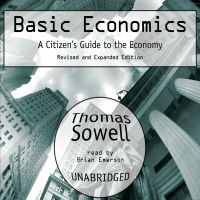
Basic EconomicsThomas Sowell18h 32m4.5 (29.3K)$28 · $0.00

Poor Charlie’s AlmanackGrover Gardener, Charles T. Munger13h 9m4.5 (24.7K)$18 · $0.00

The Ambuja StoryNarotam Sekhsaria13h 59m4.5 (830)$33 · $0.00

The Secret Door to SuccessFlorence Scovel Shinn2h 25m4.5 (2.1K)$1.20 · $0.00

This Is Going to HurtAdam Kay5h 47m4.4 (444.7K)$24 · $0.00

Big TrustShadé Zahrai, Fayçal Sekkouah8h 36m4.6 (406)$26 · $0.00
The Intelligent Investor Third EditionBenjamin Graham, Jason Zweig20h4.4 (156.6K)$46 · $0.00

Bottle of LiesKatherine Eban14h 25m4.4 (12K)$33 · $0.00

The Antiracist Business BookTrudi Lebrón6h 10m4.6 (275)$17 · $0.00
The FormulaJoshua Robinson, Jonathan Clegg10h 41m4.4 (6.9K)$29 · $0.00

Let Them LeadJohn U. Bacon7h 10m4.5 (1.4K)$24 · $0.00
You may also like

Letters from Egypt (Annotated)Lucie Lady Duff Gordon13h 27m4.1 (444)$2 · $0.00

Doctor YourselfAndrew Saul PhD9h 57m4.4 (2.7K)$20

How To EatMark Bittman, David Katz7h 13m3.8 (4.1K)$24 · $0.00

The Rebel’s ApothecaryJenny Sansouci7h 47m4.5 (546)$17

Visionary WomenAndrea Barnet19h 17m4.3 (791)$40 · $0.00

Birding to Change the WorldTrish O'Kane13h 55m4.4 (2.3K)$33 · $0.00

Go GentlyBonnie Wright5h 35m4.2 (1.7K)$24 · $0.00

Your Guide to Forest BathingM. Amos Clifford3h 37m4.0 (1.8K)$17

BiomimicryJanine M. Benyus14h 54m4.1 (3.6K)$33 · $0.00
Nature ObscuraKelly Brenner5h 52m4.1 (1K)$17

Walden, Slavery in Massachusetts & Civil DisobedienceHenry David Thoreau13h 47m4.3 (2.4K)$1.99 · $0.00

Walking Henry David Thoreau1h 15m4.0 (15.1K)Free

The Schools of Utopia & Schools of To-morrow (Illustrated)John Dewey8h 56m3.9 (167)$1.99 · $0.00
Green Business Practices for DummiesLisa Swallow3h 53m3.8 (44)$20 · $0.00

The Gene Therapy PlanMitchell L. Gaynor MD10h 30m3.9 (291)$20

Learn To Make Natural CheesesJideon F Marques12h 11m$17 · $0.00

Walk Your Way to HealthMarcus B. Cole7h 15m$6.30 · $0.00

Every Man His Own DoctorR. T. Claridge7h 49m$2 · $0.00

The Natural Food of ManHereward Carrington10h 32m4.5 (29)$2 · $0.00

THE PINK SALT WEIGHT LOSS TRICK FOR WOMENYvonne Stanton3h 30m$9.50 · $0.00