
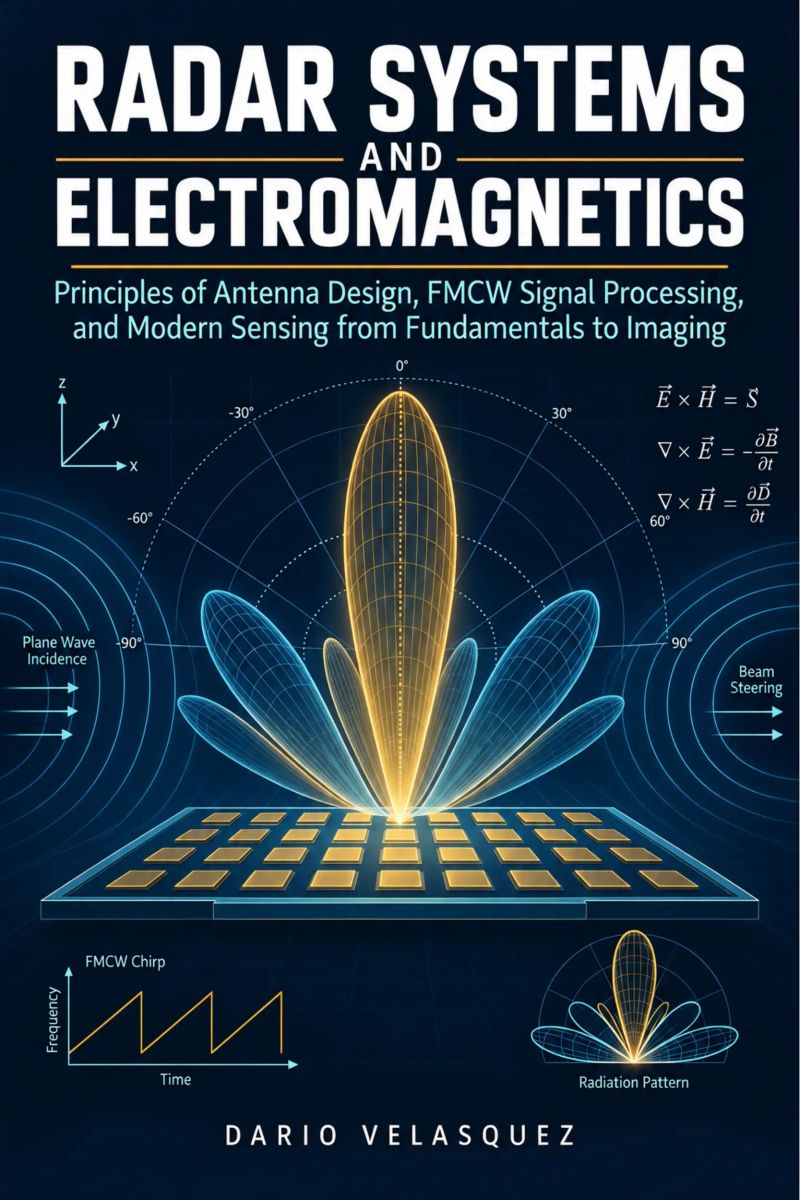
Radar Systems and Electromagnetics
Principles of Antenna Design, FMCW Signal Processing, and Modern Sensing from Fundamentals to ImagingBy Dario Velasquez


Length14h 59m
About this audiobook
Radar is not two subjects. It is one continuous path from field physics to detected target.
Most books treat antennas and signal processing as separate disciplines. This book connects them. You start with electromagnetic propagation and the radar range equation, then build aperture and phased-array design directly from radiation integrals. From there, you move into waveform choice, matched filtering, and the complete FMCW chirp chain—from sweep parameters to the range-Doppler map. The result is a single, coherent framework that shows how physics constrains algorithms and how algorithms exploit physics.
Later chapters extend the path to CFAR detection, monopulse and MIMO angle estimation, Kalman tracking, and SAR image formation. Every concept is reinforced with worked numbers you can check against your own designs. Whether you are optimizing an automotive radar sensor or simulating a synthetic aperture system, you will find the equations, block diagrams, and practical trade-offs needed to move from theory to implementation.
What you will learn:
• Apply electromagnetic foundations and the radar range equation to predict system performance
• Design aperture and array antennas using radiation integrals and pattern synthesis
• Implement phased-array beamforming and understand grating lobes, tapering, and scan loss
• Analyze radar cross section and scattering for target and clutter modeling
• Select waveforms using the ambiguity function and apply matched filtering for pulse compression
• Build the complete FMCW chirp chain, from sweep linearity to range-Doppler processing
• Mitigate clutter with Doppler processing and MTI filters
• Detect targets with CFAR and estimate angle using monopulse and MIMO techniques
• Track targets with Kalman filters and form SAR images for high-resolution sensing
Who this book is for: RF and DSP engineers, graduate students, and automotive sensing teams who need the physics and the algorithms in the same volume. If you work with radar hardware, write signal processing code, or study remote sensing, this book gives you the end-to-end understanding to design, simulate, and debug modern radar systems.
Audiobook details
GenreTechnology
Length14 hrs 59 mins
Narrated byListen with 1,000+ voices
FormateBook with Audio
Publish dateSep 27, 2026
LanguageEnglish
Table of contents
1Radar Systems and Electromagnetics
2Foreword
3Preface
4About This Book
5Chapter 1: Electromagnetic Foundations for Radar
Show all chaptersShow less
61.1 Maxwell’s Equations and the Wave Equation
71.2 Plane-Wave Propagation and Intrinsic Impedance
81.3 Polarization of Radar Signals
91.4 Propagation in Lossy Media
101.5 Atmospheric and Rain Attenuation
111.6 The Radar Frequency Spectrum
12Chapter 2: The Radar Range Equation
132.1 Derivation of the Radar Range Equation
142.2 Antenna Gain, Effective Aperture and Beamwidth
152.3 Noise, Noise Figure and the Radar Range Equation in SNR Form
162.4 Integration Gain and Detection Range Budgets
172.5 Worked Range Budget with Losses and Margins
18Chapter 3: Antenna Fundamentals
193.1 Radiation from a Current Element
203.2 Radiation Integrals and the Vector Potential
213.3 Directivity, Gain and Efficiency
223.4 Beamwidth, Sidelobes and Aperture Taper
233.5 Near Field, Far Field and Measurement
24Chapter 4: Aperture and Array Antennas
254.1 Horn Antennas
264.2 Microstrip Patch Antennas
274.3 Reflector Antennas
284.4 Linear and Planar Array Theory
294.5 Grating Lobes and Element Spacing Limits
30Chapter 5: Phased Arrays and Beamforming
315.1 Progressive Phase Steering
325.2 Amplitude Tapers and Sidelobe Control
335.3 Scan Loss and Element Pattern Effects
345.4 Analog, Digital and Hybrid Beamforming
35Chapter 6: Radar Cross Section and Scattering
366.1 Definition and Measurement of RCS
376.2 Specular, Edge and Travelling-Wave Mechanisms
386.3 Simple Target Models and Aspect Dependence
396.4 Swerling Fluctuation Models
40Chapter 7: Waveform Design and the Ambiguity Function
417.1 Range and Doppler Resolution Fundamentals
427.2 The Ambiguity Function and Its Properties
437.3 Linear FM and Phase-Coded Waveforms
447.4 Choosing a Waveform for a Mission
45Chapter 8: Matched Filtering and Pulse Compression
468.1 The Matched Filter and Its Properties
478.2 Chirp Compression and Range Sidelobes
488.3 Barker and Polyphase Codes
498.4 Stretch Processing and FMCW Connection
50Chapter 9: FMCW Radar and the Chirp Chain

Operation PedestalMax Hastings12h 29m4.4 (5.2K)$29 · $0.00

When the Heavens Went on SaleAshlee Vance18h 20m4.4 (3K)$40 · $0.00

Everybody Has a Podcast (Except You)Justin McElroy, Travis McElroy, Griffin McElroy5h 9m4.3 (2.3K)$24 · $0.00

Hands of TimeRebecca Struthers8h 8m4.4 (1.3K)$26 · $0.00

Never Lost AgainBill Kilday10h 1m4.4 (805)$29 · $0.00

How the Internet HappenedBrian McCullough13h 28m4.3 (2.7K)$23 · $0.00

Collected Writings of Nikola TeslaNikola Tesla, Thomas Commerford Martin21h 50m4.3 (1.7K)$1 · $0.00

Just AspireAjai Chowdhry9h 13m4.4 (260)$29 · $0.00

The Little Book of AliensAdam Frank8h 20m4.3 (1.3K)$26 · $0.00

The inventions, researches and writings of Nikola Tesla (Annotated)Thomas Commerford Martin16h 59m4.3 (1.3K)$2 · $0.00

KargilV.P. Malik15h 18m4.3 (2K)$24 · $0.00

Experiments with Alternating CurrentsNikola Tesla9h 16m4.3 (874)$1.99 · $0.00

Fire on the HorizonTom Shroder, John Konrad8h 23m4.3 (858)$26 · $0.00

The Smell of Kerosene (Annotated)National Aeronautics and Space Administration, Donald L. Mallick, Peter W. Merlin11h 32m4.3 (523)$2 · $0.00

The Boy Who Harnessed the WindWilliam Kamkwamba, Bryan Mealer10h 5m4.2 (78.9K)$29 · $0.00

Across the Airless WildsEarl Swift10h 8m4.3 (1.3K)$29 · $0.00

Console WarsBlake J. Harris20h 41m4.2 (13.7K)$46 · $0.00

Improvised Munitions HandbookU.S. Department of Defense4h 49m4.3 (1.6K)$0.99 · $0.00

Escaping GravityLori Garver10h 54m4.2 (2.2K)$20 · $0.00

Wireless WarsJonathan Pelson8h 2m4.3 (419)$20 · $0.00
You may also like

The Principle of RelativityAlbert Einstein7h 12m4.4 (1.2K)$2.30

Merlin’s Tour of the Universe, Revised and Updated for the Twenty-First CenturyNeil deGrasse Tyson4h 18m4.1 (3.2K)$15 · $0.00

The Experience Economy, Updated EditionB. Joseph Pine II, James H. Gilmore12h 13m3.9 (3.4K)$20
Dimensional Modeling for Data WarehousesSofia Petrova15h 17m$75

Build a Real-World App with ASP.NET CoreTheo Calderon8h 19m$5 · $0.00

Async JavaScript, UntangledVictor Fontaine7h 36m$5 · $0.00

Pass the CKAD ExamMarcus Iqbal8h 9m$5 · $0.00

Outsourcing for Your BusinessAnthony Ekanem52m$4 · $0.00

SharePoint for Beginners Made SimpleRuth Callender4h 20m$15

The 2020 WorkplaceJeanne C. Meister, Karie Willyerd9h 44m3.8 (574)$29 · $0.00

Linux For BeginnersRodrigo Montini3h 9m$7 · $0.00

Outlook Calendar Made SimpleRuth Callender3h 54m$8

The Dawn of Aeronautics: 10 Outstanding Aeronautical BooksRobert B. Meyer, V. E. Johnson, Fred T. Jane, John B. Rathbun, Thomas Herbert Russell, William J. Jackman, Octave Chanute, William D. Ennis, Charles B. Hayward, William G. Krueger, George Anthony Cavanagh, Alfred Powell Morgan48h 25m$0.99 · $0.00

Oil Change & Maintenance GuideADRIAN VICTOR. C2h 47m$10

Concurrency That PerformsEsther Tanaka7h 37m$5 · $0.00

ARDMS SPI Exam Study GuideMarie Peterson10h 44m$10

The Plain-English Guide to AsanaRuth Callender4h 20m$7

Pegi-Online Eine Ergänzung Des Pegi-Systems Für Online-SpieleGrit Stephan16m$4 · $0.00

Modern Data EngineeringOwen Fletcher7h 33m$6.50 · $0.00

Optical Transceivers and Photonic CircuitsAmara Okonkwo13h 9m$75