
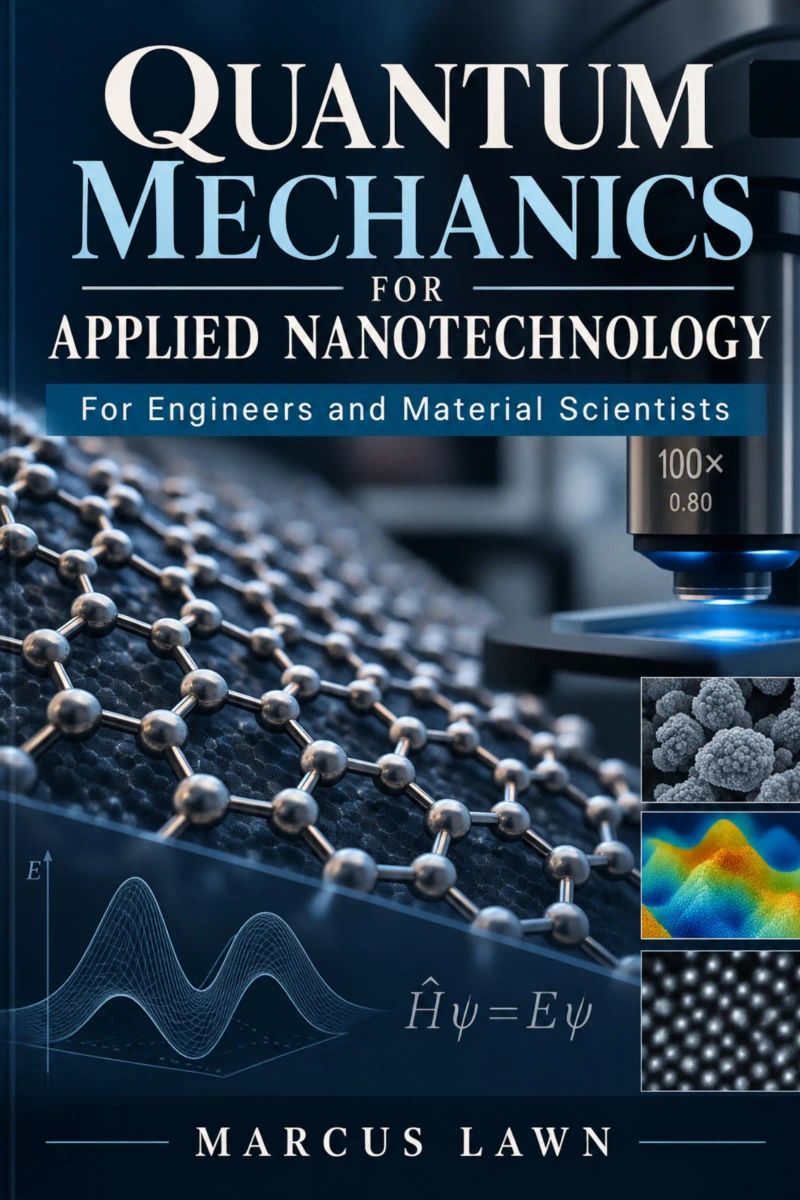
Quantum Mechanics for Applied Nanotechnology
For Engineers and Material ScientistsBy Marcus Lawn


Length18h 19m
About this audiobook
Quantum mechanics as a working engineering tool — not a historical tour.
A gate dielectric leaks far more current than any classical model predicts. A batch of nanocrystals shifts color when the synthesis runs two minutes long. A narrow constriction conducts in steps instead of a smooth curve. At the nanoscale the old rules quietly stop working, and the engineer who has to explain the result needs quantum mechanics as a practical instrument — with enough rigor to be trusted when a design depends on it.
Quantum Mechanics for Applied Nanotechnology is a complete, self-contained course written for people who build, characterize, and model things at the nanoscale. It assumes calculus, differential equations, linear algebra, and introductory physics — and no previous exposure to quantum mechanics. Twenty-three chapters take you from matter waves and the Schrödinger equation through perturbation theory, spin, identical particles, band theory, density operators, and open quantum systems, then put that machinery to work on heterostructures, quantum cascade lasers, spintronic memory, high-electron-mobility transistors, molecular junctions, qubits, and quantum sensors.
Every topic opens with something observable — the size-tuned glow of a quantum dot, the exponential current–distance curve of a tunneling microscope, the decoherence of a qubit — and the theory is developed only as deeply as that question requires. Then the book returns to the device with numbers.
Inside the book
• Twenty-three chapters in six parts, from matter waves to quantum technologies
• Worked examples in every section using real material parameters — GaAs, silicon, InAs, GaN, CdSe, graphene, MoS2 — with units carried through every step
• Guided exercises placed beside the text they support, so rigorous readers can verify every derivation while the main narrative stays fluent
• Engineering Insight notes linking the physics to fabrication tolerances, device performance, metrology, and reliability
• Key Results summaries plus conceptual, derivation, and design problems closing every chapter
• More than forty figures, each computed directly from the equations in the text
• Appendices of physical constants, a mathematical toolkit, representative materials data, and further reading
Who it is for
Electrical, mechanical, chemical, and materials engineers entering nanotechnology, semiconductor devices, photonics, or quantum technology. Advanced undergraduates and first-year graduate students who need a first course that is rigorous and practical at once. Researchers who want a clear route from the postulates of quantum mechanics to the models used in device simulation and materials design.
Quantum mechanics has a reputation for strangeness. For the engineer, its most important property is reliability: the same few principles predict the color of a nanocrystal, the leakage of a gate, the conductance of a molecule, and the lifetime of a qubit. This book makes those principles yours.
Scroll up and click Add to Cart to start building with the physics that actually governs the nanoscale.
Audiobook details
GenreScience and Nature, Technology
Length18 hrs 19 mins
Narrated byListen with 1,000+ voices
FormateBook with Audio
Publish dateSep 16, 2026
LanguageEnglish
Table of contents
1Foreword
2Preface
3About This Book
4Part I: Foundations: Why the Nanoscale Is Quantum
5Chapter 1: The Engineer’s Entry into the Quantum World
Show all chaptersShow less
61.1 When Classical Models Fail at the Nanoscale
71.2 Matter Waves and the de Broglie Wavelength
81.3 Scales of Length, Energy, and Time
91.4 Quantum Mechanics as an Engineering Design Tool
10Chapter 2: Wave Functions and Probability
112.1 The Wave Function as the State of a System
122.2 Probability Density and Normalization
132.3 Expectation Values and Measurement Statistics
142.4 Superposition and Interference
15Chapter 3: Operators and Observables
163.1 Physical Observables as Operators
173.2 Eigenvalue Equations and Measurement Outcomes
183.3 Hermitian Operators and Real Measurements
193.4 Commutators and the Uncertainty Principle
20Chapter 4: The Schrödinger Equation
214.1 The Time-Dependent Schrödinger Equation
224.2 Stationary States and the Time-Independent Equation
234.3 Boundary Conditions and Interfaces in Materials
244.4 Free Particles and Wave Packets
254.5 Solving the Schrödinger Equation Numerically
26Part II: Confinement, Tunneling, and Engineered Potentials
27Chapter 5: Energy Quantization and the Quantum Size Effect
285.1 The Particle in an Infinite Well
295.2 The Quantum Size Effect in Nanocrystals
305.3 The Particle on a Ring
315.4 Wells, Wires, and Dots in Three Dimensions
325.5 Density of States from Bulk to Quantum Dot
33Chapter 6: Finite Wells, Heterostructures, and Wave Function Penetration
346.1 The Finite Square Well
356.2 Semiconductor Heterostructures and Band Alignment
366.3 Effective Mass and the Envelope Function Picture
376.4 Double Quantum Wells and Tunnel Coupling
386.5 Superlattices and Minibands
39Chapter 7: Tunneling and Scattering
407.1 Probability Current and the Continuity Equation
417.2 Reflection and Transmission at a Potential Step
427.3 Tunneling Through a Rectangular Barrier
437.4 The WKB Approximation and Field Emission
447.5 Scanning Tunneling Microscopy
457.6 Resonant Tunneling Diodes
46Chapter 8: Transfer Matrices and the Design of Multilayer Structures
478.1 The Transfer Matrix Formalism
488.2 Arbitrary Potential Profiles and Applied Bias
498.3 From Transmission to Current: The Tsu–Esaki Formula
508.4 Engineering Multilayers: Filters, Detectors, and Cascade Lasers

A Brief History of IntelligenceMax S. Bennett12h 18m4.6 (6.6K)$29 · $0.00

The Story of BirdsSteve Brusatte11h 49m4.6 (401)$29 · $0.00

Life On Earth 40th Anniversary EditionSir David Attenborough12h 27m4.6 (6.5K)$29 · $0.00

BeyondStephen Walker15h 39m4.6 (3.2K)$33 · $0.00

LiftoffEric Berger9h 4m4.6 (9.5K)$29 · $0.00

Black Earth WisdomLeah Penniman11h 54m4.6 (577)$8 · $0.00

Total Cat MojoJackson Galaxy10h 13m4.5 (8.4K)$23 · $0.00

My Life Among the UnderdogsTia Torres5h 51m4.5 (4K)$24 · $0.00

What It Takes to Save a LifeKwane Stewart6h4.6 (556)$24 · $0.00

Pastoral SongJames Rebanks8h 35m4.5 (12K)$26 · $0.00

How Stella Learned to TalkChristina Hunger7h4.5 (10.9K)$24 · $0.00

Craig & FredCraig Grossi8h 6m4.5 (9.6K)$26 · $0.00

Celebrating BirdsNatalia Rojas, Ana Maria Martinez6h 47m4.6 (330)$24 · $0.00

Saving JemimaJulie Zickefoose4h 59m4.5 (749)$20 · $0.00

Will's Red CoatTom Ryan8h 23m4.5 (2.3K)$26 · $0.00

Of Time and TurtlesSy Montgomery10h 34m4.5 (5K)$29 · $0.00

THE WOLF TRILOGY: Call of the Wild, White Fang & The Son of the WolfJack London17h 31m4.5 (2.4K)$1.99 · $0.00

Zen and the Art of Saving the PlanetThich Nhat Hanh9h 20m4.5 (3.9K)$29 · $0.00

BLACK BEAUTY (With Original Illustrations)Anna Sewell7h 31m4.5 (1.3K)$1.99 · $0.00

Bottle of LiesKatherine Eban14h 25m4.4 (12K)$33 · $0.00
LiftoffEric Berger9h 4m4.6 (9.5K)$29 · $0.00

The Honey BusMeredith May9h 31m4.4 (16.6K)$25 · $0.00
Collected Writings of Nikola TeslaThomas Commerford Martin, Nikola Tesla19h 42m4.4 (2.8K)$1.99 · $0.00

Operation PedestalMax Hastings12h 29m4.4 (5.2K)$29 · $0.00

When the Heavens Went on SaleAshlee Vance18h 20m4.4 (3K)$40 · $0.00

Everybody Has a Podcast (Except You)Justin McElroy, Travis McElroy, Griffin McElroy5h 9m4.3 (2.3K)$24 · $0.00

Hands of TimeRebecca Struthers8h 8m4.4 (1.3K)$26 · $0.00

Never Lost AgainBill Kilday10h 1m4.4 (805)$29 · $0.00

How the Internet HappenedBrian McCullough13h 28m4.3 (2.7K)$23 · $0.00

Collected Writings of Nikola TeslaNikola Tesla, Thomas Commerford Martin21h 50m4.3 (1.7K)$1 · $0.00

Just AspireAjai Chowdhry9h 13m4.4 (260)$29 · $0.00

The Little Book of AliensAdam Frank8h 20m4.3 (1.3K)$26 · $0.00
The inventions, researches and writings of Nikola Tesla (Annotated)Thomas Commerford Martin16h 59m4.3 (1.3K)$2 · $0.00

KargilV.P. Malik15h 18m4.3 (2K)$24 · $0.00

Experiments with Alternating CurrentsNikola Tesla9h 16m4.3 (874)$1.99 · $0.00

Fire on the HorizonTom Shroder, John Konrad8h 23m4.3 (858)$26 · $0.00

The Smell of Kerosene (Annotated)National Aeronautics and Space Administration, Donald L. Mallick, Peter W. Merlin11h 32m4.3 (523)$2 · $0.00

The Boy Who Harnessed the WindWilliam Kamkwamba, Bryan Mealer10h 5m4.2 (78.9K)$29 · $0.00

Across the Airless WildsEarl Swift10h 8m4.3 (1.3K)$29 · $0.00

Console WarsBlake J. Harris20h 41m4.2 (13.7K)$46 · $0.00
You may also like
Collected Writings of Nikola TeslaThomas Commerford Martin, Nikola Tesla19h 42m4.4 (2.8K)$1.99 · $0.00
The Little Book of AliensAdam Frank8h 20m4.3 (1.3K)$26 · $0.00
Neutrino HuntersRay Jayawardhana6h 4m4.1 (955)$17
Black HolesProfessor Brian Cox7h 20m4.2 (3.7K)$24 · $0.00

Spooky Action at a DistanceGeorge Musser8h 37m3.9 (1.7K)$20

OmnilingualH. Beam Piper2h 12m4.0 (1.3K)$10 · $0.00
Death by Black Hole, and Other Cosmic QuandariesNeil deGrasse Tyson12h 5m4.2 (40.7K)$23

The Nine Billion Names of GodArthur C. Clarke15m4.2 (10.6K)$1 · $0.00

Boogie Boy and the Blue Glow MysteryCaterina Christakos15m$4.50 · $0.00

Quantum UniverseScientific American6h 20m4.2 (27)$17
Claude Code for Modern DevelopersLeon Grant8h 21m$6.50 · $0.00

The Physics of EvidenceShannon W. Bray6h 10m4.3 (11)$19.99

SharePoint for Beginners Made SimpleRuth Callender4h 20m$15

Vision and Perception - A Conversation with Kalanit Grill-SpectorHoward Burton1h 56m$3 · $0.00

Interstellar EncountersRuby M. Harris7h 13m$4.10 · $0.00

Black Hole ChasersAnna Crowley Redding2h 55m4.2 (90)$15

Outlook Calendar Made SimpleRuth Callender3h 54m$8
The Power of Principles: Physics Revealed - A Conversation with Nima Arkani-HamedHoward Burton2h 15m$3 · $0.00

Missions to MarsLarry Crumpler12h 3m4.2 (44)$29 · $0.00

A2L Refrigerant and Heat Pump DiagnosticsDenise Kowalczyk12h 55m4.8 (13)$55