
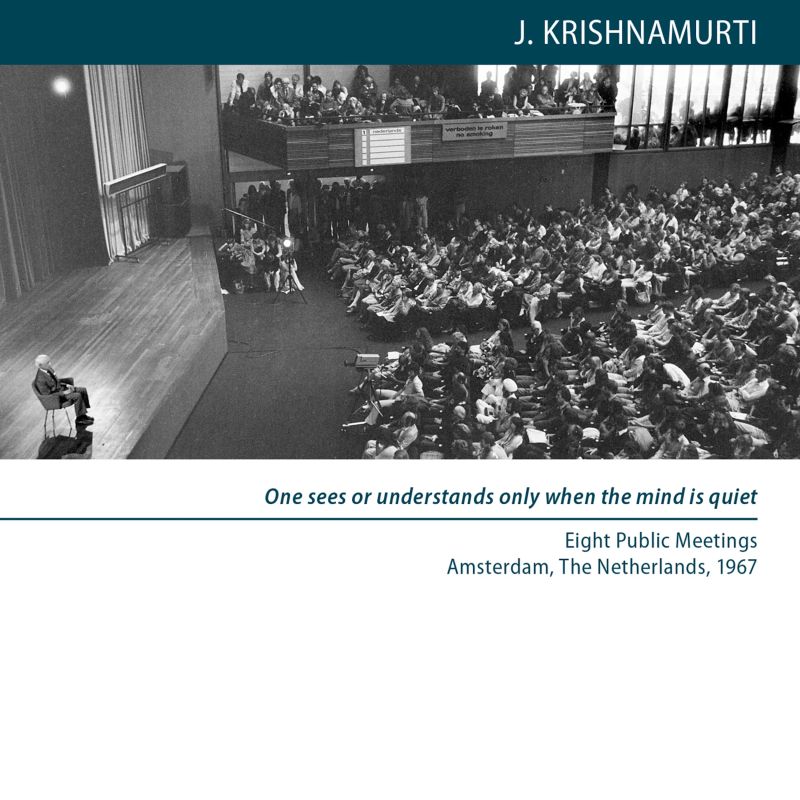
Audio only
One sees or understands only when the mind is quiet.
Eight Public Meetings - Amsterdam The Netherlands 1967By Jiddu KrishnamurtiNarrated by Jiddu KrishnamurtiLength10h 59m
About this audiobook
1. To look without a concept is to be aware of the observer and the thing observed - 20 May 1967 Duration: 88 minutes • Violence and sorrow are not limited to the West or the East; it is part of the human structure, psychologically. • Is it possible to bring about a change radically, a total revolution in the psyche itself, not through time? • The first and last freedom is when the mind is totally free from concepts and the mechanical process of building a formula. • It is an art to look, which is much more important than any art in the world, any painting, music or book; because when we can look so totally and completely, being directly in contact, there is an ending. • Q: If one has cancer, how can one be free from death? 2. Where there is pleasure there is the shadow of pain - 21 May 1967 Duration: 83 minutes • The whole movement of living, which is relationship, is a movement in action. • What is consciousness? When do you say, 'I am conscious, I am aware, I am attentive'? • Is there actually a division between the conscious and the unconscious, or it is a total movement, operating all the time? • The mind that pursues pleasure must inevitably invite its opposite, which is pain. The two go together; they are not separate. • You cannot see totally when you are making effort. • Q: If you love your own child, your attention to your child is fairly complete, but if you are a teacher you cannot give attention to all the students. 3. Is it possible to renew the mind? - 24 May 1967 Duration: 81 minutes • When the mind is living through imagination and thought, it is incapable of living in the complete fullness of the present. • Thought has created time, not chronological time but psychological time. That is, 'I will be,' 'I should be.' • Is it possible for the brain to be quiet, to give an interval between the old and the new? This interval is the timeless nature in which thought cannot possibly enter. • That which has continuity is repetitive, which is time. It's only when time comes to an end there is something new taking place. • To die every day to every problem, every pleasure, and not carry over any problem at all; so the mind remains tremendously attentive, active, clear. • Since love is not desire or pleasure, how does one come upon it? • Q: Is the feeling of responsibility a part of the order and discipline you were talking about? • Q: Why don't people get angry with what you are saying? 4. Can thought stop? - 28 May 1967 Duration: 72 minutes • When there is a process of recognition it is the projection of the past. The mind is always functioning within the field of time, which is of memory. Can the mind go beyond that? • What is pleasure and what is desire? • How is it possible, without control, subjugation or denying, for thought not to allow itself to interfere? • When all authority of every kind is put aside, denied, then you can find out for yourself. • When you are completely attentive, you see. It is only love that sees - not thought, the mind or the intellect. One has to learn how to look, how to hear. • Q: Could you distinguish between what you mean by the word 'recognizing' and 'being aware'? • Q: How is one to break off a concept that one has carefully built? 5. It is only a very silent mind that can actually see - 30 May 1967 Duration: 82 minutes • Conflict exists only when there are two opposing things: fear and non-fear, violence and non-violence. • A mind that is in a state of inquiry is entirely different from a mind that is seeking. Seeking implies effort, conformity, authority and therefore conflict. • Without space in which there is no boundary, the mind is incapable of coming upon immeasurable reality. • It is only a silent mind that can perceive, actually see, not a chattering mind, a controlled mind, a mind that is tortured, suppressed, yielding or indulging.
Audiobook details
Rating★★★★★ 4.8 (40)
Includes Amazon
GenrePhilosophy
Length10 hrs 59 mins
Narrated byJiddu Krishnamurti
FormatAudiobook
Publish dateJan 30, 2018
LanguageEnglish

Die Briefe an seine Schulen - Ausgewählte Texte aus dem BuchJiddu Krishnamurti1h 34m4.8 (14)$3 · $0.00
Brockwood Park 1969 - Public Talk 1 - Living without resistanceJiddu Krishnamurti58m$6 · $0.00
Madras (Chennai) 1977 78 - Public Talk 4 - Fear and pleasure are movements of timeJiddu Krishnamurti1h 12m$6 · $0.00
Madras (Chennai) 1977 78 - Public Talk 6 - Can the brain renew itself?Jiddu Krishnamurti1h 7m$6 · $0.00
Madras (Chennai) 1977 78 - Public Talk 2 - Observing the content of consciousnessJiddu Krishnamurti1h 9m$6 · $0.00
Brockwood Park 1975 - Public Talk 1 - What is the function of thought?Jiddu Krishnamurti1h 28m$6 · $0.00
Brockwood Park 1969 - Public Discussion 2 - Can I live completely without resistance?Jiddu Krishnamurti1h 24m$6 · $0.00
Brockwood Park 1975 - Public Discussion 2 - Do you respond according to an image?Jiddu Krishnamurti1h 30m$6 · $0.00
Is thought detrimental?Jiddu Krishnamurti1h4.4 (23)$4 · $0.00
The ground of being, and the mind of manJiddu Krishnamurti1h 12m$4 · $0.00
Does self-knowledge come through searching?Jiddu Krishnamurti58m4.4 (13)$4 · $0.00
The seed of a million yearsJiddu Krishnamurti6h 39m$11 · $0.00
Attention leads to learningJiddu Krishnamurti1h 27m$4 · $0.00
The Benediction of MeditationJiddu Krishnamurti1h 7m4.6 (36)$4 · $0.00
Why has man given supreme importance to thought?Jiddu Krishnamurti1h 25m4.5 (133)$4 · $0.00
Being serious without beliefJiddu Krishnamurti49m$4 · $0.00
Inner spaceJiddu Krishnamurti1h 1m$4 · $0.00
Fear in consciousnessJiddu Krishnamurti1h 26m$4 · $0.00
A Complete StillnessJiddu Krishnamurti1h 5m$4 · $0.00
A Religious life is a life in which the self is not.Jiddu Krishnamurti5h 7m$11 · $0.00
The Magic PresenceGodfré Ray King10h 21m4.6 (307)$1.20 · $0.00
The Art of LivingThich Nhat Hanh5h 1m4.5 (14.2K)$24 · $0.00
Moral Letters to LuciliusLucius Annaeus Seneca24h 26m4.5 (71.7K)$0.99 · $0.00
Lessons in TruthH. Emilie Cady3h 50m4.5 (2.4K)$20 · $0.00
Letters from a StoicSeneca6h 5m4.4 (80.4K)$6 · $0.00
The Discourses of EpictetusP. E. MATHESOM12h 47m4.4 (17.7K)$1.20 · $0.00
IlluminationsWalter Benjamin10h 12m4.4 (16.2K)$20 · $0.00
That Bird Has My WingsJarvis Jay Masters9h 49m4.4 (13.7K)$29 · $0.00

Tâo Teh KingLaozi2h 34m4.4 (230.9K)$2 · $0.00
SymposiumPlato3h 26m4.4 (97.9K)$1.20 · $0.00

Buddhist Boot CampTimber Hawkeye2h 39m4.4 (8.4K)$18 · $0.00
Enchiridion & The Discourses of Epictetus (Annotated)Arrian Epictetus18h 9m4.4 (3.5K)$2 · $0.00
The Meditations of the Emperor Marcus Aurelius AntoninusEmperor of Rome Marcus Aurelius5h 41m4.4 (1.8M)$1 · $0.00
Crime and PunishmentFyodor Dostoevsky23h 11m4.4 (1.3M)$12 · $0.00
MeditationsMarcus Aurelius5h 52m4.4 (433.7K)$1 · $0.00
Everyday DharmaSuneel Gupta5h 2m4.5 (761)$20 · $0.00
The Joyful Wisdom ("La Gaya Scienza")Friedrich Wilhelm Nietzsche11h 37m4.4 (26.6K)$1 · $0.00
The Art of LivingEpictetus, Sharon Lebell3h 16m4.4 (50.1K)$18 · $0.00
MeditationsEmperor Of Rome Marcus Aurelius7h 23m4.3 (477.5K)$1.20 · $0.00
The Imitation of ChristThomas à Kempis6h 27m4.3 (84.6K)$21 · $0.00
You may also like

Goodbye, AgainJonny Sun3h 43m4.3 (20.4K)$18 · $0.00
The Natural State (Annotated)U. G. Krishnamurti8h 55m4.3 (364)$2 · $0.00

Growing OldElizabeth Marshall Thomas5h 52m4.1 (751)$24 · $0.00

In Memoriam A. H. H (Annotated)Alfred Tennyson3h 50m4.1 (4.7K)$0.99 · $0.00
Breathe In, Breathe OutStuart Sandeman11h 39m4.3 (2K)$29 · $0.00

The Crack-Up - and 6 other autobiographical stories and essays on failure: My Lost City + The Crack-Up + Pasting It Together + Handle with Care + Afternoon of an Author + Early Success + My Generation (Annotated)Francis Scott Fitzgerald3h 9m3.9 (1.2K)$2 · $0.00
Hour of the HeartIrvin D. Yalom, Benjamin Yalom8h 19m4.6 (2.3K)$26 · $0.00

The Wilderness of GriefAlan D. Wolfelt, Ph.D1h 19m4.3 (421)$10 · $0.00
The Subtle Art Of Not Giving A F*ck (Gujarati)Mark Manson, Jatin Vora7h 29m4.4 (3.8K)$13 · $0.00

The Gift of TherapyIrvin Yalom7h 39m4.5 (38.8K)$26 · $0.00

A Life of One's OwnJoanna Biggs9h 21m4.1 (1.8K)$29 · $0.00
Brockwood Park 1969 - Public Talk 4 - Meditation is the beginning of understanding oneselfJ. Krishnamurti1h 25m$7 · $0.00
The seed of a million yearsJiddu Krishnamurti6h 39m$11 · $0.00
The mind that is free of authority is a very intense, alive mindJiddu Krishnamurti1h 17m$4 · $0.00
There Is insight when thought is absentJiddu Krishnamurti9h 42m$12 · $0.00
The World Within; You Are The Story of HumanityJ Krishnamurti6h 27m4.0 (14)$7 · $0.00
Brockwood Park 1975 - Public Talk 2 - Can suffering end totally?J. Krishnamurti1h 17m$6 · $0.00

My Lost City & Other Autobiographical Essays (Annotated)Francis Scott Fitzgerald3h 10m$2 · $0.00
The Quiet Pulse Beneath the NoiseJames Locke45m5.0 (2) Only with Ultra
The Dhammapada - The Way of the Buddha Vol.09Osho15h 36m$20 · $0.00