
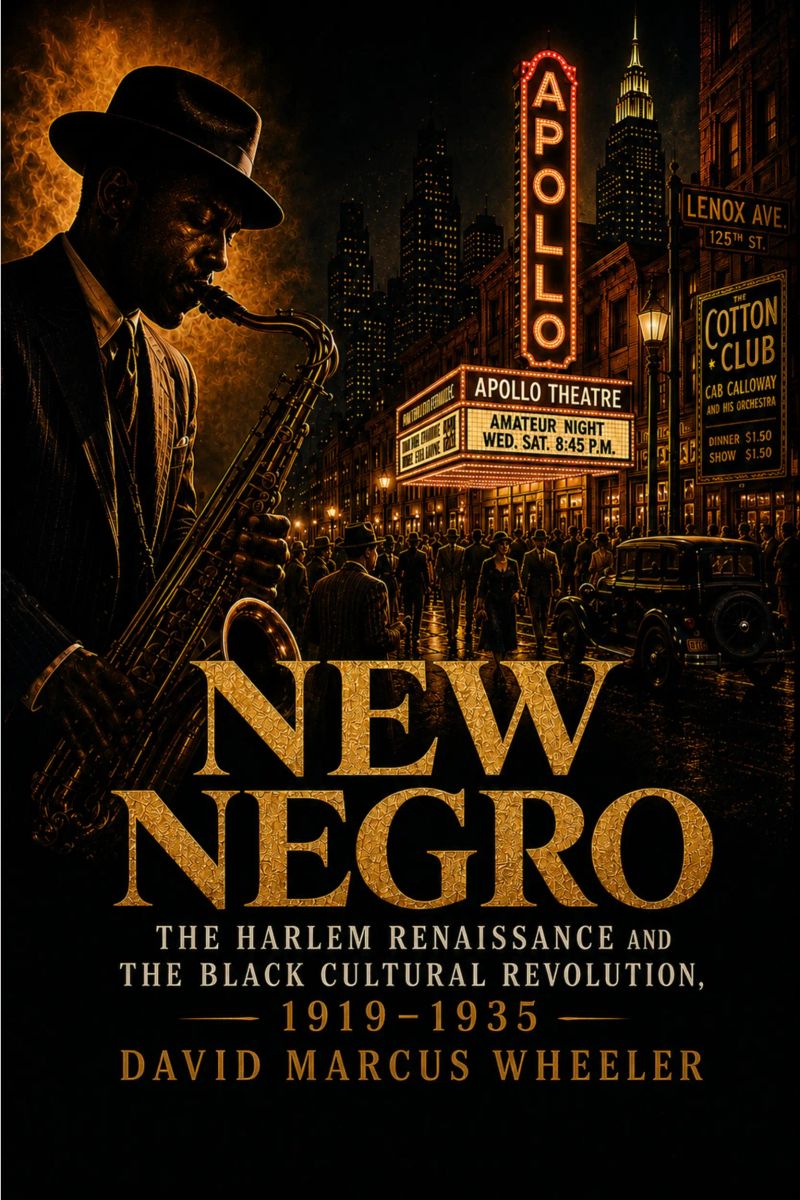
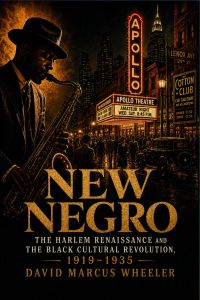
NEW NEGRO
The Harlem Renaissance and the Black Cultural Revolution, 1919-1935By David Marcus Wheeler


Length6h 39m
About this audiobook
**In 1920, an entire people stood up and declared: our lives are worth celebrating, our culture has value, we are fully human and capable of anything.** Today that sounds obvious. Back then, it was revolutionary — and it exploded out of a few square miles of upper Manhattan.
You've heard of the Harlem Renaissance. Maybe a name or two — Langston Hughes, Duke Ellington. But the textbook shrinks one of the most electrifying cultural explosions in history into a single paragraph, draining out the music, the genius, the politics, and the people who made it happen. You sense it mattered enormously — to American culture, to Black identity, to the music and literature you love today — but you've never had the full story. Until now.
**NEW NEGRO: The Harlem Renaissance and the Black Cultural Revolution, 1919–1935** drops you straight into Harlem at its blazing peak — the rent parties, the jazz clubs, the poetry, and the fierce debates over the future of Black America.
**Inside, you will discover:**
* **HOW** the Great Migration set the stage for the Harlem Renaissance and a new Black metropolis
* **WHO** the giants really were — Langston Hughes, Zora Neale Hurston, Duke Ellington, Bessie Smith, and more
* **WHAT** "the New Negro" meant — and how Alain Locke, Du Bois, and Marcus Garvey fought over it
* **HOW** jazz and the blues conquered America from the stages of the Cotton Club
* **WHY** the Black cultural revolution still shapes American music, literature, and identity today
This isn't a dusty lecture. It's the Harlem Renaissance brought roaring back to life.
The revolution happened here. Step inside.
**Scroll up and click "Buy Now" to begin NEW NEGRO today.**
Audiobook details
GenreLiterary Classics, General Fiction, Romance
Length6 hrs 39 mins
Narrated byListen with 1,000+ voices
FormateBook with Audio
LanguageEnglish
Table of contents
1Introduction
2Author’s Note
3Prologue: Up from the South
4PART ONE: THE WORLD THAT MADE HARLEM (1900-1919)
5Chapter 1: The Great Migration — Southern Black America Moves North
Show all chaptersShow less
6Chapter 2: Harlem Transforms — From White Neighborhood to Black Metropolis
7Chapter 3: World War I and Black America — The Double V Before Its Name
8Chapter 4: The Red Summer of 1919 — Race Riots and the New Militancy
9PART TWO: THE LITERATURE OF THE RENAISSANCE (1920-1935)
10Chapter 5: Langston Hughes — The Poet Laureate of Black America
11Chapter 6: Zora Neale Hurston — Folklore, Anthropology, and Black Southern Life
12Chapter 7: Claude McKay, Jean Toomer, and the Modernist Tradition
13Chapter 8: The Literary Magazines — The Crisis, Opportunity, and the Print Culture
14PART THREE: MUSIC, ART, AND PERFORMANCE
15Chapter 9: Jazz Comes to Harlem — Duke Ellington and the Cotton Club
16Chapter 10: The Blues — Bessie Smith and the Female Voice of Black Music
17Chapter 11: The Visual Artists — Aaron Douglas and the Aesthetics of the Renaissance
18Chapter 12: Theater and Dance — Black Performance and the White Audience
19PART FOUR: POLITICS AND IDEOLOGY
20Chapter 13: Alain Locke and 'The New Negro' — Defining the Renaissance
21Chapter 14: Marcus Garvey — Black Nationalism, the UNIA, and the Return to Africa
22Chapter 15: W.E.B. Du Bois and the NAACP — Integrationist Politics in the Jazz Age
23Chapter 16: A. Philip Randolph — Labor, Socialism, and Black Economic Rights
24PART FIVE: HARLEM'S LIFE
25Chapter 17: The Rent Party — Black Social Life and the Economics of Harlem
26Chapter 18: Harlem's Women — Gender, Race, and the Renaissance's Unsung Voices
27Chapter 19: The White Fascination — Primitivism, Patronage, and Cultural Appropriation
28Chapter 20: The Church in Harlem — Religion and Community in Black New York
29PART SIX: LEGACIES
30Chapter 21: The Depression Ends the Renaissance — What the Crash Took Away
31Chapter 22: The Renaissance's Influence — Black Arts After 1935
32Chapter 23: Harlem Today — Memory, Gentrification, and the Neighborhood's Meaning
33Chapter 24: The Renaissance's Place in American Culture — Literature, Music, and Identity
34Epilogue: The Harlem That Was
35Acknowledgments
36Selected Bibliography
37About the Author
More from David Marcus Wheeler

To Kill a MockingbirdHarper Lee12h 18m4.5 (7.4M)$29 · $0.00

These Precious DaysAnn Patchett11h 14m4.5 (45.2K)$29 · $0.00

The Complete Histories / History Plays of William Shakespeare (Annotated)William Shakespeare29h 42m4.6 (2.3K)$0.99 · $0.00

Braving the TruthRachel Held Evans11h 31m4.7 (359)$29 · $0.00

The Old Man and the Sea (Annotated)Ernest Hemingway4h 27m4.6 (1.4K)$2 · $0.00

Henry V (The Play, Historical Background and Analysis of the Character in the Play)William Shakespeare, William Hazlitt8h 50m4.6 (1.3K)$1.99 · $0.00

H. P. LOVECRAFT Ultimate Collection: Novellas, Short Stories, Poetry & Essays (Annotated)H. P. Lovecraft12h 28m4.6 (2.3K)$2 · $0.00
Time RegainedMarcel Proust16h 8m4.5 (10.6K)$1.99 · $0.00
The Mis-Education of the NegroCarter Goodwin Woodson4h 32m4.5 (28.4K)$10 · $0.00

TORAH - Bilingual Edition: English/Hebrew (Annotated)Max Margolis, JPS28h 26m4.6 (1K)$2 · $0.00

Betty Crocker picture cooky bookBetty Crocker, Inc. General Mills2h 13m4.5 (6.5K)$1 · $0.00

The Complete Tales of Beatrix PotterBeatrix Potter3h 36m4.5 (75K)$3 · $0.00

Anne of Green GablesL. M. Montgomery11h 1m4.5 (1.2M)$2.30 · $0.00

Crime and Punishment (The Unabridged Garnett Translation) (Annotated)Fyodor Dostoevsky24h 25m4.5 (15.4K)$0.99 · $0.00

The North American IndianEdward S. Curtis, Frederick Webb Hodge6h4.5 (1.2K)$2 · $0.00

The Picture of Dorian Gray: The Uncensored 13 Chapter Version + The Revised 20 Chapter Version (Annotated)Oscar Wilde16h 12m4.5 (2.8K)$0.99 · $0.00

Grimoire Of The Everyday WitchIsadora Lys / Virginia Santos5h 35m4.5 (3.9K)$9 · $0.00

Winnie-the-PoohAlan Alexander Milne2h 52m4.5 (401.1K)$3 · $0.00

Sitting PrettyRebekah Taussig7h 33m4.5 (18.9K)$26 · $0.00

The Poetic Edda & The Prose EddaSnorri Sturluson, Saemund Sigfusson9h 34m4.5 (4K)$1 · $0.00

WhistlerAnn Patchett10h 45m4.6 (4.6K)$29 · $0.00

Demon CopperheadBarbara Kingsolver21h 3m4.5 (949.4K)$46 · $0.00
To Kill a MockingbirdHarper Lee12h 18m4.5 (7.4M)$29 · $0.00

Remarkably Bright CreaturesShelby Van Pelt11h 17m4.4 (1.7M)$29 · $0.00
The Old Man and the Sea (Annotated)Ernest Hemingway4h 27m4.6 (1.4K)$2 · $0.00

White HotIlona Andrews13h 18m4.5 (136.9K)$5 · $0.00

The Ghost by the Billabong (The Matilda Saga, #5)Jackie French14h 58m4.6 (773)$33 · $0.00
Cast in BloodMichelle Sagara16h 35m4.6 (607)$33 · $0.00

The Captain Blood Trilogy (Annotated)Rafael Sabatini29h 20m4.6 (1K)$3 · $0.00

Ship of the Line (Annotated)Cecil Louis Troughton Smith11h 13m4.6 (1K)$2 · $0.00

The George Orwell CollectionGeorge Orwell24h 46m4.5 (14.4K)$12 · $0.00

ShivajiRanjit Desai25h 13m4.6 (3.1K)$24 · $0.00
Time RegainedMarcel Proust15h 38m4.5 (9.2K)$2 · $0.00

Driving ForceElle James4h 58m4.6 (407)$20 · $0.00

When God Calls the HeartBrian Bird, Michelle Cox3h 24m4.6 (439)$10 · $0.00

Five Little IndiansMichelle Good10h 34m4.5 (64.5K)$29 · $0.00

Lolth's WarriorR. A. Salvatore13h 20m4.6 (2.4K)$33 · $0.00

The Things We Cannot SayKelly Rimmer13h 48m4.5 (359.1K)$33 · $0.00

The Love Songs of W.E.B. Du BoisHonoree Fanonne Jeffers29h 49m4.5 (58K)$8 · $0.00

Going PostalTerry Pratchett11h 23m4.5 (189.9K)$29 · $0.00

Blizzard ShowdownShirlee McCoy5h 16m4.6 (1.1K)$12 · $0.00

To Hold and ProtectSandra Owens7h 59m4.6 (1.1K)$8 · $0.00

Arctic WitnessHeather Woodhaven5h 46m4.6 (985)$12 · $0.00

Following the TrailLynette Eason6h 35m4.6 (2.3K)$12 · $0.00

Defending from DangerJodie Bailey5h 46m4.6 (588)$24 · $0.00
White HotIlona Andrews13h 18m4.5 (136.9K)$5 · $0.00

Explosive RevengeMaggie K. Black6h 18m4.6 (545)$12 · $0.00

Her Brand of JusticeB.J. Daniels6h 48m4.6 (1.3K)$12 · $0.00

Search And DetectTerri Reed5h 51m4.6 (706)$24 · $0.00
Driving ForceElle James4h 58m4.6 (407)$20 · $0.00

Danger in the WildernessDarlene L. Turner6h 54m4.7 (299)$12 · $0.00

Yukon JusticeDana Mentink6h 15m4.6 (751)$12 · $0.00

The Rogue WarriorCindy Roland Anderson5h 44m4.6 (410)$17 · $0.00

Her Duty Bound DefenderSharee Stover6h 30m4.6 (1.1K)$24 · $0.00

DRACULA (Annotated)Bram Stoker17h 36m4.5 (6.9K)$0.99 · $0.00

Trail Of ThreatsJessica R. Patch5h 47m4.6 (425)$24 · $0.00
Ironwood, a Fae Universe SeriesAlessa Thorn26h 57m4.6 (835)$30 · $0.00

Ready to ProtectValerie Hansen5h 38m4.6 (981)$24 · $0.00

Searching For EvidenceCarol J. Post6h 21m4.6 (552)$24 · $0.00

Anne Shirley: Anne of Green Gables, Anne of Avonlea & Anne of the Island (3 Books in One Edition)Lucy Maud Montgomery28h 17m4.5 (21.4K)$1.99 · $0.00
You may also like
The DefenderEthan Michaeli22h 6m4.5 (720)$30

AntifaMark Bray7h 37m4.1 (5.6K)$20

We Want Our Bodies Backjessica Care moore2h 2m4.5 (899)$16 · $0.00
UP FROM SLAVERY (An Autobiography)Booker T. Washington9h 19m4.3 (42.5K)$2 · $0.00
AfricatownNick Tabor13h 27m4.3 (827)$23

RiseJeff Yang, Phil Yu, Philip Wang19h 49m4.4 (1.1K)$40 · $0.00

A Voice from the SouthAnna J. Cooper6h 46m4.4 (365)$2.30
The NegroW. E. B. Du Bois6h 20m4.3 (477)$2.30
This Must Be the PlaceJesse Rifkin16h 47m4.4 (259)$40 · $0.00
Du Bois: EssaysW.E.B. Du Bois6h 41m4.1 (1.5K)$1.99 · $0.00

Sketches of Southern lifeFrances Ellen Watkins Harper2h 1m4.2 (345)$2 · $0.00

Inaugural Addresses of the Presidents of the United StatesUnited States Presidents14h 15m4.2 (1.4K)Free

Woman in the Nineteenth CenturySarah Margaret Fuller Ossoli11h 56m3.9 (9.4K)$1 · $0.00
New NegroDavid Marcus Wheeler6h 31m$7

Songs of Labor, and Other PoemsMorris Rosenfeld1h 48m$2 · $0.00
New NegroDavid Marcus Wheeler5h 28m$10 · $0.00

Women's WorkMargaret Whitley, A. A. Brooke2h 30m$2 · $0.00
The Living PresentGertrude Franklin Horn Atherton8h 24m3.9 (29)$2 · $0.00

THE PROMISED LANDLorraine Evelyn Booker5h 47m$8.40

The Constitution Is My HomeIndira Jaising, Ritu Menon7h 2m$24 · $0.00