
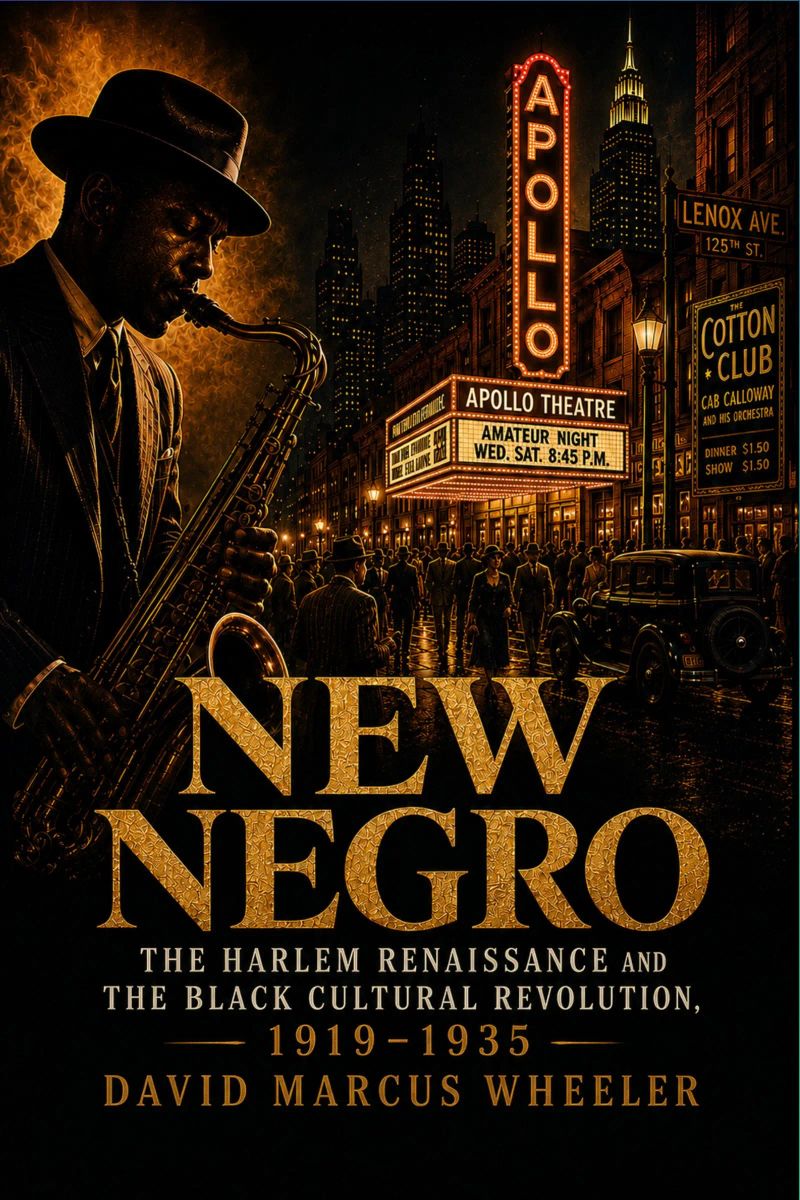
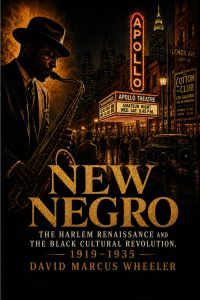
New Negro
The Harlem Renaissance and the Black Cultural Revolution, 1919-1935By David Marcus Wheeler


Length6h 31m
About this audiobook
Harlem Renaissance history, Black cultural revolution, Great Migration, jazz age New York — the complete narrative of the New Negro movement 1919-1935: Langston Hughes, Zora Neale Hurston, Duke Ellington, Marcus Garvey, and W.E.B. Du Bois.
They came by the hundreds of thousands — from Alabama, Georgia, Mississippi, from communities where Jim Crow was not merely law but daily negotiation with violence. The ones who changed the world came to Harlem. Between the end of World War One and the Great Depression, that neighborhood in upper Manhattan became the capital of Black America and the birthplace of a cultural revolution no one had planned.
David Marcus Wheeler traces the full Harlem Renaissance arc: the Great Migration's six million people from boll-weevil fields to 125th Street rent parties; the 369th Infantry "Harlem Hellfighters," who served 191 consecutive combat days and came home to the Red Summer riots of 1919; Langston Hughes and Alain Locke's 1925 anthology The New Negro; Ellington's Cotton Club orchestra; and Marcus Garvey packing Madison Square Garden with 25,000 delegates in 1920 — before his deportation ended the UNIA's mass movement.
Inside this Harlem Renaissance history:
• The Great Migration — the Chicago Defender smuggled south, the boll weevil's agricultural catastrophe, chain networks that moved six million people north (Chapter 1)
• The Red Summer of 1919 — thirteen days of Chicago riots, 38 dead, 1,000 families burned out; Claude McKay's "If We Must Die" written in the immediate aftermath (Chapter 4)
• Hughes and Hurston — the poet of Black America and the anthropologist-novelist who collected Florida folklore; their creative peaks and rupture with Locke (Chapters 5-6)
• Jazz, Blues, and performance — Ellington's Cotton Club, Bessie Smith, the Savoy Ballroom's Lindy Hop, and the appropriation debate (Chapters 9-10, 12)
• Garvey versus Du Bois — Black nationalism against integrationism; the most consequential ideological divide in Black political history (Chapters 14-15)
• A. Philip Randolph and labor — the Brotherhood of Sleeping Car Porters, twelve years of organizing, the first Black union contract with a major corporation (Chapter 16)
• The Depression's reckoning — what the crash took away and how the Renaissance's legacy shaped the civil rights era (Chapters 21-24)
In 1920, declaring that Black culture had value and Black people were fully human was radical. The art and politics of the Harlem Renaissance carried those declarations into the mainstream — and transformed American culture permanently.
For readers of Isabel Wilkerson's THE WARMTH OF OTHER SUNS and David Levering Lewis's WHEN HARLEM WAS IN VOGUE.
Audiobook details
GenreHistory, Psychology
Length6 hrs 31 mins
Narrated byListen with 1,000+ voices
FormateBook with Audio
Publish dateJun 2, 2026
LanguageEnglish
Table of contents
1Introduction
2Prologue: Up from the South
3PART ONE: THE WORLD THAT MADE HARLEM (1900-1919)
4Chapter 1: The Great Migration — Southern Black America Moves North
5Chapter 2: Harlem Transforms — From White Neighborhood to Black Metropolis
Show all chaptersShow less
6Chapter 3: World War I and Black America — The Double V Before Its Name
7Chapter 4: The Red Summer of 1919 — Race Riots and the New Militancy
8PART TWO: THE LITERATURE OF THE RENAISSANCE (1920-1935)
9Chapter 5: Langston Hughes — The Poet Laureate of Black America
10Chapter 6: Zora Neale Hurston — Folklore, Anthropology, and Black Southern Life
11Chapter 7: Claude McKay, Jean Toomer, and the Modernist Tradition
12Chapter 8: The Literary Magazines — The Crisis, Opportunity, and the Print Culture
13PART THREE: MUSIC, ART, AND PERFORMANCE
14Chapter 9: Jazz Comes to Harlem — Duke Ellington and the Cotton Club
15Chapter 10: The Blues — Bessie Smith and the Female Voice of Black Music
16Chapter 11: The Visual Artists — Aaron Douglas and the Aesthetics of the Renaissance
17Chapter 12: Theater and Dance — Black Performance and the White Audience
18PART FOUR: POLITICS AND IDEOLOGY
19Chapter 13: Alain Locke and 'The New Negro' — Defining the Renaissance
20Chapter 14: Marcus Garvey — Black Nationalism, the UNIA, and the Return to Africa
21Chapter 15: W.E.B. Du Bois and the NAACP — Integrationist Politics in the Jazz Age
22Chapter 16: A. Philip Randolph — Labor, Socialism, and Black Economic Rights
23PART FIVE: HARLEM'S LIFE
24Chapter 17: The Rent Party — Black Social Life and the Economics of Harlem
25Chapter 18: Harlem's Women — Gender, Race, and the Renaissance's Unsung Voices
26Chapter 19: The White Fascination — Primitivism, Patronage, and Cultural Appropriation
27Chapter 20: The Church in Harlem — Religion and Community in Black New York
28PART SIX: LEGACIES
29Chapter 21: The Depression Ends the Renaissance — What the Crash Took Away
30Chapter 22: The Renaissance's Influence — Black Arts After 1935
31Chapter 23: Harlem Today — Memory, Gentrification, and the Neighborhood's Meaning
32Chapter 24: The Renaissance's Place in American Culture — Literature, Music, and Identity
33Epilogue: The Harlem That Was
34Acknowledgments
35Selected Bibliography
36About the Author
More from David Marcus Wheeler

A Brief History of IntelligenceMax S. Bennett12h 18m4.6 (6.6K)$29 · $0.00

The Happiest Man on EarthEddie Jaku3h 48m4.6 (178K)$7 · $0.00

MotherlandJulia Ioffe17h 52m4.7 (2.5K)$40 · $0.00

Where Cowards Go to DieBenjamin Sledge8h 42m4.7 (351)$20 · $0.00

RevolutionariesSanjeev Sanyal11h 23m4.6 (2.6K)$29 · $0.00

We Crossed a Bridge and It TrembledWendy Pearlman6h4.6 (5.2K)$24 · $0.00

Unbroken Bonds of BattleJohnny Joey Jones8h 31m4.6 (2.6K)$8 · $0.00

The Daughter of AuschwitzTova Friedman, Malcolm Brabant7h 54m4.6 (16.7K)$26 · $0.00

Lily's PromiseLily Ebert, Dov Forman8h 54m4.6 (16.1K)$29 · $0.00

On Democracies and Death CultsDouglas Murray10h 38m4.6 (6.5K)$29 · $0.00

Across the RiverKent Babb11h 40m4.6 (927)$29 · $0.00

Balcony Over Jerusalem: A Middle East Memoir - Israel, Palestine and BeyondJohn Lyons12h 37m4.6 (1.4K)$33 · $0.00

BeyondStephen Walker15h 39m4.6 (3.2K)$33 · $0.00
Kings and PawnsHoward Bryant10h 9m4.6 (678)$29 · $0.00

No EscapeNury Turkel9h 30m4.6 (809)$28 · $0.00

Jubal Stone: U.S. Marshal: Blood Trail To Hell: A Western Adventure NovelCasey Nash3h 42m4.6 (3.2K)$18 · $0.00

Fall and RiseMitchell Zuckoff17h 23m4.6 (9.8K)$40 · $0.00

The SurvivorJosef Lewkowicz, Michael Calvin9h 22m4.6 (2.5K)$29 · $0.00

Always FaithfulThomas Schueman, Zainullah Zaki12h 12m4.6 (977)$29 · $0.00

The State of Society in France Before the Revolution of 1789 (Annotated)Alexis de Tocqueville17h 25m4.6 (1.2K)$2 · $0.00
What to Make of a LifeJim Collins13h 31m4.4 (794)$33 · $0.00

Invisible StormJason Kander6h 48m4.7 (3.2K)$24 · $0.00

I Am The StormJanice Dean9h4.6 (1.5K)$8 · $0.00
On Democracies and Death CultsDouglas Murray10h 38m4.6 (6.5K)$29 · $0.00

TerraformPropaganda5h 39m4.7 (594)$24 · $0.00

Southern Horrors: Lynch Law in All Its Phases (Annotated)Ida B. Wells-Barnett2h 44m4.6 (1.3K)$2 · $0.00
Hour of the HeartIrvin D. Yalom, Benjamin Yalom8h 19m4.6 (2.3K)$26 · $0.00

Braving the TruthRachel Held Evans11h 31m4.7 (359)$29 · $0.00
Level UpRob Dial7h 42m4.6 (3.3K)$26 · $0.00

As a JewSarah Hurwitz8h 36m4.6 (1.2K)$26 · $0.00
Saint Joan (Annotated)George Bernard Shaw6h 20m4.6 (1.2K)$1.20 · $0.00

Burn the HaystackJennie Young, PhD9h 30m4.6 (543)$29 · $0.00

Woman and the New Race (Annotated)Margaret Sanger6h 30m4.6 (1K)$0.99 · $0.00

Good InsideBecky Kennedy9h 55m4.5 (59.3K)$29 · $0.00
The Mis-Education of the NegroCarter Godwin Woodson5h 4m4.5 (29.4K)$1.20 · $0.00
Du Bois: EssaysW.E.B. Du Bois6h 22m4.6 (1.5K)$1 · $0.00

The North American Indian (Illustrated Edition)Edward S. Curtis, Frederick Webb Hodge5h 59m4.6 (1.4K)$2 · $0.00

Valley of the BirdtailAndrew Stobo Sniderman, Douglas Sanderson10h 1m4.6 (2.4K)$29 · $0.00

Lies My Therapist Told MeGreg E. Gifford9h 3m4.6 (503)$29 · $0.00

Disturbed in Their NestsAlephonsion Deng, Judy A. Bernstein11h 22m4.6 (595)$23 · $0.00
You may also like

Being TexanEditors of Texas Monthly8h 44m4.4 (255)$29 · $0.00
The DefenderEthan Michaeli22h 6m4.5 (720)$30

Mind PlatterNajwa Zebian4h 33m4.2 (13.7K)$15

WordslutAmanda Montell6h 56m4.2 (36.1K)$24 · $0.00

Australia: A History - How an ancient land became a great democracyTony Abbott14h 26m4.4 (402)$33 · $0.00
This Must Be the PlaceJesse Rifkin16h 47m4.4 (259)$40 · $0.00
Year of WonderClemency Burton-Hill10h 44m4.4 (2.8K)$29 · $0.00

South to AmericaImani Perry16h 33m4.1 (10.7K)$40 · $0.00
OrthodoxyG. K. Chesterton6h 48m4.3 (50.2K)$17
NEW NEGRODavid Marcus Wheeler6h 40m$8 · $0.00

Thomas Davis, Selections from his Prose and PoetryThomas Osborne Davis13h 9m$1 · $0.00
New NegroDavid Marcus Wheeler5h 28m$10 · $0.00

Alongside LinaMarcelo Ferraz6h 46m4.6 (135)$16 · $0.00
Business Goals and Social Commitment. Shaping Organisational Capabilities Colombia s Fundación Social, 1984-2011Carlos Dávila, José Camilo Dávila, Lina Grisales, David Schnarch11h 2m$7 · $0.00
Tagging for TalentMichael S. Salone4h 16m4.0 (24)$35

The Kingdom of Georgia: Notes of travel in a land of women, wine, and songJohn Oliver Wardrop6h 23m3.8 (11)$2 · $0.00
I, Too, Sing AmericaCatherine Clinton2h 2m4.2 (172)$15
Call and ResponseL. Michelle Smith8h 3m$26 · $0.00

History of the United States DemocracyU.S. Supreme Court, U.S. Government, U.S. Congress46h 51m$2 · $0.00
BakstElisabeth Ingles1h 49m4.1 (19)$13.50 · $0.00