
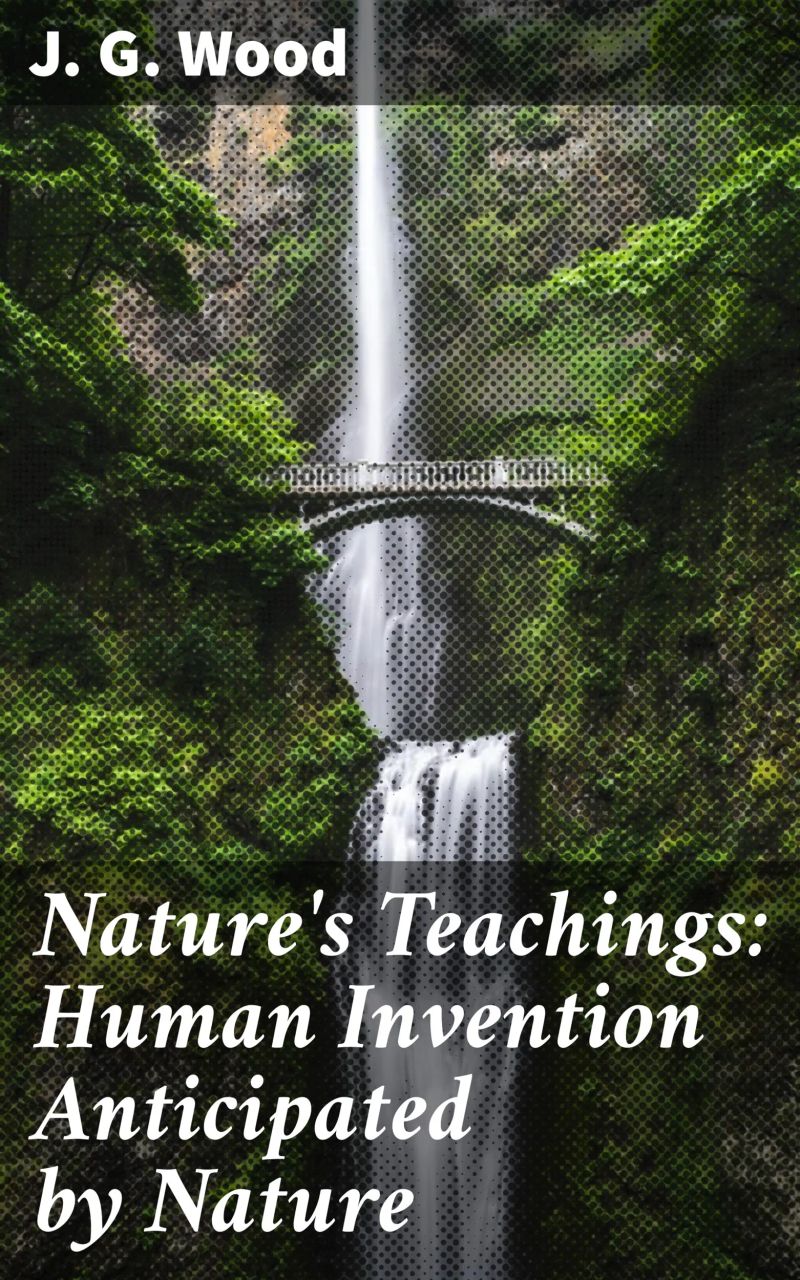
Nature's Teachings: Human Invention Anticipated by Nature
Exploring Nature's Influence on Human InnovationBy J. G. Wood


Length16h 20m
About this audiobook
In "Nature's Teachings: Human Invention Anticipated by Nature," J. G. Wood explores the profound interconnections between natural phenomena and human ingenuity. This work employs a meticulous comparative analysis, blending anecdotal narratives with scientific observation to illustrate how various inventions have been inspired by nature's designs. Wood's literary style is both accessible and richly descriptive, drawing the reader into a deeper appreciation of biomimicry. Contextually, the book emerges from the Victorian fascination with nature, science, and technology, presenting a harmonious blend of empirical inquiry and poetic reflection. J. G. Wood, a prominent naturalist and an advocate for environmental appreciation during the 19th century, was deeply influenced by the burgeoning scientific discoveries of his time. His extensive background in zoology and botany informed his understanding of nature's complexities. Additionally, Wood's work as an illustrator brings a unique visual component that enhances his written observations, allowing readers to connect more deeply with the natural world. I highly recommend "Nature's Teachings" to those interested in the intersection of nature and technology. This enlightening text invites readers to reconsider their perceptions of innovation, emphasizing the importance of nature as a timeless mentor in human creativity and design.
Audiobook details
Rating★★★★ 4.2 (17)
Includes Amazon, Goodreads
GenreScience and Nature
Length16 hrs 20 mins
Narrated byListen with 1,000+ voices
FormateBook with Audio
Publish dateDec 6, 2019
LanguageEnglish
Table of contents
1PREFACE.
2NAUTICAL. CHAPTER I.
3The Raft.
4The Boat.
5NAUTICAL. CHAPTER II. THE OAR, THE PADDLE, AND THE SCREW.
Show all chaptersShow less
6NAUTICAL. CHAPTER III. SUBSIDIARY APPLIANCES.—Part I.
7NAUTICAL. CHAPTER IV. SUBSIDIARY APPLIANCES.—Part II.
8NAUTICAL. CHAPTER V. SUBSIDIARY APPLIANCES. Part III.—The Boat-hook and Punt-pole.—The Life-buoy and Pontoon-raft.
9WAR AND HUNTING. CHAPTER I. THE PITFALL, THE CLUB, THE SWORD, THE SPEAR AND DAGGER.
10The Pitfall.
11The Club.
12The Sword.
13The Spear and the Dagger.
14WAR AND HUNTING. CHAPTER II. POISON, ANIMAL AND VEGETABLE.—PRINCIPLE OF THE BARB.
15Animal Poisons.
16Vegetable Poisons.
17Natural Animal Poisons.
18Natural Vegetable Poisons.
19The Barb.
20WAR AND HUNTING. CHAPTER III. PROJECTILE WEAPONS AND THE SHEATH.
21WAR AND HUNTING. CHAPTER IV.
22The Net.
23The Rod and Line.
24The Spring-trap.
25The Baited Trap.
26Birdlime.
27WAR AND HUNTING. CHAPTER V.
28Reverted Spikes.
29Spiked Defences.
30Tearing Weapons.
31WAR AND HUNTING. CHAPTER VI. THE HOOK.—DEFENSIVE ARMOUR.—THE FORT.
32The Hook.
33Armour.
34The Fort.
35WAR AND HUNTING. CHAPTER VII. SCALING INSTRUMENTS.—DEFENCE OF FORT.—IMITATION.—THE FALL-TRAP.
36Scaling Instruments.
37Defence of Fort.
38Imitation.
39The Fall-trap.
40WAR AND HUNTING. CHAPTER VIII. CONCEALMENT.—DISGUISE.—THE TRENCH.—POWER OF GRAVITY.—MISCELLANEA.
41Concealment.
42Disguise.
43The Trench.
44Gravity as a Propulsive Agent.
45Miscellanea.
46ARCHITECTURE. CHAPTER I.
47The Hut.
48Floors and Pillars.
49Tunnel Entrance to the Dwelling.
50Doors and Hinges.
More from J. G. Wood




A Brief History of IntelligenceMax S. Bennett12h 18m4.6 (6.6K)$29 · $0.00
The Story of BirdsSteve Brusatte11h 49m4.6 (401)$29 · $0.00

Pastoral SongJames Rebanks8h 35m4.5 (12K)$26 · $0.00

How Stella Learned to TalkChristina Hunger7h4.5 (10.9K)$24 · $0.00

Craig & FredCraig Grossi8h 6m4.5 (9.6K)$26 · $0.00
Celebrating BirdsNatalia Rojas, Ana Maria Martinez6h 47m4.6 (330)$24 · $0.00

Saving JemimaJulie Zickefoose4h 59m4.5 (749)$20 · $0.00

Will's Red CoatTom Ryan8h 23m4.5 (2.3K)$26 · $0.00

Of Time and TurtlesSy Montgomery10h 34m4.5 (5K)$29 · $0.00

Zen and the Art of Saving the PlanetThich Nhat Hanh9h 20m4.5 (3.9K)$29 · $0.00

BLACK BEAUTY (With Original Illustrations)Anna Sewell7h 31m4.5 (1.3K)$1.99 · $0.00

Bottle of LiesKatherine Eban14h 25m4.4 (12K)$33 · $0.00
IngrainedCallum Robinson8h 10m4.5 (1.1K)$26 · $0.00

The Lion Tracker's Guide To LifeBoyd Varty3h 1m4.4 (4.8K)$18 · $0.00

Born for LoveBruce D. Perry, Maia Szalavitz11h 42m4.4 (4K)$29 · $0.00

The Mountains of California (With Original Drawings & Photographs) (Annotated)John Muir11h 35m4.5 (1.1K)$2 · $0.00

The New GuysMeredith Bagby16h 50m4.4 (1.2K)$40 · $0.00

Blue PasturesMary Oliver3h 23m4.4 (3.8K)$18 · $0.00
The Rise and Reign of the MammalsSteve Brusatte13h 26m4.4 (11.1K)$33 · $0.00

VaccinatedPaul A. Offit8h 30m4.4 (3.7K)$26 · $0.00
You may also like

A Short History of the WorldH. G. Wells12h 5m3.9 (5.6K)$2.30

On the Origin of SpeciesCharles Darwin17h 4m4.2 (148K)$20 · $0.00
The Origin of SpeciesCharles Darwin14h 23m4.2 (163.7K)$9 · $0.00
The Long SummerBrian Fagan9h 36m4.0 (1K)$20 · $0.00

Where Am I?A.G. Smith1h 26m4.2 (14)$8 · $0.00

Paths of the Mound-Building Indians and Great Game AnimalsArcher Butler Hulbert1h 40m$2 · $0.00

The Zoo BookEnid Blyton4h 4m4.1 (29)$2 · $0.00

LighthousesVictoria Charles1h 2m$15 · $0.00

A Report on Washington TerritoryWilliam Henry Ruffner4h 58m$2 · $0.00

Time and TideRobert S. Ball2h 1m$2 · $0.00

Plants and their childrenFrances Theodora Parsons6h 18m$1 · $0.00

Round the Year with Enid Blyton—Summer BookEnid Blyton2h$2 · $0.00
The Geographical Distribution of Animals (Vol.1&2)Alfred Russel Wallace40h 30m$2 · $0.00

Great Inventions and DiscoveriesWillis Duff Piercy4h 53m$2 · $0.00

The Story Of The Universe Volume 3 (of 4) : The Earth's Garment : FloraEsther Singleton13h 55m$2.40

Report on the Migration of Birds in the Spring and Autumn of 1882. Fourth ReportJ. A. Harvie-Brown, John Cordeaux, Alexander Goodman More, Richard Manliffe Barrington4h 29m$2 · $0.00
Gilbert Weather Bureau (Meteorology) for BoysA. C. Gilbert2h 25m$2 · $0.00

Insectivorous PlantsCharles Darwin15h 21m3.8 (44)$1 · $0.00

The Botanist's Bookshelf: 8 Books on Plant IdentificationFrances Theodora Parsons, D. M. Crooks, Leonard Wheeler Kephart, Roy Watling, M. J. Richardson, Robert H. Mohlenbrock, Henry A. Gleason, Wilbur R. Mattoon, C. B. Webster, A. B. Brooks37h 17m$1.99 · $0.00

Commercial GeographyJacques W. Redway9h 52m$2 · $0.00