
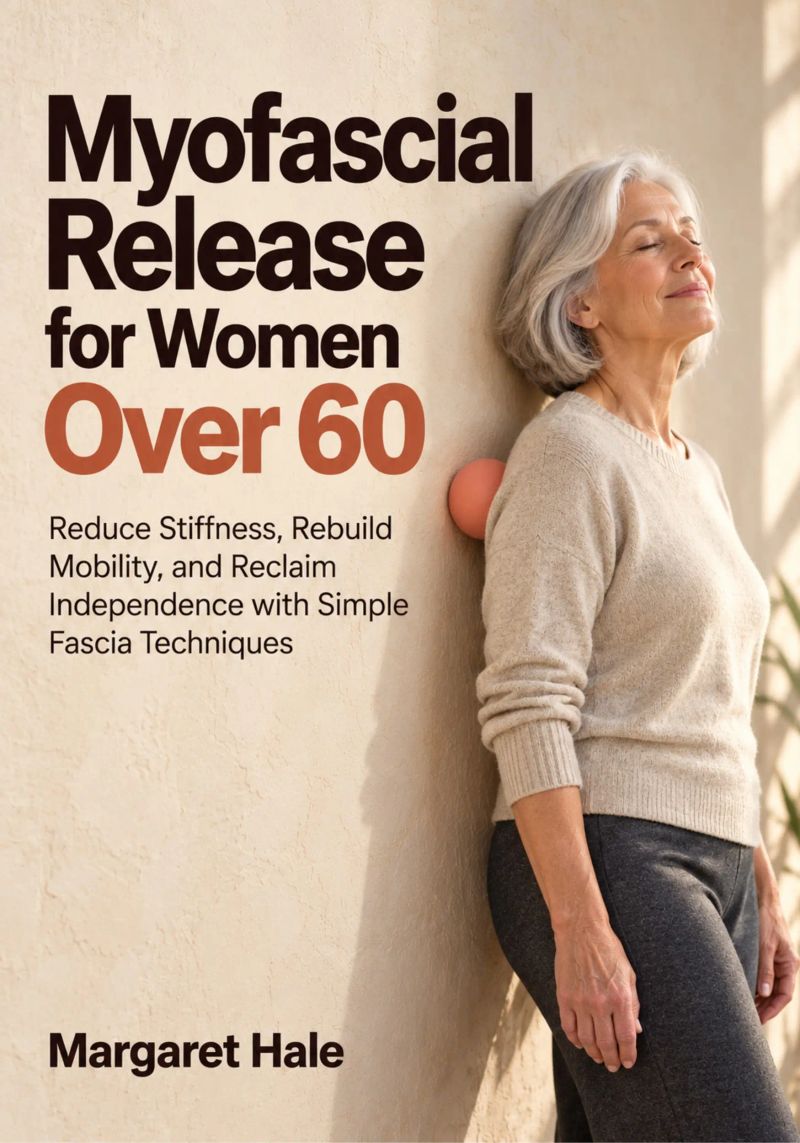
Myofascial Release For Women Over 60
Reduce Stiffness, Rebuild Mobility, and Reclaim Independence with Simple Fascia TechniquesBy Margaret Hale


Length13h 6m
About this audiobook
Did You Know That Up to 80% of Your Connective Tissue Is Water — and Losing That Fluid After 60 Could Be the Hidden Reason You Hurt Every Morning? You wake up and your body feels like it aged ten years overnight. Your heels ache on the first step. Your shoulders are stiff before you reach the kettle. Your lower back tightens the moment you try to straighten up. You have tried stretching. You have tried rest. You have been told this is simply what getting older feels like. It is not. What you are feeling is your fascia — the continuous, water-rich connective tissue that wraps every muscle, bone, and organ in your body — gradually drying out and losing the fluid mobility it had when estrogen supported it. After menopause, this process accelerates in ways no one warns you about. And because fascia is not a muscle, conventional stretching alone cannot fix it. That is exactly what this book is for. What Changes When You Address the Root Cause In Myofascial Release for Women over 60, Dr. Margaret Hale walks you through a science-backed, floor-free self-myofascial release program designed specifically for the postmenopausal body. Using nothing more than a tennis ball and a soft foam roller, you will learn to release the fascial restrictions behind your morning stiffness, persistent pain, limited mobility, balance concerns, and the pelvic floor tension that nearly every woman over 60 quietly lives with. Within the first week, most women notice their first steps in the morning hurt less. Within four weeks, they move through the day with an ease they had stopped expecting.
What You Get Inside Every chapter is built around step-by-step illustrated technique guides with precise pressure instructions so you never guess whether you are doing it right. Condition-specific modifications are embedded throughout for osteoporosis, joint replacement, peripheral neuropathy, and anticoagulant therapy. The programs included are: The 5-Minute Daily Morning Reset — a seated, equipment-minimal routine that stops overnight stiffness before it starts, designed to be done before your first cup of coffee. The 8-Week Progressive Mobility Program — a fully structured, self-paced plan that builds from beginner techniques to a complete whole-body practice, with clear weekly progression markers and a mid-program reassessment checkpoint. Five Targeted Pain Management Routines — specific sequences for heel and foot pain, hip and lower back pain, shoulder and neck tension, knee stiffness, and jaw and headache tension. The Fall Prevention and Balance Program — a 30-minute session combining fascial release with three progressive balance exercises, evidence-based and grounded in nationally recognized fall prevention frameworks. Four Fully Adapted 10-Minute Condition Routines — independently executable programs for osteoporosis, hip and knee replacement, peripheral neuropathy, and anticoagulant therapy, each with a built-in symptom decision guide. Also included are a Physician Clearance Checklist you can bring to your next appointment, a Technique Quick-Reference Card covering all 21 techniques at a glance, an Equipment Guide organized by condition, an 8-Week Program Chart, a full Glossary of clinical terms in plain language, and a Movement Index organized by body region and condition. This Book Is for You If You wake up stiff every morning and want it to stop. You have chronic pain that has not responded to stretching or rest. You are managing a condition and have been told to be careful without being told what you can actually do. Your balance has…
Audiobook details
GenreHealth and Wellness
Length13 hrs 6 mins
Narrated byListen with 1,000+ voices
FormateBook with Audio
Publish dateJul 12, 2026
LanguageEnglish
Table of contents
1Introduction
2How to Use This Book
3Preface
4Introduction
5A Note on Evidence and Safety
Show all chaptersShow less
6Part One: Foundations
7Chapter 1: What Is Fascia and Why Does It Matter After 60?
8Chapter 2: The Postmenopausal Body
9Chapter 3: Your Tools and Your Rules
10Chapter 4: Who Should Modify, Who Should Wait, and Who Should Ask Their Doctor First
11Part Two: Assess and Release
12Chapter 5: Reading Your Body
13Chapter 6: Lower Body Release
14Chapter 7: Upper Body Release
15Chapter 8: Core and Back Release
16Chapter 9: Pelvic Floor and Inner Thigh
17Part Three: Programs for Daily Life
18Chapter 10: The 5-Minute Daily Reset
19Chapter 11: The Mobility Program
20Chapter 12: Pain Management Routines
21Chapter 13: Fall Prevention and Balance
22Part Four: Conditions and Lifelong Practice
23Chapter 14: Managing Common Conditions
24Chapter 15: Fitting SMR into Your Life
25Appendix A: Technique Quick-Reference Card
26Appendix B: Equipment Guide by Condition Profile
27Appendix C: 8-Week Program at a Glance
28Appendix D: Physician Clearance Checklist
29Movement Index

The Yoga Sutras of PatanjaliPatanjali4h 8m4.5 (18.5K)$6 · $0.00

The Lost VoiceGreta Morgan8h 30m4.7 (285)$26 · $0.00

Healthy Kids, Happy KidsElisa Song14h 18m4.6 (760)$33 · $0.00
Eat It!Jordan Syatt, Michael Vacanti4h 40m4.6 (1.5K)$20 · $0.00

Consent Laid BareChanel Contos7h 11m4.5 (1.7K)$24 · $0.00

How to Make Disease DisappearRangan Chatterjee5h 26m4.5 (3.5K)$24 · $0.00

The Complete Herbal (Annotated)Nicholas Culpeper29h 8m4.5 (1.4K)$2 · $0.00

A Plague Upon Our HouseScott W. Atlas MD10h 37m4.5 (3.4K)$20 · $0.00

The Cancer CodeDr. Jason Fung10h 48m4.5 (5.3K)$29 · $0.00

The Gift of TherapyIrvin Yalom7h 39m4.5 (38.8K)$26 · $0.00

EarlySarah DiGregorio9h 47m4.5 (1.3K)$29 · $0.00

Bottle of LiesKatherine Eban14h 25m4.4 (12K)$33 · $0.00
The 36-Hour DayNancy L. Mace, Peter V. Rabins17h 13m4.4 (9.2K)$28 · $0.00

FlooredSara Reardon10h 36m4.5 (1K)$29 · $0.00

Radical RemissionKelly A. Turner9h 26m4.4 (8.1K)$29 · $0.00
The Sinatra SolutionStephen T. Sinatra MD9h4.5 (899)$20 · $0.00

The Songaminute ManSimon McDermott6h 12m4.5 (280)$24 · $0.00

Sometimes BrilliantLarry Brilliant12h 27m4.5 (954)$29 · $0.00

Live Your LifeAmanda Kloots, Anna Kloots10h 54m4.4 (13.7K)$29 · $0.00

All in Her HeadElizabeth Comen13h 25m4.4 (18.2K)$33 · $0.00
You may also like

The Body BookCameron Diaz7h 49m3.9 (11.6K)$26 · $0.00

The 22-Day RevolutionMarco Borges6h 14m3.9 (2.1K)$17 · $0.00

Playing at the BorderJoanna Ho14m4.1 (387)$4 · $0.00

Velvet DragonfliesBilly Chapata1h 36m4.1 (934)$15

How To Write a Novel: From Idea To BookJoanna Penn6h 9m4.4 (376)Free

The Book That Made Your WorldVishal Mangalwadi14h 15m4.4 (3.2K)$23

Above Life's TurmoilJames Allen2h 11m4.2 (871)$1.20 · $0.00

The Way of ExcellenceBrad Stulberg6h 46m4.2 (1.1K)$24 · $0.00

Chapter 3 Of The Discourse On Method.René Descartes17m4.0 (41.6K)$23 · $0.00

Nunca diga abraços para um gringoGavin Roy2h 33m4.3 (1.3K)$3 · $0.00

The 5-Ingredient Low-Sugar Diabetes Cookbook for SeniorsMaren Sterling2h 27m$19.80

10,000 Reasons (Fingerstyle Solo)Bill Brown Jr.56m$5
Fitbit Made SimpleWalter Hemsley4h 27m$5
The Performance PipelineStephen Drotter7h 8m4.1 (247)$22 · $0.00
The DNA RestartSharon Moalem MD, PhD10h 57m3.8 (242)$23

The Ultimate Success SeriesChris Widener11h 5m3.9 (32)$75

The Anti-Inflammatory Low-Glycemic Diabetic Cookbook for Women Over 50Maren Sterling2h 37m$21.10 · $0.00

Morning Devotional for Busy WomenJAMES REED3h 58m$6

Learn Your LessonsFalco Wisskirchen30m$18 · $0.00

The Insulin Resistance Cookbook for Perimenopausal WomenEloise Quinn4h 45m$11.50 · $0.00