
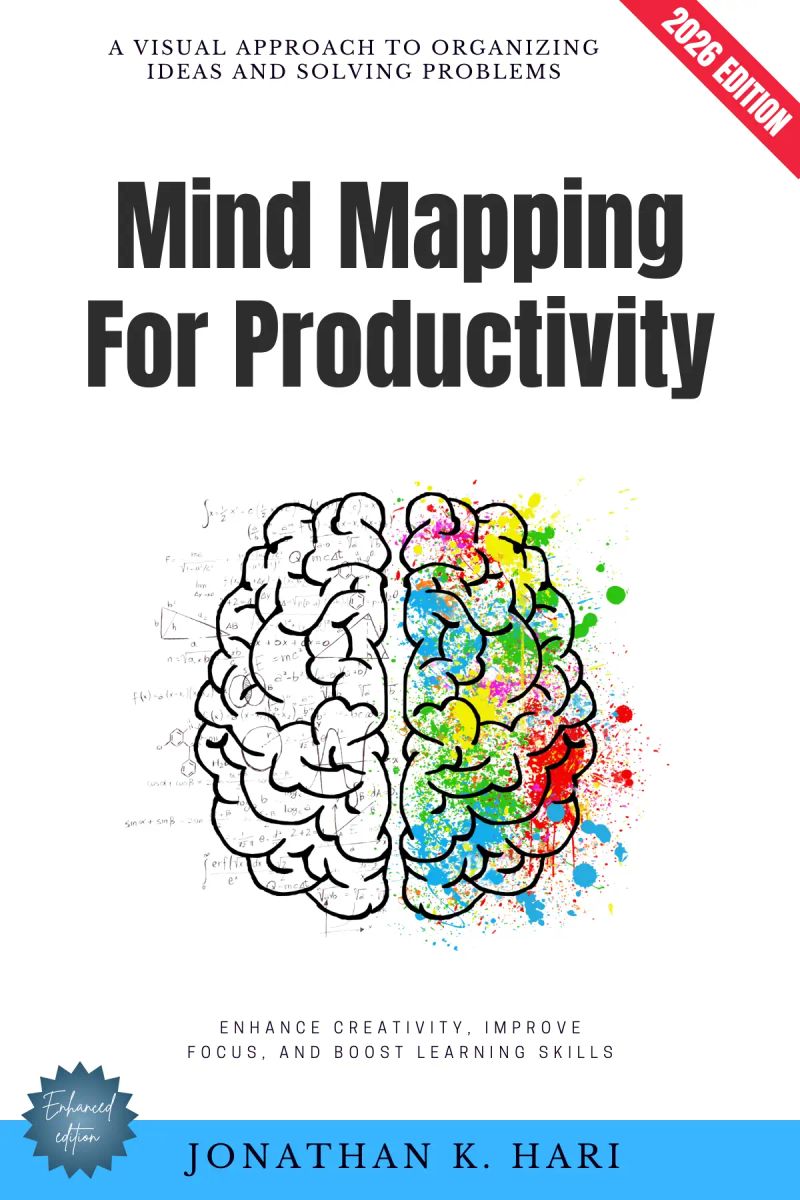
Mind Mapping for Productivity
A Visual Approach to Organizing Ideas and Solving Problems (Enhance Creativity, Improve Focus, and Boost Learning Skills)By Jonathan K. Hari


Length2h 13m
About this audiobook
Mind Mapping for Productivity
A Visual Approach to Organizing Ideas and Solving Problems
Unlock the power of your mind with a technique that mirrors how your brain naturally works. This guide shows professionals, students, and lifelong learners how to organize ideas, boost creativity, and solve problems efficiently.
Here's a Preview of What You'll Learn...
Mind Mapping basics and key benefits
How it enhances creativity, focus, and memory
Essential tools: digital and traditional
Step-by-step guide to your first mind map
Goal setting and turning ideas into action
Time management with visual planning
Boosting problem-solving and innovation
Transform the way you think, work, and create.
Audiobook details
GenreHealth and Wellness, Self-Help
Length2 hrs 13 mins
Narrated byListen with 1,000+ voices
FormateBook with Audio
Publish dateAug 18, 2020
LanguageEnglish
Table of contents
1Introduction
2Mind Mapping – Understanding the Basics and Benefits
3The Science Behind Mind Mapping – How it Boosts Creativity and Efficiency
4Essential Mind Mapping Tools – Digital and Traditional Options
5Creating Your First Mind Map – A Step-by-Step Guide
Show all chaptersShow less
6Mind Mapping for Goal Setting – Turning Ideas into Achievable Objectives
7Time Management with Mind Maps – Organizing Tasks Effectively
8Boosting Creativity and Problem-Solving – Unlocking New Ideas
9Mind Mapping for Decision Making – Visualizing Choices for Better Clarity
10Using Mind Maps for Learning and Note-Taking – Retaining Information Better
11Brainstorming and Idea Generation – Enhancing Team and Solo Creativity
12Project Planning with Mind Maps – Breaking Down Complex Tasks
13Daily Productivity Hacks Using Mind Maps – Making the Most of Your Day
14Digital Mind Mapping vs. Traditional Methods – Choosing the Right Approach
15Mastering Mind Mapping for Lifelong Productivity – Making it a Habit

Whispers in the DarkJonathan Kade50m$9.99

The Last KeyClara Whitfield47m5.0 (1)Free

Beyond the Null HorizonAlaric Shade51m$2.99 · $0.00

Apex of ShadowsLucien Crow53m$2.99 · $0.00

Neon Echoes of TomorrowSeraphine Ember47m$4.99 · $0.00

Whispers of the Shattered RealmKael Dusk47m$2.99 · $0.00

Crimson OdysseyEvelyn Frost58m$2.99 · $0.00

Shadows Between CluesSebastian Grey59m$2.99 · $0.00

Fractured HorizonsSable Thorn1h 4m$2.99 · $0.00

The Shadow AlgorithmLuna Ray49m$2.99 · $0.00

The Echo of Blue GlassClara Whitmore50m$2.99 · $0.00

The Ember TrailElysia Storm58m$2.99 · $0.00

The Ember VeilTaylor Morgan51m$2.99 · $0.00

The Singularity ParadoxJack Morrison56m Only with Ultra

Edge of the Forgotten FrontierNolan Drake47m$2.99 · $0.00

The Last FrequencyCasey Flint55mFree

Shadows of the ForgottenAvery Knight51m$2.99 · $0.00

Edge of the HorizonWyatt Stone53m$2.99 · $0.00

Whispers Between the RainDashiell Cross48m$4.99

Shadows in the AlleyCyrus Falcon46m$2.99 · $0.00

The Complete Herbal (Annotated)Nicholas Culpeper29h 8m4.5 (1.4K)$2 · $0.00

A Plague Upon Our HouseScott W. Atlas MD10h 37m4.5 (3.4K)$20 · $0.00

The Cancer CodeDr. Jason Fung10h 48m4.5 (5.3K)$29 · $0.00

The Gift of TherapyIrvin Yalom7h 39m4.5 (38.8K)$26 · $0.00

EarlySarah DiGregorio9h 47m4.5 (1.3K)$29 · $0.00

Bottle of LiesKatherine Eban14h 25m4.4 (12K)$33 · $0.00
The 36-Hour DayNancy L. Mace, Peter V. Rabins17h 13m4.4 (9.2K)$28 · $0.00

FlooredSara Reardon10h 36m4.5 (1K)$29 · $0.00

Radical RemissionKelly A. Turner9h 26m4.4 (8.1K)$29 · $0.00

The Sinatra SolutionStephen T. Sinatra MD9h4.5 (899)$20 · $0.00

The Songaminute ManSimon McDermott6h 12m4.5 (280)$24 · $0.00
Sometimes BrilliantLarry Brilliant12h 27m4.5 (954)$29 · $0.00

Live Your LifeAmanda Kloots, Anna Kloots10h 54m4.4 (13.7K)$29 · $0.00

All in Her HeadElizabeth Comen13h 25m4.4 (18.2K)$33 · $0.00

The Wisdom of Your BodyHillary McBride9h 14m4.4 (6.7K)$29 · $0.00

The Alzheimer's SolutionDean Sherzai, Ayesha Sherzai9h 47m4.4 (1.9K)$29 · $0.00
Rewire Your MindsetBrian Keane6h 49m4.5 (896)$23 · $0.00

Tuning The Human Biofield: Healing With Vibrational MedicineCENTER FOR SOUND THERAPY13h 28m4.4 (2.5K)$35 · $0.00

VaccinatedPaul A. Offit8h 30m4.4 (3.7K)$26 · $0.00

Hot and UnbotheredYana Tallon-Hicks10h 44m4.5 (600)$29 · $0.00
Learning to PrayJames Martin13h 24m4.5 (3.4K)$33 · $0.00

Birdie & HarlowTaylor Wolfe7h 50m4.6 (6.5K)$26 · $0.00

CrossroadsKaleb Dahlgren7h 56m4.6 (4.9K)$26 · $0.00

Life on the BridgeKaelynn Partlow5h 40m4.6 (1.1K)$24 · $0.00

Keep Your Love OnDanny Silk9h 4m4.6 (8.1K)$10 · $0.00

The Tao of Joy Every DayDerek Lin10h 24m4.6 (762)$20 · $0.00
UndividedVicky Beeching9h 2m4.6 (1.3K)$29 · $0.00
Level UpRob Dial7h 42m4.6 (3.3K)$26 · $0.00

Burn the HaystackJennie Young, PhD9h 30m4.6 (543)$29 · $0.00

ACRES OF DIAMONDS: Our Every-day Opportunities (Wisdom & Empowerment Series) (Annotated)Russell Conwell2h 26m4.6 (1K)$2 · $0.00

Good InsideBecky Kennedy9h 55m4.5 (59.3K)$29 · $0.00

The Lost VoiceGreta Morgan8h 30m4.7 (285)$26 · $0.00

Stripped DownBunnie Xo8h 25m4.5 (32.9K)$26 · $0.00

UnthinkableJamie Raskin15h 8m4.5 (9.3K)$8 · $0.00

Wallace D. Wattles Ultimate Collection Wallace D. Wattles16h 53m4.6 (1.3K)$1 · $0.00
Inquire WithinIn-Q2h 18m4.6 (993)$16 · $0.00

Under His WingsEmily Compagno7h 16m4.6 (848)$22 · $0.00

Eat It!Jordan Syatt, Michael Vacanti4h 40m4.6 (1.5K)$20 · $0.00

Not Everything Counts but Everything Matters: The powerful and inspirational new book about leadership and achieving success from the visionary multi-premiership winning Panthers coachIvan Cleary6h 1m4.6 (680)$24 · $0.00

The Double Dangerous Book for BoysConn Iggulden9h 10m4.5 (2.4K)$29 · $0.00
You may also like
The Problems of Philosophy (Annotated)Bertrand Russell6h 22m4.1 (58.2K)$2 · $0.00

David Hume: The Collected WorksDavid Hume37h 13m4.5 (261)$1 · $0.00

A Treatise of Human Nature (Annotated)David Hume26h 27m4.1 (31.8K)$3 · $0.00
Thought-Culture, or, Practical Mental TrainingWilliam Walker Atkinson3h 46m4.0 (251)$2.30
UltralearningScott H. Young7h 46m4.0 (29K)$26 · $0.00

On the Improvement of the UnderstandingBenedictus de Spinoza1m4.0 (1.1K)$2.30

UnthinkableHelen Thomson7h 19m4.1 (6.4K)$24 · $0.00

An Essay Concerning Human UnderstandingJohn Locke30h 12m4.0 (18K)$1.20 · $0.00

Your Mind and How to Use ItWilliam Walker Atkinson5h 10m4.0 (1.5K)$21 · $0.00
An Enquiry Concerning Human Understanding David Hume5h 16m4.1 (30.5K)Free
An Enquiry Concerning Human UnderstandingDavid Hume5h 22m4.1 (18.7K)$1 · $0.00

The Physiology of Taste; Or, Transcendental GastronomyBrillat-Savarin7h 42m4.2 (2.8K)$1 · $0.00
PsychPaul Bloom15h 5m4.2 (2.8K)$33 · $0.00

Your Mind and How to Use It: A Manual of Practical Psychology (Unabridged)William Walker Atkinson5h 55m4.2 (1.8K)$2 · $0.00

A Treatise of Human NatureDavid Hume24h 50m4.1 (20.1K)$2.30

The Pianist's Approach to Sight-Reading and MemorizingBeryl Rubinstein2h 37m$1 · $0.00

Greek in a NutshellJames Strong1h 56m3.3 (52)$2 · $0.00

Mega Mind PowerMade for Success10h 55m$20

A Philosophicall Essay for the Reunion of the LanguagesPierre Besnier1h 9m$2 · $0.00

A Commonplace Book of Thoughts, Memories, and FanciesMrs. Jameson8h 37m3.2 (11)$2 · $0.00