
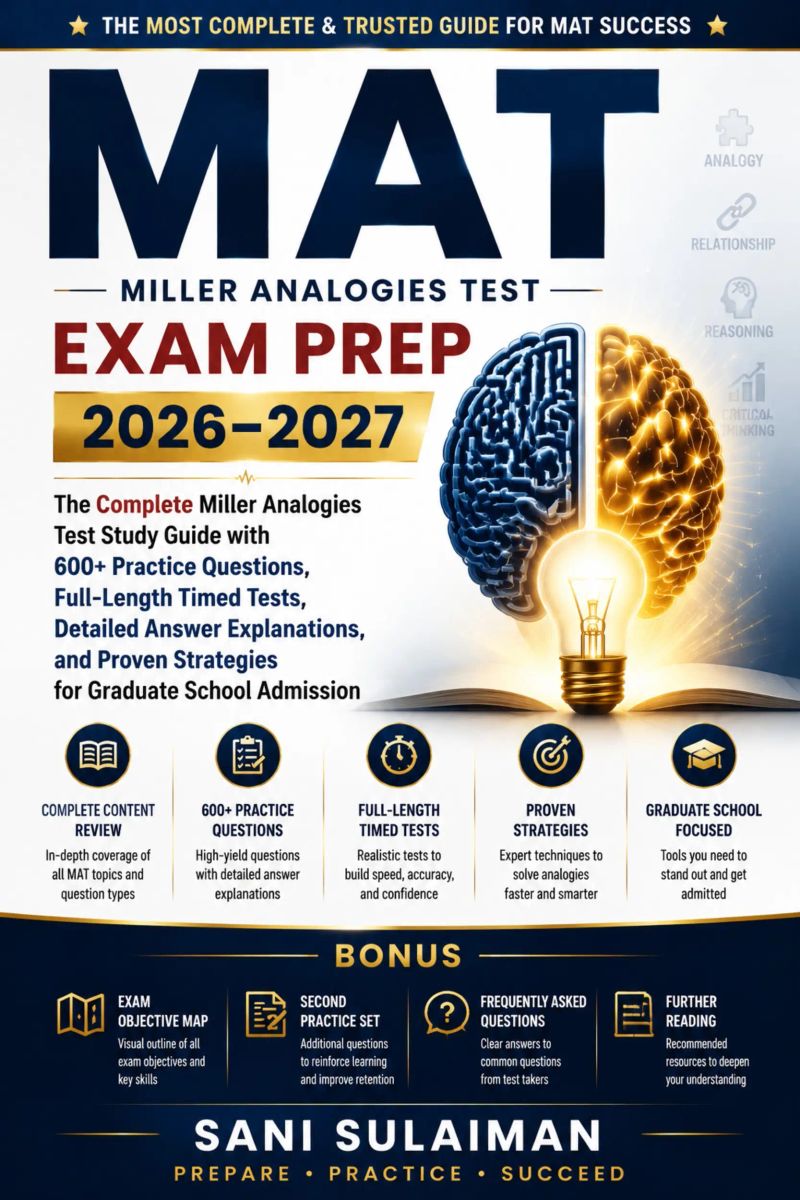
MAT Exam Prep 2026–2027
The Complete Miller Analogies Test Study Guide with 600+ Practice Questions, Full-Length Timed Tests, Detailed Answer Explanations, and Proven Strategies for Graduate School AdmissionBy Sani Sulaiman


Length5h 46m
About this audiobook
Most MAT prep books test what you already know. This one builds the skill that actually moves your score.
The Miller Analogies Test doesn't reward memorization — it rewards pattern recognition, and pattern recognition can be trained. This complete study guide is built around a single organizing framework: master the twelve relationship categories that govern every analogy on the exam, and content review across humanities, science, math, social science, and general knowledge becomes dramatically easier to apply under timed pressure.
Inside, you'll find:
600+ practice questions with fully worked answer explanations — not just the correct choice, but why every wrong answer fails
A complete domain-by-domain review: literature, fine arts, mathematics, natural science, psychology and economics, history and geography, idioms and everyday reasoning
The twelve-category relationship taxonomy that turns unfamiliar analogies into solvable patterns, plus a bridge-sentence method for decoding any pairing on sight
Advanced distractor training — the four ways test-makers build tempting wrong answers, and the elimination sequence that beats them
A full-length, 100-item timed practice examination, plus a second 60-item timed set in the appendix, both scored and diagnosed by content area
Timing and triage strategy for the computer-based format, including a three-pass method and test-day execution routine
EXAM TIP, STUDY TIP, REAL-WORLD APPLICATION, and GLOBAL CONSIDERATIONS callouts throughout, plus hands-on exercises and chapter review sets to lock in every concept before you move on
Whether your test date is six weeks out or six days out, this guide gives you a sequenced path, real practice under real conditions, and the reasoning skill that separates a passing score from a standout one.
Audiobook details
GenreEducation and Learning
Length5 hrs 46 mins
Narrated byListen with 1,000+ voices
FormateBook with Audio
LanguageEnglish
Table of contents
1MAT Exam Prep 2026–2027
2MAT Exam Prep 2026–2027
3MAT Exam Prep 2026–2027
4MAT Exam Prep 2026–2027
5MAT Exam Prep 2026–2027
Show all chaptersShow less
6Chapter 1: What the MAT Actually Measures
7A Sixty-Minute Reasoning Sprint
8How the Score Actually Works
9The Four Content Domains, and Why They Overlap More Than You Think
10Building Your Study Calendar
11Hands-On Exercise: Diagnostic Baseline
12Chapter Summary
13Key Terms
14Review Questions
15Critical Thinking Questions
16Chapter 2: The Anatomy of an Analogy
17The Bridge Sentence: One Tool for Every Item
18The Twelve Reliable Relationship Categories
19Direction and Symmetry: The Trap That Catches Careless Readers
20Hands-On Exercise: Category Sort
21Chapter Summary
22Key Terms
23Review Questions
24Critical Thinking Questions
25Chapter 3: Vocabulary Under Pressure
26Why Vocabulary Study Should Not Mean Memorizing a List
27Root, Prefix, and Suffix Triage
28Degree, Connotation, and the Intensity Ladder
29Hands-On Exercise: Root Decomposition Drill
30Chapter Summary
31Key Terms
32Review Questions
33Critical Thinking Questions
34Chapter 4: Literature, Language, and the Humanities
35Author-to-Work: The Highest-Yield Literary Pattern
36Literary Devices from a Defining Example
37Movements in Chronological and Stylistic Relation
38Hands-On Exercise: Author-Work-Movement Chains
39Chapter Summary
40Key Terms
41Review Questions
42Critical Thinking Questions
43Chapter 5: Fine Arts, Music, and Architecture
44Visual Art: Movement, Artist, Technique
45Musical Periods and Representative Composers
46Architecture: Style to Defining Element
47Hands-On Exercise: Cross-Domain Movement Map
48Chapter Summary
49Key Terms
50Review Questions
More from Sani Sulaiman

A Brief History of IntelligenceMax S. Bennett12h 18m4.6 (6.6K)$29 · $0.00

HomeschooledStefan Merrill Block7h 10m3.6 (18.5K)$28 · $0.00

EducationEllen G. White9h 41m4.6 (1.5K)$2 · $0.00

Parents and Children (Annotated)Charlotte Mason9h 23m4.6 (988)$2 · $0.00

Children Under FireJohn Woodrow Cox10h 17m4.5 (1.6K)$29 · $0.00

The State Must ProvideAdam Harris7h 15m4.5 (775)$24 · $0.00

The Call of the Wild and FreeAinsley Arment9h 7m4.4 (21.2K)$29 · $0.00
The Freelance WayRobert Vlach19h 48m4.5 (528)$40 · $0.00

Race to the BottomLuke Rosiak9h 20m4.5 (600)$29 · $0.00

They Came for the SchoolsMike Hixenbaugh9h 5m4.5 (2.6K)$8 · $0.00

Find Me UnafraidKennedy Odede, Jessica Posner11h 11m4.5 (2.7K)$29 · $0.00

Asking for ItKate Harding8h 55m4.4 (5.3K)$20 · $0.00
Defining Moments in Black HistoryDick Gregory7h 37m4.4 (6K)$26 · $0.00
The Emerald Tablets of Thoth the AtlanteanMaurice Doreal3h 4m4.4 (8.8K)$6 · $0.00

Learning AmericaLuma Mufleh6h 37m4.4 (564)$24 · $0.00
Math-ishJo Boaler7h 21m4.4 (588)$24 · $0.00

Daddy-Long-LegsJean Webster12h 18m4.2 (91K)$1.99 · $0.00
It Worked For MeColin Powell7h 42m4.3 (9.8K)$26 · $0.00

Little SoldiersLenora Chu11h 30m4.3 (3.1K)$29 · $0.00

Grammar-land; Or, Grammar in Fun for the Children of Schoolroom-shireM. L. Nesbitt2h 36m4.4 (488)$1 · $0.00
You may also like
THE THREE CRITIQUES: The Critique of Pure Reason, The Critique of Practical Reason & The Critique of JudgmentImmanuel Kant46h 8m4.2 (1.6K)$2 · $0.00

THE CRITIQUE OF PURE REASONImmanuel Kant25h 39m4.1 (51.3K)$1.99 · $0.00

The CategoriesAristotle2h 41m4.0 (2.2K)$1 · $0.00
The Intelligent Investor Rev Ed.Benjamin Graham17h 48m4.3 (191.5K)$40 · $0.00
Introduction to Mathematical PhilosophyBertrand Russell9h4.1 (2.8K)$1 · $0.00
Bertrand Russell: Problems of PhilosophyBertrand Russell4h 51m4.1 (25.1K)$1.99 · $0.00
The Hot HandBenjamin Cohen8h 39m3.9 (1.6K)$26 · $0.00
An Enquiry Concerning Human UnderstandingDavid Hume5h 22m4.1 (18.7K)$1 · $0.00
Bridge; its Principles and Rules of Play with Illustrative Hands and the Club Code of Bridge LawsJ. B. Elwell2h 58m$2 · $0.00
The Origin of the Knowledge of Right and Wrong (Annotated)Franz Brentano7h 21m3.8 (17)$2 · $0.00
Vibe TradingIsla L. Gallagher2h 49m$4.10 · $0.00

Selected Mathematical WorksLewis Carroll7h 5m$2 · $0.00

Preventable DiseasesWoods Hutchinson10h 49m3.7 (29)$2 · $0.00
How to Make Money Flipping Cameras and Lenses - A Practical Guide to Evaluating Shutter Counts, Optics, Compatibility, and Resale ValueJACK FLIPWELL8h 38m$7.80 · $0.00
Ace Statics Through Problem SolvingBethany Okonkwo13h 20m$75

Skin in the GameJim Gilreath11h 5m$25
HumoristsPaul Johnson6h 59m3.3 (175)$17 · $0.00
Nuts To Crack A Galaxy of Puzzles, Riddles, Conundrums etc.Anonymous27m$2.30

The Science of GeniusScientific American6h 14m3.9 (13)$17

The Problem of TruthHerbert Wildon Carr2h 47m$2 · $0.00