
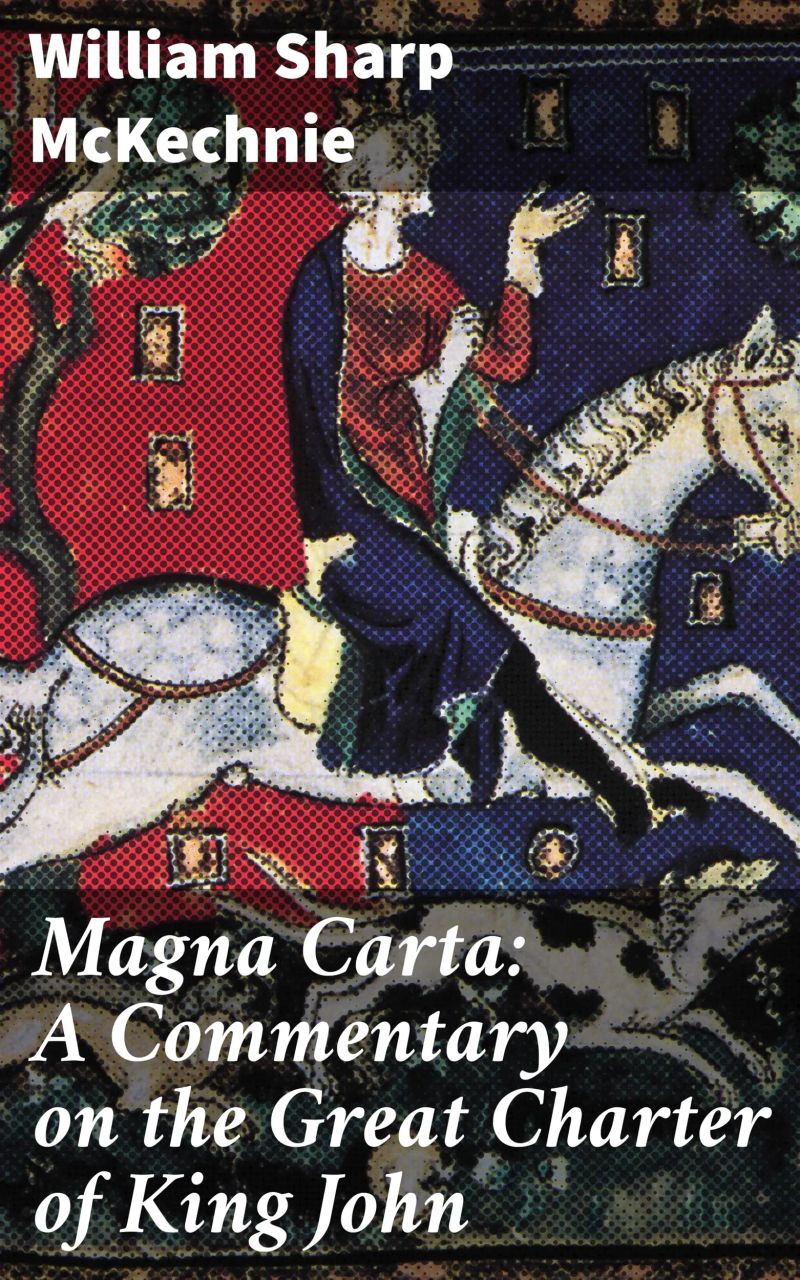
Magna Carta: A Commentary on the Great Charter of King John
With an Historical IntroductionBy William Sharp McKechnie


Length22h 46m
About this audiobook
In "Magna Carta: A Commentary on the Great Charter of King John," William Sharp McKechnie provides an in-depth analysis of one of the most pivotal documents in constitutional history. Through meticulous examination, McKechnie dissects the text of the Magna Carta, exploring its clauses and their implications within the broader context of medieval governance and legal tradition. His lucid, analytical style balances scholarly rigor with accessibility, making complex historical insights comprehensible for both enthusiasts and academics. The book situates the Charter within the socio-political turmoil of 1215 England, illuminating its role as a precursor to modern concepts of liberty and justice. William Sharp McKechnie was an esteemed Scottish legal scholar whose work reflects a profound commitment to understanding the intersection of law, history, and individual rights. His background in jurisprudence and historical studies likely inspired this commentary, as he seeks to bridge the gap between contemporary legal frameworks and their historical antecedents. McKechnie's expertise sheds light on the enduring relevance of the Magna Carta, highlighting how its principles resonate across centuries of legal development. Recommended for legal scholars, historians, and anyone intrigued by the foundations of democracy, McKechnie'Äôs commentary serves as both a scholarly resource and a compelling narrative. Engaging with the text will deepen your appreciation of the Magna Carta'Äôs significance and its lasting impact on legal systems worldwide.
Audiobook details
Rating★★★★ 4.3 (44)
Includes Goodreads, Amazon, LibraryThing
GenrePolitics and Government
Length22 hrs 46 mins
Narrated byListen with 1,000+ voices
FormateBook with Audio
Publish dateNov 5, 2021
LanguageEnglish
Table of contents
1PREFACE
2HISTORICAL INTRODUCTION.
3PART I. EVENTS LEADING TO MAGNA CARTA.
4I. William I. to Henry II.—Main Problem: the Monarchy.
5II. William I. to Henry II.—Problem of Local Government.
Show all chaptersShow less
6III. William I. to Henry II.—Problem of Church and State.
7IV. Richard I. and John.
8V. The Years of Crisis, 1213–15.
9VI. Runnymede, and after.
10PART II. FEUDAL GRIEVANCES AND MAGNA CARTA.
11I. The Immediate Causes of the Crisis.
12II. The Crown and Feudal Obligations.
13III. Royal Justice and Feudal Justice.
14PART III. MAGNA CARTA: ITS FORM AND CONTENTS.
15I. Its Prototypes: Earlier Charters.
16II. Magna Carta: its Form and Juridical Nature.
17III. Magna Carta: its Contents and Characteristics.
18IV. Magna Carta: an Estimate of its Value.
19VI. Magna Carta: Value of Traditional Interpretations.
20VII. Magna Carta. Its traditional relation to Trial by Jury.
21PART IV. HISTORICAL SEQUEL TO MAGNA CARTA.
22I. Re-issues and Confirmations of the Great Charter.
23II. Magna Carta and the Reforms of Edward I.
24PART V.
25I. Manuscripts of Magna Carta and Relative Documents.
26II. Previous Editions and Commentaries.
27TEXT, TRANSLATION, AND COMMENTARY.
28MAGNA CARTA.
29PREAMBLE.[322]
30CHAPTER ONE.
31CHAPTER TWO.
32CHAPTER THREE.
33CHAPTER FOUR.
34CHAPTER FIVE.
35CHAPTER SIX.
36CHAPTER SEVEN.
37CHAPTER EIGHT.
38CHAPTER NINE.
39CHAPTER TEN.
40CHAPTER ELEVEN.
41CHAPTER TWELVE.
42CHAPTER THIRTEEN.
43CHAPTER FOURTEEN.
44CHAPTER FIFTEEN.
45CHAPTER SIXTEEN.
46CHAPTER SEVENTEEN.
47CHAPTER EIGHTEEN.
48CHAPTER NINETEEN.
49CHAPTER TWENTY.
50CHAPTER TWENTY-ONE.
More from William Sharp McKechnie


RiggedMollie Hemingway12h 48m4.6 (4.2K)$23 · $0.00

SledgehammerDavid Friedman8h 21m4.7 (589)$26 · $0.00

Citizenship in a Republic (Annotated)Theodore Roosevelt2h 44m4.6 (1.4K)$2 · $0.00

No EscapeNury Turkel9h 30m4.6 (809)$28 · $0.00

Always FaithfulThomas Schueman, Zainullah Zaki12h 12m4.6 (977)$29 · $0.00

UnthinkableJamie Raskin15h 8m4.5 (9.3K)$8 · $0.00

My Fourth Time, We DrownedSally Hayden13h 59m4.6 (2.9K)$23 · $0.00

A Revolution of Common SenseScott Jennings9h 29m4.6 (528)$29 · $0.00

Statement From the Dock at the Rivonia TrialNelson Mandela2h 18m4.6 (1.3K)$1 · $0.00

Lessons from the EdgeMarie Yovanovitch17h 11m4.5 (5.9K)$40 · $0.00

To Rescue the American SpiritBret Baier10h 12m4.5 (2.7K)$8 · $0.00

StonewalledSharyl Attkisson15h 19m4.5 (4.3K)$33 · $0.00

The World According to Orwell: 1984 & Animal FarmGeorge Orwell15h 42m4.6 (1.1K)$1 · $0.00

Basic EconomicsThomas Sowell18h 32m4.5 (29.3K)$28 · $0.00
To Rescue the RepublicBret Baier, Catherine Whitney11h 42m4.5 (8.6K)$29 · $0.00

Modern WarriorsPete Hegseth7h 10m4.5 (4.7K)$24 · $0.00
Philosophy and Opinions of Marcus Garvey (Annotated)Marcus Mosiah Garvey4h 42m4.5 (1.7K)$1.99 · $0.00

A Plague Upon Our HouseScott W. Atlas MD10h 37m4.5 (3.4K)$20 · $0.00

One Bright MoonAndrew Kwong12h 21m4.5 (813)$29 · $0.00

CredibleDeborah Tuerkheimer8h 5m4.6 (551)$26 · $0.00
You may also like
Marx in 90 MinutesPaul Strathern1h 24m3.5 (1.6K)$7

The Autobiography of Thomas JeffersonThomas Jefferson8h 32m4.0 (2.8K)$1.99 · $0.00

Socialism: Utopian and Scientific (Annotated)Frederick Engels3h 35m4.3 (29.7K)$1.99 · $0.00

The French Revolution and NapoleonJean-Jacques Rousseau, Alexis de Tocqueville, Montesquieu, Charles Downer Hazen62h 54m4.1 (574)$2 · $0.00

The State and RevolutionVladimir lenin4h 10m4.3 (19.8K)$4 · $0.00

The Proletarian Revolution and the Renegade KautskyVladimir Lenin4h 34m4.3 (1K)$1.99 · $0.00

Religion and the Rise of CapitalismR. H. Tawney10h 12m4.1 (9.1K)$2.30

The Constitution of the United States of AmericaVarious70h 42m4.5 (46.3K)$1 · $0.00

The Wealth of NationsAdam Smith41h 55m4.1 (40.9K)$3.50 · $0.00

The Communist ManifestoKarl Marx, Friedrich Engels2h 13m3.9 (252.7K)$2 · $0.00
The Holy Bible - 3 JohnKing James2m4.5 (312)$3 · $0.00

The Story of PragueFrancis hrabe Lützow3h 56m$2 · $0.00

Gandhi and AnarchyC. Sir Sankaran Nair7h 7m4.1 (51)$2 · $0.00

Virginia under the Stuarts 1607-1688Thomas Jefferson Wertenbaker10h 6m$1 · $0.00

Address To the Christian Nobility of the German Nation (Annotated)Martin Luther5h 3m3.9 (135)$2 · $0.00

REBEL YELL: History of the Confederacy, Memoirs and Biographies of the Confederate Leaders & Official DocumentsJohn Esten Cooke, Jefferson Davis, Robert E. Lee, Frank H. Alfriend, Heros von Borcke144h 20m4.3 (11)$1.99 · $0.00

Constitutional History of England, Henry VII to George II (Vol. 1-3) (Annotated)Henry Hallam65h 44m4.0 (59)$2 · $0.00

The Ancien RégimeCharles Kingsley2h 1m$2 · $0.00
The Complete WorksThomas Jefferson210h 44m4.4 (197)$1.99 · $0.00

The Heritage of The SouthJubal Anderson Early3h 59m$2.30