
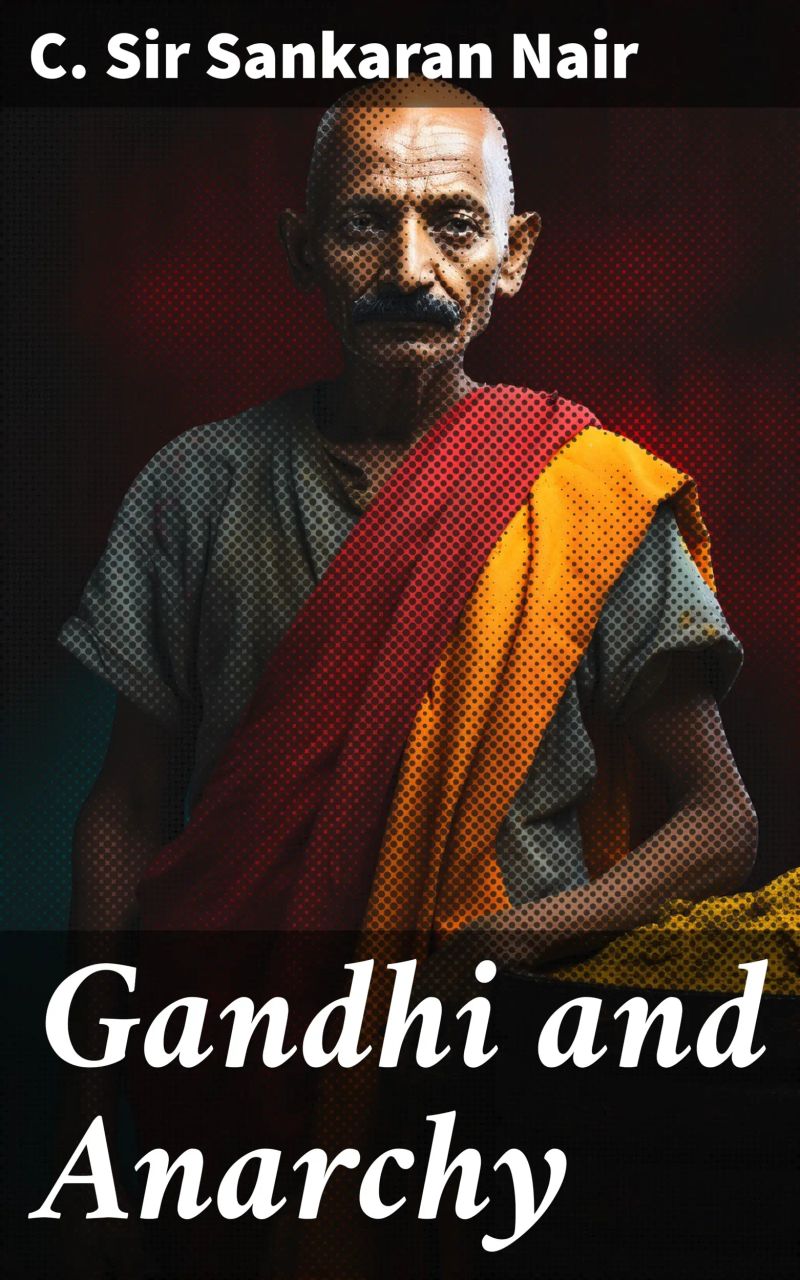
Gandhi and Anarchy
Unraveling Gandhi's Anarchist PhilosophyBy C. Sir Sankaran Nair


Length7h 6m
About this audiobook
In "Gandhi and Anarchy," C. Sir Sankaran Nair presents a profound examination of the philosophical dichotomy between Gandhian principles of non-violence and the chaotic forces of anarchy that challenge societal norms. Nair employs a critical lens, drawing from historical and contemporary sources, to dissect how Gandhi'Äôs approach to social and political justice stands in contrast to anarchist ideologies. With a blend of succinct prose and rigorous argumentation, the book situates Gandhi within the larger framework of political thought, exploring themes of resistance, moral ethics, and the role of civil disobedience in the quest for freedom. C. Sir Sankaran Nair was not only influenced by Gandhi's ideals but also lived through the tumultuous period of India's struggle for independence. His background as a lawyer, politician, and historian equipped him with the perspective necessary to critically analyze Gandhi's philosophies. Nair's experiences with colonial oppression and his engagement with various intellectual movements inspired him to explore the viability and implications of Gandhi's vision amidst the chaotic realities of societal upheaval. This work is a crucial text for readers interested in political theory, social justice, and the legacy of Gandhi. Nair's thoughtful discourse invites readers to reconsider the relationship between non-violence and the sometimes anarchic conditions of rebellion, making it an essential addition to any academic collection.
Audiobook details
Rating★★★★ 4.1 (51)
Includes Goodreads, Amazon
GenrePolitics and Government
Length7 hrs 6 mins
Narrated byListen with 1,000+ voices
FormateBook with Audio
Publish dateOct 29, 2023
LanguageEnglish
Table of contents
1HIS PHILOSOPHY
2THE NON-CO-OPERATION RESOLUTION
3THE KHILAFAT QUESTION
4THE PUNJAB ATROCITIES
5SWARAJ OR HOME RULE
Show all chaptersShow less
6EDUCATION
7VAKILS AND COURTS
8BOYCOTT OF COUNCILS
9BOYCOTT OF FOREIGN GOODS
10NON-VIOLENT NON-CO-OPERATION
11INDIVIDUAL CIVIL DISOBEDIENCE
12Effect of violent preaching
13The Leader of the Movement
14Its inevitable result
15APPENDIX II DIABOLICAL ATROCITIES.
16APPENDIX III MALABAR'S AGONY.
17APPENDIX IV Proceedings of the conference at Calicut presided over by the Zamorin Maharaja.
18APPENDIX V Petition of Malabar Ladies to Lady Reading
19The Failure of the Programme
20Experiment in youthful sacrifice
21The Lawyer-Failure
22A Foul Atmosphere
23Revise the Programme
24Enter the Councils
25N.C.O. Concession
26Suggested Modifications
27Civil Disobedience
28APPENDIX VII Extracts from the speech delivered by His Excellency Sir Harcourt Butler, Governor of the U. P. of Agra & Oudh, at the opening of the U. P. Legislative Council,
29APPENDIX VIII Extracts from the speech delivered by His Excellency Sir Harcourt Butler at a meeting of the United Provinces Legislative Council
30APPENDIX IX Extracts from the speech by His Excellency Sir Harcourt Butler at a Durbar held at Lucknow
31Violent Agitators
32Soul Force
33Criminal Intimidation
34The Arrests
35Khilafat Agitators
36The Arrests
37The Mob breaks Loose
38His Excellency's Speech at the St. Andrew's Day Dinner, on 30th November 1920
39His Excellency's Speech at the St. Andrew's Dinner, on 30th November 1921
40His Excellency's speech at the Legislative Council on 19th December 1921
41On the Defensive
42The Critics Answered
43The Lesson of Chauri Chaura
44The Issue
45APPENDIX XV Extracts from the speech of the Hon'ble Sir Henry Wheeler, Member in charge of Political Department
46APPENDIX XVI BEHAR AND ORISSA
47North and South of the Ganges
48The Giridih Riots
49"Volunteers" Recruited from Criminal Classes
50The question of Counter-Propaganda

KrantikariSanjeev Sanyal11h 44m4.6 (1.3K)$16 · $0.00

Unbroken Bonds of BattleJohnny Joey Jones8h 31m4.6 (2.6K)$8 · $0.00

On Democracies and Death CultsDouglas Murray10h 38m4.6 (6.5K)$29 · $0.00

Balcony Over Jerusalem: A Middle East Memoir - Israel, Palestine and BeyondJohn Lyons12h 37m4.6 (1.4K)$33 · $0.00

RiggedMollie Hemingway12h 48m4.6 (4.2K)$23 · $0.00

SledgehammerDavid Friedman8h 21m4.7 (589)$26 · $0.00

Citizenship in a Republic (Annotated)Theodore Roosevelt2h 44m4.6 (1.4K)$2 · $0.00

No EscapeNury Turkel9h 30m4.6 (809)$28 · $0.00

Always FaithfulThomas Schueman, Zainullah Zaki12h 12m4.6 (977)$29 · $0.00

UnthinkableJamie Raskin15h 8m4.5 (9.3K)$8 · $0.00

My Fourth Time, We DrownedSally Hayden13h 59m4.6 (2.9K)$23 · $0.00

A Revolution of Common SenseScott Jennings9h 29m4.6 (528)$29 · $0.00

Statement From the Dock at the Rivonia TrialNelson Mandela2h 18m4.6 (1.3K)$1 · $0.00

Lessons from the EdgeMarie Yovanovitch17h 11m4.5 (5.9K)$40 · $0.00

To Rescue the American SpiritBret Baier10h 12m4.5 (2.7K)$8 · $0.00

StonewalledSharyl Attkisson15h 19m4.5 (4.3K)$33 · $0.00
The World According to Orwell: 1984 & Animal FarmGeorge Orwell15h 42m4.6 (1.1K)$1 · $0.00
Basic EconomicsThomas Sowell18h 32m4.5 (29.3K)$28 · $0.00

To Rescue the RepublicBret Baier, Catherine Whitney11h 42m4.5 (8.6K)$29 · $0.00

Modern WarriorsPete Hegseth7h 10m4.5 (4.7K)$24 · $0.00
You may also like

On The Duty of Civil DisobedienceDavid Thoreau1h 6m4.0 (115K)$1 · $0.00

The French Revolution and NapoleonJean-Jacques Rousseau, Alexis de Tocqueville, Montesquieu, Charles Downer Hazen62h 54m4.1 (574)$2 · $0.00
Marx in 90 MinutesPaul Strathern1h 24m3.5 (1.6K)$7

The Autobiography of Thomas JeffersonThomas Jefferson8h 32m4.0 (2.8K)$1.99 · $0.00

God and Man at YaleWilliam F. Buckley Jr.6h 41m3.9 (2.8K)$17 · $0.00

Debunking Howard ZinnMary Grabar11h 45m3.9 (2K)$23

Now & After: The ABC of Communist AnarchismAlexander Berkman11h 37m4.2 (2.1K)$1.99 · $0.00

Rebel in the RanksBrad S. Gregory9h 46m4.1 (502)$29 · $0.00

Socialism: Utopian and Scientific (Annotated)Frederick Engels3h 35m4.3 (29.7K)$0.99 · $0.00

Rock Me on the WaterRonald Brownstein16h 15m4.0 (2.4K)$33 · $0.00

The Heritage of The SouthJubal Anderson Early3h 59m$2.30

The Roots and Fallouts of Haile Selassie's Educational PolicyMessay Kebede1h 32m$2 · $0.00

Mao ZedongLifeInk Press1h 49m$4 · $0.00

The Early History of the Scottish Union QuestionGeorge W. T. Omond2h 55m$2 · $0.00

Pictures of Southern Life, Social, Political, and MilitaryWilliam Howard Sir Russell8h 7m$1 · $0.00

Meeting MelanchthonScott Leonard Keith1h 29m$7 · $0.00

Address To the Christian Nobility of the German Nation (Annotated)Martin Luther5h 3m3.9 (135)$2 · $0.00

American Revolution: A Constitutional Interpretation (Annotated)Charles Howard McIlwain5h 17m3.9 (109)$0.99 · $0.00

Constitutional History of England, Henry VII to George II (Vol. 1-3) (Annotated)Henry Hallam65h 44m4.0 (59)$2 · $0.00

Who fears to speak of '98Anonymous54m$1 · $0.00