
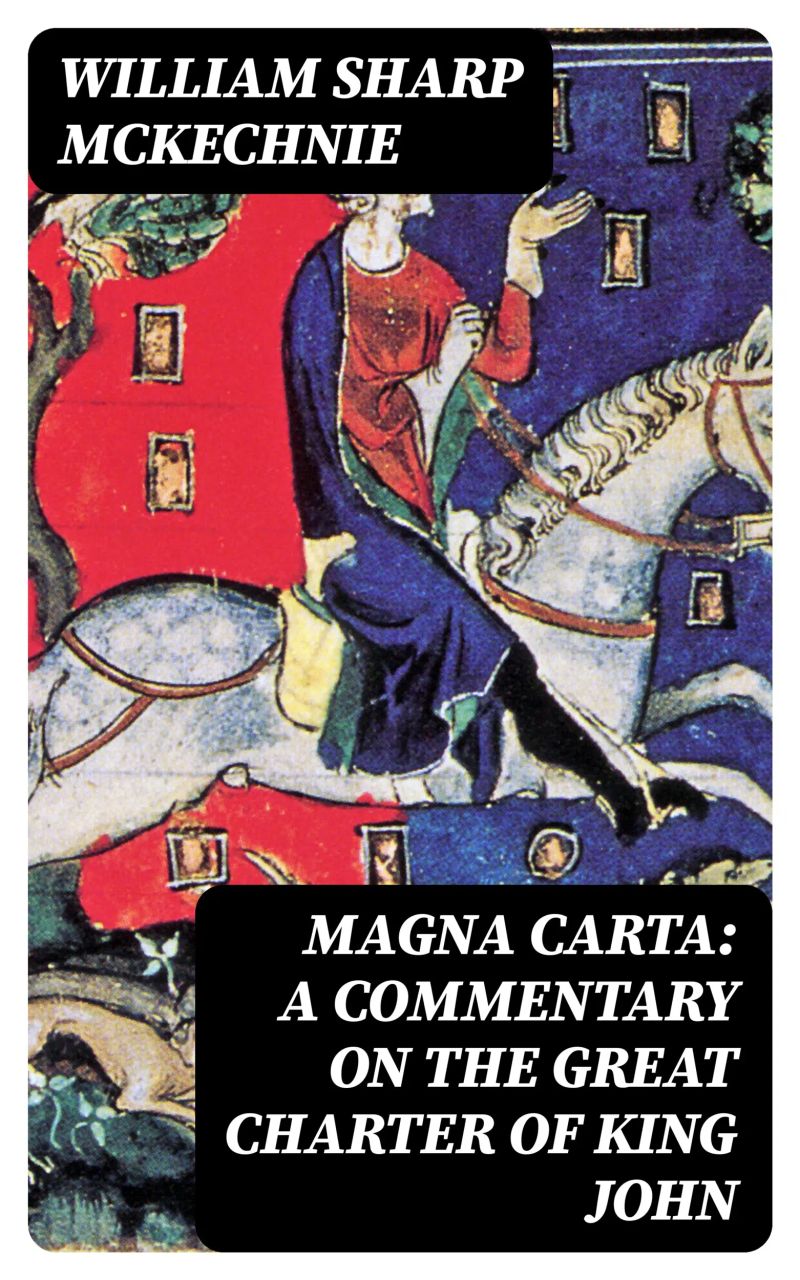
Magna Carta: A Commentary on the Great Charter of King John
With an Historical IntroductionBy William Sharp McKechnie


Length22h 46m
About this audiobook
William Sharp McKechnie's "Magna Carta: A Commentary on the Great Charter of King John" serves as a thorough exploration of one of history's most significant documents. McKechnie's scholarly commentary dissects the legal, political, and historical ramifications of the Magna Carta, revealing its role in shaping constitutional law. Employing a meticulous blend of historical context and legal analysis, McKechnie elucidates the Charter's provisions, emphasizing its enduring impact on the rights of individuals and the limitations imposed on monarchical power, which laid foundational principles for modern democratic governance. William Sharp McKechnie, a prominent Scottish legal scholar and historian, possessed a profound interest in constitutional law and its evolution. His rigorous academic background and commitment to understanding the roots of legal systems led him to investigate the Magna Carta in depth. McKechnie's scholarship not only reflects his expertise but also his passion for uncovering the historical narratives that inform contemporary legal thought, allowing readers to grasp the significance of the Magna Carta in a broader socio-political landscape. This book is highly recommended for scholars, students, and anyone interested in the foundations of modern democracy and legal frameworks. McKechnie's insightful analysis invites readers to appreciate the complexities of the Magna Carta, making it an indispensable resource for understanding its relevance and legacy in today's world.
Audiobook details
Rating★★★★ 4.2 (43)
Includes Goodreads, LibraryThing, Amazon
GenreHistory
Length22 hrs 46 mins
Narrated byListen with 1,000+ voices
FormateBook with Audio
Publish dateJun 13, 2022
LanguageEnglish
Table of contents
1PREFACE
2HISTORICAL INTRODUCTION.
3PART I. EVENTS LEADING TO MAGNA CARTA.
4I. William I. to Henry II.—Main Problem: the Monarchy.
5II. William I. to Henry II.—Problem of Local Government.
Show all chaptersShow less
6III. William I. to Henry II.—Problem of Church and State.
7IV. Richard I. and John.
8V. The Years of Crisis, 1213–15.
9VI. Runnymede, and after.
10PART II. FEUDAL GRIEVANCES AND MAGNA CARTA.
11I. The Immediate Causes of the Crisis.
12II. The Crown and Feudal Obligations.
13III. Royal Justice and Feudal Justice.
14PART III. MAGNA CARTA: ITS FORM AND CONTENTS.
15I. Its Prototypes: Earlier Charters.
16II. Magna Carta: its Form and Juridical Nature.
17III. Magna Carta: its Contents and Characteristics.
18IV. Magna Carta: an Estimate of its Value.
19VI. Magna Carta: Value of Traditional Interpretations.
20VII. Magna Carta. Its traditional relation to Trial by Jury.
21PART IV. HISTORICAL SEQUEL TO MAGNA CARTA.
22I. Re-issues and Confirmations of the Great Charter.
23II. Magna Carta and the Reforms of Edward I.
24PART V.
25I. Manuscripts of Magna Carta and Relative Documents.
26II. Previous Editions and Commentaries.
27TEXT, TRANSLATION, AND COMMENTARY.
28MAGNA CARTA.
29PREAMBLE.[322]
30CHAPTER ONE.
31CHAPTER TWO.
32CHAPTER THREE.
33CHAPTER FOUR.
34CHAPTER FIVE.
35CHAPTER SIX.
36CHAPTER SEVEN.
37CHAPTER EIGHT.
38CHAPTER NINE.
39CHAPTER TEN.
40CHAPTER ELEVEN.
41CHAPTER TWELVE.
42CHAPTER THIRTEEN.
43CHAPTER FOURTEEN.
44CHAPTER FIFTEEN.
45CHAPTER SIXTEEN.
46CHAPTER SEVENTEEN.
47CHAPTER EIGHTEEN.
48CHAPTER NINETEEN.
49CHAPTER TWENTY.
50CHAPTER TWENTY-ONE.
More from William Sharp McKechnie


A Brief History of IntelligenceMax S. Bennett12h 18m4.6 (6.6K)$29 · $0.00

The Happiest Man on EarthEddie Jaku3h 48m4.6 (178K)$7 · $0.00

MotherlandJulia Ioffe17h 52m4.7 (2.5K)$40 · $0.00

Where Cowards Go to DieBenjamin Sledge8h 42m4.7 (351)$20 · $0.00

RevolutionariesSanjeev Sanyal11h 23m4.6 (2.6K)$29 · $0.00

We Crossed a Bridge and It TrembledWendy Pearlman6h4.6 (5.2K)$24 · $0.00

Unbroken Bonds of BattleJohnny Joey Jones8h 31m4.6 (2.6K)$8 · $0.00

The Daughter of AuschwitzTova Friedman, Malcolm Brabant7h 54m4.6 (16.7K)$26 · $0.00

Lily's PromiseLily Ebert, Dov Forman8h 54m4.6 (16.1K)$29 · $0.00

On Democracies and Death CultsDouglas Murray10h 38m4.6 (6.5K)$29 · $0.00

Across the RiverKent Babb11h 40m4.6 (927)$29 · $0.00

Balcony Over Jerusalem: A Middle East Memoir - Israel, Palestine and BeyondJohn Lyons12h 37m4.6 (1.4K)$33 · $0.00

BeyondStephen Walker15h 39m4.6 (3.2K)$33 · $0.00
Kings and PawnsHoward Bryant10h 9m4.6 (678)$29 · $0.00

No EscapeNury Turkel9h 30m4.6 (809)$28 · $0.00

Jubal Stone: U.S. Marshal: Blood Trail To Hell: A Western Adventure NovelCasey Nash3h 42m4.6 (3.2K)$18 · $0.00

Fall and RiseMitchell Zuckoff17h 23m4.6 (9.8K)$40 · $0.00

The SurvivorJosef Lewkowicz, Michael Calvin9h 22m4.6 (2.5K)$29 · $0.00

Always FaithfulThomas Schueman, Zainullah Zaki12h 12m4.6 (977)$29 · $0.00

The State of Society in France Before the Revolution of 1789 (Annotated)Alexis de Tocqueville17h 25m4.6 (1.2K)$2 · $0.00
You may also like

The Wealth of NationsAdam Smith41h 55m4.1 (40.9K)$3.50 · $0.00
The Constitution of the United States of AmericaVarious70h 42m4.5 (46.3K)$1 · $0.00
The Proletarian Revolution and the Renegade KautskyVladimir Lenin4h 34m4.3 (1K)$1.99 · $0.00
The State and RevolutionVladimir lenin4h 10m4.3 (19.8K)$4 · $0.00
Marx in 90 MinutesPaul Strathern1h 24m3.5 (1.6K)$7

The French Revolution and NapoleonJean-Jacques Rousseau, Alexis de Tocqueville, Montesquieu, Charles Downer Hazen62h 54m4.1 (574)$2 · $0.00

Opium Inc.Thomas Manuel9h 27m4.2 (263)$29 · $0.00
The Autobiography of Thomas JeffersonThomas Jefferson8h 32m4.0 (2.8K)$1.99 · $0.00

The FormulaJoshua Robinson, Jonathan Clegg10h 41m4.4 (6.9K)$29 · $0.00

The Age of ReasonThomas Paine6h 53m4.1 (38.4K)$1.20 · $0.00
The American Heritage History of the Civil WarBruce Catton8h4.4 (1.7K)$20
Manifesto of the Communist PartyKarl Marx, Friedrich Engels3h 10m3.9 (248.9K)$1 · $0.00

Two Tracts on Civil Liberty, the War with America, and the Debts and Finances of the KingdomRichard Price9h 22m$1 · $0.00
The History of Rome: Rise and Fall of the EmpireJohn Bagnell Bury72h 52m4.0 (88)$2 · $0.00

The PlaybookJoshua Robinson, Jonathan Clegg8h 50m$29 · $0.00
Popular EconomicsTamny, John8h 14m3.9 (401)Free
History of the ReformationThomas M. Lindsay38h 40m4.2 (121)$1.99 · $0.00

Report on Manufactures (Summarized Edition)Alexander Hamilton2h 13m$2

Teaching Them All ThingsJohn Warwick Montgomery37m$3 · $0.00

England's Alarm! On the prevailing doctrine of libels as laid by the Earl of MansfieldWilliam Jones, Manasseh Dawes1h 2m$2 · $0.00