
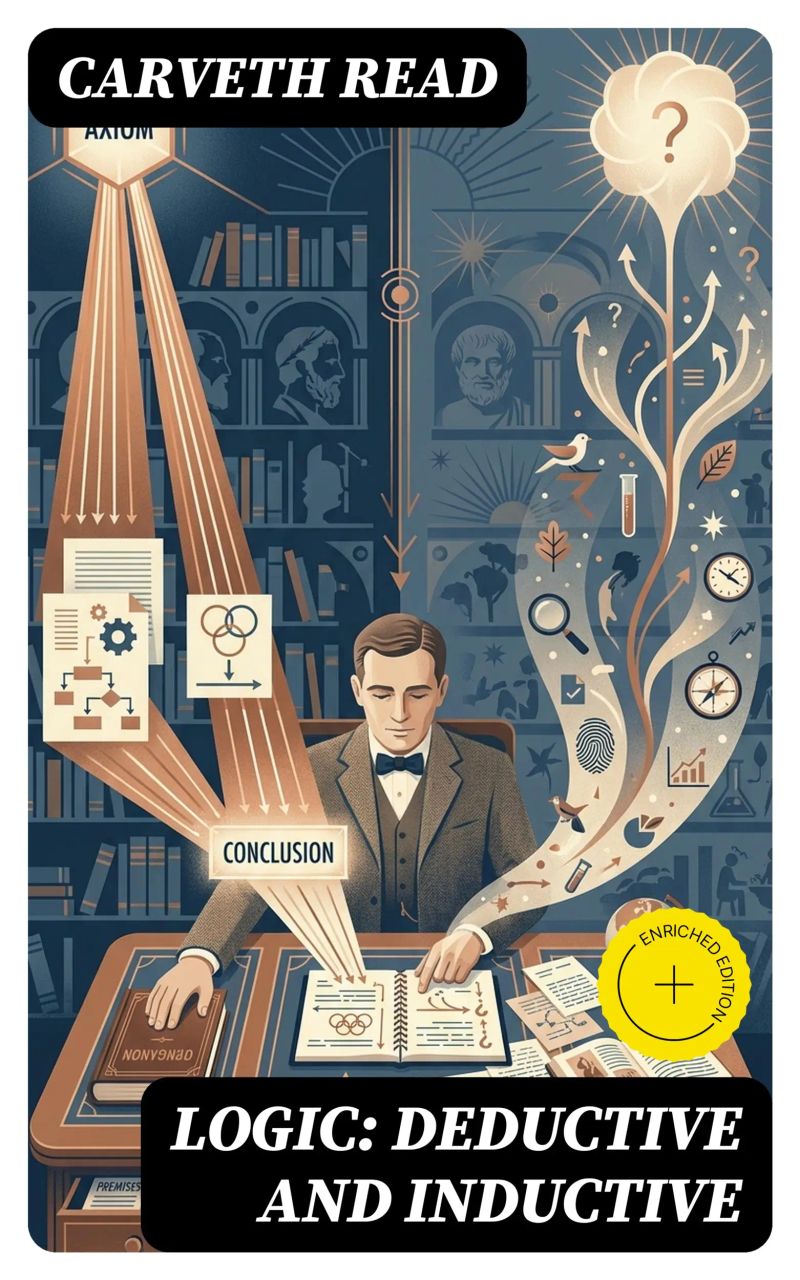
Logic: Deductive and Inductive (Annotated)
Enriched Edition. A Practical Guide to Deductive and Inductive Reasoning, Critical Thinking, and the Foundations of LogicBy Carveth Read


Length11h 44m
About this audiobook
Carveth Read's Logic: Deductive and Inductive offers a systematic account of reasoning that connects the formal precision of deduction with the empirical procedures by which knowledge is extended. Its treatment moves from concepts, judgments, propositions, and syllogistic inference toward induction, analogy, hypothesis, causation, and the assessment of evidence. Read presents logic not merely as an abstract calculus but as an instrument of inquiry, attentive to the ways arguments operate in science and everyday intellectual life. Written in a lucid, methodical, textbook style, the work belongs to the late Victorian tradition of British logic while engaging the growing pressure of scientific naturalism upon inherited Aristotelian and scholastic categories. Its larger significance lies in showing deduction and induction as complementary activities within a unified discipline of disciplined thought. Read (1848–1931) was an English philosopher whose interests ranged across logic, psychology, anthropology, and the philosophy of science. His academic career, including teaching at University College London, placed him within a period when evolutionary theory, experimental psychology, and the expansion of the sciences were reshaping philosophical method. These intellectual circumstances help explain the book's practical emphasis: logic is presented as a guide to discovering, testing, and organizing truth rather than as a purely verbal technique. Read's engagement with both classical traditions and modern scientific reasoning gives the volume its distinctive breadth. This book is recommended to students of logic, philosophy, and intellectual history, as well as to readers seeking a historically situated introduction to deductive and inductive reasoning. It remains valuable for its clarity, comprehensive scope, and thoughtful account of how formal argument supports genuine inquiry.
This enriched edition has been carefully crafted to add value to your reading experience.
- A succinct Introduction situates the work's timeless appeal and themes.
- The Synopsis outlines the central plot, highlighting key developments without spoiling critical twists.
- A detailed Historical Context immerses you in the era's events and influences that shaped the writing.
- A thorough Analysis dissects symbols, motifs, and character arcs to unearth underlying meanings.
- Reflection questions prompt you to engage personally with the work's messages, connecting them to modern life.
- Hand‐picked Memorable Quotes shine a spotlight on moments of literary brilliance.
- Interactive footnotes clarify unusual references, historical allusions, and archaic phrases for an effortless, more informed read.
Audiobook details
Rating★★★★ 3.7 (110)
Includes Goodreads
GenrePhilosophy
Length11 hrs 44 mins
Narrated byListen with 1,000+ voices
FormateBook with Audio
Publish dateSep 4, 2022
LanguageEnglish
Table of contents
1Logic: Deductive and Inductive (Annotated)
2Introduction
3Synopsis
4Historical Context
5PREFACE
Show all chaptersShow less
6CHAPTER I
7INTRODUCTORY
8CHAPTER II
9GENERAL ANALYSIS OF PROPOSITIONS
10CHAPTER III
11OF TERMS AND THEIR DENOTATION
12CHAPTER IV
13THE CONNOTATION OF TERMS
14CHAPTER V
15THE CLASSIFICATION OF PROPOSITIONS
16CHAPTER VI
17CONDITIONS OF IMMEDIATE INFERENCE
18CHAPTER VII
19IMMEDIATE INFERENCES
20CHAPTER VIII
21ORDER OF TERMS, EULER'S DIAGRAMS, LOGICAL EQUATIONS, EXISTENTIAL IMPORT OF PROPOSITIONS
22CHAPTER IX
23FORMAL CONDITIONS OF MEDIATE INFERENCE
24CHAPTER X
25CATEGORICAL SYLLOGISMS
26CHAPTER XI
27ABBREVIATED AND COMPOUND ARGUMENTS
28CHAPTER XII
29CONDITIONAL SYLLOGISMS
30CHAPTER XIII
31TRANSITION TO INDUCTION
32CHAPTER XIV
33CAUSATION
34CHAPTER XV
35INDUCTIVE METHOD
36A. Qualitative Determination
37B. Quantitative Determination
38CHAPTER XVI
39THE CANONS OF DIRECT INDUCTION
40(I) The Canon of Agreement.
41§ 2. The Canon of the Joint Method of Agreement in Presence and in Absence.
42§ 3. The Canon of Difference .
43§ 4. The Canon Of Concomitant Variations.
44§ 5. The Canon Of Residues.
45CHAPTER XVII
46COMBINATION OF INDUCTION WITH DEDUCTION
47CHAPTER XVIII
48HYPOTHESES
49CHAPTER XIX
50LAWS CLASSIFIED; EXPLANATION; CO-EXISTENCE; ANALOGY
More from Carveth Read

Sceptical Essays (Annotated)Bertrand Russell9h 16m4.6 (1K)$2 · $0.00

WitnessAriel Burger8h 1m4.6 (1.3K)$20 · $0.00
The Magic PresenceGodfré Ray King10h 21m4.6 (307)$1.20 · $0.00

The Art of LivingThich Nhat Hanh5h 1m4.5 (14.2K)$24 · $0.00
Moral Letters to LuciliusLucius Annaeus Seneca24h 26m4.5 (71.7K)$1.99 · $0.00

Lessons in TruthH. Emilie Cady3h 50m4.5 (2.4K)$20 · $0.00
The Discourses of EpictetusP. E. MATHESOM12h 47m4.4 (17.7K)$1.20 · $0.00

IlluminationsWalter Benjamin10h 12m4.4 (16.2K)$20 · $0.00
That Bird Has My WingsJarvis Jay Masters9h 49m4.4 (13.7K)$29 · $0.00

Tâo Teh KingLaozi2h 34m4.4 (230.9K)$2 · $0.00
SymposiumPlato3h 26m4.4 (97.9K)$1.20 · $0.00

Buddhist Boot CampTimber Hawkeye2h 39m4.4 (8.4K)$18 · $0.00
Enchiridion & The Discourses of Epictetus (Annotated)Arrian Epictetus18h 9m4.4 (3.5K)$2 · $0.00
The Meditations of the Emperor Marcus Aurelius AntoninusEmperor of Rome Marcus Aurelius5h 41m4.4 (1.8M)$1 · $0.00
Crime and PunishmentFyodor Dostoevsky23h 11m4.4 (1.3M)$12 · $0.00

MeditationsMarcus Aurelius5h 52m4.4 (433.7K)$1 · $0.00

Everyday DharmaSuneel Gupta5h 2m4.5 (761)$20 · $0.00

The Joyful Wisdom ("La Gaya Scienza")Friedrich Wilhelm Nietzsche11h 37m4.4 (26.6K)$1 · $0.00
The Art of LivingEpictetus, Sharon Lebell3h 16m4.4 (50.1K)$18 · $0.00
MeditationsEmperor Of Rome Marcus Aurelius7h 23m4.3 (477.5K)$1.20 · $0.00