
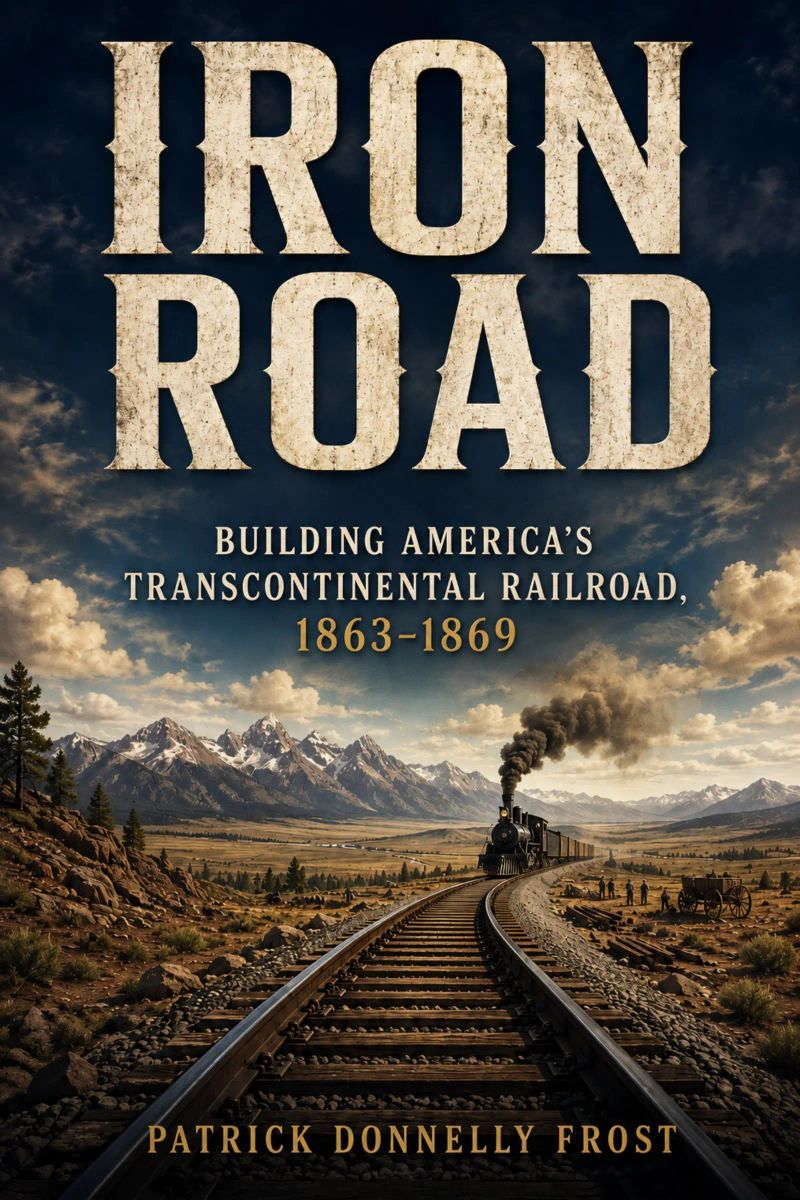
Iron Road
Building America's Transcontinental Railroad, 1863–1869By Patrick Donnelly Frost


Length6h 31m
About this audiobook
Transcontinental railroad history, Union Pacific Central Pacific 1863-1869, Chinese and Irish workers, Credit Mobilier scandal, Promontory Summit — the complete narrative history of building America's iron road.
At 12:47 p.m. on May 10, 1869, the telegraph operator at Promontory Summit tapped out a single word: Done. Stanford swung the silver maul at the golden spike and missed. Durant swung and also missed. A railroad worker drove the actual spikes home. The 10,000 Chinese workers who had hung in wicker baskets over Sierra Nevada cliffs to drill blasting holes, the Irish immigrants who had graded 425 miles of Wyoming desert in a single year — they had already gone. The champagne was for the men who had financed it.
Iron Road is the complete transcontinental railroad history: from Asa Whitney's 1845 lobbying campaign through the Pacific Railroad Acts Lincoln signed in 1862, the Sierra Nevada tunnels, and the Crédit Mobilier scandal in which Thomas Durant and Oakes Ames extracted $44 million in fraudulent overcharges — distributing stock to congressmen "where it will do the most good to us."
Inside this American railroad history:
The Chinese workers — 10,000 men from Guangdong Province, paid $26-$35/month and covering their own food, drove the Summit Tunnel through 1,659 feet of Sierra Nevada granite, and were rewarded with the Chinese Exclusion Act of 1882 (Chapter 6)
The Crédit Mobilier scandal — Durant's company charged the Union Pacific $94 million for $50 million of actual work, distributed stock to the Speaker of the House, and saddled the railroad with debt that drove it to bankruptcy in 1893 (Chapter 13)
The Big Four — Stanford, Crocker, Hopkins, and Huntington extracted an estimated $65–$70 million in construction profits; Stanford's $30 million estate endowed a university in memory of his fifteen-year-old son (Chapter 14)
The war for the plains — Red Cloud's Fetterman Fight killing 80 soldiers in 1866; Sherman's bison extermination policy; 30 million animals reduced to fewer than 1,000 by 1890 (Chapter 12)
The economic transformation — freight from Omaha to Sacramento: $270/ton by wagon in 1866, $105/ton by rail in 1870; Nebraska's population up 268 percent in the 1870s (Chapter 20)
The transcontinental railroad did not merely connect two coasts. It settled the Great Plains, destroyed the bison herds, dispossessed the Plains nations, generated the century's greatest corporate fraud, and created the national market that made Carnegie's steel and Rockefeller's oil possible. This is the complete railroad narrative history — the golden spike, and everything it cost.
For readers of Stephen Ambrose's NOTHING LIKE IT IN THE WORLD and David Grann's KILLERS OF THE FLOWER MOON.
Audiobook details
GenreHistory
Length6 hrs 31 mins
Narrated byListen with 1,000+ voices
FormateBook with Audio
Publish dateJun 2, 2026
LanguageEnglish
Table of contents
1Introduction
2Prologue: The Dream of a Continent Crossed
3PART ONE: THE VISION (1830–1862)
4Chapter 1: The Dream — Asa Whitney and the Transcontinental Vision
5Chapter 2: The Surveys — Four Routes and the Politics of the Railroad
Show all chaptersShow less
6Chapter 3: The Pacific Railroad Acts — Lincoln and the Congressional Breakthrough
7Chapter 4: The Companies — Union Pacific and Central Pacific
8PART TWO: THE WORKERS (1863–1869)
9Chapter 5: The Irish — Immigrant Labor on the Union Pacific
10Chapter 6: The Chinese — Ten Thousand Workers on the Central Pacific
11Chapter 7: The Engineers — Judah, Dodge, and the Men Who Found the Route
12Chapter 8: The Bosses — Durant, Stanford, and the Men Who Profited
13PART THREE: THE BUILDING (1864–1869)
14Chapter 9: Laying Track — The Technology and Labor of Construction
15Chapter 10: Through the Sierra Nevada — The Central Pacific's Mountain Challenge
16Chapter 11: Across the Great Plains — The Union Pacific's Race Through the West
17Chapter 12: The War for the Plains — Railroad Expansion and Native Resistance
18PART FOUR: THE MONEY AND THE CORRUPTION (1864–1873)
19Chapter 13: Crédit Mobilier — The Great American Railroad Scandal
20Chapter 14: The Big Four — Stanford, Crocker, Hopkins, and Huntington
21Chapter 15: Government and Capital — Subsidies, Bonds, and Congressional Complicity
22Chapter 16: The Environmental Cost — What the Railroad Did to the Land
23PART FIVE: PROMONTORY AND AFTER (1869–1893)
24Chapter 17: The Last Miles — The Race to Promontory Summit
25Chapter 18: The Golden Spike — May 10, 1869
26Chapter 19: The Network Expands — Four More Transcontinentals
27Chapter 20: The Economic Transformation — What the Railroad Made Possible
28PART SIX: LEGACIES
29Chapter 21: The Railroad and the West — Settlement, Cities, and Change
30Chapter 22: The Railroad and Labor — The Great Strike of 1877
31Chapter 23: The Railroad and Native America — Displacement and Destruction
32Chapter 24: The Iron Road's Long Shadow — What the Transcontinental Meant
33Epilogue: The World the Railroad Made
34Acknowledgments
35Selected Bibliography
36About the Author
More from Patrick Donnelly Frost

A Brief History of IntelligenceMax S. Bennett12h 18m4.6 (6.6K)$29 · $0.00

The Gulag Archipelago Volume 3Aleksandr I. Solzhenitsyn21h 56m4.7 (8.9K)$46 · $0.00
Pearl of Great PriceJoseph Smith3h 8m4.7 (7.2K)$1.20 · $0.00

The Happiest Man on EarthEddie Jaku3h 48m4.6 (178K)$7 · $0.00

MotherlandJulia Ioffe17h 52m4.7 (2.5K)$40 · $0.00

Where Cowards Go to DieBenjamin Sledge8h 42m4.7 (351)$20 · $0.00

RevolutionariesSanjeev Sanyal11h 23m4.6 (2.6K)$29 · $0.00

We Crossed a Bridge and It TrembledWendy Pearlman6h4.6 (5.2K)$24 · $0.00

Unbroken Bonds of BattleJohnny Joey Jones8h 31m4.6 (2.6K)$8 · $0.00

The Daughter of AuschwitzTova Friedman, Malcolm Brabant7h 54m4.6 (16.7K)$26 · $0.00
Lily's PromiseLily Ebert, Dov Forman8h 54m4.6 (16.1K)$29 · $0.00
On Democracies and Death CultsDouglas Murray10h 38m4.6 (6.5K)$29 · $0.00

Across the RiverKent Babb11h 40m4.6 (927)$29 · $0.00

Balcony Over Jerusalem: A Middle East Memoir - Israel, Palestine and BeyondJohn Lyons12h 37m4.6 (1.4K)$33 · $0.00

BeyondStephen Walker15h 39m4.6 (3.2K)$33 · $0.00
Kings and PawnsHoward Bryant10h 9m4.6 (678)$29 · $0.00

No EscapeNury Turkel9h 30m4.6 (809)$28 · $0.00
Jubal Stone: U.S. Marshal: Blood Trail To Hell: A Western Adventure NovelCasey Nash3h 42m4.6 (3.2K)$18 · $0.00

Fall and RiseMitchell Zuckoff17h 23m4.6 (9.8K)$40 · $0.00
The SurvivorJosef Lewkowicz, Michael Calvin9h 22m4.6 (2.5K)$29 · $0.00
You may also like
Australia: A History - How an ancient land became a great democracyTony Abbott14h 26m4.4 (289)$33 · $0.00
Men to Match My MountainsIrving Stone22h 45m4.3 (2.5K)$30
An Apache Campaign In The Sierra MadreJohn Gregory Bourke2h 20m4.1 (330)$1 · $0.00

A History of the City of Brooklyn and Kings CountyStephen M. Ostrander13h 22m$2 · $0.00
An Economic History of AustraliaEdward Shann17h 25m$2 · $0.00
History of the Philippine Islands (Vol. 1&2)Joaquín Martínez de Zúñiga11h 47m$1 · $0.00
The History of Ballarat, from the First Pastoral Settlement to the Present TimeWilliam Bramwell Withers16h 18m$2 · $0.00

The history of Bannock County, IdahoA. C. Saunders3h 4m$1 · $0.00
The Settler and the SavageR. M. Ballantyne10h 17m$2.30
A History of American Christianity (Annotated)Leonard Woolsey Bacon14h 59m3.7 (54)$2 · $0.00
A History of KansasAnna E. Arnold6h 38m$2 · $0.00
The History of Ballarat, from the First Pastoral Settlement to the Present TimeWilliam Bramwell Withers16h 16m$2 · $0.00
The Settlement of Illinois, 1778-1830Arthur Clinton Boggess8h 48m$2 · $0.00
The Medicine Line: Native Nations and the U.S.-Canada BorderDaniel R. Whitcomb4h 52m$6
A Complete Account of the Settlement at Port JacksonWatkin Tench5h 46m4.4 (58)$1 · $0.00
The English Colony in New South Wales (Vol. 1&2) (Annotated)David Collins39h 37m3.9 (44)$1.99 · $0.00
Old Fort GarlandRosamund Slack, James T. Forrest39m$2 · $0.00
History of Tasmania (Annotated)John West34h 14m4.2 (38)$2 · $0.00
Chicago and the Old Northwest, 1673-1835Milo Milton Quaife19h 24m$1 · $0.00
THE CALL OF THE WILD WEST - Ultimate Western Collection: 175+ Novels & Short Stories in One VolumeZane Grey, Max Brand, Owen Wister, James Fenimore Cooper, B. M. Bower, J. Allan Dunn, William MacLeod Raine, Robert E. Howard, Bret Harte, Mark Twain, Jack London, O. Henry, James Oliver Curwood, Emerson Hough, Clarence E. Mulford, Willa Cather, Andy Adams, Charles Alden Seltzer, Jackson Gregory, Washington Irving, R.M. Ballantyne, Frank H. Spearman, Charles Siringo, William Patterson White, James B. Hendryx, Stephen Crane, Grace Livingston Hill, Robert W. Chambers, Frederic Remington, Frederic Homer Balch, Will Lillibridge, Rex Beach, Dane Coolidge, Francis William Sullivan, Marah Ellis Ryan, Forrestine C. Hooker, Charles King, Ann S. Stephens, Isabel E. Ostrander, Frederic Logan Paxson1014h 53m$2 · $0.00