
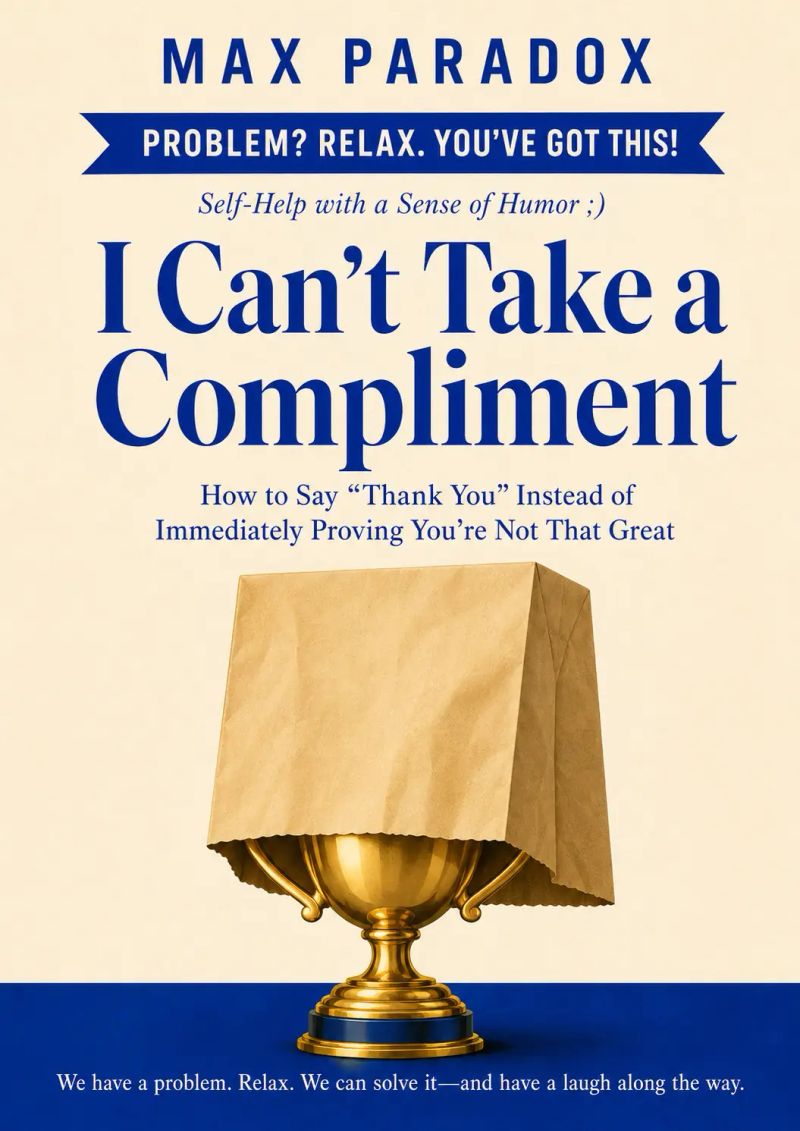
I Can't Take a Compliment - How to Say “Thank You” Instead of Immediately Proving You're Not That Great
By Max Paradox


Length6h 53m
About this audiobook
Someone says, “You did a great job.”
You say, “Thanks, but honestly…”
And there it is.
Within seconds, you have explained why the achievement was mostly luck, why someone else deserves the credit, what you did wrong, and why the person complimenting you may need their standards professionally examined.
If accepting praise feels more uncomfortable than criticism, I Can't Take a Compliment is a practical, funny guide to understanding why-and changing what happens next.
Max Paradox takes apart the strange little habits that make compliments so difficult: minimizing achievements, arguing with praise, hiding behind self-deprecating humor, moving the goalposts, giving all the credit away, worrying that “thank you” sounds arrogant, and treating every kind sentence like an invoice that must be repaid.
This is not a book about becoming obsessed with yourself. You will not be instructed to stare into a mirror and announce that you are an unstoppable force of excellence before breakfast.
Instead, you will learn how to receive praise like a normal human being.
Inside, you’ll discover how to:
say thank you without immediately adding a disclaimer;
tell the difference between humility and self-erasure;
accept praise even when you do not fully believe it;
share credit without deleting your own contribution;
handle compliments about your appearance, work, abilities, and character;
stop treating praise as pressure or obligation;
recognize backhanded compliments and manipulation;
use positive feedback as useful evidence rather than emotional life support;
name your strengths without sounding like your own publicist;
recover when the old habit returns.
The book also shows why compliments sometimes feel threatening even when you want them. Praise can clash with an old self-image, trigger perfectionism, create fear of future expectations, or make you feel unexpectedly visible. Instead of trying to force instant confidence, you’ll learn small responses that work even when your brain is still unconvinced.
The central method is deliberately simple: pause, receive, and stop correcting.
Because a compliment does not require a courtroom.
You can be competent and still make mistakes. Attractive and still dislike some photos. Confident and still feel nervous. Proud of something and still know how to improve it.
The goal is not blind positivity.
It is accuracy.
And occasionally allowing someone to say something nice without making them defend it for the next seven minutes.
This publication was prepared with the assistance of tools that support the creative process, including artificial intelligence-based solutions. The final concept, structure, and editing belong to the author.
Audiobook details
GenreSelf-Help
Length6 hrs 53 mins
Narrated byListen with 1,000+ voices
FormateBook with Audio
Publish dateAug 31, 2026
LanguageEnglish
Table of contents
1INTRO
2Chapter 1 - Why “Thank You” Feels Suspicious
3Chapter 2 - You Are Not Required to Disprove the Witness
4Chapter 3 - Your Inner Compliment Auditor
5Chapter 4 - The Myth of the Arrogant Thank-You
Show all chaptersShow less
6Chapter 5 - Stop Throwing the Compliment Back
7Chapter 6 - A Compliment Is Not an Invoice
8Chapter 7 - The Moving Goalpost Machine
9Chapter 8 - Let People See the Good Part
10Chapter 9 - The Compliment Landing Procedure
11Chapter 10 - Learn to Keep the Good Evidence
12Chapter 11 - Stop Negotiating Against Yourself
13Chapter 12 - Use the Compliment Instead of Escaping It
14Chapter 13 - Compliments About Your Appearance Are Not Court Testimony
15Chapter 14 - Say What You Actually Did
16Chapter 15 - What to Do When the Compliment Still Feels Wrong
17Chapter 16 - What to Do When You Mess Up Again
18Chapter 17 - When Other People Make It Weird
19Chapter 18 - Catch the Habit Before It Rebuilds Itself
20Chapter 19 - Build a Self-Image That Can Survive a Compliment
21Chapter 20 - Say Thank You and Keep Walking

How to Stop Being Afraid of the FutureMax Paradox6h 15m$7.70 · $0.00
I Hate My Job - How to Take Back Control Before You Throw Your ID Badge into the Coffee MachineMax Paradox6h 49m$7.70 · $0.00
I Can't Say No - How to Decline Without Explaining Yourself for the Next Three DaysMax Paradox6h 56m$7.70 · $0.00

The World Ends at the Border - Patriotism, Certainty, and the Comfort of Never Being TestedMax Paradox6h 10m$7.70 · $0.00

I Have a Day Job, but the Internet Says I Need Three More Businesses - How to Stop Feeling Like a Failure Without a Side HustleMax Paradox8h$7.70 · $0.00

I'm Afraid to Check My Bank Account - How to Stop Treating Online Banking Like a Psychological Horror MovieMax Paradox6h 30m$7.70 · $0.00

We’ll Fix It Later - The Absurd Truth About Building and Finishing a HouseMax Paradox3h 17m$7.70 · $0.00

The Absurdity of American Healthcare - How to Survive Illness, Deductibles, and the Quiet Art of Financial EnduranceMax Paradox4h 11m$7.70 · $0.00

How to Stop Sabotaging Your Own LifeMax Paradox7h 44m$7.70 · $0.00
I Can't Let People Go - How to Stop Resuscitating Relationships That Left the Building Long AgoMax Paradox7h 20m$7.70 · $0.00
How to Forgive Yourself for Mistakes and Move OnMax Paradox6h 28m$7.70 · $0.00
How to Stop Caring What Other People ThinkMax Paradox7h 8m$7.70 · $0.00
How to Control Your Anger Before It Destroys Your RelationshipsMax Paradox7h 22m$7.70 · $0.00

I'm Afraid of Change - How to Move Forward When the Old Disaster Feels Safer Than the New PossibilityMax Paradox6h 41m$7.70 · $0.00

Sprzątanie nigdy się nie kończy - Jak utrzymać dom w stanie „da się żyć” bez zostawania własną pomocą domowąMax Paradox5h 25m$7.70 · $0.00

The Absurdities of Epstein’s Island - How Everyone Knew, Nothing Changed, and Normal Life Won AnywayMax Paradox4h 24m$7.70 · $0.00

The Absurdities of Being a CEO - A Calm, Exhausting, Slightly Uncomfortable Study of Power, Responsibility, and Pretending Everything Is FineMax Paradox3h 22m$7.70 · $0.00

Jak chronić dziecko przed hejtem i cyberprzemocą - Jak rozpoznawać zagrożenia, reagować bez paniki i wspierać dziecko, zanim internetowy problem przejmie jego życieMax Paradox6h 5m$7.70 · $0.00
How to Get Through a BreakupMax Paradox6h 17m$7.70 · $0.00
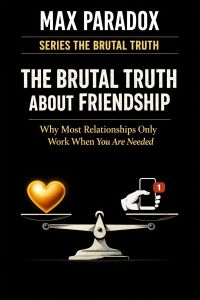
The Brutal Truth About Friendship - Why Most Relationships Only Work When You Are NeededMax Paradox5h 31m$7.70 · $0.00
Learning to PrayJames Martin13h 24m4.5 (3.4K)$33 · $0.00

Swayam Ki AwaazPrem Rawat8h 34m4.7 (1.1K)$26 · $0.00

Forever BoyKate Swenson9h 27m4.7 (5K)$29 · $0.00

You Are Worth ItKyle Carpenter, Don Yaeger8h 53m4.7 (4.8K)$29 · $0.00

The Happiest Man on EarthEddie Jaku3h 48m4.6 (178K)$7 · $0.00

Finding MeViola Davis9h 15m4.6 (256.4K)$29 · $0.00

Spiritual AnatomyDaaji Kamlesh D. Patel9h 47m4.7 (319)$29 · $0.00

The Dangerous Truth about Today’s MarijuanaLaura Stack CSP, MBA9h 57m4.7 (385)$20 · $0.00

The Gospel according to Spiritualism (Translated)Allan Kardec14h 39m4.6 (3.9K)$5.70 · $0.00

Birdie & HarlowTaylor Wolfe7h 50m4.6 (6.5K)$26 · $0.00

CrossroadsKaleb Dahlgren7h 56m4.6 (4.9K)$26 · $0.00

Life on the BridgeKaelynn Partlow5h 40m4.6 (1.1K)$24 · $0.00

Keep Your Love OnDanny Silk9h 4m4.6 (8.1K)$10 · $0.00

The Tao of Joy Every DayDerek Lin10h 24m4.6 (762)$20 · $0.00

UndividedVicky Beeching9h 2m4.6 (1.3K)$29 · $0.00

HE CAN WHO THINKS HE CAN & OTHER BOOKS ON SUCCESSOrison Swett Marden5h 54m4.6 (1.2K)$1.99 · $0.00
Level UpRob Dial7h 42m4.6 (3.3K)$26 · $0.00

Burn the HaystackJennie Young, PhD9h 30m4.6 (543)$29 · $0.00

ACRES OF DIAMONDS: Our Every-day Opportunities (Wisdom & Empowerment Series) (Annotated)Russell Conwell2h 26m4.6 (1K)$2 · $0.00

Good InsideBecky Kennedy9h 55m4.5 (59.3K)$29 · $0.00