
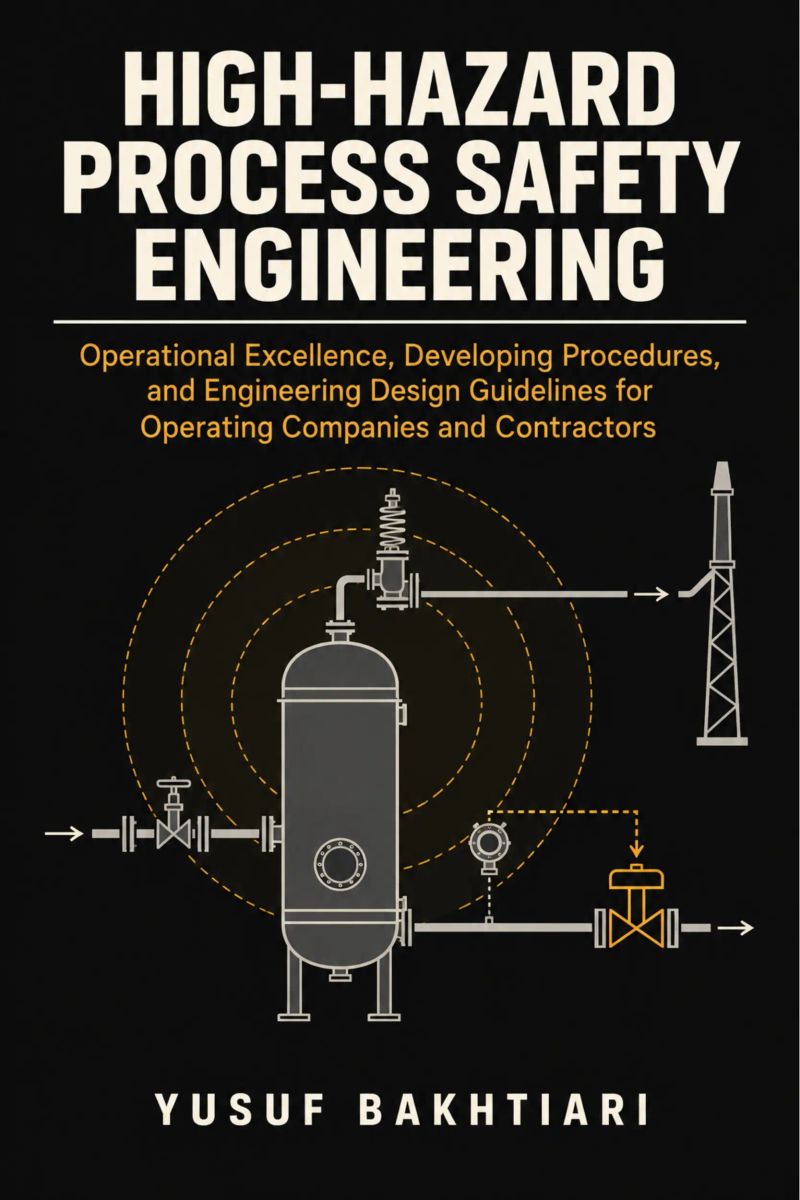
High-Hazard Process Safety Engineering
Operational Excellence, Developing Procedures, and Engineering Design Guidelines for Operating Companies and ContractorsBy Yusuf Bakhtiar


Length16h 11m
About this audiobook
High-hazard facilities rarely fail for want of a rule. They fail where the rule was written for a plant that no longer exists, or where the procedure was accurate but nobody used it as written.
This book addresses both halves of that failure. On the engineering side, it covers hazard analysis and layer of protection work, inherently safer design, layout and separation, materials and corrosion allowance, relief and effluent design, area classification, fire and gas detection, and safety instrumented function integrity. On the operating side, it covers procedure development from task analysis, conduct of operations with handover and field verification, management of change, risk-based inspection and deficiency handling, contractor oversight and permit systems, and investigation with metrics that actually lead.
Written for operating companies and contractors in high-hazard service, the book connects engineering design guidelines to the operational discipline that keeps them valid over time. It treats process safety as an integrated system, not a collection of documents. Each chapter provides practical guidance that can be applied directly to existing facilities, new projects, and contractor scopes of work.
What you will learn:
• How to build and sustain a risk-based process safety programme that fits your organisation
• Methods for process hazard analysis and layer of protection analysis that produce usable results
• How to apply inherently safer design principles and plant layout to reduce risk at the source
• Materials selection, corrosion allowance, and design for mechanical integrity
• Pressure relief and effluent handling design that accounts for real operating scenarios
• Electrical area classification, ignition control, and fire and gas detection system design
• Safety instrumented system integrity, including function testing and proof test intervals
• Procedure development from task analysis, plus conduct of operations and operational discipline
• Management of change, risk-based inspection, contractor control, permit systems, and incident investigation with leading metrics
Who it is for: Process safety engineers, operations and maintenance managers, EHS professionals, and contractors working in oil and gas, chemicals, petrochemicals, and other high-hazard industries. It is also suitable for engineers moving into process safety roles and for teams responsible for closing the gap between written procedures and actual practice.
Audiobook details
GenreTechnology
Length16 hrs 11 mins
Narrated byListen with 1,000+ voices
FormateBook with Audio
Publish dateSep 27, 2026
LanguageEnglish
Table of contents
1High-Hazard Process Safety Engineering
2Foreword
3Preface
4About This Book
5Important Safety Notice
Show all chaptersShow less
6Chapter 1: Risk-Based Process Safety Programmes
71.1 The Anatomy of a Risk-Based Programme
81.2 Leadership Accountability and Governance
91.3 Competence, Staffing and Training Systems
101.4 Process Safety Information and Its Currency
111.5 Element Interlocks and Programme Failure Modes
121.6 Programme Implementation and Maturity Staging
13Chapter 2: Process Hazard Analysis
142.1 Study Planning, Scope and Team Composition
152.2 Node Selection and Guideword Application
162.3 What-If, Checklist and Hybrid Methods
172.4 Recording Safeguards and Credible Consequences
182.5 Recommendation Tracking and Closure
192.6 Revalidation and Study Lifecycle
20Chapter 3: Risk Assessment and Layer of Protection Analysis
213.1 Initiating Event Frequency and Consequence Estimation
223.2 Independent Protection Layers and Their Rules
233.3 Tolerable Risk Criteria and Risk Gaps
243.4 Building and Reading a Layer of Protection Analysis Tally
253.5 Quantitative Methods and Their Limits
26Chapter 4: Inherently Safer Design and Plant Layout
274.1 The Four Strategies: Minimise, Substitute, Moderate, Simplify
284.2 Inventory Reduction and Hazard Segregation
294.3 Separation Distances and Siting of Occupied Buildings
304.4 Ventilation, Drainage and Layout Details
31Chapter 5: Materials, Corrosion and Design for Integrity
325.1 Material Selection for Service
335.2 Corrosion Allowance and Damage Mechanisms
345.3 Design Temperature, Pressure and Margin Philosophy
355.4 Materials Verification and Positive Material Identification
36Chapter 6: Pressure Relief and Effluent Handling
376.1 Relief Scenario Identification and Sizing Basis
386.2 Relief Device Selection and Set Pressure
396.3 Disposal Systems, Knockout Drums and Flares
406.4 Effluent Handling, Scrubbing and Environmental Limits
416.5 Inspection, Set Pressure Verification and Record Keeping
42Chapter 7: Electrical Area Classification and Ignition Control
437.1 Classified Zone Determination
447.2 Equipment Protection Concepts and Selection
457.3 Static Electricity, Bonding and Grounding
467.4 Portable Equipment, Hot Surfaces and Ignition Source Control
47Chapter 8: Fire and Gas Detection and Fire Protection
488.1 Detector Selection and Coverage
498.2 Alarm and Shutdown Philosophy
508.3 Active Suppression Systems

Hands of TimeRebecca Struthers8h 8m4.4 (1.3K)$26 · $0.00
Never Lost AgainBill Kilday10h 1m4.4 (805)$29 · $0.00

How the Internet HappenedBrian McCullough13h 28m4.3 (2.7K)$23 · $0.00

Collected Writings of Nikola TeslaNikola Tesla, Thomas Commerford Martin21h 50m4.3 (1.7K)$1 · $0.00

Just AspireAjai Chowdhry9h 13m4.4 (260)$29 · $0.00

The Little Book of AliensAdam Frank8h 20m4.3 (1.3K)$26 · $0.00

The inventions, researches and writings of Nikola Tesla (Annotated)Thomas Commerford Martin16h 59m4.3 (1.3K)$2 · $0.00

KargilV.P. Malik15h 18m4.3 (2K)$24 · $0.00

Experiments with Alternating CurrentsNikola Tesla9h 6m4.3 (874)$1 · $0.00

Fire on the HorizonTom Shroder, John Konrad8h 23m4.3 (858)$26 · $0.00

The Smell of Kerosene (Annotated)National Aeronautics and Space Administration, Donald L. Mallick, Peter W. Merlin11h 32m4.3 (523)$2 · $0.00

The Boy Who Harnessed the WindWilliam Kamkwamba, Bryan Mealer10h 5m4.2 (78.9K)$29 · $0.00

Across the Airless WildsEarl Swift10h 8m4.3 (1.3K)$29 · $0.00

Console WarsBlake J. Harris20h 41m4.2 (13.7K)$46 · $0.00

Improvised Munitions HandbookU.S. Department of Defense4h 49m4.3 (1.6K)$1.99 · $0.00

Escaping GravityLori Garver10h 54m4.2 (2.2K)$20 · $0.00

Wireless WarsJonathan Pelson8h 2m4.3 (418)$20 · $0.00

Let There Be WaterSeth M. Siegel8h 36m4.2 (2.3K)$20 · $0.00

The PerfectionistsSimon Winchester11h 46m4.2 (9.9K)$29 · $0.00

Rethinking NarcissismDr. Craig Malkin6h 7m4.2 (3.4K)$24 · $0.00
You may also like
Built to LastJim Collins6h 17m4.1 (93K)$40 · $0.00

EarlySarah DiGregorio9h 47m4.5 (1.3K)$29 · $0.00

The road to Wigan PierGeorge Orwell7h 24m4.1 (30K)$4 · $0.00

Evolution Gone WrongAlex Bezzerides9h 13m4.1 (1.6K)$29 · $0.00

Myofascial Release For Women Over 60Margaret Hale12h 7m$14.50 · $0.00

Bookbinding, and the Care of Books (Annotated)Douglas Cockerell5h 32m4.0 (19)$2 · $0.00

Introducing Allergens to Your Baby's Diet- When and HowAurora Brooks1h 7m$3.50 · $0.00

The Care of BooksJohn Willis Clark11h 28m4.1 (61)$2 · $0.00
CRITICAL CARE NURSING CERTIFICATE STUDY GUIDE 2026/2027Adrian Hartwell14h 38m$11.50 · $0.00

The Motorist's Companion: 5 Classic Automobile BooksH. Clifford Brokaw, Charles A. Starr, Charles Andrew Coey, The automotive business magazine Motor, Ford Motor Company, Frank B. Scholl40h 28m$1.99 · $0.00

Excellence in OperationsMercandetti Fabio F.6h 27m$29 · $0.00

I am learning JapaneseJM Gardner3h 57m4.3 (19)$18 · $0.00

The Pend Principle (Increase Revenue, Build Brands)Unknown Author1h 8m$18 · $0.00

The Woman and the CarDorothy Levitt1h 51m4.1 (219)$2 · $0.00

Business Plan Handbook for Start-upsArthur Lämmle39m4.8 (12)$11 · $0.00

Managing Commercial Construction ProjectsAdaeze Nwachukwu14h 51m$55

Take Control of Your FilesNoor Kessler8h$5 · $0.00
The Cost of Doing NothingInvestor Ventures3h 29m5.0 (3)$19.99

Don’t Retire BrokeRick Rodgers7h 20m3.9 (254)$20

United Nations Convention on the Rights of the ChildUnited Nations2h 21m4.3 (130)$2 · $0.00