
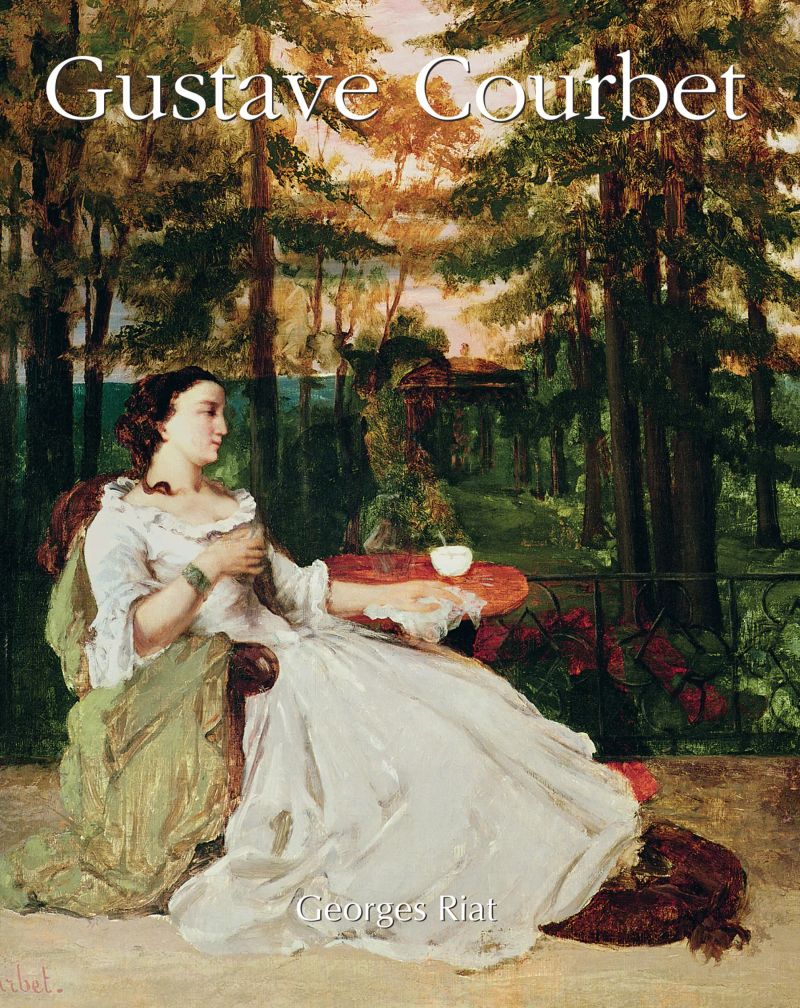
Gustave Courbet
Realism Without CompromiseBy Georges Riat


Length6h 1m
About this audiobook
Ornans, Courbet's birthplace, is near the beautiful valley of the Doubs River, and it was here as a boy, and later as a man, that he absorbed the love of landscape.
He was by nature a revolutionary, a man born to oppose existing order and to assert his independence; he had that quality of bluster and brutality which makes the revolutionary count in art as well as in politics. In both directions his spirit of revolt manifested itself. He went to Paris to study art, yet he did not attach himself to the studio of any of the prominent masters. Already in his country home he had had a little instruction in painting, and preferred to study the masterpieces of the Louvre. At first his pictures were not sufficiently distinctive to arouse any opposition, and were admitted to the Salon. Then followed the Funeral at Ornans, which the critics violently assailed: "A masquerade funeral, six metres long, in which there is more to laugh at than to weep over." Indeed, the real offence of Courbet's pictures was that they represented live flesh and blood. They depicted men and women as they really are and realistically doing the business in which they are engaged. His figures were not men and women deprived of personality and idealised into a type, posed in positions that will decorate the canvas. He advocated painting things as they are, and proclaimed that la vérité vraie must be the aim of the artist. So at the Universal Exposition of 1855 he withdrew his pictures from the exhibition grounds and set them in a wooden booth, just outside the entrance. Over the booth he posted a sign with large lettering. It read, simply: "Courbet – Realist." Like every revolutionary, he was an extremist. He ignored the fact that to every artist the truth of nature appears under a different guise according to his way of seeing and experiencing. Instead, he adhered to the notion that art is only a copying of nature and not a matter also of selection and arrangement. In his contempt for prettiness Courbet often chose subjects which may fairly be called ugly. But that he also had a sense of beauty may be seen in his landscapes. That sense, mingled with his capacity for deep emotion, appears in his marines – these last being his most impressive work. Moreover, in all his works, whether attractive or not to the observer, he proved himself a powerful painter, painting in a broad, free manner, with a fine feeling for colour, and with a firmness of pigment that made all his representations very real and stirring.
Audiobook details
Rating★★★★★ 4.6 (11)
Includes Amazon
GenreOther
Length6 hrs 1 min
Narrated byListen with 1,000+ voices
FormateBook with Audio
Publish dateMay 8, 2012
LanguageEnglish
Table of contents
1Gustave Courbet Gustave Courbet
2© 2023, Collection Oskar Reinhart « Am Römerholz », Winterthur
3List of Illustrations
4Introduction: Childhood and Youthin Ornans and Besançon
5constant talker and nature-lover, sober as an Arab, tall, long-
Show all chaptersShow less
6I. The Beginnings
7The First Exhibitions in Paris
8Gustave Courbet
9The Beginnings
10Country, Sentiment of Youth and Man with a Leather Belt, Portrait of
11Gustave Courbet
12company of his childhood friends, the musician Promayet and the
13The Beginnings
14Chamber of Deputies, and of a counter-exhibition in private
15The Beginnings of Realism
16The Beginnings
17Gustave Courbet
18Champfleury and Proudhon.
19The Beginnings
20Gustave Courbet
21Salon of 1849 itself:
22The Beginnings
23Gustave Courbet
24The Beginnings
25Gustave Courbet
26Courbet as a Socialist Painter
27grand, independent and vagabond life of the bohemian.”
28The Beginnings
29Gustave Courbet
30The Beginnings
31This shower of favourable and unfavourable criticism, spread
32The Beginnings
33Gustave Courbet
34Bathers (p. 119), and The Sleeping Spinner (p. 96). Two days
35This work, the fate of which so worried Champfleury and other
36Goethe’s Faust.
37Gustave Courbet
38The Beginnings
39Gustave Courbet
401853, he bought The Sleeping Spinner and The Bathers, and
41II. Glory
42Women from the Village (p. 71).
43Gustave Courbet
44(Unemployment), a gravedigger (Death) and a streetwalker
45Gustave Courbet
46Glory
47The landscape of Franche-Comté, with its deep blue sky and its tall
48The jury rejected A Burial at Ornans and The Painter’s Studio, and
49Gustave Courbet
50Landscape near Ornans; The Puits Noir and Château d’Ornans.
More from Georges Riat
Gustave CourbetGeorges Riat7h 31m4.2 (20)$15.50 · $0.00
Gustave CourbetGeorges Riat6h 30m$18 · $0.00
Gustave CourbetGeorges Riat6h 30m$18 · $0.00
CourbetGeorges Riat2h 6m4.2 (22)$13.50 · $0.00
Gustave Courbet et œuvres d'artGeorges Riat2h 3m$15 · $0.00
Gustave CourbetGeorges Riat5h 45m4.7 (12)$18 · $0.00
Gustave CourbetGeorges Riat6h 2m4.2 (20)$18 · $0.00
Mere ChristianityC. S. Lewis7h 7m4.4 (519.7K)$24 · $0.00

Her Daily BreadKate Wood12h 57m4.6 (153)$33 · $0.00
The Holy Bible - 1 SamuelKing James2h 13m4.8 (1.6K)$3 · $0.00

The American Standard Bible — The Gospel of MatthewMatthew3h 56m4.7 (3K)$2 · $0.00

Bad Fat Black GirlSesali Bowen6h 32m4.7 (2.8K)$24 · $0.00

The King James Audio Bible New Testament CompleteChristopher Glyn20h 2m4.7 (2.6K)$12 · $0.00
Faiths CheckbookCharles Spurgeon12h 44m4.7 (3.2K)$11 · $0.00

Ten Things I Wish You Knew About Your Child's Mental HealthDr. Billy Garvey4h 53m4.7 (2.4K)$20 · $0.00

Designing Terry Pratchett’s DiscworldPaul Kidby3h 52m4.7 (343)$20 · $0.00
The Chosen Book OneAmanda Jenkins, Kristen Hendricks, Dallas Jenkins3h 8m4.6 (4.9K)$10 · $0.00

The Lives of BrianBrian Johnson9h 45m4.6 (3.5K)$29 · $0.00
Expository Thoughts on the Gospel of LukeJ.C. Ryle27h 13m4.7 (536)$18 · $0.00

CrossroadsKaleb Dahlgren7h 56m4.6 (4.9K)$26 · $0.00

Across the RiverKent Babb11h 40m4.6 (927)$29 · $0.00

Brain Training for RidersAndrea Monsarrat Waldo5h 56m4.7 (550)$19 · $0.00
My Effin' LifeGeddy Lee17h 11m4.6 (13.1K)$40 · $0.00

Kings and PawnsHoward Bryant10h 9m4.6 (678)$29 · $0.00

The Elementia Chronicles #2: The New OrderSean Fay Wolfe11h 17m4.6 (841)$29 · $0.00
The ActsLuke2h 55m4.6 (19.7K)$12 · $0.00

New Testament - Easy NavigationWorld English Bible19h 35m4.6 (1.3K)$1.30 · $0.00
You may also like

Hell and Other DestinationsMadeleine Albright13h 23m4.1 (6K)$33 · $0.00

SharpMichelle Dean11h 35m3.6 (1.9K)$23 · $0.00

AutobiographyMargaret Sanger21h 43m4.1 (318)$2 · $0.00

SledgehammerDavid Friedman8h 21m4.7 (589)$26 · $0.00

Mencken: The American IconoclastMarion Elizabeth Rodgers24h 14m4.2 (368)$35

Big Hair and Plastic GrassDan Epstein12h 54m4.1 (1.8K)$23 · $0.00

A History of the Arab PeoplesAlbert Hourani21h 5m4.1 (7.3K)$32

The American FutureSimon Schama15h 59m3.9 (1.4K)$33 · $0.00

Right for a ReasonMiriam Weaver, Amy Jo Clark4h 44m4.4 (347)$17

Madame de Staël (Annotated)Bella Duffy7h 38m$1.99 · $0.00

The Grandes DamesStephen Birmingham11h 32m4.2 (236)$27 · $0.00
KlimtJane Rogoyska, Patrick Bade1h 23m4.1 (67)$13.50 · $0.00
The Grand Old ManRichard B. Cook11h 11m$2 · $0.00

A Man and His PresidentsAlvin S. Felzenberg17h 28m4.1 (207)$25
Rising StarDavid Garrow56h 10m3.7 (666)$53 · $0.00

The Making of a DreamLaura Wides-Muñoz11h 59m4.1 (244)$29 · $0.00

Heir to the Empire CityEdward P. Kohn9h 34m3.9 (183)$20 · $0.00

TrailblazerCarol Moseley Braun11h 47m4.1 (70)$29 · $0.00

Margaret Sanger – An Autobiography (Annotated)Margaret Sanger21h 51m3.8 (184)$2 · $0.00

Andrew Jackson (Annotated)William Garrott Brown3h 12m3.5 (80)$1.99 · $0.00