
Audio only
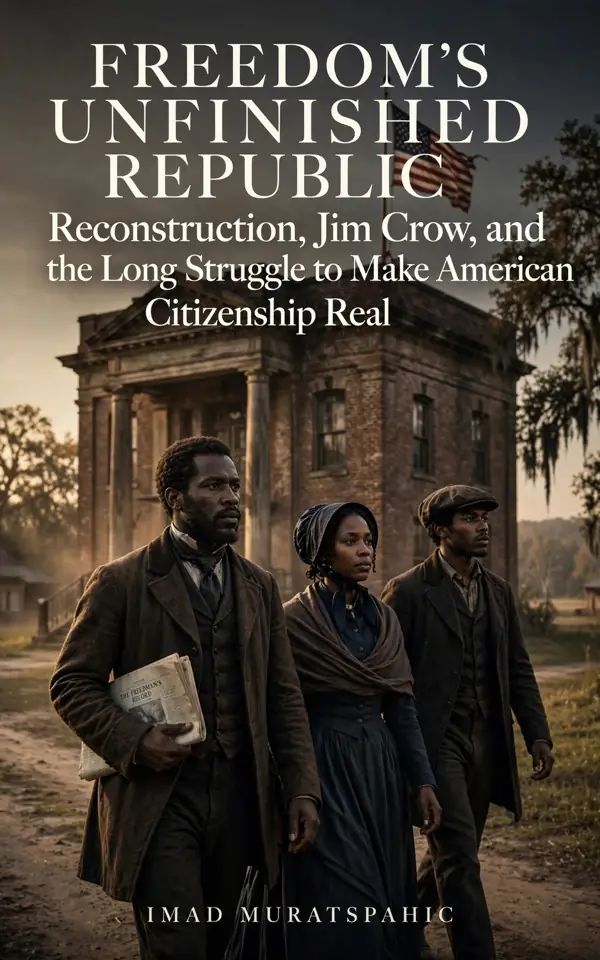
Freedom's Unfinished Republic
Reconstruction, Jim Crow, and the Long Struggle to Make American Citizenship RealBy Imad Muratspahic


Length2h 49m
About this audiobook
Emancipation ended slavery, but it did not settle the meaning of freedom in the United States.
Freedom's Unfinished Republic traces the struggle to make American citizenship meaningful from Reconstruction after the Civil War through the rise of Jim Crow and the modern civil-rights movement. It examines constitutional amendments, Black political participation, education, labour, racial violence, segregation, disenfranchisement, and the campaigns that transformed American law.
Drawing together political history, constitutional change, and the experiences of communities pursuing equal rights, this book explores why the promises of freedom proved difficult to fulfil—and how generations of Americans continued to fight to make those promises real.
Audiobook details
GenreHistory
Length2 hrs 49 mins
Narrated byListen with 1,000+ voices
FormateBook with Audio
Publish dateOct 10, 2026
LanguageEnglish
Table of contents
1Dedication
2Introduction — A Republic Reopened
3Part I — Freedom Becomes a Question of Power
4Chapter 1 — The War Breaks the Old Order
5Chapter 2 — What Freedom Meant on the Ground
Show all chaptersShow less
6Chapter 3 — Presidential Reconstruction and the Return of Former Confederates
7Chapter 4 — Congress Rewrites the Terms of Citizenship
8Chapter 5 — The Ballot Changes Southern Politics
9Chapter 6 — Schools, Families, and the Freedmen's Bureau
10Part II — Building a New Society, Fighting to Keep It
11Chapter 7 — Land, Labor, and the Limits of Economic Freedom
12Chapter 8 — Terror as Political Strategy
13Chapter 9 — Enforcement, Federal Power, and the Limits of Protection
14Chapter 10 — Women, Citizenship, and the Suffrage Divide
15Chapter 11 — State Governments in an Unfinished Revolution
16Chapter 12 — Crisis, Fatigue, and Northern Retreat
17Chapter 13 — The Disputed Election and the Narrowing of Reconstruction
18Part III — The Counterrevolution and Its Opponents
19Chapter 14 — Jim Crow Is Built
20Chapter 15 — Courts and the Retreat from Reconstruction's Promise
21Chapter 16 — Memory, Myth, and the Story America Told Itself
22Chapter 17 — Institutions of Survival and Resistance
23Part IV — The Second Reconstruction
24Chapter 18 — Migration, War, and the Return of Federal Responsibility
25Chapter 19 — Brown, Boycotts, and the Long Work of Organizing
26Chapter 20 — Selma and the Voting Rights Act
27Chapter 21 — After 1965: What Law Can—and Cannot—Do
28Conclusion — Making Citizenship Real
29Appendix A — Chronology
30Appendix B — Constitutional Amendments and Major Laws
31Appendix C — Questions for Further Study
32Research Guide and Selected Bibliography
33About the Author

The Woman God Says You AreImad Muratspahic2h 11m$9 · $0.00

A King Against the WorldImad Muratspahic1h 45m$7.90 · $0.00

SafeImad Muratspahic1h 3m$11 · $0.00

The Society of Cursed NamesImad Muratspahic1h 52m$7.30 · $0.00

The Blackwood CovenantImad Muratspahic44m$7.30 · $0.00

The Hollows of Blackwood CountyImad Muratspahic1h 21m$7.30 · $0.00

The Parish WatchImad Muratspahic2h 12m4.7 (16)$7.30 · $0.00

No Time Like The End TimesImad Muratspahic2h$5.10 · $0.00

Don't Let One Mistake Ruin the GameImad Muratspahic1h 39m$11 · $0.00

Built to HoldImad Muratspahic2h 31m$11 · $0.00

Gold Beyond the SaharaImad Muratspahic1h 30m$7.90 · $0.00

Seguridad para NiñosImad Muratspahic3h 16m$12 · $0.00

Anxious Attachment ResetImad Muratspahic3h 50m$5.10 · $0.00

Retirement Gift for MenImad Muratspahic1h 6m$11 · $0.00

Forgiving Someone Who Hurt YouImad Muratspahic3h 37m$7.90 · $0.00

Biblia Explicada Libro por LibroImad Muratspahic5h 7m$12 · $0.00

The Purified MindImad Muratspahic1h 38m$7.30 · $0.00

Devotional for TeachersImad Muratspahic3h 2m$12 · $0.00

Monsoon and SteelImad Muratspahic1h 35m$7.90 · $0.00

A Brief History of IntelligenceMax S. Bennett12h 18m4.6 (6.6K)$29 · $0.00

The Happiest Man on EarthEddie Jaku3h 48m4.6 (178K)$7 · $0.00

MotherlandJulia Ioffe17h 52m4.7 (2.5K)$40 · $0.00

Where Cowards Go to DieBenjamin Sledge8h 42m4.7 (351)$20 · $0.00

RevolutionariesSanjeev Sanyal11h 23m4.6 (2.6K)$29 · $0.00

We Crossed a Bridge and It TrembledWendy Pearlman6h4.6 (5.2K)$24 · $0.00

Unbroken Bonds of BattleJohnny Joey Jones8h 31m4.6 (2.6K)$8 · $0.00

The Daughter of AuschwitzTova Friedman, Malcolm Brabant7h 54m4.6 (16.7K)$26 · $0.00

Lily's PromiseLily Ebert, Dov Forman8h 54m4.6 (16.1K)$29 · $0.00

On Democracies and Death CultsDouglas Murray10h 38m4.6 (6.5K)$29 · $0.00

Across the RiverKent Babb11h 40m4.6 (927)$29 · $0.00

Balcony Over Jerusalem: A Middle East Memoir - Israel, Palestine and BeyondJohn Lyons12h 37m4.6 (1.4K)$33 · $0.00

BeyondStephen Walker15h 39m4.6 (3.2K)$33 · $0.00
Kings and PawnsHoward Bryant10h 9m4.6 (678)$29 · $0.00

No EscapeNury Turkel9h 30m4.6 (809)$28 · $0.00

Jubal Stone: U.S. Marshal: Blood Trail To Hell: A Western Adventure NovelCasey Nash3h 42m4.6 (3.2K)$18 · $0.00

Fall and RiseMitchell Zuckoff17h 23m4.6 (9.8K)$40 · $0.00

The SurvivorJosef Lewkowicz, Michael Calvin9h 22m4.6 (2.5K)$29 · $0.00

Always FaithfulThomas Schueman, Zainullah Zaki12h 12m4.6 (977)$29 · $0.00

The State of Society in France Before the Revolution of 1789 (Annotated)Alexis de Tocqueville17h 25m4.6 (1.2K)$2 · $0.00
You may also like

Hell and Other DestinationsMadeleine Albright13h 23m4.1 (6K)$33 · $0.00

Religion and the Rise of CapitalismR. H. Tawney10h 12m4.1 (9.1K)$2.30

A History of the Arab PeoplesAlbert Hourani21h 5m4.1 (7.3K)$32

The Life of St. Thomas Aquinas (Annotated)G. K. Chesterton7h 17m4.2 (13.6K)$2 · $0.00

The Grandes DamesStephen Birmingham11h 32m4.2 (236)$27 · $0.00

The History of the Women's Suffrage: The Origin of the Movement (Illustrated Edition) (Annotated)Harriot Stanton Blatch, Elizabeth Cady Stanton, Susan B. Anthony, Matilda Gage176h 30m$2 · $0.00

Japanese Girls and Women (Annotated)Alice Mabel Bacon8h 46m4.4 (103)$1.20 · $0.00

Madame de Staël (Annotated)Bella Duffy7h 38m$1.99 · $0.00

History of the United States of America, Volume VIGeorge Bancroft17h 17m$25

Miracles and Vistas: A Walt Whitman CompendiumWalt Whitman8h 59m$20

THE SECOND WAVELydia Frances Hooper5h 2m$10 · $0.00

The Suffragettes – Complete History Of the Movement (6 Volumes in One Edition) (Annotated)Elizabeth Cady Stanton, Susan B. Anthony, Matilda Gage, Harriot Stanton Blatch, Ida H. Harper305h 34m4.5 (36)$1.99 · $0.00

Journey in Blue: A Peek into the Workers' Party of SingaporeYee Jenn Jong7h 59m4.3 (72)$12 · $0.00

A Short History of Women's RightsEugene A. Hecker5h 49m4.0 (27)$1 · $0.00
The Complete History of the Women's Suffrage Movement in U.S.Jane Addams, Elizabeth Cady Stanton, Ida Husted Harper, Anna Howard Shaw, Matilda Gage, Susan B. Anthony, Harriot Stanton Blatch, Alice Stone Blackwell394h 53m$1.99 · $0.00

MIRIAM O'CALLAGHANWilliam L. Steiner2h 38m$6.50 · $0.00

A Man and His PresidentsAlvin S. Felzenberg17h 28m4.1 (207)$25

Leadership and CrisisBobby Jindal9h 4m4.0 (211)$20

History of Woman Suffrage (Complete Six-Volume Edition) (Annotated)Various305h 48m4.4 (147)$1.99 · $0.00

A Decade of Italian WomenThomas Adolphus Trollope26h 5m$1.99 · $0.00