
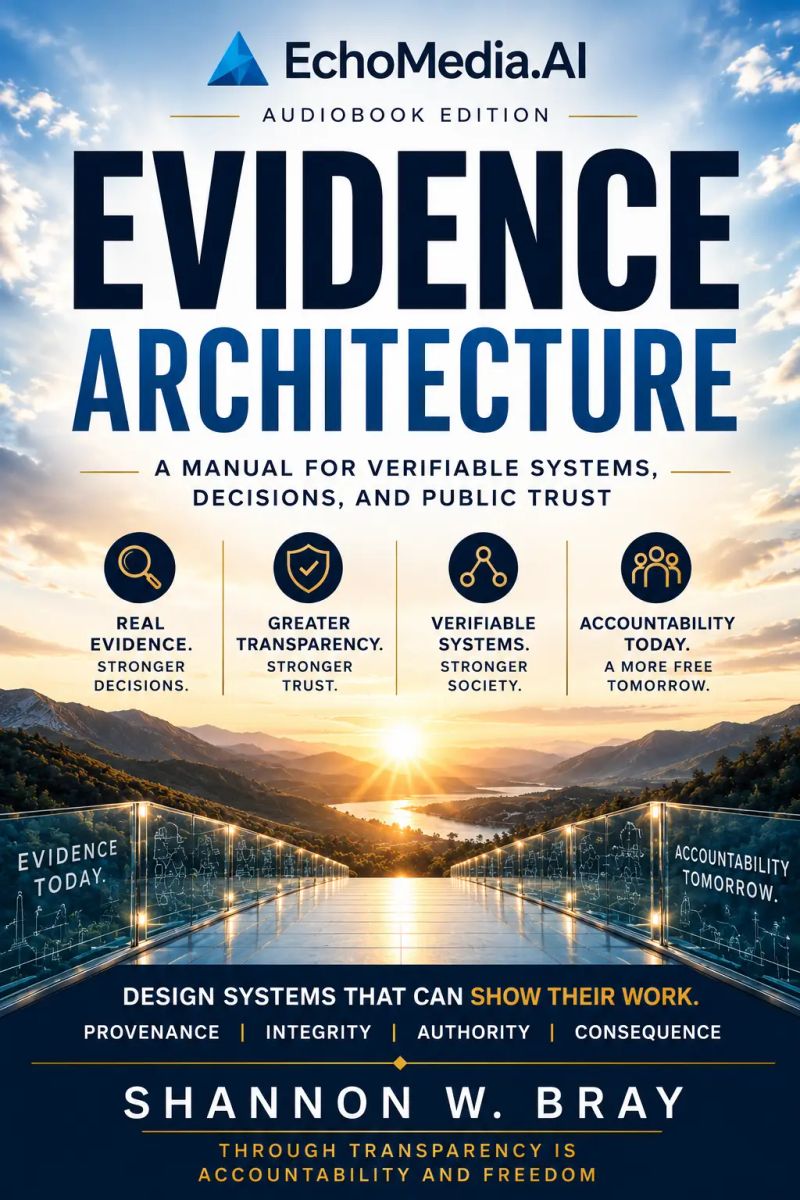
Evidence Architecture
A Manual for Verifiable Systems, Decisions, and Public TrustBy Shannon W. Bray


Length16h 25m
About this audiobook
**Evidence Architecture** introduces a new way to design systems that can show their work. Instead of relying on logs, institutional trust, or unverifiable claims, Evidence Architecture preserves the evidence needed to independently examine what happened, who or what acted, under which authority, and whether that authority still stands.
This practical manual explores evidence-centric design across artificial intelligence, cybersecurity, government, elections, critical infrastructure, business, journalism, and mobile systems. It explains Evidence Objects, Evidence Graphs, cryptographic commitments, chain of custody, policy-bound evidence, verification, provenance, standing, and consequence custody.
Written for architects, engineers, auditors, investigators, policymakers, and technology leaders, the book establishes a central principle: **systems should never claim more than their evidence can prove.**
Audiobook details
Rating★★★★★ 5.0 (1)
GenreTechnology, Business and Economics
Length16 hrs 25 mins
Narrated byListen with 1,000+ voices
FormateBook with Audio
Publish dateSep 1, 2026
LanguageEnglish
Table of contents
1Chapter 1
2Lecture 1 — Why Should a System Be Able to Show Its Work?
3Lecture 2 — What Is Evidence Architecture?
4Lecture 3 — The Evidence Architecture Reference Model
5Lecture 4 — Seven Rules for Evidence-Centric Design
Show all chaptersShow less
6Lecture 5 — From Evidence Architecture to ETS and PLVX
7Lecture 6 — Building an Evidence Object
8Lecture 7 — Following Evidence Through Its Lifecycle
9Lecture 8 — Evidence Is a Graph, Not a Folder
10Lecture 9 — What Can Verification Actually Prove? Part 1
11Lecture 9 — What Can Verification Actually Prove? Part 2
12Lecture 10 — The ETS Components and What Each One Is Allowed to Know
13Lecture 11 — Evidence Is Incomplete Without the Rules That Governed It
14Lecture 12 — Six Ways to Build an Evidence-Centric System
15Lecture 13 — Who Is Allowed to Produce, See, and Verify Evidence? Part 1
16Lecture 13 — Who Is Allowed to Produce, See, and Verify Evidence? Part 2
17Lecture 14 — Can the System Recover Without Lying About What Happened?
18Lecture 15 — Can Two Independent Systems Reach the Same Evidence Conclusion? Part 1
19Lecture 15 — Can Two Independent Systems Reach the Same Evidence Conclusion? Part 2
20Lecture 16 — What Changes When a Business Becomes Evidence-Native?
21Lecture 17 — How Do You Prove What an AI System Actually Did?
22Lecture 18 — From Security Alerts to Defensible Findings
23Lecture 19 — Can Government Prove It Had the Authority to Act?
24Lecture 20 — How Do You Make Election Administration Verifiable Without Exposing the Vote?
25Lecture 21 — Can Critical Infrastructure Preserve Evidence While Everything Else Is Failing?
26Lecture 22 — Can You Verify a Public Artifact Without Deciding Whether It Is True?
27Lecture 23 — Who Governs the Evidence System?
28Lecture 24 — How Do You Measure Whether an Organization Can Actually Prove Anything?
29Lecture 25 — What Happens When Evidence Has to Cross Clouds, Borders, and Organizations?
30Lecture 26 — How Do You Keep an Evidence System From Becoming a Surveillance System?
31Lecture 27 — What Should You Build First?
32Lecture 28 — When the Phone Becomes an Evidence Producer Part 1
33Lecture 28 — When the Phone Becomes an Evidence Producer Part 2
34Mathematics Primer 1 — Why Can a Tiny Fingerprint Represent a Huge File?
35Mathematics Primer 2 — How Can One Small Proof Protect a Long History?
36Mathematics Primer 3 — Why Does Ninety-Five Percent Accurate Sometimes Mean Only Sixteen Percent Likely?
37Mathematics Primer 4 — How Do Relationships, Authority, and Time Become Testable? Part 1
38Mathematics Primer 4 — How Do Relationships, Authority, and Time Become Testable? Part 2
39Optional Companion — How to Use the Evidence Architecture Appendices
40Optional Companion — How to Read an Evidence Pack
41Evidence Architecture Mathematics Primer — Reference Equations
42Appendices Part 1
43Appendices Part 2
44Appendices Part 3
45Appendices Part 4
46Publication and Source Notes
More from Shannon W. Bray
The Physics of EvidenceShannon W. Bray6h 10m4.3 (11)$19.99
Lantern Protocol: VRX Physics LaboratoryShannon W. Bray6h 4mFree

The First CipherShannon W. Bray8h 6m Only with Ultra

Book 1Shannon W. Bray5h 40m3.9 (19)$4.99

Silver BulletShannon W. Bray5h 32m4.4 (18)$9.99
The Living AnchorShannon W. Bray8h 37mFree

Liberty UnleashedShannon W Bray2h 3mFree

The Honey BusMeredith May9h 31m4.4 (16.6K)$25 · $0.00
Collected Writings of Nikola TeslaThomas Commerford Martin, Nikola Tesla19h 42m4.4 (2.8K)$1.99 · $0.00

Operation PedestalMax Hastings12h 29m4.4 (5.2K)$29 · $0.00
When the Heavens Went on SaleAshlee Vance18h 20m4.4 (3K)$40 · $0.00
Everybody Has a Podcast (Except You)Justin McElroy, Travis McElroy, Griffin McElroy5h 9m4.3 (2.3K)$24 · $0.00

Hands of TimeRebecca Struthers8h 8m4.4 (1.3K)$26 · $0.00
Never Lost AgainBill Kilday10h 1m4.4 (805)$29 · $0.00
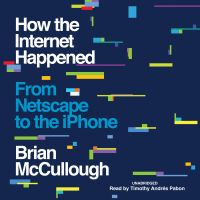
How the Internet HappenedBrian McCullough13h 28m4.3 (2.7K)$23 · $0.00
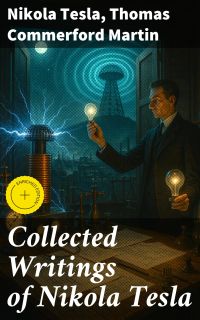
Collected Writings of Nikola TeslaNikola Tesla, Thomas Commerford Martin21h 50m4.3 (1.7K)$1 · $0.00
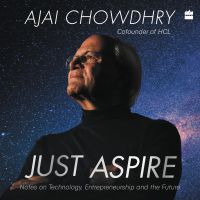
Just AspireAjai Chowdhry9h 13m4.4 (260)$29 · $0.00
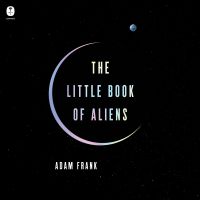
The Little Book of AliensAdam Frank8h 20m4.3 (1.3K)$26 · $0.00
The inventions, researches and writings of Nikola Tesla (Annotated)Thomas Commerford Martin16h 59m4.3 (1.3K)$2 · $0.00

KargilV.P. Malik15h 18m4.3 (2K)$24 · $0.00
Experiments with Alternating CurrentsNikola Tesla9h 16m4.3 (874)$1.99 · $0.00

Fire on the HorizonTom Shroder, John Konrad8h 23m4.3 (858)$26 · $0.00

The Smell of Kerosene (Annotated)National Aeronautics and Space Administration, Donald L. Mallick, Peter W. Merlin11h 32m4.3 (523)$2 · $0.00

The Boy Who Harnessed the WindWilliam Kamkwamba, Bryan Mealer10h 5m4.2 (78.9K)$29 · $0.00

Across the Airless WildsEarl Swift10h 8m4.3 (1.3K)$29 · $0.00
Console WarsBlake J. Harris20h 41m4.2 (13.7K)$46 · $0.00
Improvised Munitions HandbookU.S. Department of Defense4h 49m4.3 (1.6K)$1.99 · $0.00
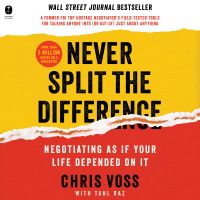
Never Split the DifferenceChris Voss, Tahl Raz8h 7m4.4 (277.7K)$26 · $0.00
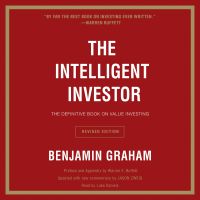
The Intelligent Investor Rev Ed.Benjamin Graham17h 48m4.3 (191.5K)$40 · $0.00
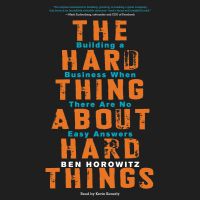
The Hard Thing About Hard ThingsBen Horowitz7h 57m4.2 (134.3K)$26 · $0.00
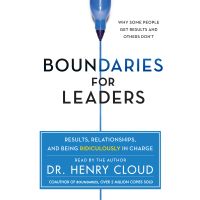
Boundaries for LeadersHenry Cloud7h 36m4.3 (3.6K)$26 · $0.00

Eat It!Jordan Syatt, Michael Vacanti4h 40m4.6 (1.5K)$20 · $0.00
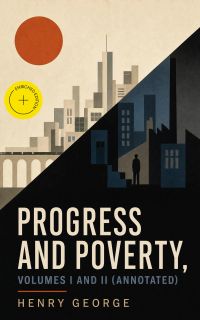
Progress and Poverty, Volumes I and II (Annotated)Henry George19h 21m4.6 (574)$1.99 · $0.00
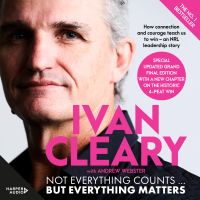
Not Everything Counts but Everything Matters: The powerful and inspirational new book about leadership and achieving success from the visionary multi-premiership winning Panthers coachIvan Cleary6h 1m4.6 (680)$24 · $0.00
BuildTony Fadell11h 5m4.5 (14.3K)$8 · $0.00
The Joys Of CompoundingGautam Baid17h 34m4.5 (2.5K)$18 · $0.00
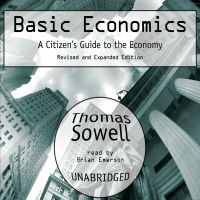
Basic EconomicsThomas Sowell18h 32m4.5 (29.3K)$28 · $0.00

Poor Charlie’s AlmanackGrover Gardener, Charles T. Munger13h 9m4.5 (24.7K)$18 · $0.00
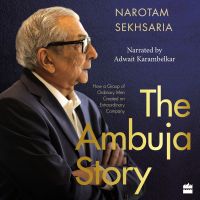
The Ambuja StoryNarotam Sekhsaria13h 59m4.5 (830)$33 · $0.00

The Secret Door to SuccessFlorence Scovel Shinn2h 25m4.5 (2.1K)$1.20 · $0.00

This Is Going to HurtAdam Kay5h 47m4.4 (444.7K)$24 · $0.00

Big TrustShadé Zahrai, Fayçal Sekkouah8h 36m4.6 (406)$26 · $0.00
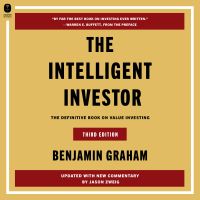
The Intelligent Investor Third EditionBenjamin Graham, Jason Zweig20h4.4 (156.6K)$46 · $0.00

Bottle of LiesKatherine Eban14h 25m4.4 (12K)$33 · $0.00

The Antiracist Business BookTrudi Lebrón6h 10m4.6 (275)$17 · $0.00
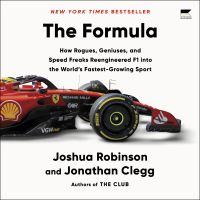
The FormulaJoshua Robinson, Jonathan Clegg10h 41m4.4 (6.9K)$29 · $0.00
Let Them LeadJohn U. Bacon7h 10m4.5 (1.4K)$24 · $0.00
You may also like
12 BytesJeanette Winterson9h4.0 (2.5K)$20
ITIL Foundation Essentials ITIL 4 Edition - The ultimate revision guide, second editionClaire Agutter1h 12m4.2 (462)$27 · $0.00
The Problem of Increasing Human Energy (Annotated)Nikola Tesla6h 44m4.2 (3.2K)$2 · $0.00
The Creativity CodeMarcus du Sautoy9h 54m4.0 (2.2K)$20 · $0.00
The Masterclass of Machine LearningJohn9h 55m$6.80
Understanding AI For Everyday ImpactJasper Livingstone4h 7m$9

Automate Real Work with AILena Devlin7h 30m$5 · $0.00
The Future Ready OrganizationGyan Nagpal7h 44m4.3 (35)$26 · $0.00
The Evolution Of AIJasper Livingstone10h 56m$9
The Artificial AuthorSimone Aliprandi7h 42m$15 · $0.00

Build with Agentic AIDaria Quill7h 21m$5

Online Traffic SecretsAnthony Ekanem49m$4 · $0.00

Code to ScreenTheo Vantage3h 49m$9
Master AiHenrique Xavier Oliveira2h 5m$6 · $0.00
The future of BlockchainUnknown Author1h 2m$17 · $0.00
Me, My Customer, and AIHenrik Werdelin, Nicholas Thorne3h 41m3.3 (16)$20
AI, Consciousness, and the SelfSaraban K. K. 50m4.9 (12) Only with Ultra
The Essential Works of Nikola TeslaNikola Tesla48h 48m4.5 (33)$1.99 · $0.00
The Last Skill You'll Ever NeedDr. Josh Harari2h 5m$5.70 · $0.00
Giant Brains, or, Machines That ThinkEdmund Callis Berkeley9h 21m$2.30