
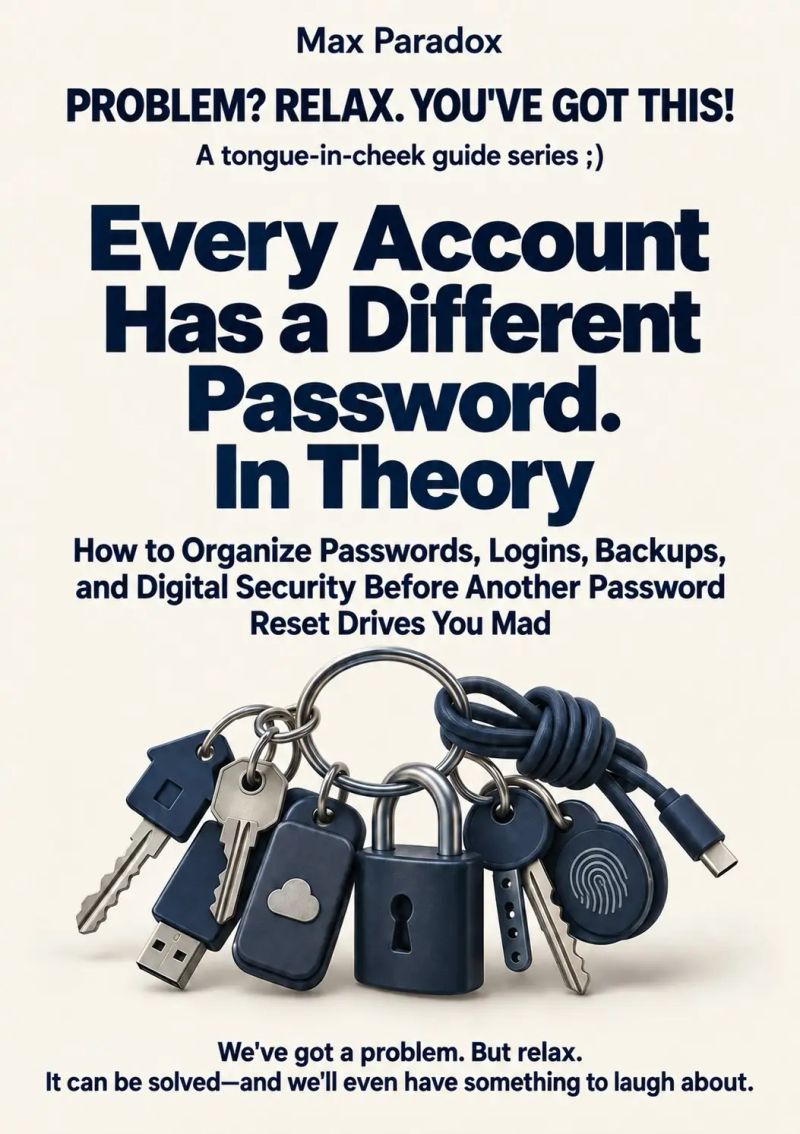
Every Account Has a Different Password. In Theory - How to Organize Passwords, Logins, Backups, and Digital Security Before Another Password Reset Drives You Mad
By Max Paradox


Length8h 7m
About this audiobook
Every account has a different password. One ends in last year, another has an exclamation mark, and the third is definitely saved somewhere. The reset message goes to an email address you barely remember, which sends its recovery code to a telephone number you no longer own. You wanted to buy one thing. Instead, you have begun an expedition through your digital past.
Every Account Has a Different Password. In Theory is a practical guide to organising the everyday parts of digital security. Max Paradox writes for people who want their accounts, devices, and files to be manageable without turning computer administration into a second profession. The goal is a usable system with fewer mysteries when something goes wrong.
The book begins by looking at how many entrances your digital life contains. Passwords, additional authentication, recovery addresses, old devices, and services that remain permanently signed in all deserve attention. Being logged in today does not necessarily mean you can log in tomorrow. You will consider what needs protecting first, how password management fits together, and how an extra security measure can remain useful rather than becoming another route to being locked out.
Backups receive the same practical treatment. Synchronisation and a backup are not automatically the same thing, and a collection of copied files is more reassuring when you know how to restore them. The chapters explore file organisation, recovery, updates, app permissions, and sharing access without simply passing around the key to everything.
The book also considers the situations that make good intentions difficult to maintain: prompts arriving while you are busy, urgent messages demanding a quick click, a lost phone, an old account nobody remembers, and a security routine so complicated that you quietly stop using it. Instead of assuming unlimited patience, the advice returns to priorities and arrangements that fit ordinary behaviour.
When a problem has already happened, the first need is to reduce confusion and choose an appropriate next step. Later chapters discuss incident response, the limits of perfect protection, manageable maintenance, and closing old accounts before they become forgotten doors. Readers are encouraged to understand their own setup rather than collect impressive terms with no clear purpose.
Written with observational humour, this guide recognises the absurdity of proving to a website that you are the person who forgot the secret you invented four years ago. Yet the practical questions stay concrete. Where is the recovery information? What is actually backed up? Who needs access? What happens if the device you rely on is unavailable?
This is a book for organising personal digital life, not a promise that any system can eliminate every risk. It provides a starting point for making sensible improvements, checking the parts that matter, and keeping the resulting routine understandable. You can begin with the accounts and files you rely on most, then work outward as time allows.
If another password reset has made you wonder whether the internet requires a qualification you missed, start here. You do not have to remember everything. You do need a clearer idea of how the important pieces fit together.
This publication was prepared using tools that support the creative process, including artificial intelligence solutions. The final concept, structure and editing are the responsibility of the author.
Audiobook details
GenreTechnology
Length8 hrs 7 mins
Narrated byListen with 1,000+ voices
FormateBook with Audio
Publish dateSep 25, 2026
LanguageEnglish
Table of contents
1INTRO
2Chapter 1 - You Have More Digital Doors Than You Think
3Chapter 2 - A Password You Have to Remember Is Not a System
4Chapter 3 - The Second Factor Should Not Become the Second Disaster
5Chapter 4 - The Weakest Password May Be "Forgot Password"
Show all chaptersShow less
6Chapter 5 - Being Logged In Is Not the Same as Knowing How to Log In
7Chapter 6 - Sync Is Not a Backup
8Chapter 7 - "Update Later" Eventually Becomes a Problem
9Chapter 8 - Not Every App Deserves a Key to Your House
10Chapter 9 - The Less Often You Type a Password, the Better
11Chapter 10 - Check First, Then Click
12Chapter 11 - A Backup Is Only Real If You Can Restore It
13Chapter 12 - Your Files Should Not Require a Treasure Map
14Chapter 13 - Losing Your Phone Should Not Mean Losing Your Life
15Chapter 14 - Do Not Share Everything by Sending the Password
16Chapter 15 - If Your Security System Is Unbearable, You Will Eventually Bypass It
17Chapter 16 - When Something Goes Wrong, Stop the Chaos First
18Chapter 17 - Real Life Will Not Follow Your Security Checklist
19Chapter 18 - Fifteen Minutes of Maintenance Beats an Annual Digital Apocalypse
20Chapter 19 - Close Old Doors Before You Forget Where They Lead
21Chapter 20 - You Need a System, Not a PhD in the Internet

My Neighbor Is Testing My Patience - How to Handle Noise, Shared Spaces, and Everyday Friction Without Starting a Neighborhood WarMax Paradox11h 12m$7.70 · $0.00

Sąsiad testuje moją cierpliwość - Jak reagować na hałas, wspólne przestrzenie i codzienne spięcia bez rozpoczynania wojny na klatce schodowejMax Paradox9h 54m$7.70 · $0.00

Nasza przyjaźń działa tylko wtedy, kiedy piszę pierwszy - Jak rozpoznać jednostronną relację, porozmawiać o wzajemności i zdecydować, komu nadal dawać swój czasMax Paradox9h 22m$7.70 · $0.00

Our Friendship Only Works When I Text First - How to Recognize a One-Sided Friendship, Talk About Mutual Effort, and Decide Who Deserves Your TimeMax Paradox11h 7m$7.70 · $0.00

Pracuję z domu, ale chyba już mieszkam w pracy - Jak wyznaczać godziny pracy, chronić własną przestrzeń i odzyskać życie poza laptopemMax Paradox3h 5m$7.70 · $0.00

The Grandparents Help, but Only on Their Terms - How to Agree on Childcare Rules, Address Broken Agreements, and Talk Without Competing Over Who Knows BestMax Paradox4h 19m$7.70 · $0.00

The Kids Moved Out. What Am I Supposed to Do Now? - How to Find Your Own Rhythm, Build an Adult Relationship with Your Children, and Create a Life Beyond Daily ParentingMax Paradox2h 55m$7.70 · $0.00

Wszyscy mówią o AI, a ja nie wiem, od czego zacząć - Jak wykorzystać sztuczną inteligencję do codziennych spraw, sprawdzać odpowiedzi i nie oddawać jej własnego rozsądkuMax Paradox4h 16m$7.70 · $0.00

Wszystko jest teraz w aplikacji, a ja chcę tylko załatwić sprawę - Jak oswoić cyfrową codzienność, korzystać z potrzebnych usług i prosić o pomoc bez wstydu i doktoratu z klikaniaMax Paradox5h 11m$7.70 · $0.00

We Can’t Figure Out How to Live Together - How to Agree on Cleaning, Quiet, Guests, and Privacy Before Your Home Becomes a Championship of ComplaintsMax Paradox3h 37m$7.70 · $0.00

My Parents Need Help, but I Can’t Take On a Second Job - How to Agree on Care, Share Responsibilities with Family, and Support Aging Parents Without Taking Everything On YourselfMax Paradox2h 52m$7.70 · $0.00

Papierologia mnie przerasta - Jak ogarnąć dokumenty, rachunki, terminy i reklamacje bez zatrudniania sekretarki do własnego życiaMax Paradox6h 23m$7.70 · $0.00

Retirement Was Supposed to Be Freedom, Not an Endless Sunday - How to Build a Daily Rhythm, Stay Connected, and Find Purpose When Work No Longer Sets Your ScheduleMax Paradox4h 7m$7.70 · $0.00

Zostałem szefem i teraz wszyscy czegoś chcą - Jak przejść od kolegi do przełożonego, delegować zadania i prowadzić trudne rozmowy bez udawania wszechwiedzącegoMax Paradox3h 59m$7.70 · $0.00

Why Am I the Only One Who Remembers Everything? - How to Share the Planning, Shopping, and Household Tasks Without Being Everyone’s Human CalendarMax Paradox4h 38m4.5 (12)$7.70 · $0.00

Będę Za Pięć Minut. Czyli Za Dwadzieścia - Jak przestać się spóźniać, realistycznie planować wyjścia i zostawiać sobie zapas czasu bez ustawiania pięciu fałszywych alarmówMax Paradox5h 37m$7.70 · $0.00

I Bought a Car and Now I'm Afraid of Every Warning Light - How to Handle Servicing, Insurance, Costs, and Basic Car Care Without Pretending to Be a MechanicMax Paradox7h 16m$7.70 · $0.00

Guests Will Be Here in Two Hours, and I Just Noticed the Floor - How to Get Your Home, Food, and Yourself Ready for a Visit Without a Full Renovation, Twelve Courses, or Pretending It Always Looks Like ThisMax Paradox6h 57m$7.70 · $0.00

Chyba Właśnie Zostałem Szefem - Jak zacząć zarządzać ludźmi, delegować, dawać feedback i nie próbować robić wszystkiego samemuMax Paradox6h 3m4.7 (39)$7.70 · $0.00
Never Lost AgainBill Kilday10h 1m4.4 (805)$29 · $0.00

How the Internet HappenedBrian McCullough13h 28m4.3 (2.7K)$23 · $0.00

Collected Writings of Nikola TeslaNikola Tesla, Thomas Commerford Martin21h 50m4.3 (1.7K)$1 · $0.00

Just AspireAjai Chowdhry9h 13m4.4 (260)$29 · $0.00

The Little Book of AliensAdam Frank8h 20m4.3 (1.3K)$26 · $0.00

The inventions, researches and writings of Nikola Tesla (Annotated)Thomas Commerford Martin16h 59m4.3 (1.3K)$2 · $0.00

KargilV.P. Malik15h 18m4.3 (2K)$24 · $0.00

Experiments with Alternating CurrentsNikola Tesla9h 16m4.3 (874)$1.99 · $0.00

Fire on the HorizonTom Shroder, John Konrad8h 23m4.3 (858)$26 · $0.00

The Smell of Kerosene (Annotated)National Aeronautics and Space Administration, Donald L. Mallick, Peter W. Merlin11h 32m4.3 (523)$2 · $0.00

The Boy Who Harnessed the WindWilliam Kamkwamba, Bryan Mealer10h 5m4.2 (78.9K)$29 · $0.00

Across the Airless WildsEarl Swift10h 8m4.3 (1.3K)$29 · $0.00

Console WarsBlake J. Harris20h 41m4.2 (13.7K)$46 · $0.00

Improvised Munitions HandbookU.S. Department of Defense4h 49m4.3 (1.6K)$1.99 · $0.00

Escaping GravityLori Garver10h 54m4.2 (2.2K)$20 · $0.00

Wireless WarsJonathan Pelson8h 2m4.3 (418)$20 · $0.00

Let There Be WaterSeth M. Siegel8h 36m4.2 (2.3K)$20 · $0.00

The PerfectionistsSimon Winchester11h 46m4.2 (9.9K)$29 · $0.00
Rethinking NarcissismDr. Craig Malkin6h 7m4.2 (3.4K)$24 · $0.00

Project Animal FarmSonia Faruqi11h 23m4.3 (563)$20 · $0.00
You may also like

The House of the DeadFyodor Dostoevsky11h 21m4.2 (41.6K)$8 · $0.00

The Clergyman's DaughterGeorge Orwell10h 36m3.7 (16K)$2.30

The Faulkner ReaderWilliam Faulkner31h 41m4.4 (1.7K)$1 · $0.00

MadnessMarya Hornbacher9h 43m4.1 (17.9K)$29 · $0.00

The Birthday PartyStanley N. Alpert10h 56m3.8 (43.3K)$21 · $0.00

All Day Is A Long TimeDavid Sanchez6h 46m3.8 (1.7K)$24 · $0.00

It Takes What It TakesTrevor Moawad, Andy Staples5h 25m4.2 (5.7K)$24 · $0.00

The Secret Language of the BodyJennifer Mann, Karden Rabin8h 39m4.3 (1K)$26 · $0.00

Bogie & BacallWilliam J. Mann27h 34m4.0 (1K)$53 · $0.00

A Clergyman's Daughter (Annotated)George Orwell12h 5m3.6 (39K)$2 · $0.00

The RevisionersMargaret Wilkerson Sexton8h 23m4.0 (9.8K)$20 · $0.00

Live WireKelly Ripa9h 59m4.1 (18.5K)$29 · $0.00

The Relive Box and Other StoriesT.C. Boyle7h 16m3.9 (1.5K)$24 · $0.00

Notes from a Dead HouseFyodor Dostoevsky13h 32m4.2 (43.5K)$20

Pieces You'll Never Get BackSamina Ali6h 30m4.1 (418)$23

Women Holding ThingsMaira Kalman26m4.5 (2.3K)$7 · $0.00

The Mind Under InfluenceDanniel Silva3h 36m$1.80 · $0.00

The Psychology of the Emotions (Annotated)Th. Ribot18h 20m$1.99 · $0.00
My Parents Need Help, but I Can’t Take On a Second Job - How to Agree on Care, Share Responsibilities with Family, and Support Aging Parents Without Taking Everything On YourselfMax Paradox2h 52m$7.70 · $0.00

Spin CyclesCharles Coe1h 24m4.1 (18)$14.10 · $0.00