
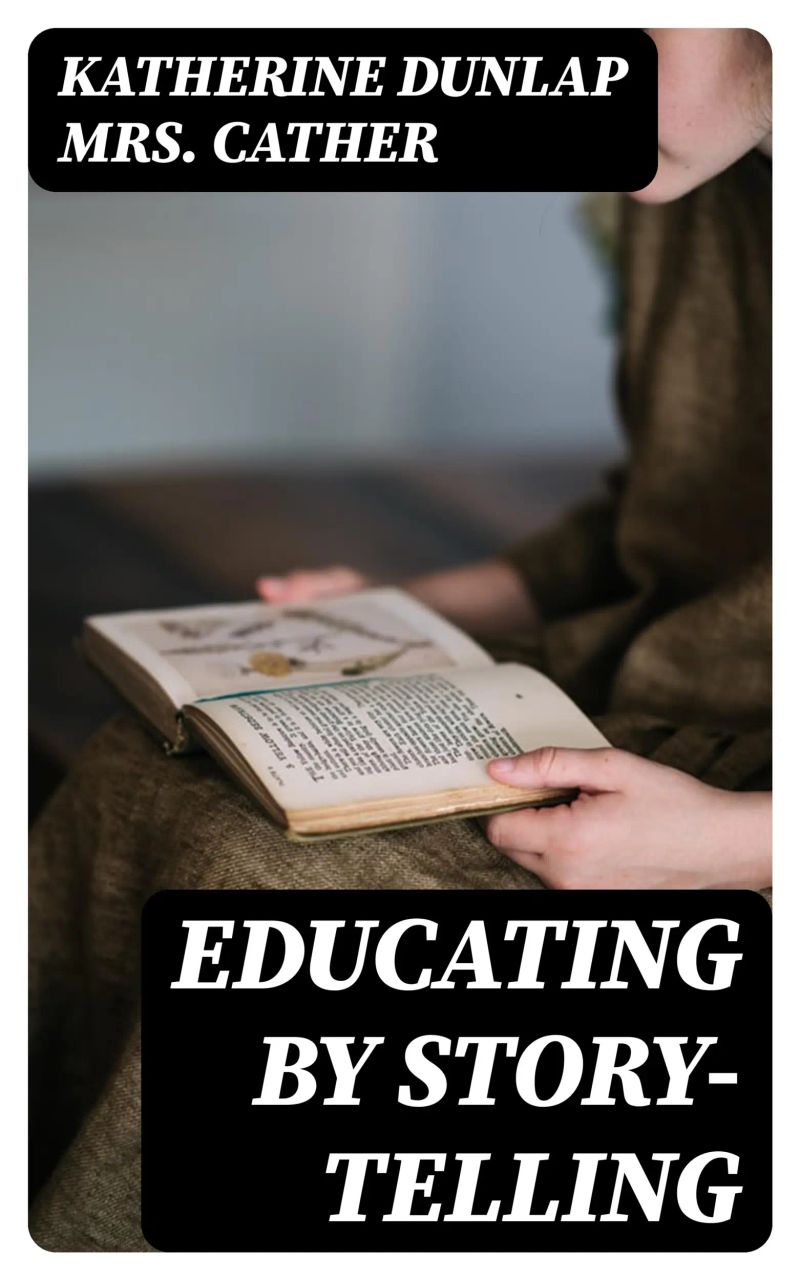
Educating by Story-Telling
Showing the Value of Story-Telling as an Educational Tool for the Use of All Workers with ChildrenBy Katherine Dunlap Mrs. Cather


Length11h 16m
About this audiobook
In "Educating by Story-Telling," Katherine Dunlap Mrs. Cather presents an insightful exploration into the art of narrative as a pedagogical tool. The book deftly intertwines storytelling with educational theory, demonstrating how narratives can enhance understanding, retention, and moral reasoning in learners, particularly in early education. Cather's literary style blends earnest prose with practical examples, reflecting the early 20th-century educational reforms that emphasized creativity and emotional engagement over rote memorization, positioning the work as both a theoretical and practical guide for educators of the time. Katherine Dunlap Mrs. Cather, an influential educator and reformer, drew from her extensive teaching experience and a deep understanding of child psychology to craft this essential work. Her commitment to progressive education, marked by a focus on individual student needs and the cultivation of critical thinking, undoubtedly influenced her approach to storytelling as a vehicle for learning. Cather's own life—rooted in a rich tapestry of literature and teaching—shapes her perspectives and contributes to the depth of her arguments. I wholeheartedly recommend "Educating by Story-Telling" to educators, parents, and anyone interested in the dynamic relationship between narrative and learning. Cather's timeless insights into the power of storytelling will inspire readers to reconsider their approaches to education, fostering environments that celebrate creativity and intellectual engagement.
Audiobook details
GenreEducation and Learning
Length11 hrs 16 mins
Narrated byListen with 1,000+ voices
FormateBook with Audio
Publish dateSep 4, 2022
LanguageEnglish
Table of contents
1Introduction
2CHAPTER ONE The Purpose and Aim of Story-Telling
3A. RHYTHMIC PERIOD
4Sources of Story Material for the Rhythmic Period
5B. IMAGINATIVE PERIOD
Show all chaptersShow less
6Bibliography of Fairy Tales
7C. HEROIC PERIOD
8Sources of Story Material for the Heroic Period
9D. ROMANTIC PERIOD
10Sources of Story Material for the Romantic Period
11CHAPTER SIX Building the Story
12Books on Story-Telling
13Some Authors and Selections That Can Be Presented through the Story-Telling Method
14Sources of Material to Lead to an Appreciation of Literature
15A BOY OF OLD VIENNA
16Sources of Material to Awaken an Appreciation of Music
17Pictures to Use in Telling Musical Stories
18Artists and Paintings That Can Be Presented to Young Children through the Story-Telling Method
19Artists and Paintings for Children of the Intermediate Period
20Artists and Paintings That Lead to Appreciation of the Beautiful and to Respect for Labor
21Artists and Paintings for the Heroic and Epic Periods
22General Bibliography of Art Story Material
23Sources for Moderate-Priced Reproductions of Masterpieces
24Bibliography of Material for Dramatization
25Sources of Material for Bible Stories
26Stories to Develop or Stamp out Certain Traits and Instincts
27Sources of Material to Use in the Teaching of Ethics
28THE SEARCH FOR THE SEVEN CITIES
29THE GOD OF THE THUNDERING WATER
30Sources of Material to Use in History and Geography
31THE WONDERFUL BUILDERS
32Sources of Material for Science Stories
33THE DERVISH OF MOCHA
34Sources of Material to Use in Domestic Science and Manual Training
35CHAPTER EIGHTEEN Does the Work of the Story-Teller Pay?
36THE STORY OF THE MAN IN THE MOON
37THE DISCONTENTED PIG
38THE BAT AND HIS PARTNERS
39BRIER ROSE
40THE COAT OF ALL COLORS
41THE POOR MAN AND THE RICH MAN
42THE SILVER CONES
43THE FORGET-ME-NOT
44THE LITTLE STEPMOTHER
45THE RABBIT AND THE EASTER EGGS
46THE EASTER EGGS
47PRINCE UNEXPECTED
48THE GREEDY COBBLER
49THE STORY OF A SALMON
50THE PIGEONS OF VENICE

A Brief History of IntelligenceMax S. Bennett12h 18m4.6 (6.6K)$29 · $0.00
HomeschooledStefan Merrill Block7h 10m3.6 (18.5K)$28 · $0.00

The State Must ProvideAdam Harris7h 15m4.5 (775)$24 · $0.00
The Call of the Wild and FreeAinsley Arment9h 7m4.4 (21.2K)$29 · $0.00
The Freelance WayRobert Vlach19h 48m4.5 (528)$40 · $0.00
Race to the BottomLuke Rosiak9h 20m4.5 (600)$29 · $0.00

They Came for the SchoolsMike Hixenbaugh9h 5m4.5 (2.6K)$8 · $0.00
Find Me UnafraidKennedy Odede, Jessica Posner11h 11m4.5 (2.7K)$29 · $0.00

Asking for ItKate Harding8h 55m4.4 (5.3K)$20 · $0.00
Defining Moments in Black HistoryDick Gregory7h 37m4.4 (6K)$26 · $0.00
The Emerald Tablets of Thoth the AtlanteanMaurice Doreal3h 4m4.4 (8.8K)$6 · $0.00
Learning AmericaLuma Mufleh6h 37m4.4 (564)$24 · $0.00
Math-ishJo Boaler7h 21m4.4 (588)$24 · $0.00
Daddy-Long-LegsJean Webster12h 18m4.2 (91K)$1.99 · $0.00
It Worked For MeColin Powell7h 42m4.3 (9.8K)$26 · $0.00
Little SoldiersLenora Chu11h 30m4.3 (3.1K)$29 · $0.00
Grammar-land; Or, Grammar in Fun for the Children of Schoolroom-shireM. L. Nesbitt2h 36m4.4 (488)$1 · $0.00
Financial FeministTori Dunlap8h 3m4.2 (22.2K)$8 · $0.00

DarkwaterWilliam Edward Burghardt Du Bois6h 40m4.3 (1.4K)$11 · $0.00

The Highway Code UKDepartment for Transport3h 33m4.2 (36.6K)$11 · $0.00
You may also like
Fancy Nancy and the Mermaid BalletJane O'Connor9m4.4 (2.9K)$4 · $0.00
The Age of ChivalryThomas Bulfinch13h 16m3.9 (1.5K)$25
PoeticsAristotle1h 37m4.1 (38.5K)$2.30
Wonderful Tales for Children (Illustrated)Nathaniel Hawthorne24h4.2 (14.4K)$1.99 · $0.00
Fifty Famous People: A Book of Short StoriesJames Baldwin4h 17m4.1 (394)$2 · $0.00
Fifty Famous Stories Retold (Annotated)James Baldwin4h 18m4.1 (3.2K)$1.99 · $0.00
Pete the Cat: Big Easter AdventureJames Dean4m4.2 (31.9K)$4 · $0.00
Wonder BookNathaniel Hawthorne13h 49m4.1 (1.7K)$1 · $0.00
Hero Within - Rev. & Expanded Ed.Carol S. Pearson11h 8m4.2 (1.6K)$8 · $0.00
Uncle Wiggily's Story Book Howard R. Garis5h 55m4.4 (2.1K)Free
Totem and TabooSigmund Freud6h 19m4.0 (28.6K)$3.50 · $0.00
The Princess and the Goblin & The Princess and Curdie (Complete Illustrated Edition) (Annotated)George MacDonald12h 14m4.2 (23.2K)$0.99 · $0.00
The Daring Book for GirlsAndrea J. Buchanan, Miriam Peskowitz3h 50m4.1 (5.8K)$20 · $0.00
The Champions of the Round Table (Unabridged)Howard Pyle13h 50m4.1 (899)$1.99 · $0.00
The Way to WealthBenjamin Franklin15m4.3 (4.7K)$2 · $0.00
Educating by Story-TellingMrs. Katherine Dunlap Cather12h 11m4.2 (17)$2 · $0.00
Literature in the Elementary SchoolPorter Lander MacClintock6h 26m$2 · $0.00
The Adventures of Pinocchio (Illustrated Edition) (Annotated)Carlo Collodi6h 16m3.8 (17)$0.99 · $0.00
Stories of King Arthur's Knights (Annotated)Mary Macgregor2h 22m3.5 (61)$0.99 · $0.00
Mt. Olympus Theme ParkElizabeth Catanese57m$8