
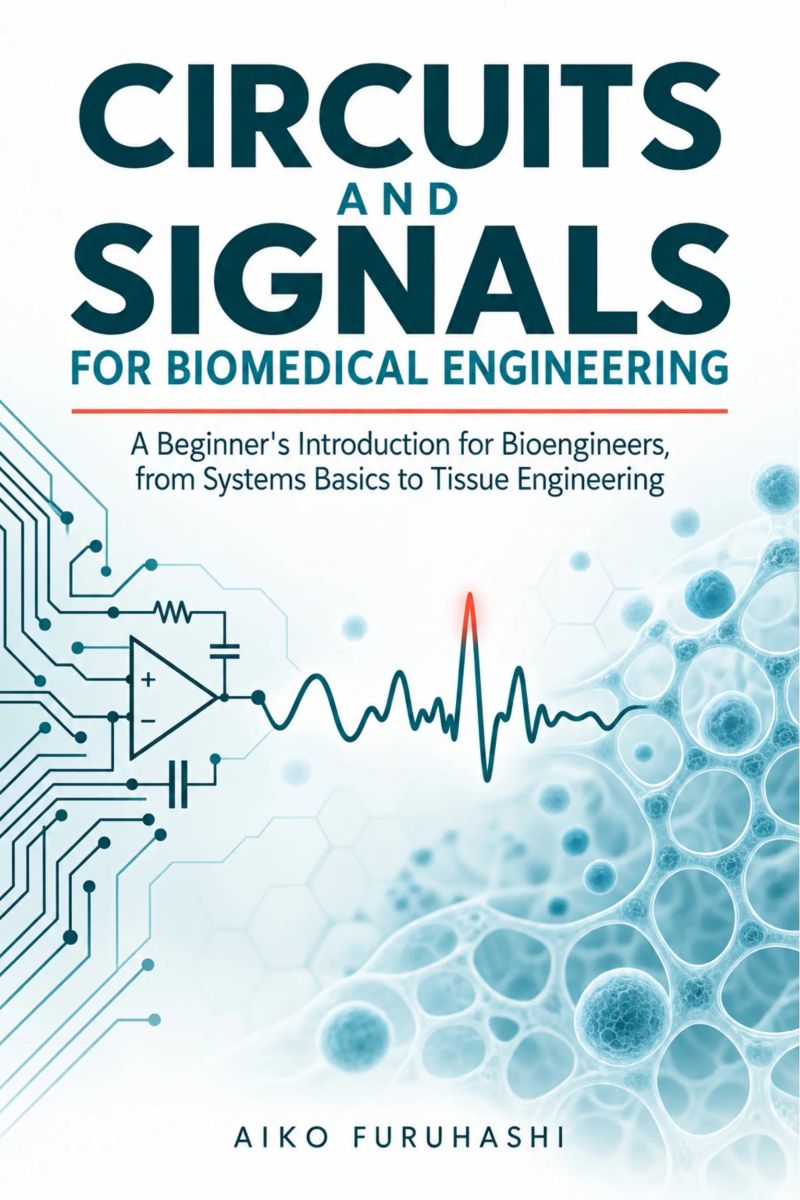
Circuits and Signals for Biomedical Engineering
A Beginner's Introduction for Bioengineers, from Systems Basics to Tissue EngineeringBy Aiko Furuhashi


Length13h 25m
About this audiobook
Biomedical engineering asks you to be fluent in two languages at once: the physiology that produces a signal and the electronics that capture it. This book teaches both in the same chapter.
Most introductory texts make you choose: learn circuits first and hope the biology makes sense later, or learn physiology first and treat the electronics as a black box. Circuits and Signals for Biomedical Engineering refuses that split. You will build circuit analysis from Ohm's and Kirchhoff's laws up to impedance and transfer functions, then design the instrumentation amplifier that pulls a one-millivolt electrocardiogram out of power-line noise. Every concept is anchored to a measurement a biomedical engineer actually makes.
The electrode chapters explain half-cell potentials and motion artifact, so you understand why a good electrode matters as much as a good amplifier. The signals chapters take you through convolution, Laplace and Fourier methods, sampling, aliasing and digital filter design, each with MATLAB you can run on a real recording. Later chapters move outward to physiological sensors, the physics behind radiography, ultrasound and magnetic resonance, compartment modeling, and the hydrogels and scaffolds used in tissue engineering. The result is a single continuous path from a biopotential on the skin to a processed signal on a screen, and from there to the materials that repair the body.
What you will learn:
• Apply Ohm's law, Kirchhoff's laws and Thevenin equivalents to bioinstrumentation circuits
• Analyze capacitors, inductors and the frequency domain, including impedance and transfer functions
• Design operational amplifier and instrumentation amplifier stages for low-level biopotentials
• Explain electrode behavior, half-cell potentials and motion artifact in ECG, EEG and EMG recordings
• Identify and reduce noise, interference and grounding problems while maintaining patient isolation
• Use convolution, Laplace transforms and Fourier analysis to describe biomedical systems
• Sample, anti-alias and digitally filter biosignals with runnable MATLAB examples
• Select sensors and transducers for physiological measurement
• Describe the principles of X-ray, ultrasound and magnetic resonance imaging
• Model physiological transport with compartment models and understand hydrogels and scaffolds for tissue engineering
Who it is for: Bioengineering undergraduates taking a first circuits or signals course, career changers entering biomedical engineering from another technical field, and anyone who needs to read a schematic and a physiological waveform with equal confidence. No prior circuits background is assumed; the mathematics is developed as the applications require it.
Audiobook details
GenreTechnology
Length13 hrs 25 mins
Narrated byListen with 1,000+ voices
FormateBook with Audio
Publish dateSep 27, 2026
LanguageEnglish
Table of contents
1Circuits and Signals for Biomedical Engineering
2Foreword
3Preface
4About This Book
5Important Safety Notice
Show all chaptersShow less
6Chapter 1: What Biomedical Engineers Build
71.1 The Biomedical Engineering Landscape
81.2 The Physiological Signal Chain
91.3 Instrumentation, Imaging, Implants and Rehabilitation
101.4 The Mathematics Each Field Demands
111.5 Units, Safety and Professional Responsibility
12Chapter 2: Circuit Fundamentals: Ohm’s Law, Kirchhoff and Thevenin
132.1 Charge, Current, Voltage and Power
142.2 Ohm’s Law and Resistive Networks
152.3 Kirchhoff’s Laws and Nodal Analysis
162.4 Source Transformation and Thevenin Equivalents
172.5 Worked Design: A Sensor Bridge and Its Load
18Chapter 3: Capacitors, Inductors and the Frequency Domain
193.1 Capacitors and Inductors
203.2 RC and RL Transients and Time Constants
213.3 Sinusoids, Phasors and Impedance
223.4 Passive Filters and the Bode Idea
233.5 Worked Design: An Anti-Alias Front End for a Biopotential
24Chapter 4: Operational Amplifiers and the Instrumentation Amplifier
254.1 The Ideal Operational Amplifier and Feedback
264.2 Inverting, Noninverting and Buffer Configurations
274.3 Difference Amplifiers and Common-Mode Rejection
284.4 The Three-Op-Amp Instrumentation Amplifier
294.5 Real Device Limits and a Biopotential Preamplifier Design
30Chapter 5: Electrodes and Biopotentials: ECG, EEG and EMG
315.1 The Electrode-Electrolyte Interface
325.2 Silver-Silver Chloride and Other Electrode Types
335.3 Motion Artifact and Skin Preparation
345.4 Origin, Amplitude and Bandwidth of ECG, EEG and EMG
355.5 Worked Design: A Three-Lead ECG Front End
36Chapter 6: Noise, Interference, Shielding and Patient Isolation
376.1 Describing Noise: Sources and Spectral Density
386.2 Power-Line Interference and Its Coupling Paths
396.3 Shielding, Guarding and the Driven Reference
406.4 Leakage Current, Isolation and Electrical Safety
416.5 Worked Design: A Noise Budget for an ECG Channel
42Chapter 7: Signals and Systems: Convolution, Laplace and Transfer Functions
437.1 Signals, Linearity and Time Invariance
447.2 Convolution and the Impulse Response
457.3 The Laplace Transform and Transfer Functions
467.4 Frequency Response and Bode Plots
477.5 Worked Design: Modeling a Pressure Catheter as a First-Order System
48Chapter 8: Fourier Analysis, Sampling and Aliasing
498.1 Fourier Series and the Fourier Transform
508.2 Sampling and the Sampling Theorem

The Honey BusMeredith May9h 31m4.4 (16.6K)$25 · $0.00

Collected Writings of Nikola TeslaThomas Commerford Martin, Nikola Tesla19h 42m4.4 (2.8K)$1.99 · $0.00

Operation PedestalMax Hastings12h 29m4.4 (5.2K)$29 · $0.00

When the Heavens Went on SaleAshlee Vance18h 20m4.4 (3K)$40 · $0.00

Everybody Has a Podcast (Except You)Justin McElroy, Travis McElroy, Griffin McElroy5h 9m4.3 (2.3K)$24 · $0.00

Hands of TimeRebecca Struthers8h 8m4.4 (1.3K)$26 · $0.00

Never Lost AgainBill Kilday10h 1m4.4 (805)$29 · $0.00

How the Internet HappenedBrian McCullough13h 28m4.3 (2.7K)$23 · $0.00

Collected Writings of Nikola TeslaNikola Tesla, Thomas Commerford Martin21h 50m4.3 (1.7K)$1 · $0.00

Just AspireAjai Chowdhry9h 13m4.4 (260)$29 · $0.00

The Little Book of AliensAdam Frank8h 20m4.3 (1.3K)$26 · $0.00

The inventions, researches and writings of Nikola Tesla (Annotated)Thomas Commerford Martin16h 59m4.3 (1.3K)$2 · $0.00

KargilV.P. Malik15h 18m4.3 (2K)$24 · $0.00

Experiments with Alternating CurrentsNikola Tesla9h 16m4.3 (874)$1.99 · $0.00

Fire on the HorizonTom Shroder, John Konrad8h 23m4.3 (858)$26 · $0.00

The Smell of Kerosene (Annotated)National Aeronautics and Space Administration, Donald L. Mallick, Peter W. Merlin11h 32m4.3 (523)$2 · $0.00

The Boy Who Harnessed the WindWilliam Kamkwamba, Bryan Mealer10h 5m4.2 (78.9K)$29 · $0.00

Across the Airless WildsEarl Swift10h 8m4.3 (1.3K)$29 · $0.00

Console WarsBlake J. Harris20h 41m4.2 (13.7K)$46 · $0.00

Improvised Munitions HandbookU.S. Department of Defense4h 49m4.3 (1.6K)$1.99 · $0.00
You may also like

Taoist Teachings From the Book of Lieh TzŭLie Yukou2h 40m4.2 (1.3K)$1 · $0.00

The Art of Horse-Shoeing: A Manual for FarriersWilliam Hunting2h 58m4.6 (33)$1.50 · $0.00

Tax Strategies for High-Income Earners 2027Imad Muratspahic3h 37m$9 · $0.00

How to Choose the Right Formula for Your BabyAurora Brooks1h 2m$3.50 · $0.00

COLORADO MOTORCYCLE PERMIT EXAM PREP 2026–2027Tyler Knox9h 9m$10
On the Execution of Music, and Principally of Ancient MusicCamille Saint-Saëns34m$1 · $0.00

Elements of Foreign Exchange: A Foreign Exchange PrimerFranklin Escher3h 36m4.1 (11)$1 · $0.00
Even IfBill Brown Jr.55m$5

Natural Stability and the Parachute Principle in AeroplanesW. LeMaitre2m$2 · $0.00
PunctuationFrederick W. Hamilton1h 36m$2 · $0.00
From Chess to CourtesyRonaldo P. Macedo Jr.13h 54m$17 · $0.00

Understanding Soccer: A Guide to Playing, Watching, and Enjoying the Beautiful GameTavin D. Spicer4h 10m$3.50 · $0.00
International Fluid Mechanics in BriefRafael Quintanilla11h 39m$70

VegetarianNaumann & Göbel Verlag3h 23m4.4 (15)$5 · $0.00
Prelude in Cm (Chopin)Bill Brown Jr.30m$2

History of SportsKenny Abdo17m$2

I'll See You in My DreamsBill Brown Jr.1h 5m$10

1000 essential words in AlbanianJM Gardner2h 18m$10 · $0.00
Guitar By Ear: Rock and Blues Box Set 4Bill Brown Jr.14h 43m$23
Lessons in Music Form (Annotated)Percy Goetschius5h 15m4.6 (16)$2 · $0.00