
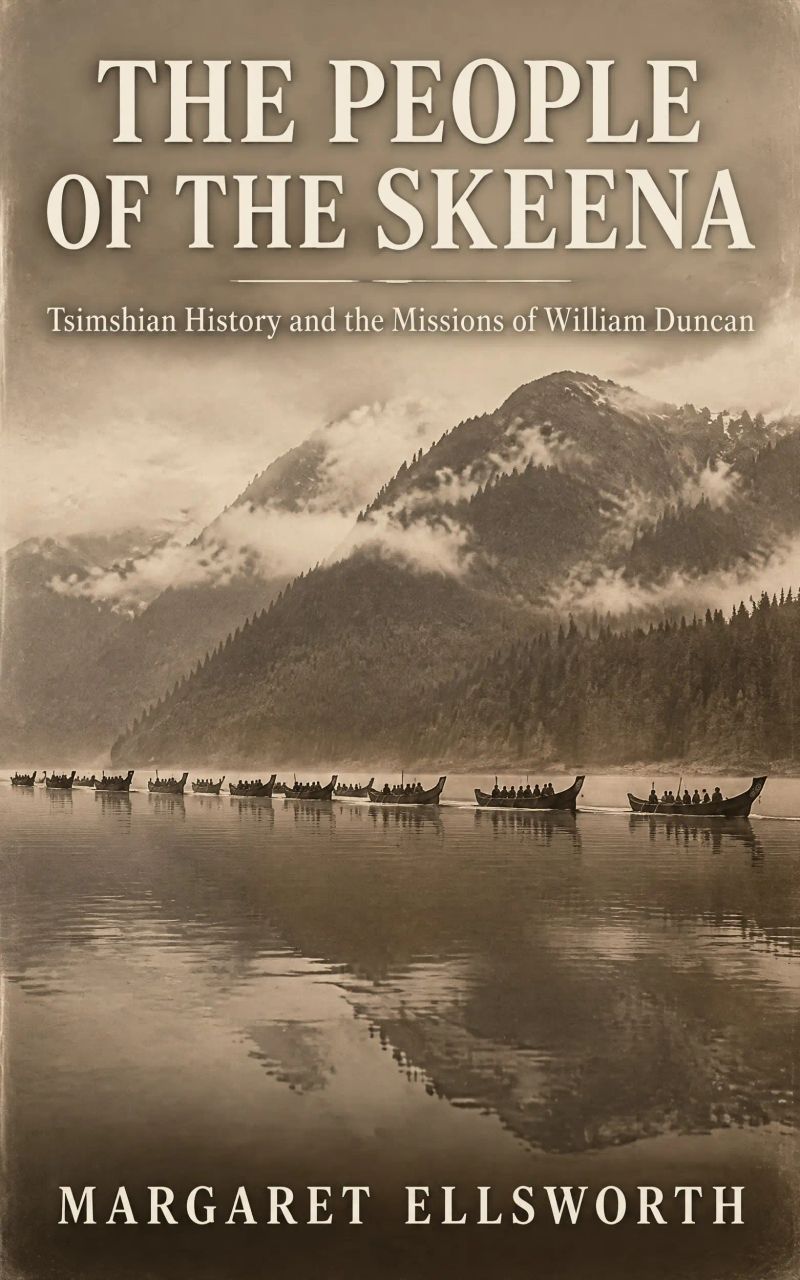
The People of the Skeena: Tsimshian History and the Missions of William Duncan
By Margaret Ellsworth


Length4h 48m
About this audiobook
Among the Tsimshian, a name, a crest or a fishing station did not truly belong to a house until the claim had been witnessed and paid for at a feast. Chiefs held such things in trust for their houses, and the houses belonged to four great clans, Raven, Eagle, Killer Whale and Wolf. The people's name means, roughly, "inside the Skeena River," and for thousands of years they have lived at its mouth and along the coast beside it, where salmon and eulachon run thick in the silty water.
In 1857 a young English lay missionary named William Duncan arrived at the Hudson's Bay Company post of Fort Simpson. Five years later he led Tsimshian converts down the coast to found Metlakatla, a model Christian village with its own church, sawmill, store and rules. He later quarreled with his own church, the quarrel became a fight over who owned the land, and in 1887 some eight hundred Tsimshian followed him north to Annette Island, Alaska. Their story runs on through the potlatch ban, the epidemics, the long road toward aboriginal title in Canada and the return of feast law. The town they built across the border is today the only Indian reservation in Alaska.
Audiobook details
GenreHistory
Length4 hrs 48 mins
Narrated byListen with 1,000+ voices
FormateBook with Audio
Publish dateSep 19, 2026
LanguageEnglish
Table of contents
1Chapter 1: The River and the Sea
2Chapter 2: The Cedar and the Canoe
3Chapter 3: Feasts of Standing
4Chapter 4: Fort Simpson, 1857
5Chapter 5: Metlakatla on the Skeena
Show all chaptersShow less
6Chapter 6: The Schism
7Chapter 7: The Long Canoe Journey
8Chapter 8: Two Metlakatlas
9Chapter 9: The Potlatch Ban and the Law
10Chapter 10: The Great Dying and the Fever
11Chapter 11: The Long Road to Title
12Chapter 12: Feast Law in a New Century
13About the Author
More from Margaret Ellsworth


A Brief History of IntelligenceMax S. Bennett12h 18m4.6 (6.6K)$29 · $0.00

The Happiest Man on EarthEddie Jaku3h 48m4.6 (178K)$7 · $0.00

MotherlandJulia Ioffe17h 52m4.7 (2.5K)$40 · $0.00

Where Cowards Go to DieBenjamin Sledge8h 42m4.7 (351)$20 · $0.00

RevolutionariesSanjeev Sanyal11h 23m4.6 (2.6K)$29 · $0.00

We Crossed a Bridge and It TrembledWendy Pearlman6h4.6 (5.2K)$24 · $0.00

Unbroken Bonds of BattleJohnny Joey Jones8h 31m4.6 (2.6K)$8 · $0.00

The Daughter of AuschwitzTova Friedman, Malcolm Brabant7h 54m4.6 (16.7K)$26 · $0.00

Lily's PromiseLily Ebert, Dov Forman8h 54m4.6 (16.1K)$29 · $0.00

On Democracies and Death CultsDouglas Murray10h 38m4.6 (6.5K)$29 · $0.00

Across the RiverKent Babb11h 40m4.6 (927)$29 · $0.00

Balcony Over Jerusalem: A Middle East Memoir - Israel, Palestine and BeyondJohn Lyons12h 37m4.6 (1.4K)$33 · $0.00

BeyondStephen Walker15h 39m4.6 (3.2K)$33 · $0.00
Kings and PawnsHoward Bryant10h 9m4.6 (678)$29 · $0.00

No EscapeNury Turkel9h 30m4.6 (809)$28 · $0.00

Jubal Stone: U.S. Marshal: Blood Trail To Hell: A Western Adventure NovelCasey Nash3h 42m4.6 (3.2K)$18 · $0.00

Fall and RiseMitchell Zuckoff17h 23m4.6 (9.8K)$40 · $0.00

The SurvivorJosef Lewkowicz, Michael Calvin9h 22m4.6 (2.5K)$29 · $0.00

Always FaithfulThomas Schueman, Zainullah Zaki12h 12m4.6 (977)$29 · $0.00

The State of Society in France Before the Revolution of 1789 (Annotated)Alexis de Tocqueville17h 25m4.6 (1.2K)$2 · $0.00
You may also like
The BeadworkersBeth Piatote5h 15m4.1 (1.2K)$17 · $0.00
Returning to EarthJim Harrison7h 43m4.1 (3.3K)$17 · $0.00

The Last Fish TaleMark Kurlansky6h 20m4.0 (1.2K)$14
The Happy Isles of OceaniaPaul Theroux24h 8m4.1 (8.6K)$53 · $0.00

Saving JemimaJulie Zickefoose4h 59m4.5 (749)$20 · $0.00

One Story, One SongRichard Wagamese5h 17m4.4 (1.6K)$17

The GrandmotherBožena Němcová11h 3m4.1 (12.3K)$1 · $0.00

A Thousand Trails HomeSeth Kantner8h 2m4.4 (524)$20 · $0.00
The Wisdom of the ShireNoble Smith4h 48m4.1 (1.7K)$14

Dishes & Beverages of the Old SouthMartha McCulloch-Williams4h 39m4.0 (386)$0.99 · $0.00

The Lakota WayJoseph M. Marshall III1h 13m4.4 (5.1K)$10

The Place of TidesJames Rebanks7h 27m4.4 (7.1K)$24 · $0.00

The Domestic Life of Thomas Jefferson Compiled From Family Letters and Reminiscences (Annotated)Sarah N. Randolph13h 6m4.2 (281)$2 · $0.00

The Bear Hunter's DaughtersAnneli Jordahl13h 9m3.7 (1.5K)$29 · $0.00

Grandma Says: Wake Up, World!Agnes Baker Pilgrim6h 11m4.5 (35)$17

Food, Clothing, and Everyday ComfortsSantiago Machain7h 58m$25 · $0.00

Walking with AbelAnna Badkhen9h 20m3.7 (448)$20 · $0.00

Mother Earth Is Our ElderKatlia (Catherine) Lafferty10h 16m$29 · $0.00

To the American Indian (Annotated)Lucy Thompson8h 10m4.0 (51)$1.99 · $0.00
The Essential Writings of Charles EastmanCharles A. Eastman16h 36m4.6 (34)$1.99 · $0.00