
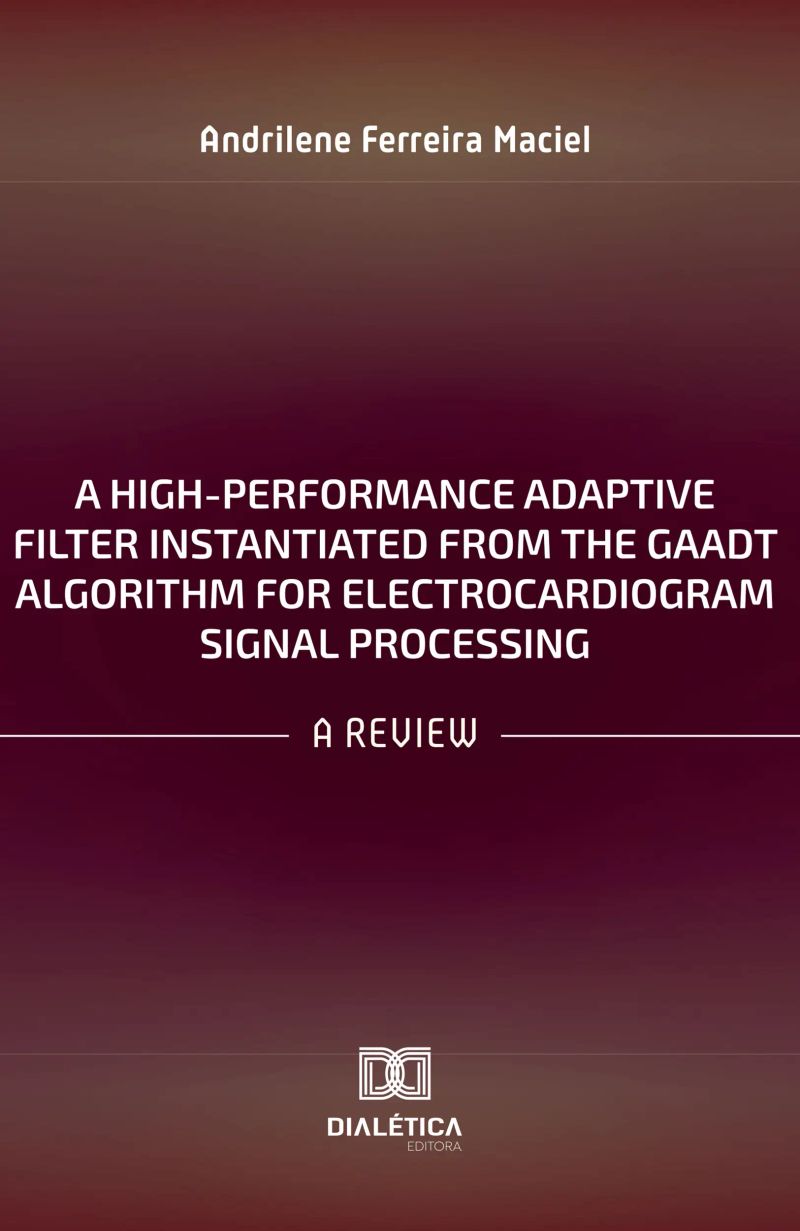
A High-Performance Adaptive Filter Instantiated from the GAADT Algorithm for Electrocardiogram Signal Processing
A ReviewBy Andrilene Ferreira Maciel


Length2h 55m
About this audiobook
This book was developed to meet the needs of undergraduate and graduate students in the areas of genetic algorithms, signal processing, statistics, and data mining in the area of computer science. Several exercises contained in this book were extracted from the GAADT and CGAADT algorithms. The first chapter of this book aims to provide the reader with basic concepts about electrocardiogram signal processing and its effectiveness in diagnosing cardiac arrhythmia based on signal capture. The following chapter presents the basic concepts of genetic algorithms, pseudolanguage, variables, and their uses. The following chapters deal with the basic structures of the electrocardiogram, morphology, and waveform characteristics of cardiac signals. The basic structures of the GAADT and CGAADT genetic algorithms for electrocardiogram signal processing are then presented. An additional chapter dealing with the applications of CGAADT in the construction of an adaptive filter on a high-performance platform using a Graphics Processing Unit (GPU) for electrocardiogram signal processing concludes this work.
Audiobook details
GenreTechnology
Length2 hrs 55 mins
Narrated byListen with 1,000+ voices
FormateBook with Audio
Publish dateAug 27, 2025
LanguageEnglish
Table of contents
1Acknowledgments
2Preface
3CHAPTER 1 INTRODUCTION
4CHAPTER 2 GENETIC ALGORITHM
52.1 History and Concept
Show all chaptersShow less
62.2 Holland’s Genetic Algorithm
72.3 Summary and Conclusions
82.4 Proposed Exercises
9CHAPTER 3 GENETIC ALGORITHM BASED ON ABSTRACT DATA TYPES (GAADT)
103.1 Basic concepts
113.2 GAADT
123.3 Basic Types of GAADT
133.4 Genetic Operators GAADT
143.4.1 GAADT mathematical model
153.4.1 Environment In GAADT, the characteristics of an environment will dictate how chromosome populations will evolve. An environment A is an 8-tuple <P, ℙ, Rq, AFG, AFC, Tx,Σ, P0>, where:
163.4.2 The Algorithm
173.6 Proposed Exercise
18CHAPTER 4 BIOLOGICAL SIGNALS OF ELECTROCARDIOGRAM (ECG)
194.1 Fundamentals
204.1.1 Electrical Activity of the Heart
214.1.2 Anatomy of the Heart
224.1.3 Basic characteristics of the electrocardiogram
234.1.4 Cardiac Arrhythmias
244.1.5 Sinus Arrhythmia
254.1.6 Atrial Fibrillation
264.1.7 Atrial Flutter
274.2 Summary and Conclusions
284.3 Proposed Exercises
29CHAPTER 5 MODELING OF THE COMPACT ALGORITHM BASED ON ABSTRACT DATA TYPES FOR ELECTROCARDIOGRAM SIGNALS
305.1 Basic Concepts
315.2 GPU Accelerated Computing
325.3 Scalable Programming Model in CUDA
335.4 Thread and Memory Hierarchy
345.5 Applications of CGAADT
355.6 Specification of CGAADT on GPU
365.7 Basic Types Definition
375.8 Genetic Operators
385.9 Functionalities: GAADT x CGAADT
395.11 Summary and Conclusions
405.12 Proposed Exercises
41CHAPTER 6 CGAADT APPLICATION
426.1 Fundamentals
436.2 Hardware Infrastructure: 6.2.1 Implementation of GAADT and CGAADT on the FPGA
446.3 Implementation of GAADT and CGAADT on GPU/CUDA
456.4 Databases
466.5 CGAADT Data Flow
476.6 APPLICATION 01: 6.6.1 COMPARISON OF THE CGAADT(GPU) AND GAADT(CPU)
486.7 APPLICATION 2
496.8 APPLICATION Nº 3: 6.8.1 Database
506.9 Summary and Conclusions
More from Andrilene Ferreira Maciel


Operation PedestalMax Hastings12h 29m4.4 (5.2K)$29 · $0.00

When the Heavens Went on SaleAshlee Vance18h 20m4.4 (3K)$40 · $0.00

Everybody Has a Podcast (Except You)Justin McElroy, Travis McElroy, Griffin McElroy5h 9m4.3 (2.3K)$24 · $0.00

Hands of TimeRebecca Struthers8h 8m4.4 (1.3K)$26 · $0.00

Never Lost AgainBill Kilday10h 1m4.4 (805)$29 · $0.00

How the Internet HappenedBrian McCullough13h 28m4.3 (2.7K)$23 · $0.00

Collected Writings of Nikola TeslaNikola Tesla, Thomas Commerford Martin21h 50m4.3 (1.7K)$1 · $0.00

Just AspireAjai Chowdhry9h 13m4.4 (260)$29 · $0.00

The Little Book of AliensAdam Frank8h 20m4.3 (1.3K)$26 · $0.00
The inventions, researches and writings of Nikola Tesla (Annotated)Thomas Commerford Martin16h 59m4.3 (1.3K)$2 · $0.00

KargilV.P. Malik15h 18m4.3 (2K)$24 · $0.00

Experiments with Alternating CurrentsNikola Tesla9h 16m4.3 (874)$1.99 · $0.00

Fire on the HorizonTom Shroder, John Konrad8h 23m4.3 (858)$26 · $0.00

The Smell of Kerosene (Annotated)National Aeronautics and Space Administration, Donald L. Mallick, Peter W. Merlin11h 32m4.3 (523)$2 · $0.00

The Boy Who Harnessed the WindWilliam Kamkwamba, Bryan Mealer10h 5m4.2 (78.9K)$29 · $0.00

Across the Airless WildsEarl Swift10h 8m4.3 (1.3K)$29 · $0.00

Console WarsBlake J. Harris20h 41m4.2 (13.7K)$46 · $0.00

Improvised Munitions HandbookU.S. Department of Defense4h 49m4.3 (1.6K)$0.99 · $0.00

Escaping GravityLori Garver10h 54m4.2 (2.2K)$20 · $0.00

Wireless WarsJonathan Pelson8h 2m4.3 (418)$20 · $0.00
You may also like

Algorithms in Java, Coded and TestedBianca Zielinski7h 25m$5 · $0.00

Machine Learning in the CloudLionel Jansen8h 21m$5 · $0.00

The AI Advantage for Restaurant OwnersMiles Draper4h 21m$5

Build a 2.5D RPG with Godot 4 and C#Gregory Whitlock7h 8m$5 · $0.00

Bio-Inspired AI in C++Zoe Becker7h 10m$5 · $0.00
Python Programming Made PracticalAustin Gray7h 21m5.0 (1)$6.50 · $0.00

Ethical Hacking Practice LabAaron Blake7h 51m$6.50 · $0.00

The AI Advantage for LandlordsMiles Draper3h 59m$9

Smart TV Guide for BeginnersWalter Hemsley4h 12m$7

ElevenLabs Made SimpleMiles Draper4h 27m$6

Target Date FundsPenelope I. Westwood4h 32m$4 · $0.00

Monetize your content with NFTsUnknown Author1h 5m$17 · $0.00
Statistical Methods for Engineers and ScientistsPriya Ramanathan15h 5m$95
THE CLAUDE AI BIBLE FOR BEGINNERSSheldon Caldwell4h 42m$17.50 · $0.00

How to Profit from Google AdSenseAnthony Ekanem37m$4 · $0.00

From Zero To AutomaticSara Melo1h 25m$1.80 · $0.00

n8n Automation Made SimpleMiles Draper3h 54m$7

The AI Advantage for Property ManagersMiles Draper4h 23m$8

The AI Advantage for PharmacistsMiles Draper4h 23m$8

Trello for Beginners Made SimpleRuth Callender4h 7m$7