
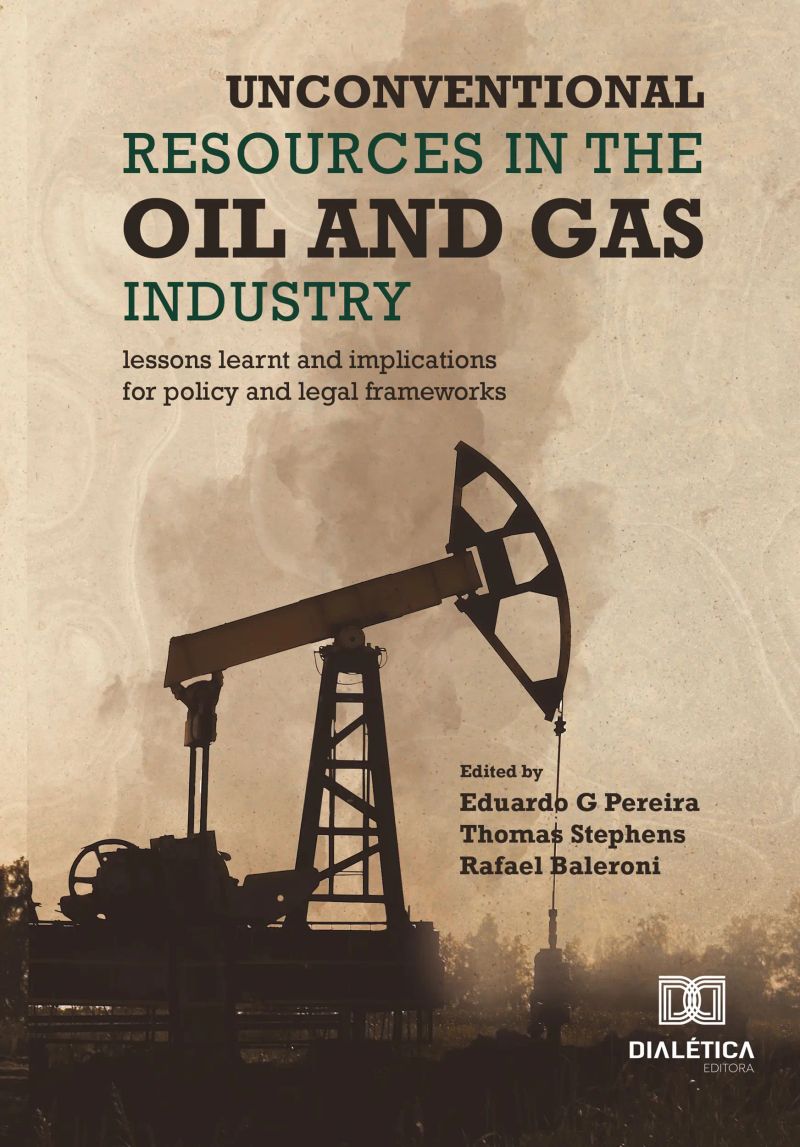
Unconventional Resources in the Oil and Gas Industry
lessons learnt and implications for policy and legal frameworksDe Eduardo Pereira


Duração25h 16m
Sobre este audiolivro
The emergence of unconventional oil and gas extraction, known as the "shale revolution", since 2008 has fundamentally reshaped the global energy sector. This revolution, driven by technological advancements in hydraulic fracturing and horizontal drilling, has unlocked vast reserves of oil and gas previously deemed inaccessible. Despite challenges like the COVID-19 pandemic, fluctuating oil prices, and growing environmental concerns, unconventional resources continue to play a pivotal role in shaping energy policies worldwide. This book delves deeply into the transformative impact of unconventional resources on international energy markets and policies, providing a comprehensive analysis of their significance.
Written by over 20 experts in oil and gas law, the book offers a rich, multidisciplinary perspective. It covers topics that are "horizontal" and cut across various jurisdictions, providing a comparative approach that spans 11 different countries, including the USA, Canada, Argentina, Brazil, Colombia, Mexico, the UK, Algeria, Libya, China, and Germany. This extensive analysis ensures a broad understanding of the global landscape of unconventional resources.
Main themes include:
· Global Impact: Unconventional resources have not only transformed the United States into a leading oil and gas producer but have also significantly influenced energy strategies worldwide. Countries across North America, South America, Europe, and Asia have adopted various strategies to harness these resources, reshaping the global energy market.
· Policy Considerations: Key policy issues addressed in the book include the environmental and social impacts of unconventional resource extraction. Topics such as water management, the coexistence of drilling operations with other land uses, and the social implications of resource extraction are thoroughly examined.
· Legal Framework: The book explores the complex legal landscape governing unconventional operations, delves into stakeholder dynamics, regulatory frameworks, and the intricacies of legal provisions that vary from one jurisdiction to another.
· Geographical Analysis: In its second part, the book provides an in-depth analysis of specific country regulations. This section offers comparative insights into the regulatory approaches of eleven countries, highlighting both common challenges and unique strategies.
The book concludes by exploring lessons learned and future perspectives within the framework of the energy trilemma—balancing energy security, environmental sustainability, and economic affordability. It emphasizes the transformative impact of unconventional resources on energy independence and security, while also addressing the contentious environmental considerations that accompany such developments.
Overall, this book aims to equip readers with a comprehensive understanding of the legal and regulatory landscape surrounding unconventional oil and gas resources. By examining global experiences and diverse regulatory frameworks, it seeks to inform decision-making processes and promote sustainable development in the unconventional energy sector. The book benefits from critical analyses and comparative descriptive reviews of each country's unique approach, making it an invaluable resource for policymakers, industry professionals, and scholars alike.
Detalhes do audiolivro
GêneroTechnology
Duração25 h 16 min
Narrado porOuça com mais de 1.000 vozes
FormatoeBook com áudio
Data de publicação12 de ago. de 2024
IdiomaInglês
Sumário
1INTRODUCTION TO THE BOOK
2PREAMBLE TO PART I
31. WHAT ARE UNCONVENTIONAL RESOURCES AND HOW HAVE THEY EVOLVED
42. WHO ARE THE MAIN STAKEHOLDERS BEHIND AN UNCONVENTIONAL PROJECT AND THEIR MAIN EXPECTATIONS?
53. WHAT ARE THE MAIN BARRIERS TO DEVELOPING AN UNCONVENTIONAL ACTIVITY?
Mostrar todos os capítulosVer menos
64. TAILORING LAWS TO ADDRESS UNCONVENTIONAL DEVELOPMENTS: MAIN TOPICS TO CONSIDER
75. TAILORING LAWS TO ADDRESS UNCONVENTIONAL DEVELOPMENTS: US AND EUROPEAN EXPERIENCES
86. TO WHAT EXTENT SHOULD INDUSTRY STANDARDS BE USED AND IMPLEMENTED
97. TO WHAT EXTENT CAN UNCONVENTIONAL RESOURCES CO-EXIST WITH OTHER LAND USE, SUCH AS AGRICULTURE
108. CO-EXISTENCE BETWEEN EXPLOITATION OF UNCONVENTIONAL RESOURCES AND OTHER LAND USES: CASE STUDIES AND RECOMMENDATIONS
11PREAMBLE TO PART II
129. USA (pt. 1)
139. USA (pt. 2)
1410. CANADA
1511. ARGENTINA (pt. 1)
1611. ARGENTINA (pt. 2)
1712. BRAZIL
1813. COLOMBIA
1914. MEXICO
2015. UNITED KINGDOM
2116. ALGERIA
2217. LIBYA
2318. CHINA
2419. GERMANY
2520. CONCLUSION
26ABOUT THE EDITORS
27ABOUT THE AUTHORS
Mais de Eduardo Pereira



Operation PedestalMax Hastings12h 29min4.4 (5.2K)$29 · $0.00

When the Heavens Went on SaleAshlee Vance18h 20min4.4 (3K)$40 · $0.00

Everybody Has a Podcast (Except You)Justin McElroy, Travis McElroy, Griffin McElroy5h 9min4.3 (2.3K)$24 · $0.00

Hands of TimeRebecca Struthers8h 8min4.4 (1.3K)$26 · $0.00

Never Lost AgainBill Kilday10h 1min4.4 (805)$29 · $0.00

How the Internet HappenedBrian McCullough13h 28min4.3 (2.7K)$23 · $0.00

Collected Writings of Nikola TeslaNikola Tesla, Thomas Commerford Martin21h 50min4.3 (1.7K)$1 · $0.00
Just AspireAjai Chowdhry9h 13min4.4 (260)$29 · $0.00

The Little Book of AliensAdam Frank8h 20min4.3 (1.3K)$26 · $0.00

The inventions, researches and writings of Nikola Tesla (Annotated)Thomas Commerford Martin16h 59min4.3 (1.3K)$2 · $0.00

KargilV.P. Malik15h 18min4.3 (2K)$24 · $0.00

Experiments with Alternating CurrentsNikola Tesla9h 16min4.3 (874)$0.99 · $0.00

Fire on the HorizonTom Shroder, John Konrad8h 23min4.3 (858)$26 · $0.00

The Smell of Kerosene (Annotated)National Aeronautics and Space Administration, Donald L. Mallick, Peter W. Merlin11h 32min4.3 (523)$2 · $0.00

The Boy Who Harnessed the WindWilliam Kamkwamba, Bryan Mealer10h 5min4.2 (78.9K)$29 · $0.00

Across the Airless WildsEarl Swift10h 8min4.3 (1.3K)$29 · $0.00

Console WarsBlake J. Harris20h 41min4.2 (13.7K)$46 · $0.00
Improvised Munitions HandbookU.S. Department of Defense4h 49min4.3 (1.6K)$1.99 · $0.00

Escaping GravityLori Garver10h 54min4.2 (2.2K)$20 · $0.00

Wireless WarsJonathan Pelson8h 2min4.3 (419)$20 · $0.00
Você também pode gostar

The Meaning of It AllRichard P. Feynman2h 51min4.1 (14K)$12

Splat the Cat: Fishy TalesRob Scotton3min4.1 (467)$4 · $0.00

Life on the MississippiMark Twain15h 28min4.0 (73.2K)$2
Encyclopedia of aquarium plantsPeter Hiscock9h 14min4.4 (387)$11 · $0.00

On the HeavensAristotle4h 5min4.0 (431)$1.80 · $0.00

The Boston School Atlas, Embracing a Compendium of GeographyB. Franklin Edmands3h 30min$2 · $0.00

Insect ManufacturesAnonymous2h 34min$2.40

How to Make Money Flipping Boats - How to Assess Hulls, Engines, and Systems, Control Renovation Costs, and Sell in SeasonJACK FLIPWELL2h 1min$5.10

The Craft of Wood: 4 Classic Books for WoodworkersGeorge Alexander Ross, Edwin W. Foster, Archie Seldon Milton, Otto K. Wohlers, William Noyes12h 52min4.6 (10)$1.99 · $0.00

Drawing Horses. Practical guide to drawing horsesRoberto Fabbretti11min4.3 (11)$10

The Money Pit, Vol. 9Tom Kraeutler, Leslie Segrete10h 37min$20

Anatomy of the CatJacob Reighard, H. S. Jennings16h 28min4.0 (11)$1 · $0.00

Machines that BuildJulie Murray14min$1

Rust, Smut, Mildew, & Mould: An Introduction to the Study of Microscopic FungiM. C. Cooke7h 20min4.2 (16)$1 · $0.00

The Geographical Distribution of AnimalsAlfred Russel Wallace42h 20min4.2 (132)$0.99 · $0.00

On the Generation of AnimalsAristotle8h 13min4.0 (258)$1 · $0.00

The Bird Study BookThomas Gilbert Pearson3h 59min$16 · $0.00

Let's learn English and discover the world of animalsGiovanna Mazzoni, Elena Ercole33min$13 · $0.00

Natural CuriositiesAlfred Wallace Wallace1h 51min$15

Studies in SpermatogenesisN. M. Stevens2h 48min$0.99 · $0.00