
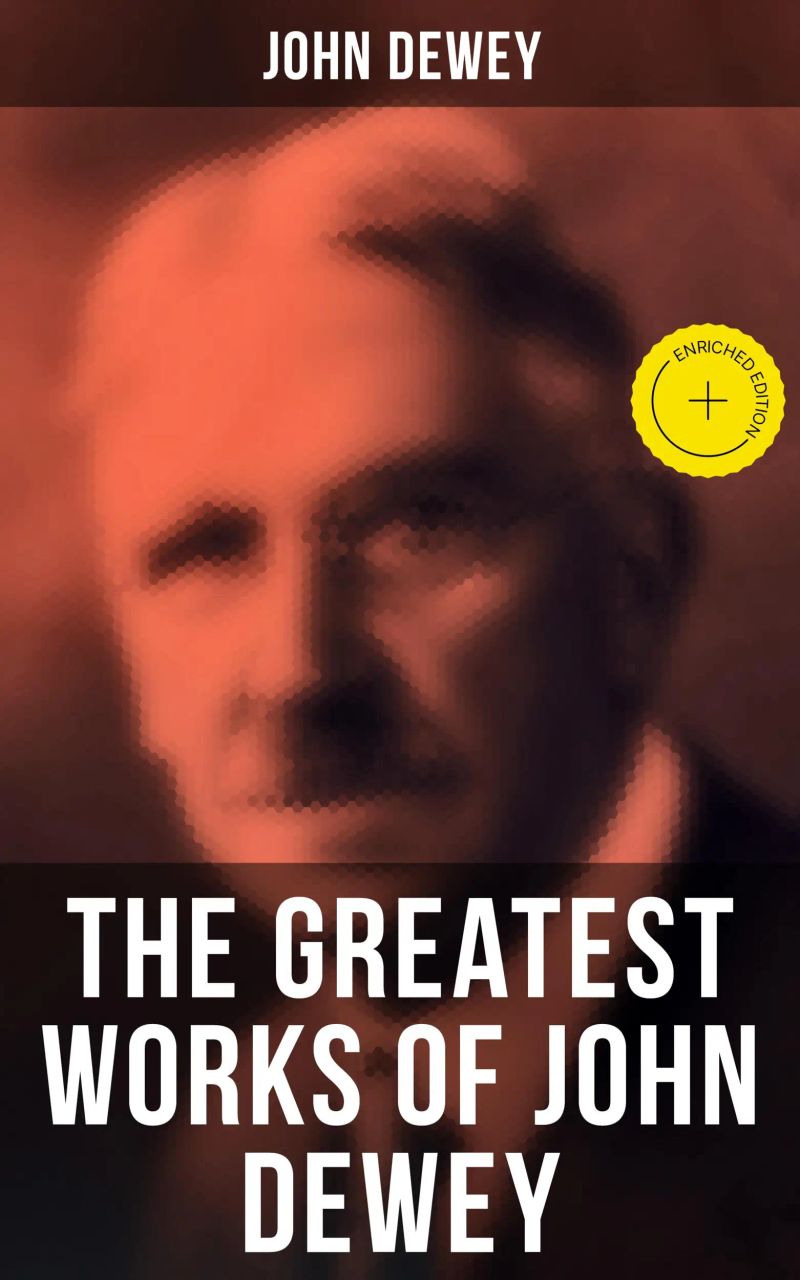
The Greatest Works of John Dewey
Enriched edition. American School System, Theory of Educational, Philosophy, Psychological Works, Political Writings: 40 Titles in One VolumeBy John Dewey


Length168h 56m
About this audiobook
John Dewey's 'The Greatest Works of John Dewey' is a thought-provoking collection of essays and philosophical writings that delve into the pragmatist movement of the early 20th century. Dewey's writing style is characterized by its clarity, logical reasoning, and emphasis on the practical aspects of philosophy. The book encompasses a wide range of topics including education, democracy, and ethics, making it a comprehensive look at Dewey's influential ideas. Each essay is a masterpiece of philosophical inquiry, exploring the fundamental questions of existence and morality. Dewey's works are considered a cornerstone of American philosophy, shaping the way we think about knowledge and society. John Dewey, a renowned philosopher and educator, was deeply interested in the role of education in shaping individuals and society. His experiences as a teacher and his observations of the world around him led him to develop his unique philosophical theories. Dewey's commitment to intellectual rigor and social progress is evident in his writings, making him a leading figure in the development of modern philosophy. I highly recommend 'The Greatest Works of John Dewey' to readers interested in exploring the intersection of philosophy, education, and democracy. Dewey's insights are as relevant today as they were a century ago, making this collection a timeless and invaluable resource for those seeking to deepen their understanding of philosophy and society.
In this enriched edition, we have carefully created added value for your reading experience:
- An Introduction draws the threads together, discussing why these diverse authors and texts belong in one collection.
- Historical Context explores the cultural and intellectual currents that shaped these works, offering insight into the shared (or contrasting) eras that influenced each writer.
- A combined Synopsis (Selection) briefly outlines the key plots or arguments of the included pieces, helping readers grasp the anthology's overall scope without giving away essential twists.
- A collective Analysis highlights common themes, stylistic variations, and significant crossovers in tone and technique, tying together writers from different backgrounds.
- Reflection questions encourage readers to compare the different voices and perspectives within the collection, fostering a richer understanding of the overarching conversation.
Audiobook details
Rating★★★★ 4.5 (18)
Includes Amazon, Goodreads
GenrePhilosophy
Length168 hrs 56 mins
Narrated byListen with 1,000+ voices
FormateBook with Audio
Publish dateDec 18, 2019
LanguageEnglish
Table of contents
1The Greatest Works of John Dewey
2Introduction
3Historical Context
4Synopsis (Selection)
5On Education
Mostrar todos os capítulosVer menos
6Chapter One: Education as a Necessity of Life
7Chapter Two: Education as a Social Function
8Chapter Three: Education as Direction
9Chapter Four: Education as Growth
10Chapter Five: Preparation, Unfolding, and Formal Discipline
11Chapter Six: Education as Conservative and Progressive
12Chapter Seven: The Democratic Conception in Education
13Chapter Eight: Aims in Education
14Chapter Nine: Natural Development and Social Efficiency as Aims
15Chapter Ten: Interest and Discipline
16Chapter Eleven: Experience and Thinking
17Chapter Twelve: Thinking in Education
18Chapter Thirteen: The Nature of Method
19Chapter Fourteen: The Nature of Subject Matter
20Chapter Fifteen: Play and Work in the Curriculum
21Chapter Sixteen: The Significance of Geography and History
22Chapter Seventeen: Science in the Course of Study
23Chapter Eighteen: Educational Values
24Chapter Nineteen: Labor and Leisure
25Chapter Twenty: Intellectual and Practical Studies
26Chapter Twenty-one: Physical and Social Studies: Naturalism and Humanism
27Chapter Twenty-two: The Individual and the World
28Chapter Twenty-Three: Vocational Aspects of Education
29Chapter Twenty-four: Philosophy of Education
30Chapter Twenty-five: Theories of Knowledge
31Chapter Twenty-six: Theories of Morals
32The Child and the Curriculum
33The School and Society
34Chapter 1: The School and Social Progress
35Chapter 2: The School and the Life of the Child
36Chapter 3: Waste in Education
37Chapter 4: Three Years of the University Elementary School
38Chapter 4: The Psychology of Elementary Education
39Chapter 5: Froebel's Educational Principles
40Chapter 6: The Psychology of Occupations
41Chapter 7: The Development of Attention
42Chapter 8: The Aim of History in Elementary Education
43Schools Of To-morrow
44Chapter I Education As Natural Development
45Chapter II An Experiment In Education As Natural Development
46Chapter III Four Factors In Natural Growth
47Chapter IV The Reorganization Of The Curriculum
48Chapter V Play
49Chapter VI Freedom And Individuality
50Chapter VII The Relation Of The School To The Community
Democracy and Education & Other Writings (A Collected Edition)John Dewey25h 20m4.1 (12.5K)$1.99 · $0.00
The Logic of ThoughtJohn Dewey52h 28m$1.99 · $0.00

The Collected Works of John Dewey (Annotated)John Dewey168h 46m4.5 (36)$2 · $0.00

Collected Writings on Education (Annotated)John Dewey24h 16m$2 · $0.00

PSYCHOLOGY & SOCIAL PRACTICE – Premium Collection (Annotated)John Dewey40h 49m$2 · $0.00

China, Japan and the U.S.A (Annotated)John Dewey8h 54m3.8 (12)$2 · $0.00

EXPERIENCE AND EDUCATION – Premium Edition (Including Democracy & Education) (Annotated)John Dewey19h 17m4.6 (1K)$2 · $0.00

Reconstruction in PhilosophyJohn Dewey6h 43m4.0 (690)$1 · $0.00

The Collected Works of John DeweyJohn Dewey168h 59m4.1 (45)$1 · $0.00
The Essential John Dewey: 20+ Books in One EditionJohn Dewey88h 54m$1 · $0.00

Leibniz's New Essays Concerning the Human Understanding: A Critical ExpositionJohn Dewey8h 57m3.9 (24)$1 · $0.00
How We Think & Other Works On LogicJohn Dewey51h 12m$2 · $0.00

John Dewey: Philosophical WorksJohn Dewey86h 57m$1 · $0.00
Schools Of To-morrow + The Schools of UtopiaJohn Dewey7h 42m3.9 (146)$1 · $0.00
John Dewey: The Philosophy of EducationJohn Dewey33h 59m4.0 (64)$1 · $0.00

The Collected Works of John DeweyJohn Dewey166h 52m4.1 (31)$2 · $0.00
CREATIVE INTELLIGENCE & Other Works on the Human Thought ProcessJohn Dewey52h 27m4.1 (25)$1.99 · $0.00

Democracy and Education & Experience and EducationJohn Dewey19h 11m4.3 (18)$1 · $0.00
John Dewey: The Philosophy of Education (Annotated)John Dewey33h 49m$1.99 · $0.00
JOHN DEWEY Premium Collection – 40+ Books in One Single Volume: Works on Psychology, Education, Philosophy & Politics (Annotated)John Dewey168h 33m4.4 (44)$1.99 · $0.00

IlluminationsWalter Benjamin10h 12m4.4 (16.2K)$20 · $0.00
That Bird Has My WingsJarvis Jay Masters9h 49m4.4 (13.7K)$29 · $0.00

Tâo Teh KingLaozi2h 34m4.4 (230.9K)$2 · $0.00

SymposiumPlato3h 26m4.4 (97.9K)$1.20 · $0.00

Buddhist Boot CampTimber Hawkeye2h 39m4.4 (8.4K)$18 · $0.00
Enchiridion & The Discourses of Epictetus (Annotated)Arrian Epictetus18h 9m4.4 (3.5K)$2 · $0.00

The Meditations of the Emperor Marcus Aurelius AntoninusEmperor of Rome Marcus Aurelius5h 41m4.4 (1.8M)$1 · $0.00

Crime and PunishmentFyodor Dostoevsky23h 11m4.4 (1.3M)$12 · $0.00

MeditationsMarcus Aurelius5h 52m4.4 (433.7K)$1 · $0.00
Everyday DharmaSuneel Gupta5h 2m4.5 (761)$20 · $0.00

The Joyful Wisdom ("La Gaya Scienza")Friedrich Wilhelm Nietzsche11h 37m4.4 (26.6K)$1 · $0.00
The Art of LivingEpictetus, Sharon Lebell3h 16m4.4 (50.1K)$18 · $0.00
MeditationsEmperor Of Rome Marcus Aurelius7h 23m4.3 (477.5K)$1.20 · $0.00

The Imitation of ChristThomas à Kempis6h 27m4.3 (84.6K)$21 · $0.00

Sadhana: the realisation of lifeRabindranath Tagore3h 49m4.4 (8.6K)$6 · $0.00
SapiensYuval Noah Harari15h 18m4.3 (1.4M) · 1193$33 · $0.00
You BelongSebene Selassie8h 35m4.4 (2.7K)$26 · $0.00

The Song Celestial; Or, Bhagavad-Gîtâ (from the Mahâbhârata)Anonymous2h 18m4.4 (3.2K)$2 · $0.00

The KybalionThe Three Initiates3h 47m4.3 (58.7K)$20 · $0.00

Chuang Tzu: Mystic, Moralist, and Social ReformerZhuangzi14h 42m4.4 (1.2K)$1 · $0.00
You may also like

The Stones of VeniceJohn Ruskin49h 48m4.1 (3.4K)$1.99 · $0.00

On the SoulAristotle3h 25m4.1 (8K)$1.20 · $0.00
The Elements of Drawing, in three Letters to BeginnersJohn Ruskin7h 39m4.1 (1.6K)$2.30
The Essential Writings of Ralph Waldo EmersonRalph Waldo Emerson10h 1m4.4 (6.5K)$12 · $0.00

Emile, or On EducationJean-Jacques Rousseau26h 3m3.8 (7.2K)$1 · $0.00

The Descent of Man, and Selection in Relation to SexCharles Darwin28h 1m4.1 (6.4K)$1 · $0.00

Why Do Men Fall Asleep After SexMark Leyner, Billy Goldberg6h 32m3.7 (2.2K)$24 · $0.00
The Hidden Habits of GeniusCraig Wright10h 7m4.0 (2.3K)$29 · $0.00
SapiensYuval Noah Harari15h 18m4.3 (1.4M) · 1203$33 · $0.00

The Critique of JudgmentImmanuel Kant15h 31m4.2 (10.4K)$1.99 · $0.00

The Simple Beauty of the Unexpected, Second EditionMarcelo Gleiser6h 16m4.1 (354)$17
An Enquiry Concerning the Principles of MoralsDavid Hume4h 1m4.1 (7.1K)Free

StanleySyd Hoff8m4.1 (458)$4 · $0.00

The Hand Phrenologically ConsideredAnonymous1h 35m$2 · $0.00

How to Design a Montessori-Inspired Nursery for Your BabyAurora Brooks1h 10m$3.50 · $0.00

The Water-Colours of J. M. W. TurnerA. J. Finberg, W. G. Rawlinson, J. M. W. Turner1h 36m3.8 (79)$1 · $0.00

From sketch-book and diaryElizabeth Butler4h 24m$2 · $0.00

Scientific and Evolutionary Foundations of Morality – 4 Classic Moral StudiesAlexander Bain, William Kingdon Clifford, Thomas Huxley, W. R. Sorley29h 21m$2

Encaustic ArtJennifer Margell3h 39m4.2 (17)$11 · $0.00

California and the CaliforniansDavid Starr Jordan38m3.9 (11)$1 · $0.00