
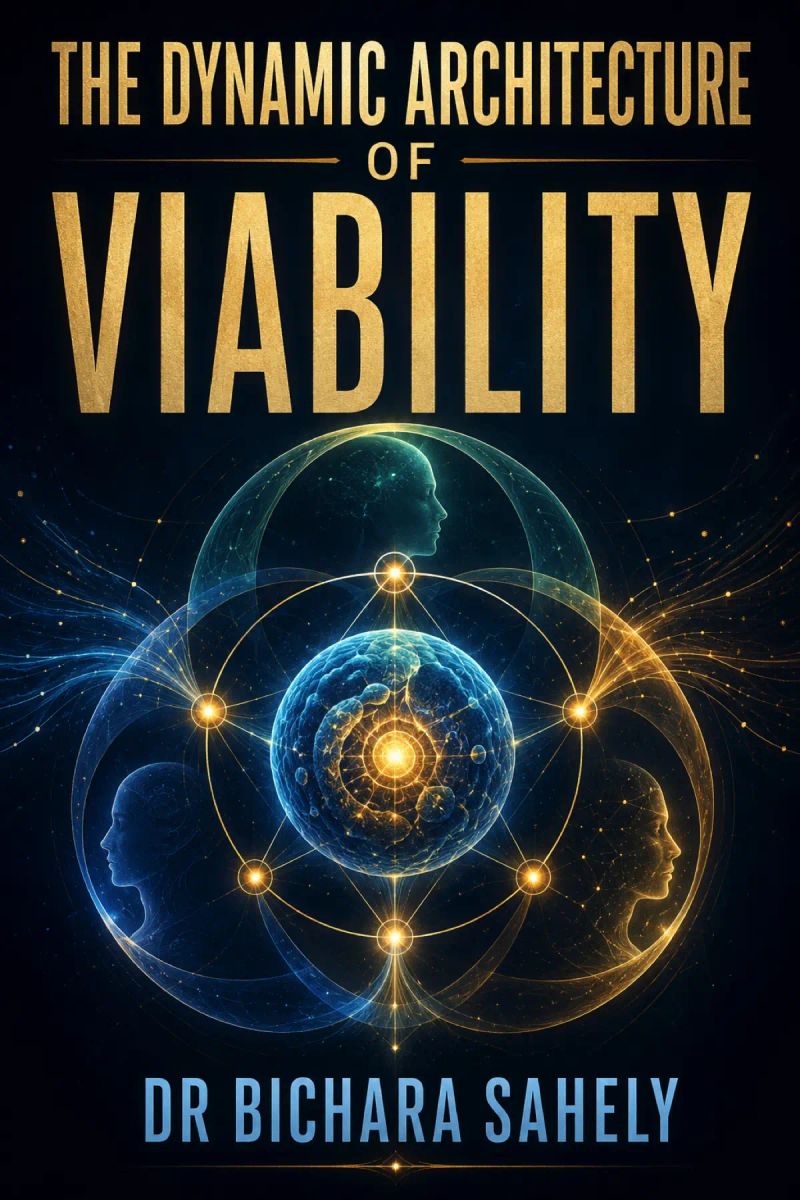
The Dynamic Architecture of Viability
From Distinction, Energy, Constraint, and Absence to Sentience, Relation, and Life-Coherent WorldsBy Dr Bichara Sahely


Length2h
About this audiobook
How do distinctions become living worlds — and how do living worlds become sentient, relational, and morally answerable? The Dynamic Architecture of Viability integrates Maturana’s biology of cognition, affective neuroscience, Deacon’s teleodynamics, Friston’s free-energy principle, Wilber’s integral framework, McMurtry’s life-value philosophy, and octonionic and exceptional mathematics. It traces how energy channelled by constraints can become self-maintaining organization, felt significance, action, memory, social worlds, and ethical responsibility. Using first-, second-, and third-person windows, seven viability functions, cross-scale cases, and testable bridge hypotheses, it carefully separates established science from metaphysical proposal and mathematical analogy. Its guiding question is practical: what does a system conserve, whose life does it enable, and what possibilities does it leave open?
Audiobook details
GenrePhilosophy, Science and Nature
Length2 hrs
Narrated byListen with 1,000+ voices
FormateBook with Audio
Publish dateAug 8, 2026
LanguageEnglish
Table of contents
1Introduction
2Listener's Note
3AI Transparency Note
4Disclaimer
5How to Listen
Mostrar todos os capítulosVer menos
6Orientation for the Listener: A spoken picture of the whole architecture
7Preface — The synthesis that was already implicit
8Part One — From the first distinction to a living domain
91. Distinction is necessary but not yet alive: 1.1 The first methodological rule
102. Energy, exergy and the insufficiency of power alone: 2.1 Three meanings of free energy
113. Autopoiesis, cognition and worlds brought forth: 3.1 Objectivity and mathematics
12Part Two — The viability grammar in motion
134. Seven recurrent functions, not seven things
144.1 The seven triads
15A spoken picture of the sevenfold closure
164.2 A binary construction
175. From grammar to dynamics
185.1 Multiple timescales
195.2 The recursive loop
206. Deacon, Friston and Inverse Darwinism as complementary windows
21Part Three — From immanent concern to felt concern
227. Affect as the intrinsic significance of regulation
237.1 The metaphysical identity hypothesis
247.2 The hippocampus is not an emotion-and-memory location
258. Qualia: differentiation explained, existence not dissolved
269. The second-person window: A spoken picture of three windows and four locations
2710. A-Q-A-L, Wilber–Combs and category discipline
28Part Four — A triune-aspect process monism
2911. Can reality be both experience and structure?
3011.1 Comparison with analytic idealism
3111.2 Why triality comes to mind
3211.3 The remaining uncertainty
33Part Five — The formal architecture: grammar, algebra, geometry and dynamics
3412. Mathematics has a life of implication: 12.1 Four formal levels
3513. From Fano incidence to octonionic composition
3614. The exceptional ascent and its exact limits
37A spoken picture of the relational-exceptional programme
3814.1 Hopf fibrations and projection
3914.2 The Altimeter and the Wu-Wei vector
40Part Six — One circulation across organism, relation, institution and planet
4115. The field of viability: A spoken picture of the circulation across scales
4216. Four cross-scale tests
4316.1 Septic shock
4416.2 Coral-reef bleaching
4516.3 Financial crisis
4616.4 The US–Israel–Iran conflict system
4717. Signal fidelity, trust and optionality
48Part Seven — Life-coherence, love and the Greatest Commandment
4918. Why viability needs a value test
5019. The Greatest Commandment as relational grammar

Preserving Life, Transforming Power in GazaDr Bichara Sahely1h 42mFree

Preserving Life, Transforming PowerDr. Bichara Sahely1h 4mFree

Putting the Missing Bridge to WorkDr. Bichara Sahely2h 12mFree

The Missing BridgeDr. Bichara Sahely1h 5mFree

Transformational Laboratories ProtocolDr. Bichara Sahely2h 33mFree

Artificial Intelligence and the Epistemic CommonsDr Bichara Sahely3h 12mFree

Conflict, Repair, and Non-DominationDr Bichara Sahely2h 21mFree

Institutions of Reflexive TransformationDr Bichara Sahely1h 51mFree

The Politics of Civilizational HealingDr. Bichara Sahely2h 13mFree

The Missing Grammar of Modern CivilizationDr. Bichara Sahely2h 8mFree

Civilizational Healing Research ArchitectureDr. Bichara Sahely1h 24mFree

How Does a Civilization Learn to Heal?Dr. Bichara Sahely1h 16mFree

From Competent Physicians to Healing SocietiesDr. Bichara Sahely2h 20mFree

Competence Is Necessary, but Not SufficientDr. Bichara Sahely1h 15mFree

Life-Grounding CanMEDSDr. Bichara Sahely1h 13mFree

Completing the Life-Value Onto-Axiology ProgramDr. Bichara Sahely1h 9m5.0 (1)Free

BEYOND GLOBAL JUSTICEDr. Bichara Sahely1h 25mFree

The Sweetness That Consumed the WorldBichara Sahely16h 14mFree
THE SOVEREIGNTY OF CREDITDr. Bichara Sahely3h 56mFree

IlluminationsWalter Benjamin10h 12m4.4 (16.2K)$20 · $0.00

That Bird Has My WingsJarvis Jay Masters9h 49m4.4 (13.7K)$29 · $0.00

Tâo Teh KingLaozi2h 34m4.4 (230.9K)$2 · $0.00

SymposiumPlato3h 26m4.4 (97.9K)$1.20 · $0.00

Buddhist Boot CampTimber Hawkeye2h 39m4.4 (8.4K)$18 · $0.00
Enchiridion & The Discourses of Epictetus (Annotated)Arrian Epictetus18h 9m4.4 (3.5K)$2 · $0.00

The Meditations of the Emperor Marcus Aurelius AntoninusEmperor of Rome Marcus Aurelius5h 41m4.4 (1.8M)$1 · $0.00

Crime and PunishmentFyodor Dostoevsky23h 11m4.4 (1.3M)$12 · $0.00

MeditationsMarcus Aurelius5h 52m4.4 (433.7K)$1 · $0.00

Everyday DharmaSuneel Gupta5h 2m4.5 (761)$20 · $0.00

The Joyful Wisdom ("La Gaya Scienza")Friedrich Wilhelm Nietzsche11h 37m4.4 (26.6K)$1 · $0.00
The Art of LivingEpictetus, Sharon Lebell3h 16m4.4 (50.1K)$18 · $0.00

MeditationsEmperor Of Rome Marcus Aurelius7h 23m4.3 (477.5K)$1.20 · $0.00

The Imitation of ChristThomas à Kempis6h 27m4.3 (84.6K)$21 · $0.00

Sadhana: the realisation of lifeRabindranath Tagore3h 49m4.4 (8.6K)$6 · $0.00

SapiensYuval Noah Harari15h 18m4.3 (1.4M) · 1204$33 · $0.00

You BelongSebene Selassie8h 35m4.4 (2.7K)$26 · $0.00

The Song Celestial; Or, Bhagavad-Gîtâ (from the Mahâbhârata)Anonymous2h 18m4.4 (3.2K)$2 · $0.00

The KybalionThe Three Initiates3h 47m4.3 (58.7K)$20 · $0.00

Chuang Tzu: Mystic, Moralist, and Social ReformerZhuangzi14h 42m4.4 (1.2K)$1 · $0.00

A Brief History of IntelligenceMax S. Bennett12h 18m4.6 (6.6K)$29 · $0.00
The Story of BirdsSteve Brusatte11h 49m4.6 (401)$29 · $0.00

Craig & FredCraig Grossi8h 6m4.5 (9.6K)$26 · $0.00

Celebrating BirdsNatalia Rojas, Ana Maria Martinez6h 47m4.6 (330)$24 · $0.00

Saving JemimaJulie Zickefoose4h 59m4.5 (749)$20 · $0.00

Will's Red CoatTom Ryan8h 23m4.5 (2.3K)$26 · $0.00

Of Time and TurtlesSy Montgomery10h 34m4.5 (5K)$29 · $0.00

Zen and the Art of Saving the PlanetThich Nhat Hanh9h 20m4.5 (3.9K)$29 · $0.00

BLACK BEAUTY (With Original Illustrations)Anna Sewell7h 31m4.5 (1.3K)$1.99 · $0.00

Bottle of LiesKatherine Eban14h 25m4.4 (12K)$33 · $0.00
IngrainedCallum Robinson8h 10m4.5 (1.1K)$26 · $0.00

The Lion Tracker's Guide To LifeBoyd Varty3h 1m4.4 (4.8K)$18 · $0.00

Born for LoveBruce D. Perry, Maia Szalavitz11h 42m4.4 (4K)$29 · $0.00

The Mountains of California (With Original Drawings & Photographs) (Annotated)John Muir11h 35m4.5 (1.1K)$2 · $0.00

The New GuysMeredith Bagby16h 50m4.4 (1.2K)$40 · $0.00

Blue PasturesMary Oliver3h 23m4.4 (3.8K)$18 · $0.00

The Rise and Reign of the MammalsSteve Brusatte13h 26m4.4 (11.1K)$33 · $0.00

VaccinatedPaul A. Offit8h 30m4.4 (3.7K)$26 · $0.00

The Light EatersZoë Schlanger10h 57m4.4 (22.8K)$29 · $0.00

Where the Lost Dogs GoSusannah Charleson11h 7m4.5 (699)$23 · $0.00
You may also like
THE THEORY OF THE LEISURE CLASS: An Economic Study of American Institutions and a Social Critique of Conspicuous Consumption (Annotated)Thorstein Veblen12h 58m4.4 (1K)$1.99 · $0.00
AlchemyRory Sutherland9h 38m4.3 (32.6K)$29 · $0.00

Farnsworth’s Classical English StyleWard Farnsworth5h 34m4.4 (312)$17
Darwin’s House of CardsTom Bethell8h 57m4.3 (341)$20 · $0.00

An Enquiry Concerning Human UnderstandingDavid Hume7h 23m4.1 (24.2K)$1 · $0.00
ConflictedIan Leslie7h 52m4.1 (1.4K)$26 · $0.00

Aesthetic IntelligencePauline Brown6h 57m4.0 (1.2K)$24 · $0.00
How to Master the Art of Selling Anything ProgramTom Hopkins10h 28m4.3 (179)$25
The Academy of Master ClosingTom Hopkins7h 45m4.6 (31)$40

Sign Language Among North American Indians (Annotated)Garrick Mallery14h 32m4.2 (174)$1.99 · $0.00
The Language of SalesTom Hopkins, Andrew Eilers5h 26m4.2 (110)$20

The New Science of Healthy AgingScientific American6h 14m3.9 (265)$17

Ultimate Customer ServiceMade for Success8h 9m4.2 (46)$20

The New HustleEmma Isaacs5h 1m3.7 (297)$15 · $0.00

The DNA of Business for Network MarketingEric Golden2h 58m3.9 (69)$20

Business & Economics Collection: Thorstein Veblen Edition (30+ Works in One Volume)Thorstein Veblen91h 26m4.5 (11)$2 · $0.00
Going Broke, Updated EditionStuart Vyse13h 10m3.9 (65)$23 · $0.00

Sell to Anyone!Zig Ziglar, Brian Tracy3h 13m4.2 (20)$20

A Book of PrefacesH. L. Mencken7h 33m3.8 (67)$2 · $0.00
Public Speaking SuperstarMade for Success7h 25m3.6 (72)$30